3621
Noninvasive Identification of Breast Cancer HER2 Status by Deep Learning on Multiparametric MRI Images1suining central hospital, Suining, China, 2Shenzhen University Medical School, Shenzhen, China, 3Guangzhou First People’s Hospital, South China University of Technology, Guangzhou, China
Synopsis
Keywords: Diagnosis/Prediction, Breast, Multiparametric magnetic resonance imaging
Motivation: Multiparametric magnetic resonance imaging (mpMRI) offers valuable insights for predicting HER2 expression. However, when fusing mpMRI features, redundancy or wastage of information may impact model performance.
Goal(s): Our aim was to construct an effective deep learning model by incorporating the interrelated and complementary features of different MRI sequences.
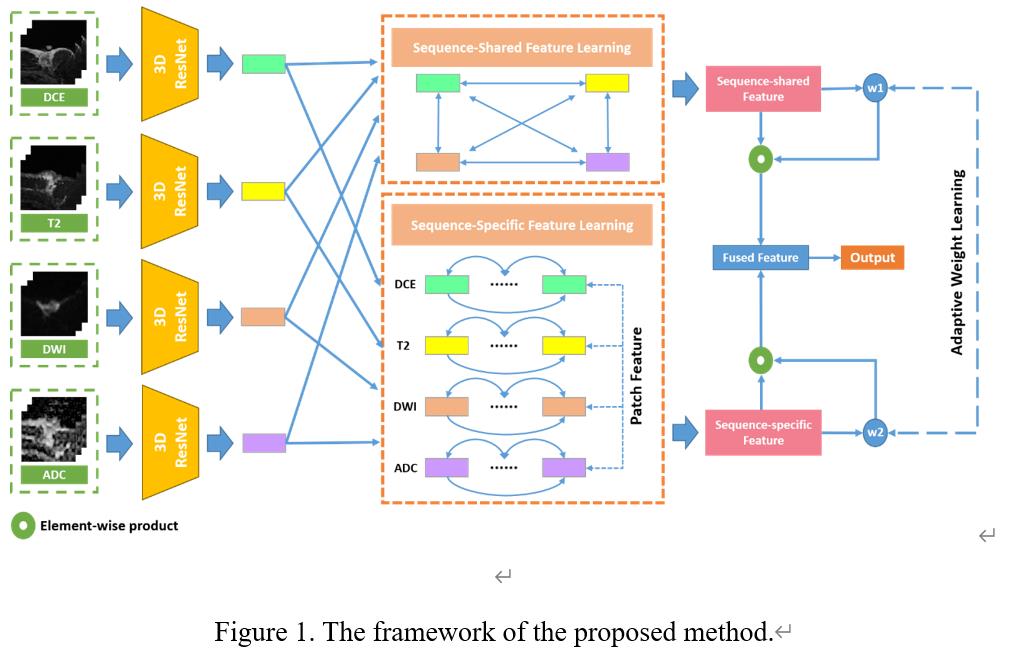
Approach: Leveraging a contrastive learning approach, we aligned features across sequences and within each sequence separately to obtain sequence-shared and sequence-specific features. Subsequently, these two features were fused by utilizing an adaptive weighting scheme.
Results: When compared to widely used deep learning approaches, our method achieved the best AUC of 0.743.
Impact: The method explored the interrelated and complementary features of different MRI sequences, which outperformed widely used deep learning methods in terms of performance. This method was expected to have a positive impact on the accurate prediction of HER2 expression status.
Introduction
Multiparametric magnetic resonance imaging (mpMRI) has found extensive application in the evaluation of the human epidermal growth factor receptor 2(HER2) expression status in breast cancer. However, existing methods have not fully harnessed the interrelatedness and complementarity among the mpMRI data, potentially leading to information redundancy or wastage . This study aimed to explore the interrelated and complementary features in different MRI sequences of breast cancer and to develop an effective deep learning model capable of integrating mpMRI information for accurate prediction of HER2 expression status.Methods
A total of 390 patients with breast cancer who underwent preoperative dynamic contrast-enhanced (DCE), diffusion-weighted imaging (DWI), and T2-weighted imaging were retrospectively recruited from two institutions, including 282 HER2-negative and 108 HER2-overexpressing cases. The corresponding apparent diffusion coefficient (ADC) maps were obtained from DWI. The dataset was divided into a training set with 273 cases, a validation set with 39 cases, and a test set with 78 cases.[1] To investigate the correlation across sequences, the feature of each sequence was projected into a latent space. Simultaneously, a contrastive learning algorithm was employed to maximize the similarity and minimize the distance among the feature representations of all sequences. Aligning sequence features in this manner provided access to sequence-shared features, which helped to eliminate redundant information within mpMRI features. Furthermore, sequence-specific features as a complement to sequence-shared features were introduced to avoid wastage of mpMRI information. Since sequence-specific features focused on the internal similarity within each sequence, we divided the breast cancer tumor region into several image patches and utilized a contrastive learning technique to maximize the feature similarity within these patches. Subsequently, an adaptive weighting scheme was used to fuse these two types of features for HER2 expression prediction. Our proposed method was compared with widely used deep learning methodes, including single-modal method (classified by ResNet) and multi-modal methods (fused features extracted by ResNet with concatenation, summation, or maximum operation).Results
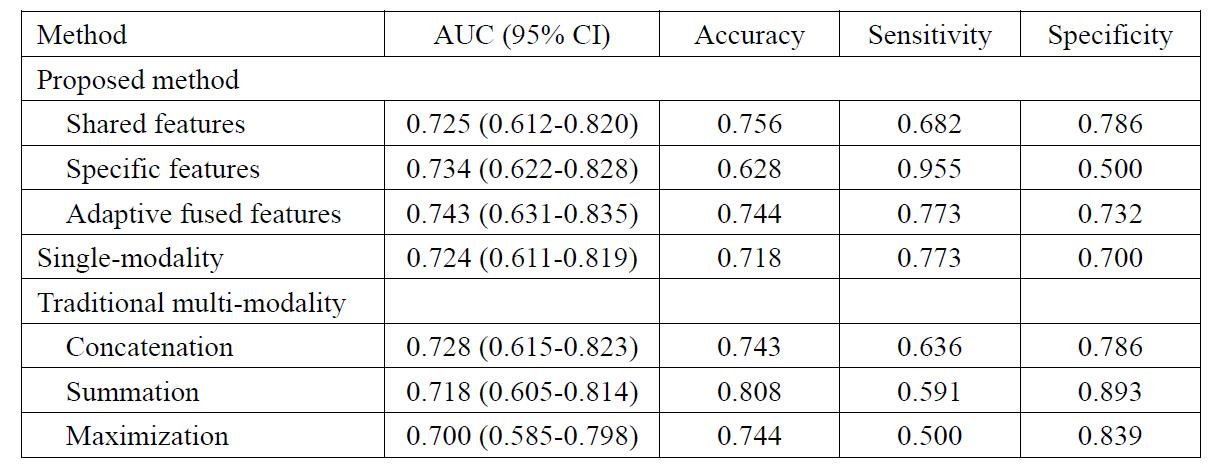
When using only sequence-shared features or sequence-specific features, the model achieved AUCs of 0.725 and 0.734 in distinguishing between HER2-negative and HER2-overexpressing, respectively. When these two types of features were fused by adaptive weights, the model's AUC was improved to 0.743 (Table 1). The proposed method demonstrated the best predictive performance for HER2 expression status in the test cohort, despite the lack of significant differences compared to traditional single-modal and multi-modal learning approaches (all P > 0.05 by DeLong’s test).Conclusion
Through the fusion of sequence-shared and specific features, we effectively harnessed the interrelatedness and complementarity of mpMRI information, which allowed us to construct a predictive model for HER2 expression status in breast cancer with high performance.Discussion
Through sequence sharing and fusion of specific features, we effectively leverage the interconnectedness and complementarity of mpMRI information to construct a high-performance predictive model of HER2 expression status in breast cancer. This study deeply explored the correlation and complementary features between different MRI sequences of breast cancer, and established a deep learning model to accurately predict HER2, which greatly improved the treatment and prognosis of breast cancer, and provided a clearer idea for clinicians to guide patients to make treatment decisions.Acknowledgements
Thanks to doctors and scholars who contributed to this study.References
-Figures