3616
Advancing Prenatal Diagnosis of Placenta Accreta Spectrum Using MR T2-Weighted Radiomics Analysis: A Promising Approach for Early Detection1Beijing Obstetrics and Gynecology Hospital,Capital Medical University, Beijing, China, 2Xi'an Polytechnic University, Xi'an, China, 3GE Healthcare,MR Research China,Beijing, Beijing, China
Synopsis
Keywords: Diagnosis/Prediction, Bioeffects & Magnetic Fields
Motivation: Enhancing Placenta accreta spectrum (PAS) prediction through advanced MR T2WI radiomics, improving outcomes for both mothers and babies.
Goal(s): Improve PAS detection, enhance prenatal care, and reduce maternal and fetal risks.
Approach: Employing radiomics analysis on MR T2-weighted imaging, we establish a predictive model for PAS, augmenting prenatal diagnosis.
Results: The radiomics model exhibited exceptional accuracy and reliability, showcasing its potential for significantly enhancing PAS prediction in clinical practice.
Impact: The successful implementation of this study stands to significantly enhance the early identification capacity for PAS and offer robust support for clinical decision-making. Such an achievement carries immense practical significance in addressing the potential rise in PAS cases.
INTRODUCTION
Placenta accreta spectrum (PAS) poses a grave pregnancy complication, bearing the potential for substantial bleeding and endangering both maternal and fetal lives. Early identification and diagnosis of PAS are imperative. Although ultrasound is the current primary diagnostic tool for PAS, it encounters significant limitations, especially when the placenta is positioned on the posterior uterine wall, hampered by factors like amniotic fluid, maternal obesity, or intestinal gas. In contrast, magnetic resonance imaging (MRI) remains unaffected by maternal body size, intestinal gas, or placental location. However, its subjective nature and interobserver variability may lead to missed or misdiagnosed PAS cases. Both methods have utility in PAS prediction and diagnosis, but their accuracy and reliability require enhancement. This study leveraged radiomics analysis using MR T2-weighted imaging (T2WI) data in the sagittal plane to establish a predictive model for PAS, synergizing with MRI for improved prenatal diagnosis.METHODS
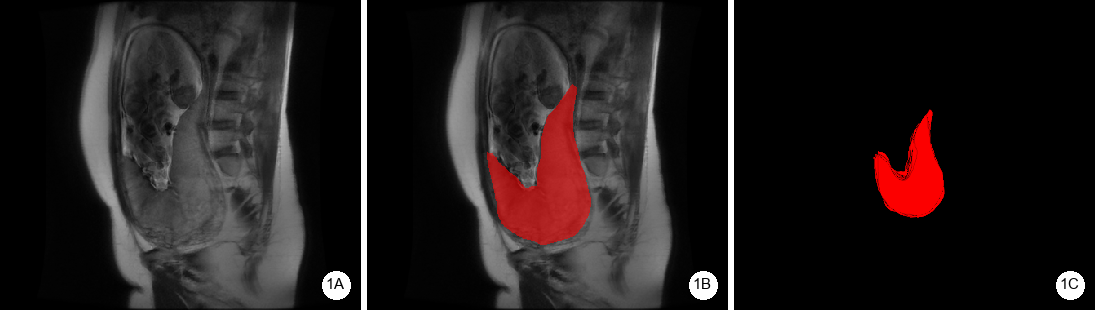
This study retrospectively analyzed 433 singleton pregnant women who delivered at Beijing Obstetrics and Gynecology Hospital from January 2018 to June 2023, comprising 208 PAS patients and 225 non-PAS patients. The cohort was divided into a training set (304 cases) and a testing set (129 cases) in a 7:3 ratio. The training set included 146 PAS cases and 158 non-PAS cases, while the testing set consisted of 62 PAS cases and 67 non-PAS cases. Initial image segmentation delineated regions of interest (ROIs) layer by layer in T2WI sequences(Figure 1A,B,C) by low-experience radiologists, using specialized medical image software (ITK-SNAP). ROIs were subsequently confirmed and saved by a senior radiologist. Radiomics features were extracted from the T2WI sequences, and the correlation coefficient (Pearson correlation) between labels and radiomics features on the training set was calculated. Features were ranked based on correlation coefficients, retaining the top 147 radiomics features. LASSO regression was applied, resulting in the selection of 22 radiomics features. Utilizing these features, a radiomics model was constructed for the training set, and predictions were made for both training and testing sets. The area under the curve (AUC) and accuracy were calculated for both sets.RESULTS
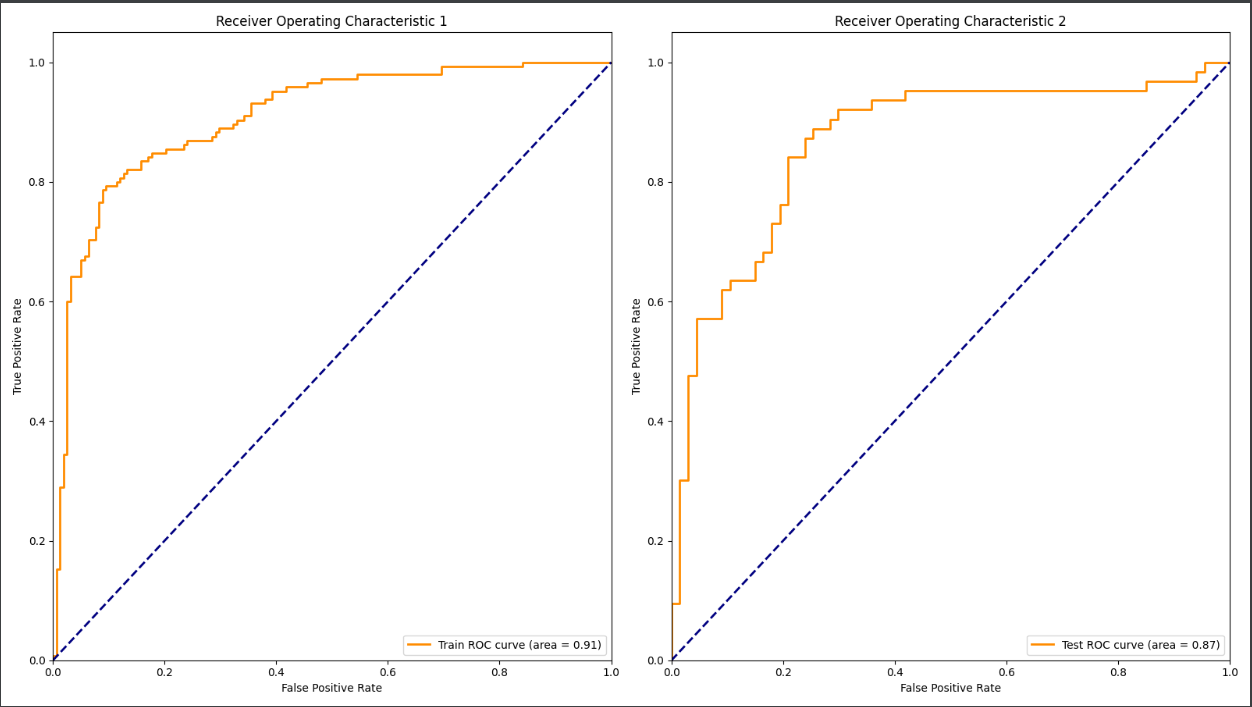
The ROC curves for the radiomics model demonstrated excellent predictive performance(Figure 2A,B): an AUC of 0.91, accuracy of 84.49%, sensitivity of 81.37%, specificity of 87.34%, positive predictive value (PPV) of 85.51%, and negative predictive value (NPV) of 83.64% for the training set. The test set yielded an AUC of 0.87, accuracy of 81.53%, sensitivity of 87.30%, specificity of 76.12%, PPV of 77.46%, and NPV of 86.44%. These results underscore the model's high performance and clinical application potential.CONCLUSION
The research findings underscore the efficacy of the MR T2WI-based radiomics model in prenatal PAS prediction, offering early intervention options for high-risk pregnant women and mitigating adverse maternal outcomes.Acknowledgements
No acknowledgement found.References
No reference found.Figures