3612
The value of synthetic MRI for early prediction of NAC response in breast cancer: a complement to apparent diffusion coefficient in radiomics1The First Hospital of China Medical University, Shenyang, China, 2GE Healthcare, Beijing, China
Synopsis
Keywords: Diagnosis/Prediction, Breast
Motivation: Contrast-free sequences is receiving increasing attention. As a novel technology, radiomics analysis of Sythetic MRI(SyMRI) in breat treatment has not been widely explored.
Goal(s): To analyse the radiomics features extracted from SyMRI and its complementary value to conventional ADC sequence.
Approach: Recursive feature elimination (RFE) was used to select features and support vector machine (SVM) was used to build models. The model performance was assessed by receiver operating characteristic (ROC) analysis and compared by DeLong test.
Results: Delta-radiomics models based on SyMRI sequences outperformed the single time-point models. The SyMRI sequence that complements the conventional ADC is delta-T2 mapping.
Impact: Radiomics modle generated from delta-T2 mapping showed stable performance and complementary value to ADC sequence. Once scan-multiparameter and contrast-free SyMRI can obtain the comparative or even elevated value as ADC in early prediction of NAC response in breast cancer.
Introduction
Neoajuvant chemotherapy (NAC) has been widely used in locally advanced breast cancer in last decades. Achieving pathologic complete response (pCR) after NAC represents a more favorable long-term outcome and sometimes surgical avoidance [1,2]. Previous work has shown that the quantitative parameters of SyMRI can predict pCR before and after NAC treatment [3-5], also can be a supplement to changes in tumor size and ADC value [4]. However, the value of SyMRI radiomics analysis for its rich post-processing sequences has not been widely explored. This study aims to analyse the radiomics features extracted from SyMRI and its complementary value to ADC sequence, which will contribute to the application of contrast-free sequences in radiomics.Methods
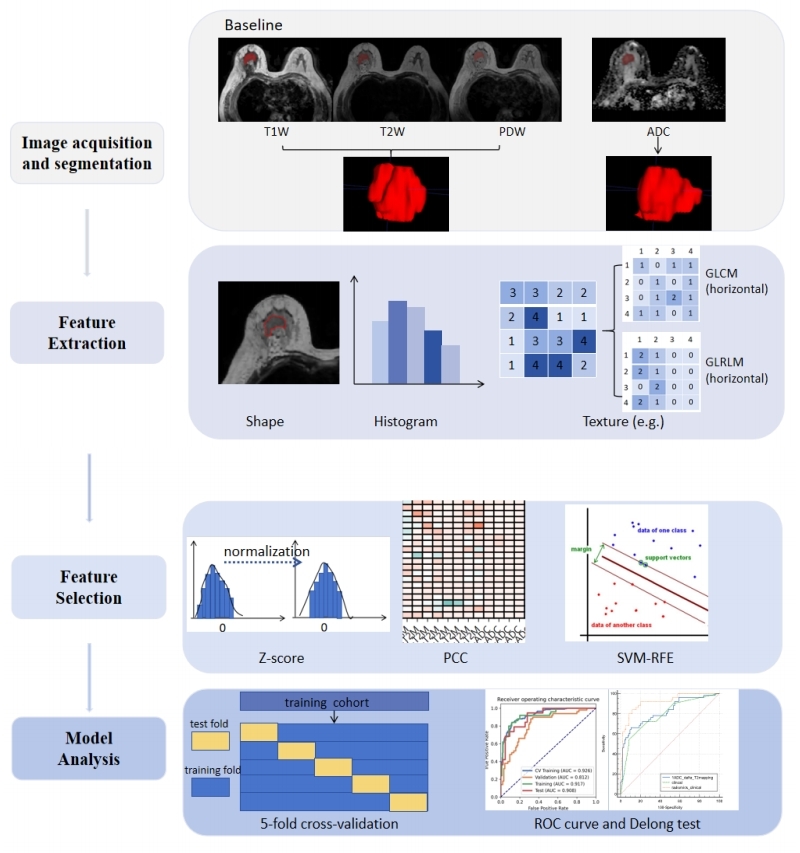
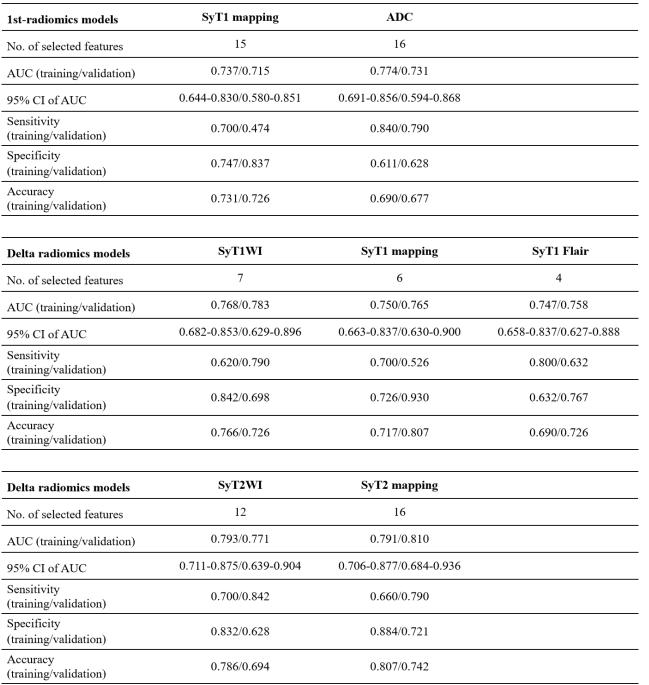
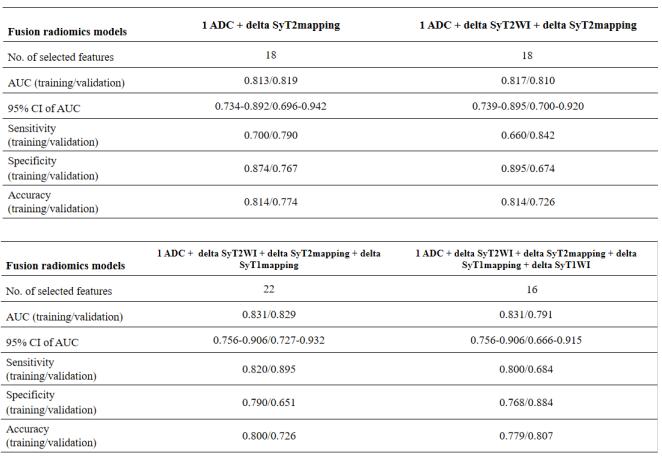
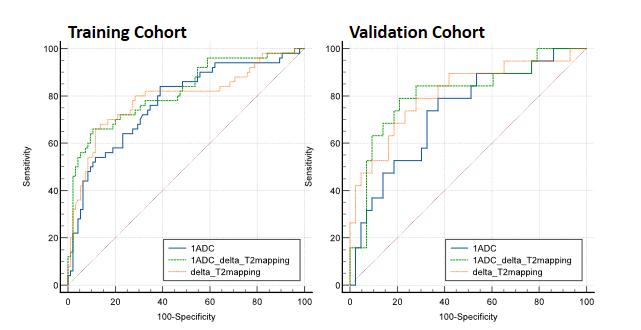
A total of 207 patients with breast cancer who received NAC before surgery were prospectively enrolled from October 2018 to December 2021. A cutoff time of April 9th, 2021 was used to divide the training cohort (n=145) and validation cohort (n=62) at a ratio of 7:3. All patients underwent diagnostic MRI before and after the first cycle of NAC. By quantifying the region of interest (ROI) on the MRI images, 107 radiomic features were calculated from each SyMRI sequence and ADC sequence. Recursive feature elimination (RFE) was used to select features and support vector machine (SVM) was used to build models. We determine the value of 0.7 as the boundary, models with the AUC value higher than 0.7 in both the training and validation cohort were considered to have relatively good performance (Table1). Models met the above condition were combined in pairs or multiple combinations as submodel to generate fusion models (Table2). Based on our limited sample size, the pre-screened features out of each sequence rather than all the features were used to build the fusion models to avoid curse of dimensionality. The model performance was assessed by receiver operating characteristic (ROC) analysis and compared by DeLong test (Fig1).Results
Delta-radiomics models based on SyMRI sequences outperformed the baseline and the first cycle of NAC radiomics models. After the first cycle of NAC ,ADC radiomics modle get its highest AUC (AUC = 0.774/0.731, training/validation cohort). The SyMRI sequence that complements the regular ADC is delta-T2 mapping (AUC=0.813/0.819 for training/validation cohort). Clinical-radiomics model generated good calibration and discrimination capacity with AUC = 0.917/0.908, training/validation cohort.Discussion
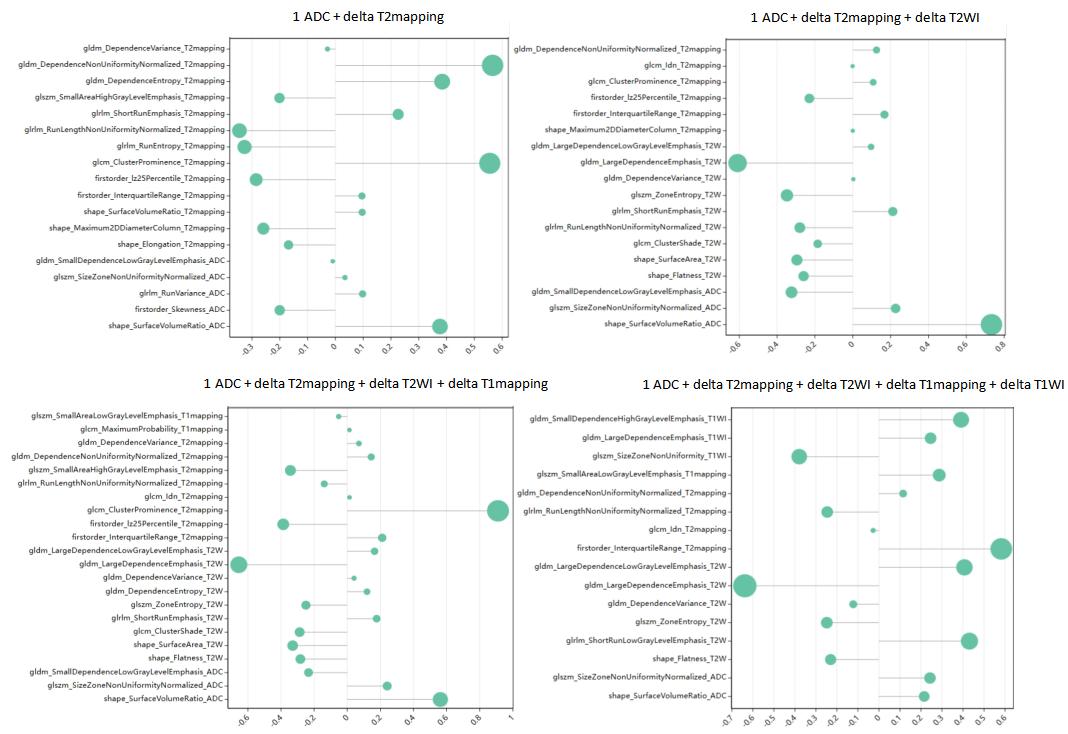
ADC radiomics modle based on the first cycle of NAC get the highest AUC (AUC = 0.774/0.731, training/validation cohort). It is consistent with the results of previous quantitative parameter study [6]. Of the three radiomics models generated from each sequences of SyMRI, delta-radiomics modles showed the highest predictive value. It may reflect the sensitivity of SyMRI to post-treatment response. Delta-radiomics features can show the dynamically chages such as morphological characteristics which cannot be detected in single time-point models [7]. Apart from the current study, only one previous study evaluated the diagnostic performance of SyMRI-radiomics in predicting pCR for breast cancer after NAC, Hwang et al found that multivariable radiomics model from T1 maps acquired after 4 cycle of NAC predicted pCR with higher AUCs of 0.78 and 0.72 in the training and testing cohorts, respectively [8]. In our study, models constructed from sequences associated with T2 have higher predictice value than T1 and PD, in fusion models, T2 mapping and T2WI occupy a large proportion (Fig2). We hypothesize that the reasons for the discrepancy can be attributed to: 1) We collected MRI images after the first cycle of NAC, while they use midtreantment ones. T2 may have potential application in early treatment response monitoring. 2) They only included patients with the TN phenotype, perhaps T1-related radiomics features are more sensitive to TN breast cancer. Although the AUC of the raiomics fusion model was not significantly different from that of single models, the former showed better specificity and accuracy than the latter ones(Fig3 and Table1.2). Combined with clinical characteristics, the clinical-radiomics model could provide more accurate information of patients’prognosis.Conclusion
The radiomics model developed from SyMRI and ADC is a promising strategy for predicting breast cancer prognosis. Once scan-multiparameter and contrast-free SyMRI can obtain the comparative or even elevated value as ADC in early prediction of NAC response in breast cancer.Acknowledgements
No acknowledgment found.References
[1] von Minckwitz, G., et al., Response-guided neoadjuvant chemotherapy for breast cancer. J Clin Oncol, 2013. 31(29): p. 3623-30.
[2] ortazar, P., et al., Pathological complete response and long-term clinical benefit in breast cancer: the CTNeoBC pooled analysis. Lancet, 2014. 384(9938): p. 164-72.
[3] Jiang, W., et al., Correlation between synthetic MRI relaxometry and apparent diffusion coefficient in breast cancer subtypes with different neoadjuvant therapy response. Insights Imaging, 2023. 14(1): p. 162.
[4] Du, S., et al., Contrast-free MRI quantitative parameters for early prediction of pathological response to neoadjuvant chemotherapy in breast cancer. Eur Radiol, 2022. 32(8): p. 5759-5772.
[5] Zhao, R., et al., Time Course Changes of Synthetic Relaxation Time During Neoadjuvant Chemotherapy in Breast Cancer: The Optimal Parameter for Treatment Response Evaluation. J Magn Reson Imaging, 2023. 58(4): p. 1290-1302.
[6] Pereira, N.P., et al., Diffusion-Weighted Magnetic Resonance Imaging of Patients with Breast Cancer Following Neoadjuvant Chemotherapy Provides Early Prediction of Pathological Response - A Prospective Study. Sci Rep, 2019. 9(1): p. 16372.
[7] O'Connor, J.P., et al., Imaging intratumor heterogeneity: role in therapy response, resistance, and clinical outcome. Clin Cancer Res, 2015. 21(2): p. 249-57.
[8] Hwang, K.P., et al., A Radiomics Model Based on Synthetic MRI Acquisition for Predicting Neoadjuvant Systemic Treatment Response in Triple-Negative Breast Cancer. Radiol Imaging Cancer, 2023. 5(4): p. e230009.
Figures