3576
Mitigating MR fingerprinting undersampling errors is more effective through sequence optimization than via low rank reconstruction1C.J. Gorter MRI Center, Radiology, Leiden University Medical Center, Leiden, Netherlands, 2Department of Imaging Physics, Delft University of Technology, Delft, Netherlands, 3Department of Radiology and Nuclear Medicine, Erasmus MC, Rotterdam, Netherlands, 4Computational Imaging Group for MR Therapy and Diagnostics, University Medical Center Utrecht, Utrecht, Netherlands, 5Department of Radiotherapy, University Medical Center Utrecht, Utrecht, Netherlands
Synopsis
Keywords: MR Fingerprinting, MR Fingerprinting
Motivation: To reduce undersampling errors in MR Fingerprinting maps, both sequence optimization and low rank (LR) reconstruction methods have been proposed , but these have not been compared or combined.
Goal(s): To compare the effectiveness of LR-reconstruction and sequence optimization for reducing undersampling errors.
Approach: Undersampled 2D spiral MRF data as acquired with 7 different flip angle patterns in 6 healthy subjects are reconstructed with the standard vendor reconstruction and an in-house LR-reconstruction and compared to fully-sampled MRF T1- and T2-maps.
Results: Undersampling-optimized sequences showed a reduced error compared to other sequences, even after LR-reconstruction.
Impact: We show that optimized flip-angle patterns with or without LR-reconstruction outperform traditional schemes with LR reconstruction. Inclusion of LR-reconstruction in the optimization step is not essential, when designing sequences that minimize undersampling artifacts.
Introduction
MR Fingerprinting allows for efficient measurements of multiple tissue parameters such as T1,T2 and M0 through the acquisition of a transient state signal often combined with non-cartesian undersampling patterns, e.g. based on spirals.1 The chosen flip-angle (FA-)pattern, that determines the transient states, affects both the precision and accuracy of the obtained relaxometry maps Therefore, FA-sequence optimization is an important way to improve MRF.2–7 In particular, Cramér-Rao bound (CRB) based optimization is often applied, which maximizes signal-to-noise (SNR) efficiency.4 Recently we proposed a different optimization approach that explicitly takes undersampling errors into account6 based on the theoretical framework of Stolk and Sbrizzi.8Alternatively, undersampling errors can be reduced through improved reconstruction methods among which low-rank(LR) reconstruction is most often used due to its effectiveness and simplicity.9,10
In this work we study the effect of LR-reconstruction on undersampled data acquired with optimized FA-patterns and conventional patterns. We hypothesized that FA-optimization yields more improvements than just LR-reconstruction on human designed or CRB-optimized patterns.
Methods
In vivo brain data were acquired on a 3.0T Philips Ingenia MRI scanner (Philips, The Netherlands) from six healthy subjects with different FA-patterns11 shown in Fig.1 (for details see Heesterbeek et al6). This study was approved by the local medical ethics committee and from all volunteers informed consent was obtained prior to image acquisition.The field of view of all sequences was 224x224mm2 with a resolution of 1x1 mm2and 5 mm slice thickness; a constant density spiral was used achieving an undersampling factor of 1/32 with $$$360^\circ/32=11.25^\circ$$$ rotation between spirals of consecutive flip angles. Two slices were acquired with a slice gap of 2 cm. All sequences use a constant repetition time of 15ms and echo time of 4 ms. The conventional pattern (Conv, see Fig.1), a CRB based pattern and the pattern from Optimization A (OptA) were acquired both undersampled and fully sampled (32/32) with a 6s delay time. The fully sampled data was used as reference. OptC was acquired twice to have the same readout time. OptD, OptE and OptF were only acquired in an undersampled fashion (1/32).
Images were reconstructed using the scanner reconstruction including spiral deblurring; undersampled data was also reconstructed using LR-reconstruction10 (code from 12) with ranks ranging from 2 to 7. T1,T2-maps were obtained via dictionary matching; dictionaries were generated with a 3% step-size (150ms<T1<5s,30ms<T2<1s). The relative error compared to the fully sampled reference maps was calculated. As a general measure the median value and median absolute error (MAE) were calculated after masking out the CSF. A Wilcoxon signed-rank test was performed to compare different sequences and reconstruction methods.
Results
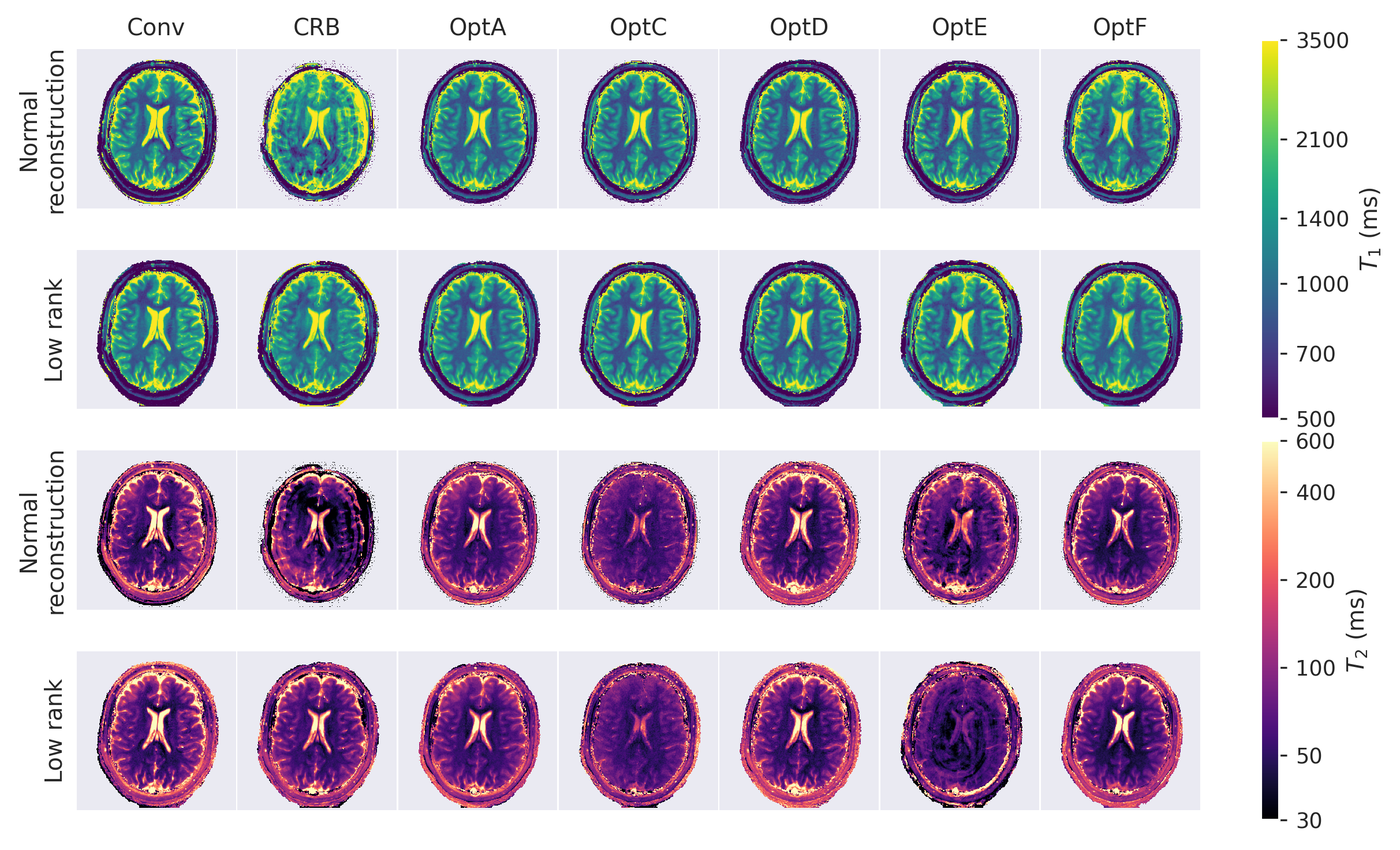
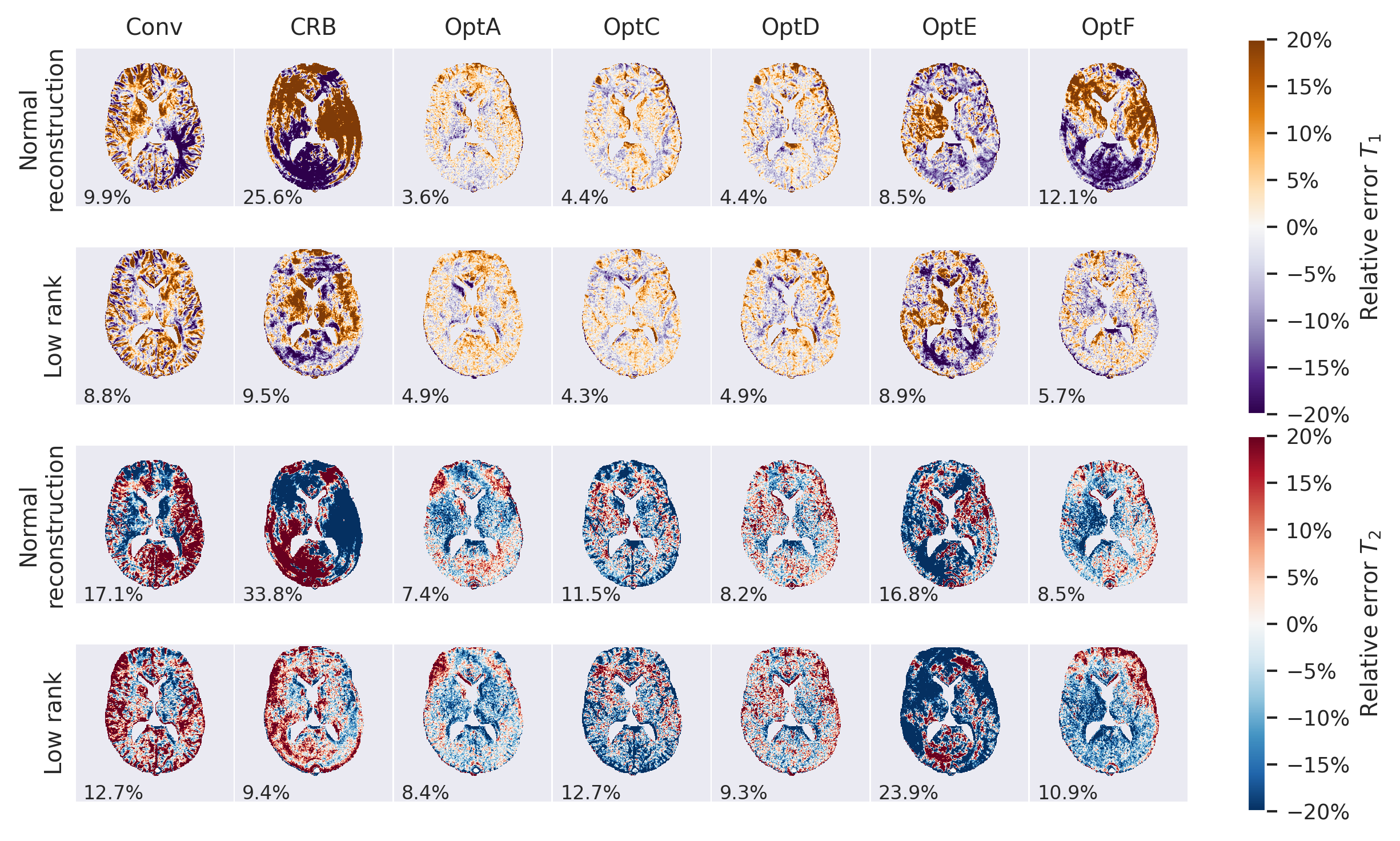
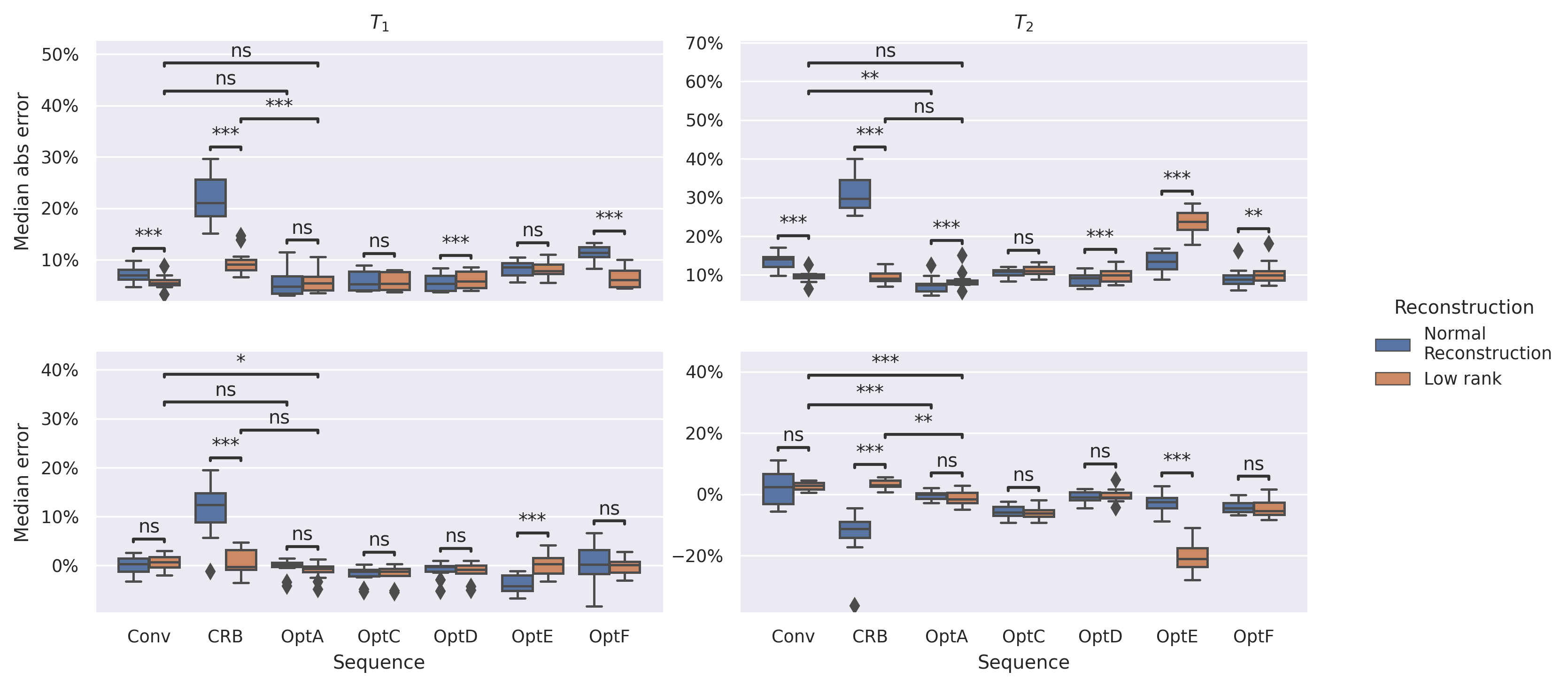
Median absolute errors for the two reconstructions and different sequences are shown in Fig.2. Applying rank 2 was insufficient, especially for T2-mapping. Reconstructions from the CRB and Conv FA-patterns distinctly improved with an LR-reconstruction. OptE gave a distinctly worse result for low rank reconstruction (MAE>20%). Minimal differences were observed for LR-ranks 4 to 7 for most sequences, rank 5 was therefore chosen for further analyses. Obtained relaxometry maps are shown in Fig.3 and relative error maps in a different slice are shown in Fig.4. Fig.5 shows the comparison with MAE and median error for the different reconstructions and sequences. The LR-reconstruction strongly reduced T1-errors for the CRB sequence, however the MAE remains larger than in OptA($$$9.6\%\pm\ 2.5\%~$$$vs$$$~5.8\%\pm2.1\%$$$). It can also be observed that a small but significant difference remains between the undersampling optimized sequence and the conventional pattern after LR-reconstruction.Discussion
As visible in Fig.2 and 3, the use of an LR-reconstruction effectively reduced undersampling errors for the CRB,Conv(T1 and T2) and OptF(T2) sequences. Undersampling errors were not visible in the other sequences, even without LR-reconstruction. However, for sequence OptE new artifacts arose with the LR-reconstruction. This rapidly varying flip angle pattern resulted in rapidly varying LR-bases, which seemed to amplify errors from flow or$$$~B_0~$$$and$$$~B_1^+$$$-inhomogeneities. This emphasizes, as reported before in literature4, that the use of a smooth flip angle pattern is beneficial. After LR-reconstruction OptA showed significant improvements compared to the conventional and CRB-optimized patterns (Fig.5), although differences were smaller than with the zero-filled reconstructions. The MAE does not approach 0 after LR-reconstruction for optimized sequences, showing that differences between fully sampled and undersampled maps remain, but in the form of noise-like errors. Possibly spatial regularization can mitigate this.Conclusion
Optimized flip angle patterns reduce undersampling errors more effectively than only LR-reconstruction, but after LR-reconstruction obtained results between optimized and conventional FA-patterns become more similar. When a smooth flip angle pattern is used, LR-reconstruction and undersampling mitigating optimization can be combined, e.g. for computational benefits.Acknowledgements
The authors would like to thank M. Doneva, T. Amthor and P. Koken for providing the MRF patch.
This research was partly funded by the Medical Delta consortium, a collaboration between the Delft University of Technology, Leiden University, Erasmus University Rotterdam, Leiden University Medical Center and Erasmus Medical Center.
References
1. Ma D, Gulani V, Seiberlich N, et al. Magnetic resonance fingerprinting. Nature. 2013;495(7440):187-192. doi:10.1038/nature11971
2. Sommer K, Amthor T, Doneva M, Koken P, Meineke J, Börnert P. Towards predicting the encoding capability of MR fingerprinting sequences. Magnetic Resonance Imaging. 2017;41:7-14. doi:10.1016/j.mri.2017.06.015
3. Cohen O, Rosen MS. Algorithm comparison for schedule optimization in MR fingerprinting. Magnetic Resonance Imaging. 2017;41:15-21. doi:10.1016/j.mri.2017.02.010
4. Zhao B, Haldar JP, Liao C, et al. Optimal Experiment Design for Magnetic Resonance Fingerprinting: Cramér-Rao Bound Meets Spin Dynamics. IEEE Transactions on Medical Imaging. 2019;38(3):844-861. doi:10.1109/TMI.2018.2873704
5. Leitão D, Teixeira RPAG, Price A, Uus A, Hajnal JV, Malik SJ. Efficiency analysis for quantitative MRI of T1 and T2 relaxometry methods. Phys Med Biol. 2021;66(15):15NT02. doi:10.1088/1361-6560/ac101f
6. Heesterbeek DGJ, Koolstra K, van Osch MJP, van Gijzen MB, Vos FM, Nagtegaal MA. Mitigating undersampling errors in MR fingerprinting by sequence optimization. Magnetic Resonance in Medicine. 2023;89(n/a):2076-2087. doi:10.1002/mrm.29554
7. Jordan SP, Hu S, Rozada I, et al. Automated design of pulse sequences for magnetic resonance fingerprinting using physics-inspired optimization. Proceedings of the National Academy of Sciences. 2021;118(40):e2020516118. doi:10.1073/pnas.2020516118
8. Stolk CC, Sbrizzi A. Understanding the Combined Effect of k-Space Undersampling and Transient States Excitation in MR Fingerprinting Reconstructions. IEEE Transactions on Medical Imaging. 2019;38(10):2445-2455. doi:10.1109/TMI.2019.2900585
9. Tamir JI, Uecker M, Chen W, et al. T2 shuffling: Sharp, multicontrast, volumetric fast spin-echo imaging. Magnetic Resonance in Medicine. 2017;77(1):180-195. doi:https://doi.org/10.1002/mrm.26102
10. Assländer J, Cloos MA, Knoll F, Sodickson DK, Hennig J, Lattanzi R. Low rank alternating direction method of multipliers reconstruction for MR fingerprinting: Low Rank ADMM Reconstruction. Magnetic Resonance in Medicine. 2018;79(1):83-96. doi:10.1002/mrm.26639
11. Jiang Y, Ma D, Seiberlich N, Gulani V, Griswold MA. MR fingerprinting using fast imaging with steady state precession (FISP) with spiral readout. Magnetic Resonance in Medicine. 2015;74(6):1621-1631. doi:10.1002/mrm.25559
12. Nagtegaal M, Hartsema E. Multi-component MRF reconstruction. Published online 2022. doi:10.4121/19434689.V1
Figures
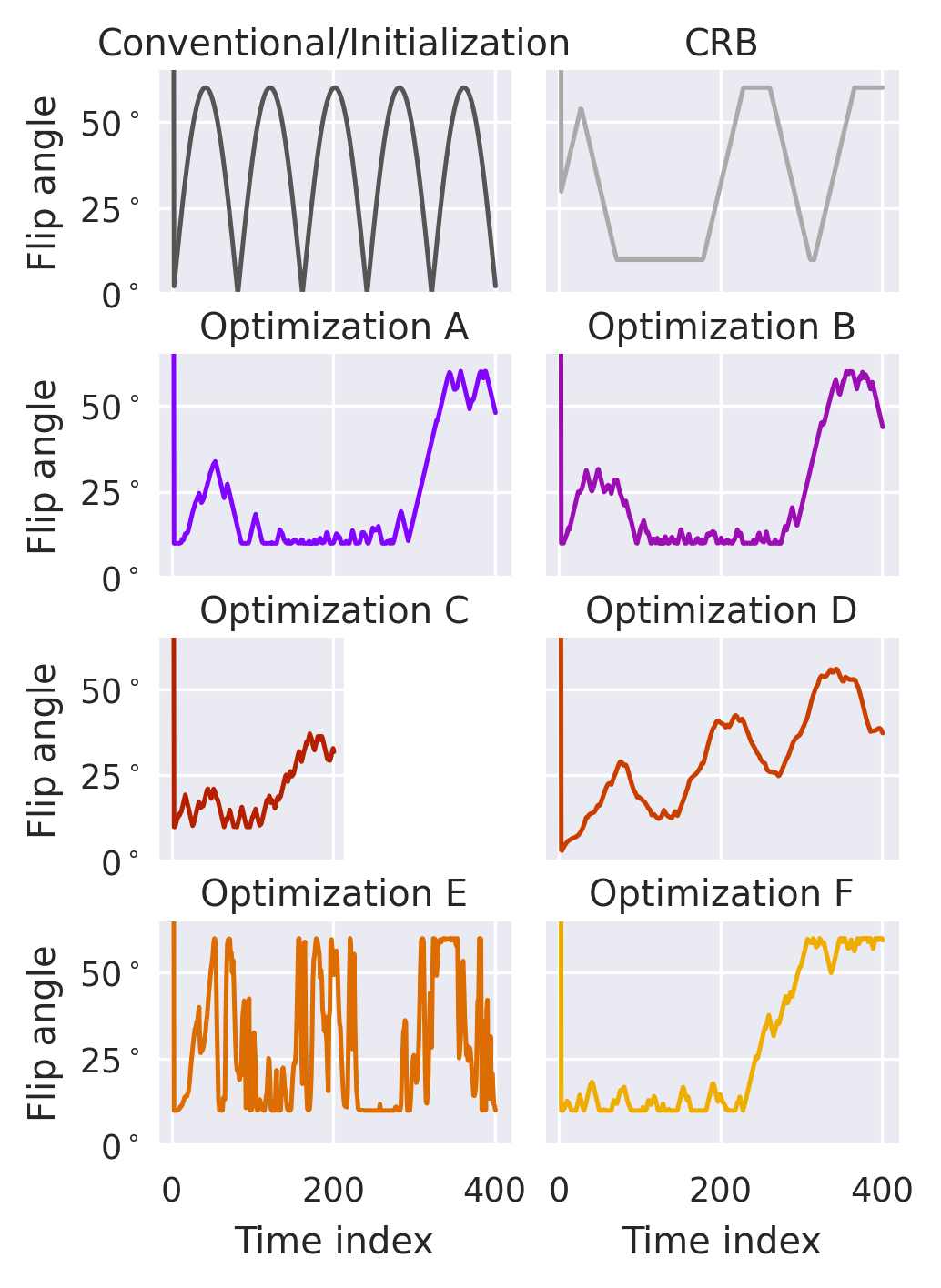
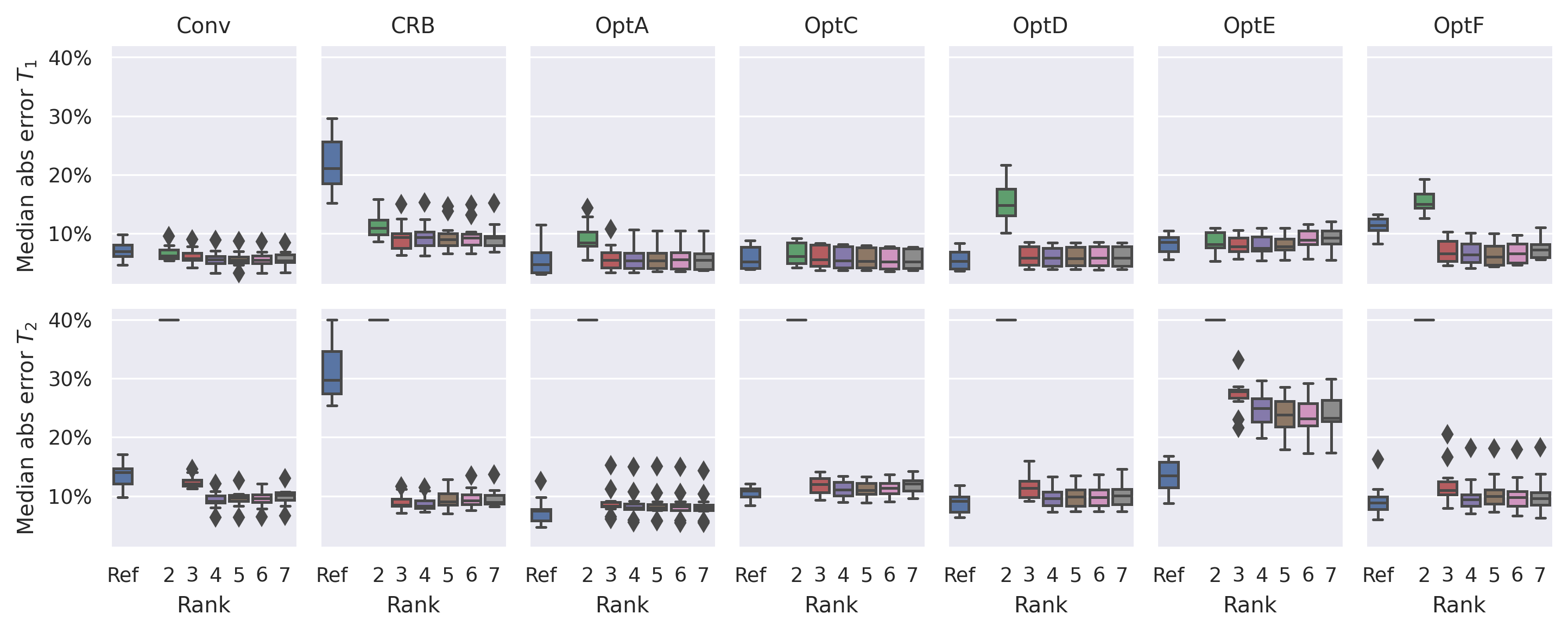
Figure 2 Median absolute error box plots for $$$T_1$$$ and $$$T_2$$$ (rows) are shown for different sequences (columns) with a zero-filled (Ref) and low rank reconstruction with different ranks. The error was clipped at 40%.