3575
Temporal Low-Rank based k-space Sampling Pattern Optimization for MR Fingerprinting1School of Biomedical Engineering and Imaging Sciences, King's College London, London, United Kingdom, 2London Collaborative Ultra high field System, London, United Kingdom, 3MR Research Collaborations, Siemens Healthcare Limited, Camberley, United Kingdom, 4Centre for the Developing Brain, London, United Kingdom
Synopsis
Keywords: MR Fingerprinting, MR Fingerprinting
Motivation: MRF can estimate tissue parameters with high efficiency, requiring optimization of sequence parameters alongside k-space sampling patterns. A comprehensive optimization framework was not established yet.
Goal(s): Develop a framework for optimizing k-space sampling and understanding reconstruction errors for MRF using temporal low-rank reconstruction.
Approach: We quantify MRF performance with the condition number of temporal low-rank system matrices and show suitability in simulation and phantom experiments.
Results: We derive optimality-criteria for schedule and sampling, and provide an algorithm for sampling optimization. We demonstrate that systematic deviations from the signal model are a major source of errors in MRF, and address these with center-weighted sampling.
Impact: Our results are relevant for researchers interested in the fundamental understanding of MR Fingerprinting. Our theory helps designing MRF sequences, guiding future aspirations to jointly optimize sampling and flip-angle schedule, and identifying significant sources of errors in existing implementations.
Introduction
MR Fingerprinting1 has great potential for quantitative imaging due to its efficiency benefit over steady-state techniques2,3. This comes at the cost of complex reconstruction and many degrees of freedom which need to be optimized to achieve the predicted performance.Optimization of all relevant sequence parameters, crucially k-space sampling, was not achieved to date. Existing works mostly minimize Cramer-Rao-bounds (CRB) of estimated tissue properties4. Undersampling is a central source of errors in MRF but its direct inclusion in CRB calculations is infeasible, and modelling it as thermal noise is insufficient5,6. Fuderer7 and Stolk8 include sampling in their frameworks but do not enable its optimization. Brute force optimization is difficult because search spaces are vast9, and little insight can be gained.
We investigated sampling optimization in MRF using a temporal low-rank framework (TLR)10, known to effectively reduce undersampling artifacts. With TLR, every point in time contributes to every compressed temporal component, making it hard to understand intuitively what constitutes optimal sampling. We analyzed TLR to determine optimality criteria and provide an algorithm for optimization, demonstrating its efficacy in simulation and phantom experiments.
Methods
The TLR reconstruction solves $$$min_x||UFLx−y||$$$, with sampling $$$U$$$, Fourier transform $$$F$$$, temporal (de)compression11 $$$L$$$, measured k-space $$$y$$$ (with temporal dimension), and compressed image-space $$$x$$$. If the system matrix $$$A=E^HE$$$ with $$$E=UFL$$$ is singular or poorly conditioned, undersampling errors are introduced12.Noting that $$$F$$$ and $$$L$$$ commute, we define a generalized sampling matrix12 $$$M=L^HUL$$$ with block diagonal structure. For Cartesian sampling, $$$cond(A)=cond(M)=\kappa$$$, providing a direct means for evaluation. $$$A$$$ is invertible if all blocks $$$M_k$$$ (Fig. 1) have full rank, indicating the minimum amount of data necessary for reconstruction.
We tested if $$$\kappa$$$ is a measure of MRF performance by correlating it with reconstruction errors in simulations, employing four flip-angle schedules (Fig. 2). Isolating undersampling effects, our simulation excludes noise and the forward model has four singular components, equivalent to the reconstruction.
We algorithmically minimize $$$\kappa$$$ for 3D Cartesian MRF by swapping samples' positions, and examine efficacy in simulations, and experiments with a spherical gel phantom (FUNSTAR, Gold Standard Phantoms, UK; MAGNETOM Terra, Siemens Healthcare, Erlangen, Germany; 8-TX 32-RX head-coil, Nova Medical, USA).
Further, we demonstrate the necessity of center-weighted sampling (here: CASPR13) to address systematic deviations from the signal model.
Results
Fig. 3A shows that even in error-free simulations, iterative reconstruction produces significant errors due to poor conditioning. For feasible scanning times (acquiring 4-6 k-spaces) $$$M$$$ is close to singular for every schedule.Fig. 3B illustrates how optimal samples can be chosen one by one based on $$$\kappa$$$. Intuitively, this produces regular sampling for the temporal Fourier basis (rightmost column). As expected, sampling the same point twice gives bad conditioning because no new information is acquired. Otherwise, interpretation of optimal choices of samples is difficult.
Our optimization algorithm extends this to k-space sampling. Fig. 4A shows that conditioning and error is improved for Koolstra's schedule and the fast cycle, but not Jiang's and Zhao's. Single-channel phantom experiments with the fast cycle (Fig. 4B) reflect this. Aliasing is reduced and $$$\sigma_{2,3}$$$ appear to be dominated by thermal noise.
Parallel imaging (first two columns Fig. 5A) improves conditioning, hence reducing aliasing. Interestingly, optimization does not achieve substantial improvement. The third column in Fig. 5A (CASPR) shows that using center-weighted sampling further reduces aliasing. While not fully mitigated in the real scan, aliasing is not visible in the simulation closely replicating this scan (rightmost column Fig. 5A), indicating the presence of an unaccounted source of errors.
Discussion
We showed that $$$\kappa=cond(M)$$$ is useful for measuring severity of undersampling-errors in Cartesian MRF, and hypothesize that these concepts extend to non-Cartesian sampling. We optimized sampling for single-channel MRF experiments, making thermal noise the major source of errors instead of aliasing. Optimization failed for two schedules because their TLR bases do not provide sufficient complementary (orthogonal) information. This implies optimality-criteria for MRF: choose samples that optimize $$$\kappa$$$, and design a schedule enabling that for all employed temporal undersampling patterns. This suggests that sampling can be included in schedule optimization by minimizing CRBs of undersampled temporal signals; equivalent to estimating parameters from undersampled signals.We demonstrated that parallel imaging improved $$$\kappa$$$ substantially, rendering our sampling optimization inconsequential. Our results suggest that systematic deviations from the signal model amplified by poor conditioning are responsible for residual aliasing. Since their magnitude is proportional to true k-space signals, center-weighted sampling counteracts these by improving $$$\kappa$$$ in the central region of k-space.
Concluding, we used TLR to show how undersampling affects MRF performance and derived optimality criteria for schedule and sampling.
Acknowledgements
The first author would like to acknowledge funding from the EPSRC Centre for Doctoral Training in Smart Medical Imaging (EP/S022104/1) and Siemens Healthineers, by core funding from the Wellcome/EPSRC Centre for Medical Engineering [WT203148/Z/16/Z], the National Institute for Health Research (NIHR) Clinical Research Facility based at Guy’s and St Thomas’ NHS Foundation Trust and King’s College London and by the Wellcome Trust Collaboration in Science grant [WT201526/Z/16/Z]. The views expressed are those of the author(s) and not necessarily those of the NHS, the NIHR or the Department of Health and Social Care.References
[1] D. Ma et al., "Magnetic resonance fingerprinting", Nature, vol. 495, no. 7440, pp. 187–192, Mar 2013.
[2] J. Asslaender, "A perspective on MR fingerprinting", Journal of Magnetic Resonance Imaging, vol. 53, no. 3, pp. 676–685, Apr 2020.
[3] D. Leitao et al., "Efficiency analysis for quantitative MRI of T1 and T2 relaxometry methods", Physics in Medicine & Biology, vol. 66, no. 15, p. 15NT02, Jul. 2021.
[4] B. Zhao et al., "Optimal experiment design for magnetic resonance fingerprinting: Cramer-Rao bound meets spin dynamics", IEEE Transactions on Medical Imaging, vol. 38, no. 3, pp. 844–861, Mar 2019.
[5] K. Sommer et al., "Towards predicting the encoding capability of MR fingerprinting sequences", Magnetic Resonance Imaging, vol. 41, pp.7–14, Sep 2017.
[6] D. Kara et al., "Parameter map error due to normal noise and aliasing artifacts in MR fingerprinting", Magnetic Resonance in Medicine, vol. 81, no. 5, pp. 3108–3123, Jan 2019.
[7] M. Fuderer et al., "Efficient performance analysis and optimization of transient-state sequences for multiparametric magnetic resonance imaging", NMR in Biomedicine, vol. 36, no. 3, Nov. 2022.
[8] C. C. Stolk et al., "Understanding the combined effect of k-space undersampling and transient states excitation in MR fingerprinting reconstructions", IEEE Transactions on Medical Imaging, vol. 38, no. 10, pp. 2445–2455, Oct 2019.
[9] S. P. Jordan et al., "Automated design of pulse sequences for magnetic resonance fingerprinting using physics-inspired optimization", Proceedings of the National Academy of Sciences, vol. 118, no. 40, Sep. 2021.
[10] B. Zhao et al., "Accelerated MR parameter mapping with low-rank and sparsity constraints", Magnetic Resonance in Medicine, vol. 74, no. 2,pp. 489–498, Aug 2014.
[11] D. F. McGivney et al., "SVD compression for magnetic resonance fingerprinting in the time domain", IEEE Transactions on Medical Imaging, vol. 33, no. 12, pp. 2311–2322, Dec 2014.
[12] J. Asslaender et al., "Low rank alternating direction method of multipliers reconstruction for MR fingerprinting", Magnetic Resonance in Medicine,vol. 79, no. 1, pp. 83–96, Mar 2017.
[13] C. Prieto et al., "Highly efficient respiratory motion compensated
free-breathing coronary MRA using golden-step Cartesian acquisition",
Journal of Magnetic Resonance Imaging, vol. 41, no. 3, pp. 738–746, Feb.
2014.
[14] Y. Jiang et al., "MR fingerprinting using fast imaging with steady state precession (FISP) with spiral readout", Magnetic Resonance in Medicine,vol. 74, no. 6, pp. 1621–1631, Dec 2014.
[15] K. Koolstra et al., "Cartesian MR fingerprinting in the eye at 7T using compressed sensing and matrix completion-based reconstructions", Magnetic Resonance in Medicine, vol. 81, no. 4, pp. 2551–2565, Nov 2018.
Figures
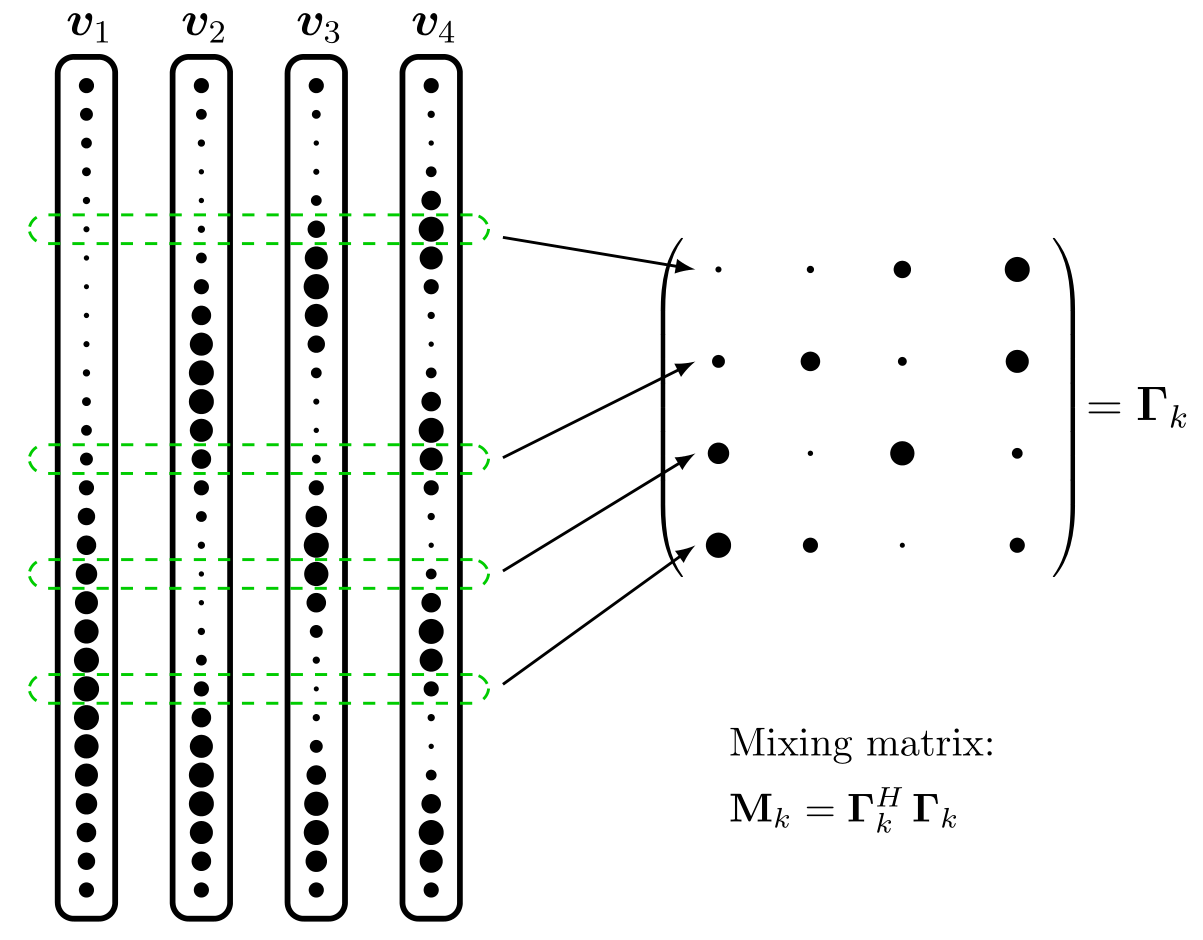
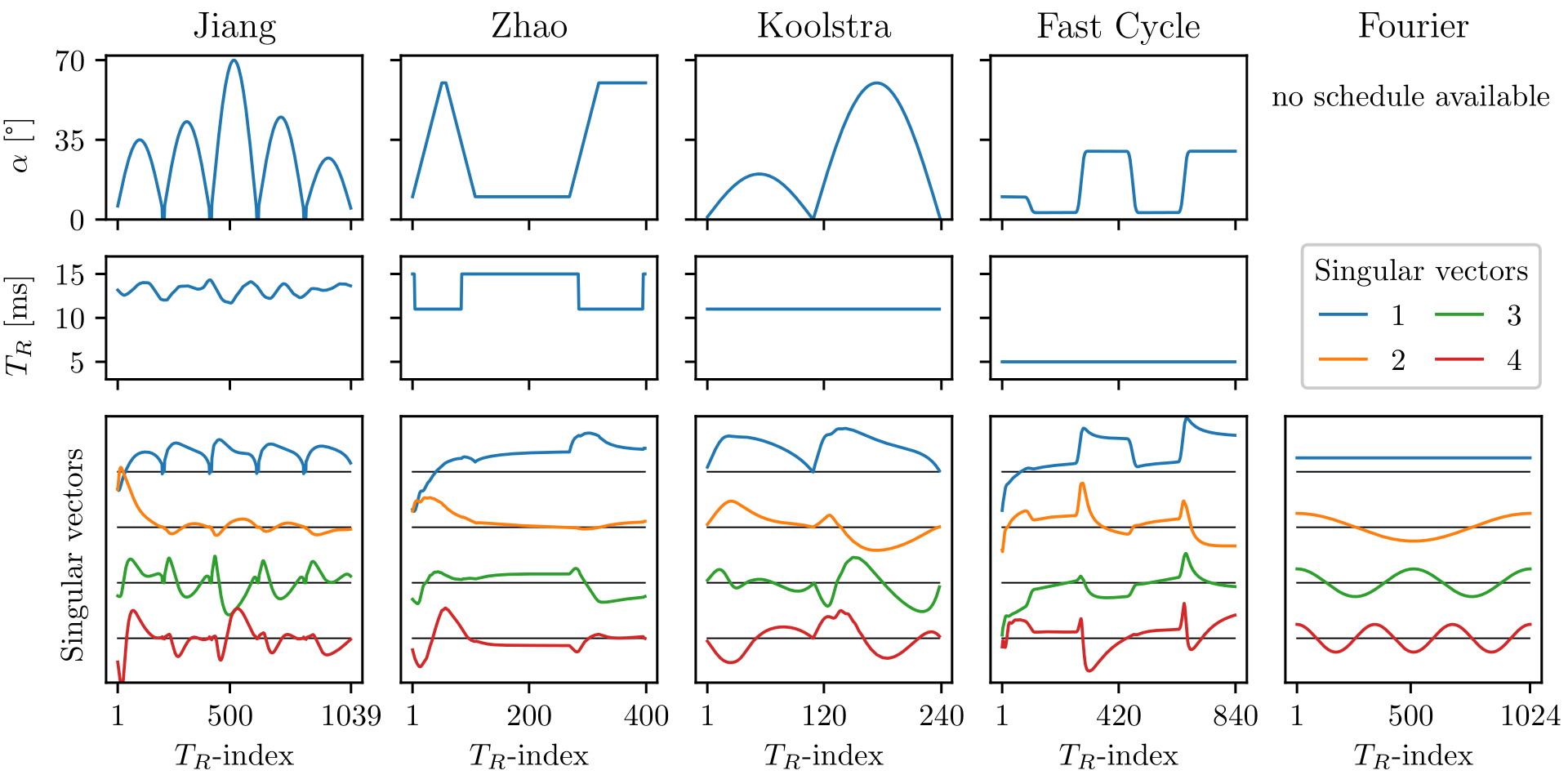
Fig. 2 Flip-angle and TR schedules: "Jiang"14, "Zhao"4, and "Koolstra"15 were taken from previous works, while the "fast cycle" was generated for this work. Every schedule starts with an adiabatic inversion pulse (not displayed). The last row shows the temporal low-rank bases derived from SVD11 of the dictionaries. Truncation error at four singular components is 4,7% (Jiang), 5,4% (Zhao), 1,6% (Koolstra), and 4,8% (fast cycle). The fifth column shows temporal Fourier modes as an artificial basis with no equivalent schedule, used for illustrative purposes in Fig. 4A.
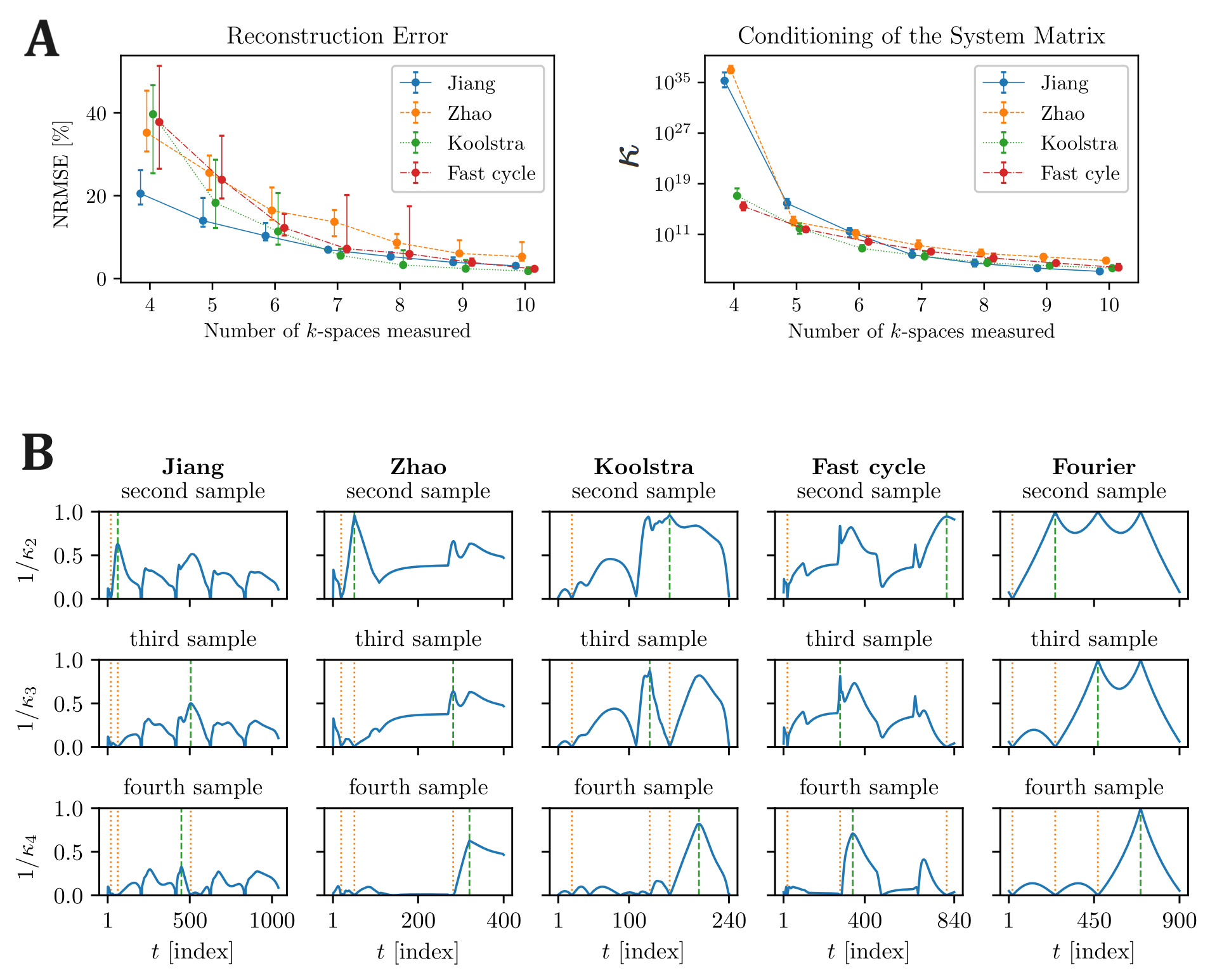
Fig. 3 A) Simulated reconstruction error (left) and conditioning (right) versus the number of sampled k-spaces of equivalent non-dynamic scans. Sampling is uniform random in the k-t domain. Reconstruction errors are substantial due to bad conditioning.
B) Construction of temporal sampling with optimal κ. Curves show 1/κ as a function of sample location in time. In each plot orange lines denote samples already collected, and the green line marks the optimal next sample to collect based on κ. The first sample is chosen arbitrarily. Regular sampling gives ideal κ=1 for the Fourier basis.
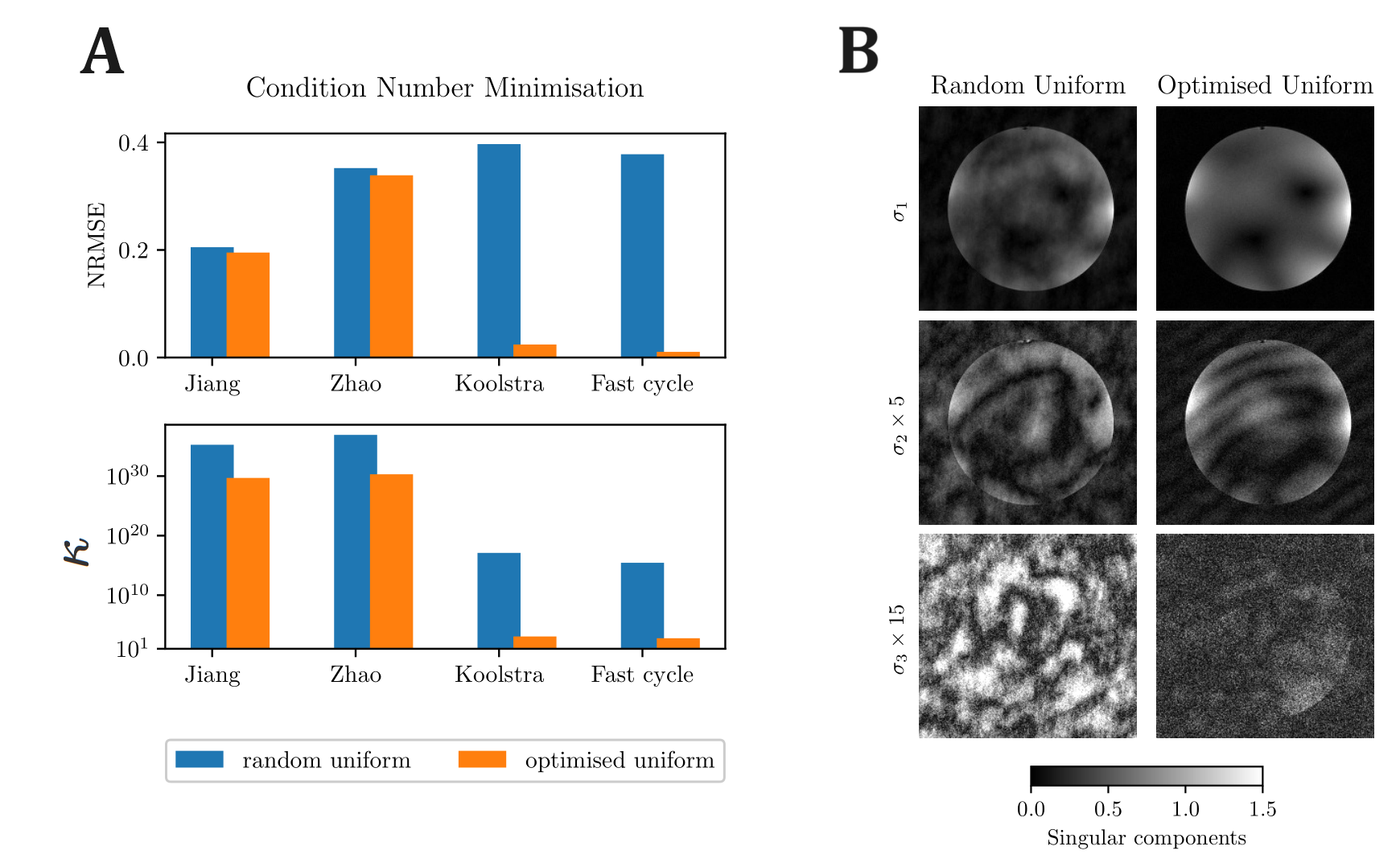
Fig. 4 A) Behavior of single-channel reconstruction error (top) before and after sampling optimization is reflected by conditioning κ (bottom). Error is substantially reduced for Koolstra's schedule and the fast cycle, but not for Jiang's and Zhao's, showing that insufficient orthogonal information is available for the latter.
B) Single-channel reconstructions of gel phantom scans using the fast cycle and uniform Cartesian random (left), and optimized sampling patterns (right). Aliasing present in the left column is considerably reduced on the right, where noise is dominant.
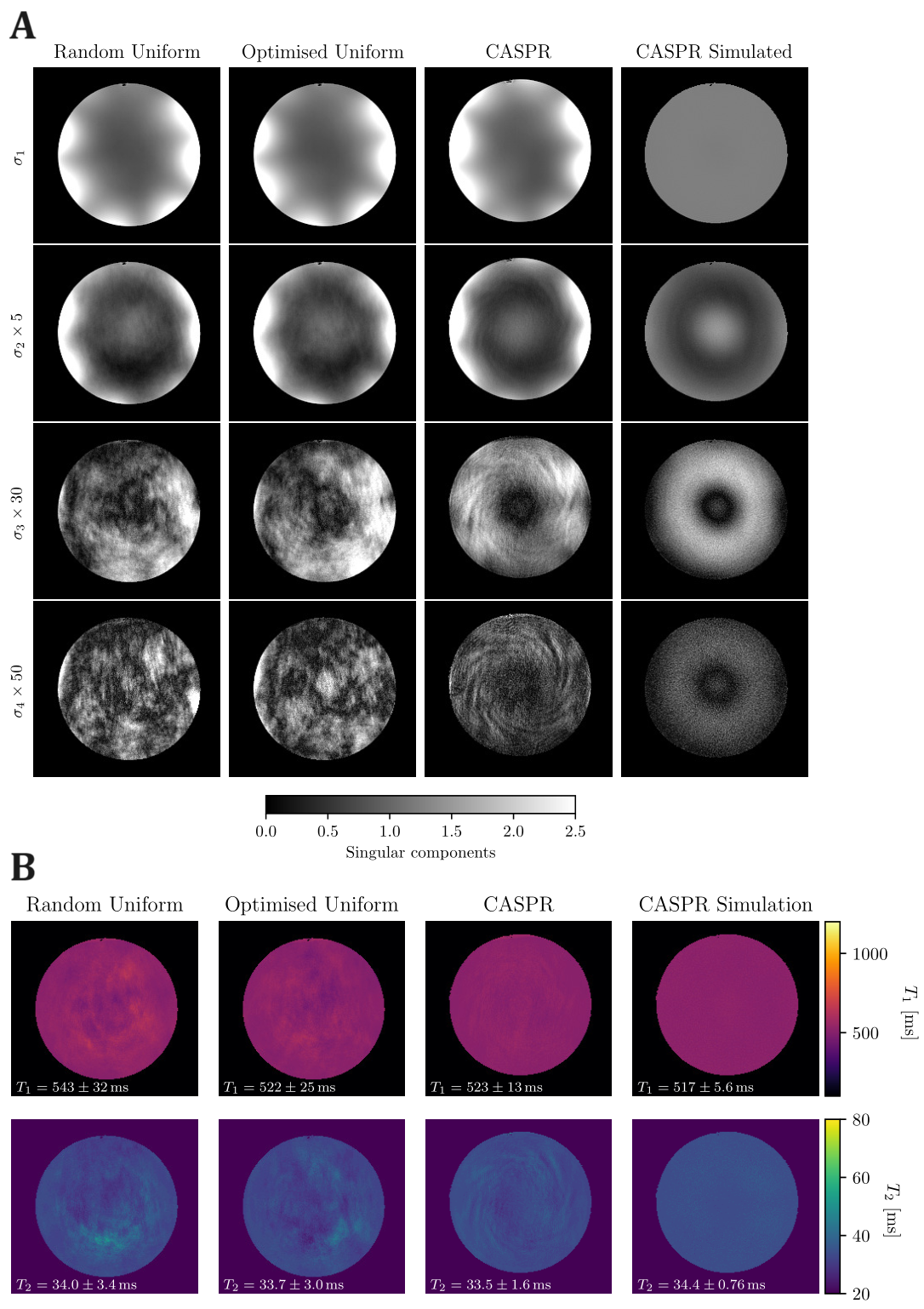
Fig. 5 A) Parallel imaging phantom scans (fast cycle). First two columns: uniform random and optimized Cartesian sampling, notice the cloud-like aliasing. Optimization barely reduces aliasing, unlike in single-channel reconstructions (Fig. 4B). Third column: CASPR, aliasing is substantially reduced. Fourth column: Realistic simulation of the CASPR scan (incl. B1+, TLR truncation errors, noise), no aliasing is visible. Non-uniformity of real scans is due to B1+ and B1-, while only B1+ was used in the simulation.
B) T1 and T2 maps of the above scans (via dictionary matching).