3570
DAES: Self-Supervised Parameter Estimation Model for MR Fingerprinting1School of Software, Tsinghua University, Beijing, China, 2State Key Laboratory of Modern Optical Instrumentation, College of Optical Science and Engineering, Zhejiang University, Hangzhou, China, 3Stanford University, Stanford, CA, United States, 4Department of Biomedical Engineering, Tsinghua University, Beijing, China, 5Athinoula A. Martinos Center for Biomedical Imaging, Massachusetts General Hospital, Charlestown, MA, United States, 6Harvard Medical School, Boston, MA, United States
Synopsis
Keywords: MR Fingerprinting, MR Fingerprinting, self-supervised learning
Motivation: Accurate estimation of relaxation parameters using MRF requires lengthy acquisitions as it benefits from having multiple spiral interleaves to boost the data quality.
Goal(s): We aim to reduce acquisition time by denoising highly under-sampled data while retaining the fidelity of the estimated parameter maps.
Approach: An unsupervised convolutional neural network called DAES is proposed. It combines Denoising Auto-coder (DAE) with subspace modeling, taking advantage of both denoising framework and Bloch simulation-based dictionary information.
Results: DAES outperforms conventional dictionary matching in both simulated and in-vivo data for MRF, demonstrating stronger ability to estimate parameters from highly under-sampled data.
Impact: Magnetic Resonance Fingerprinting with the proposed unsupervised Denoising Auto-encoder permits high-quality T1 and T2 mapping while substantially reducing the acquisition time.
Introduction
MR Fingerprinting (MRF) is a powerful technique for non-invasively characterizing T1, T2 and M0 parameters of tissues. Nevertheless, due to the complex encoding features of MRF, single-interleaf spiral data may suffer from noise amplification and artifacts, thus hampering the quality of parameter fitting. To reduce noise and improve robustness, multiple interleave acquisitions can be used, yet this comes at the cost of additional scan time. Also, conventional parameter estimation methods including dictionary matching1 and variable projection (Varpro)2 process each voxel separately, thus failing to leverage their spatial relations.Most previous work on neural network-based parameter estimation focuses on supervised paradigms3-7, which learn a direct mapping from MRF signals to parameter maps. Supervised learning often demands a high quality training dataset, which may necessitate long acquisition times and large number of subjects.
Prior work on unsupervised learning introduced subspace modeling, approximating Bloch simulation in the network’s forward model to reduce noise8. It enables training without high quality datasets. A recent study deployed an unsupervised network to MRF by utilizing subspace modeling for denoising9. However, the improved accuracy came at the cost of spatial blurring in the estimated maps.
To address these problems, we propose a self-supervised network consisting of a Denoising Auto-encoder and subspace modeling, DAES, which effectively denoises without incurring blurring. This approach maps MRF signals to itself, thus reducing the scale and quality in the required training data.The model operates in a scan-specific manner and does not require an external training dataset., High quality parameter maps can be obtained from a single interleaf of MRF data while approximating the fidelity of lengthy, multi-interleaf acquisitions.
Code/data: https://drive.google.com/drive/folders/14vuQqs3Pn8I50DUgBtsavgjg4h6qWPXU?usp=sharing/
Methods
In-vivo data. 2D FISP MRF10 on a Siemens Prisma system with 20ch reception was used to acquire in-vivo data. The ground-truth data involved 6-interleaves to mitigate artifacts and boost SNR. Each acquisition contains 30 slices with 4mm thickness at matrix=220×220, requiring 6 minutes/interleaf. Data were reconstructed using sliding window (window size=5)11. The training data used only one interleaf.Simulated data. A 72 slices brain-like phantom was generated to simulate the 1-interleaf acquisition with the same sequence and head coil, and the reconstruction was performed using the same pipeline. B0 inhomogeneity was incorporated to introduce an inhomogeneous background phase in every TR, while B1+ inhomogeneity was incorporated to introduce flip angle variation.
DAES framework. DAES employs a denoising auto-encoder to compress input multi-echo MRF images into six subspace coefficients to succinctly represent the signal evolution. The coefficient images are then multiplied with a subspace matrix obtained from the Bloch-based dictionary, which approximates the process of non-differentiable dictionary-matching: (Fig.1). After the reconstruction, cleaner MRF images are passed through dictionary matching to estimate T1, T2 and M0 maps. DAES is optimized in a self-supervised manner through L1 loss between input and synthesized images.
DAES deployment. DAES was deployed on Tensorflow12 and trained using Adam optimizer13 with a descending learning rate from 0.001 to 0.00001. For in-vivo data, the proposed network is trained on 1-interleaf data, and compared to the reference 6-interleaves data. For simulated data, under-sampled data and fully-sampled data are marked as training and testing data respectively.
Root mean squared error (RMSE) in brain parenchyma was used for evaluation.
Results
Simulation. Fig2 shows T1, T2 and M0 maps synthesized by proposed method and standard sliding-window reconstruction on under-sampled data, and compared with the simulated parameter maps. The improvement on RMSE reaches up to 40%.In vivo. Fig3 compares T1, T2 and M0 maps synthesized by proposed method and sliding-window reconstruction on 1-interleaf in-vivo data, with 6-interleaves data as ground truth. The improvement of RMSE on M0 reaches up to 5-fold, while reduction of RMSE on T1 and T2 reaches 2-fold.
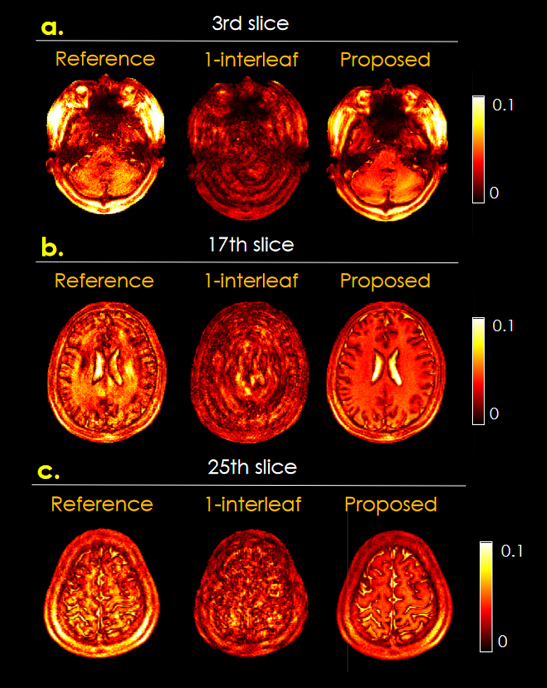
Fig4 shows different slices of MRF time series obtained from the proposed method using 1-interleaf in-vivo data.
Discussion and Conclusion
A self-supervised method DAES is proposed to reduce acquisition time and improve quality of parameter estimation for MRF. Combining DAE and linear approximation for Bloch simulation enables efficient and self-supervised parameter estimation in a scan-specific manner.The training costs around 10 hours per dataset, which can be improved greatly by pre-training the model.
Future work will explore k-space reconstruction of MRF series through unrolled networks and subspace modeling to further mitigate aliasing artifacts and noise from single-interleaf data.
Acknowledgements
This work was supported by research grants NIH R01 EB028797, P41 EB030006, U01 EB026996, R03 EB031175, R01 EB032378, UG3 EB034875, and NVidia Corporation for computing support.References
1. Ma, D., Gulani, V., Seiberlich, N., Liu, K., Sunshine, J. L., Duerk, J. L., & Griswold, M. A. (2013). Magnetic resonance fingerprinting. Nature, 495(7440), 187–192.
2. Haldar JP, Anderson J, Sun SW. Maximum likelihood estimation of T1 relaxation parameters using VARPRO. In: Proceedings of the 15th Annual Meeting of ISMRM, Berlin, Germany. ; 2007. p. 41.
3. Fang, C., Yang, Z., Wassermann, D., & Li, J.-R. (2023). A simulation-driven supervised learning framework to estimate brain microstructure using diffusion MRI. Medical Image Analysis, 90, 102979.
4.Nykänen, O., Nevalainen, M., Casula, V., Isosalo, A., Inkinen, S. I., Nikki, M., Lattanzi, R., Cloos, M. A., Nissi, M. J., & Nieminen, M. T. (2023). Deep-Learning-Based Contrast Synthesis From MRF Parameter Maps in the Knee Joint. Journal of Magnetic Resonance Imaging: JMRI, 58(2), 559–568.
5. Dar, S. U. H., Öztürk, Ş., Özbey, M., Oguz, K. K., & Çukur, T. (2023). Parallel-stream fusion of scan-specific and scan-general priors for learning deep MRI reconstruction in low-data regimes. Computers in Biology and Medicine, 167, 107610.
6. Li, Y., Joaquim, M. R., Pickup, S., Song, H. K., Zhou, R., & Fan, Y. (2023). Learning ADC maps from accelerated radial k-space diffusion-weighted MRI in mice using a deep CNN-transformer model. Magnetic Resonance in Medicine: Official Journal of the Society of Magnetic Resonance in Medicine / Society of Magnetic Resonance in Medicine. https://doi.org/10.1002/mrm.29833.
7. Zhao, Z., Nie, C., Zhao, L., Xiao, D., Zheng, J., Zhang, H., Yan, P., Jiang, X., & Zhao, H. (2023). Multi-parametric MRI-based machine learning model for prediction of WHO grading in patients with meningiomas. European Radiology. https://doi.org/10.1007/s00330-023-10252-8.
8. Kang, B., Kim, B., Schär, M., Park, H., & Heo, H.-Y. (2021). Unsupervised learning for magnetization transfer contrast MR fingerprinting: Application to CEST and nuclear Overhauser enhancement imaging. Magnetic Resonance in Medicine: Official Journal of the Society of Magnetic Resonance in Medicine / Society of Magnetic Resonance in Medicine, 85(4), 2040–2054.
9. Gao, M., Ye, H., Kim, T. H., Zhang, Z., So, S., & Bilgic, B. (2022). Accurate parameter estimation using scan-specific unsupervised deep learning for relaxometry and MR fingerprinting. arXiv:2112.03815. https://doi.org/10.48550/arXiv.2112.03815.
10. Jiang, Y., Ma, D., Seiberlich, N., Gulani, V., & Griswold, M. A. (2015). MR fingerprinting using fast imaging with steady state precession (FISP) with spiral readout. Magnetic Resonance in Medicine: Official Journal of the Society of Magnetic Resonance in Medicine / Society of Magnetic Resonance in Medicine, 74(6), 1621–1631.
11. Cao, X., Liao, C., Wang, Z., Chen, Y., Ye, H., He, H., & Zhong, J. (2017). Robust sliding-window reconstruction for Accelerating the acquisition of MR fingerprinting. Magnetic Resonance in Medicine: Official Journal of the Society of Magnetic Resonance in Medicine / Society of Magnetic Resonance in Medicine, 78(4), 1579–1588.
12. Hope, T., Resheff, Y. S., & Lieder, I. (2017). Learning TensorFlow: A Guide to Building Deep Learning Systems. “O’Reilly Media, Inc.”
13. Kingma DP, Ba J. Adam: A method for stochastic optimization. arXiv preprint arXiv:14126980. 2014.
Figures
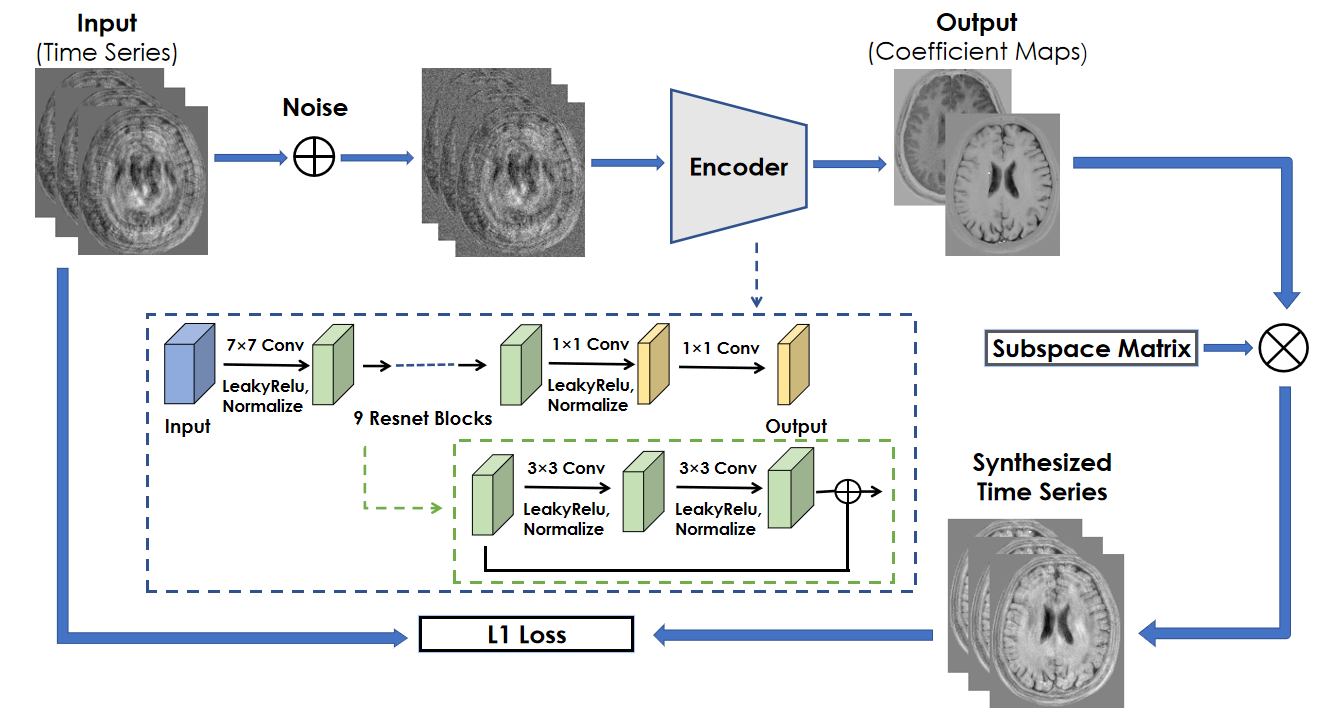
Figure 1. DAES framework. DAES employs a denoising auto-encoder to compress input MRF images into six coefficient images to remove aliasing artifacts. The coefficient images are then multiplied with a subspace matrix obtained from MRF dictionary, which is used to approximate the process of non-differentiable Bloch dictionary-matching. Gaussian noise was added to the acquired images to create input for the network. The training aims to minimize the dissimilarity (e.g., L1 loss) between clean acquired images and synthesized images generated from noisy network input.
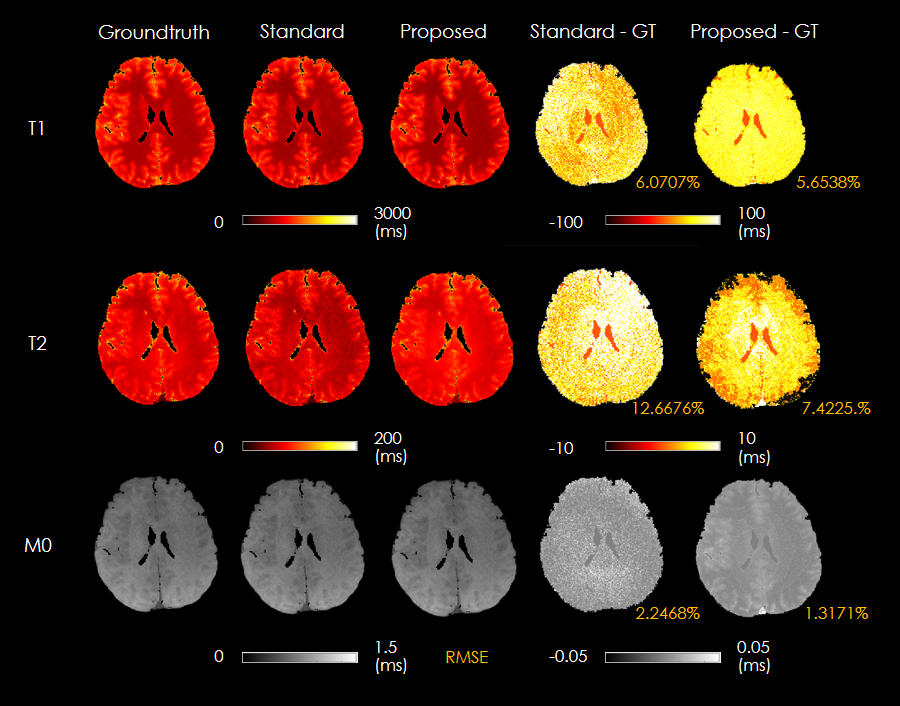
Figure 2. Simulated data results. T1, T2 and M0 maps synthesized by proposed method and standard sliding-window reconstruction on under-sampled data, and compared with the simulated parameter maps. The improvement on RMSE can reach up to 40%.
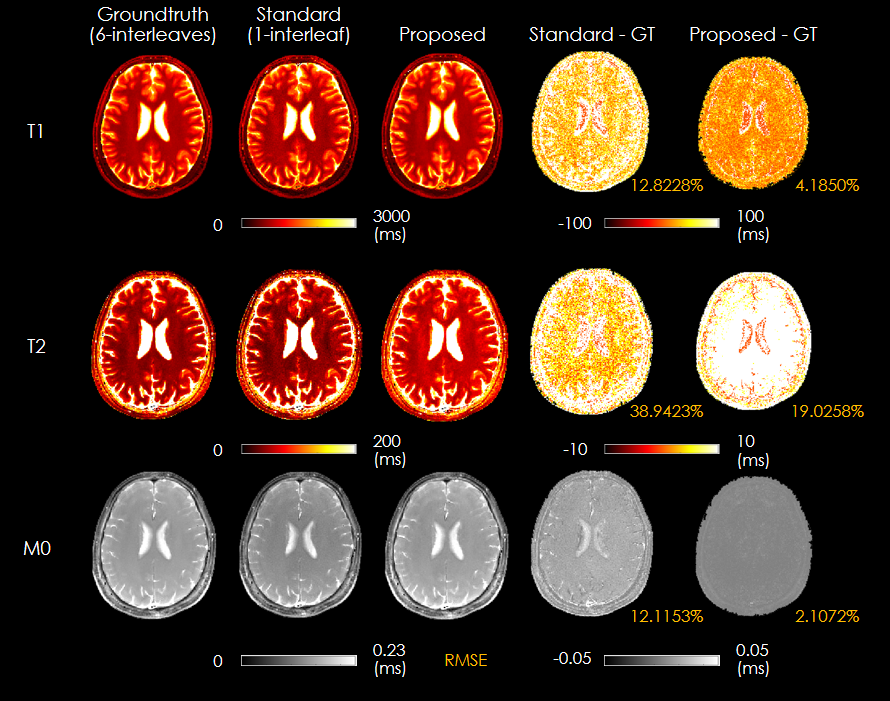
Figure 3. In-vivo data results. T1, T2 and M0 maps synthesized by proposed method and standard sliding-window reconstruction on 1-interleaf in-vivo data, with 6-interleaves data as ground truth.