3540
Hemodynamics and vessel morphology in Fontan patients at a high-altitude surgical center1University of Colorado, Aurora, CO, United States, 2Children's Hospital Colorado, Aurora, CO, United States, 3University of Michigan, Ann Arbor, MI, United States, 4Children's Hospital Colorado, Denver, CO, United States
Synopsis
Keywords: Flow, Vessels
Motivation: There is currently limited data examining longitudinal changes in hemodynamics and vascular properties in Fontan patients living at altitude.
Goal(s): We aimed to assess hemodynamic parameters and vessel morphology in Fontan patients at a single high-altitude surgical center and assess correlations between these parameters and post-Fontan outcomes.
Approach: We retrospectively reviewed patients undergoing Fontan operation from 1999 to 2021. We analyzed data from cardiac magnetic resonance imaging and cardiac catheterization.
Results: Our findings highlight post-Fontan changes in flow, pressure, and area. The changes in systemic and caval flow, along with pressure variations, offer insights into the effects of Fontan circulation.
Impact: This study advances our understanding of Fontan circulation at high-altitude, paving the way for improved prognostic information and long-term outcomes in this patient population.
Background
The Fontan operation for single ventricle congenital heart disease alters vascular anatomy and hemodynamics. Living at altitude may impact post-Fontan morbidity and mortality, however, limited long-term data exists for this patient population. This study examines hemodynamic and morphological changes, and identifies predictors of Fontan failure, in Fontan patients at a high-altitude center.Methods
A retrospective cohort study was performed in Fontan patients who underwent serial cardiac catheterization (CATH) and cardiovascular magnetic resonance (CMR) between 1999-2023. Vascular pressures and resistance were obtained from CATH. Vessel flow and area were obtained from CMR. Mixed effect linear regression models were used to assess the relationship between time post-Fontan measured continuously as years post operation and each outcome. Logistic regression modeling was used to model the relationship between the probability of transplant or death, whichever came first, and each vessel pressure, flow, and area measurement.Results
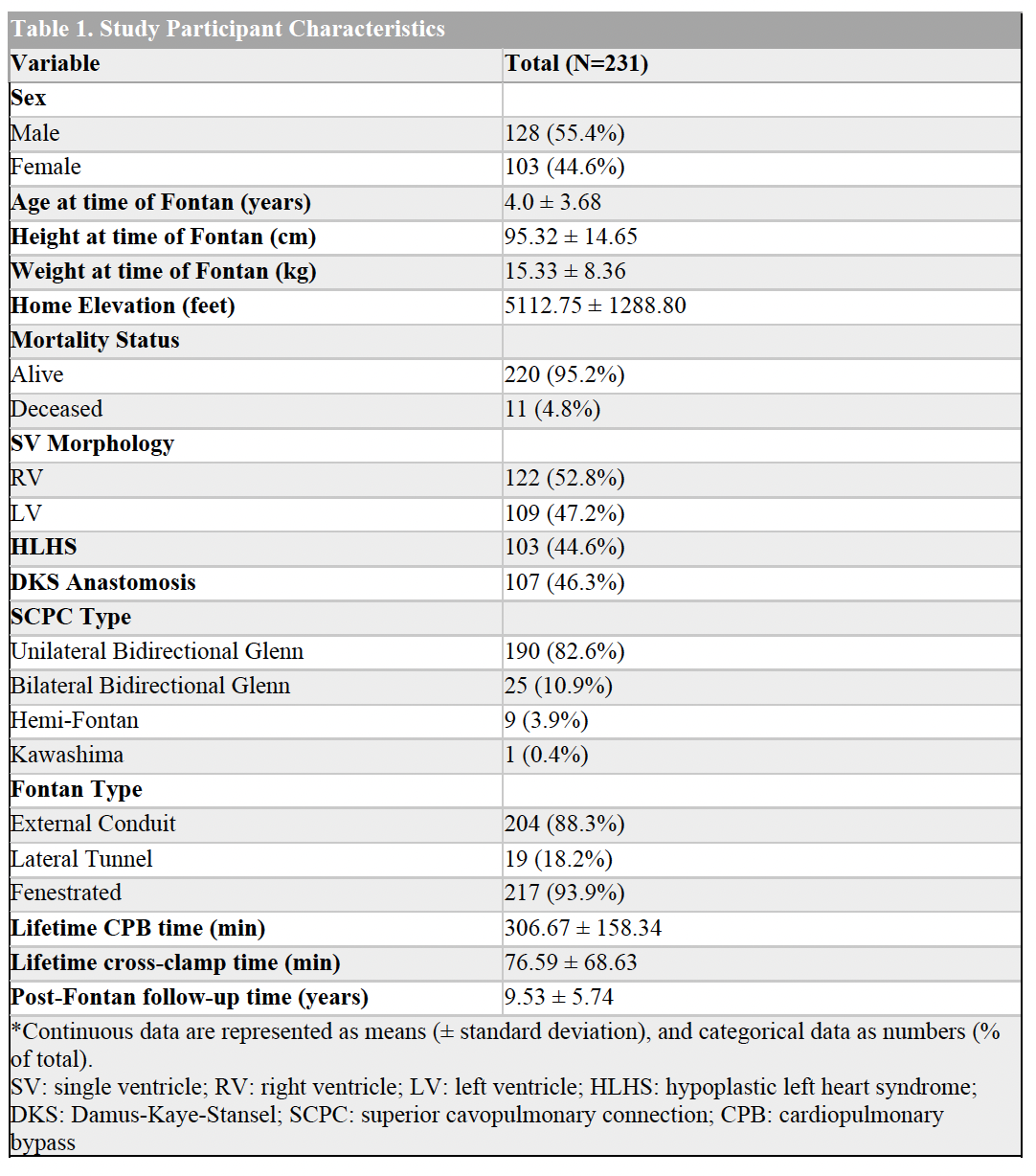
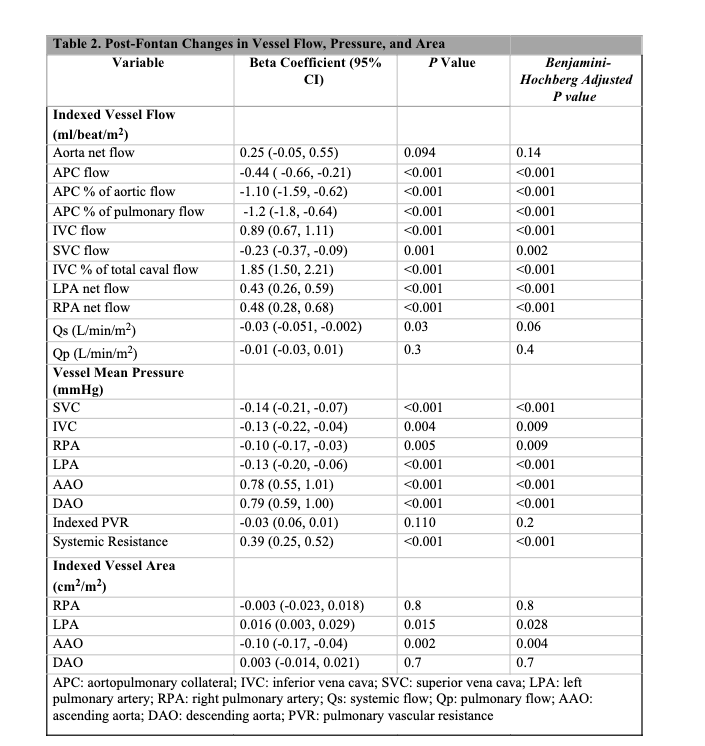
231 unique patients were included (55% male, 44% with hypoplastic left heart). In total, 195 CMRs and 524 CATHs were analyzed. Mean age at time of Fontan was 4.0 ± 3.68 years. Mean home elevation was 5112.75 ± 1288.80. The majority of patients had a fenestrated external conduit type Fontan. The mean follow-up time post-Fontan at the time of data collection was 9.55 ± 5.74 years. (Table 1)Across this cohort of patients, in the time following Fontan operation, inferior vena cava (IVC) flow and IVC contribution to total caval flow increased, superior vena cava (SVC) flow decreased, and branch pulmonary artery (PA) flow increased. Aortic flow did not change, but aortopulmonary collateral (APC) flow decreased. There were no significant changes in systemic flow (Qs) or pulmonary flow (Qp).
SVC, IVC, right pulmonary artery (RPA), and left pulmonary artery (LPA) mean pressures all decreased. Ascending aorta (AAO) and descending aorta (DAO) mean pressures increased. Pulmonary vascular resistance (PVR) did not significantly change over time post-Fontan, while systemic resistance increased.
LPA area increased over time, while RPA area did not change. (Table 2)
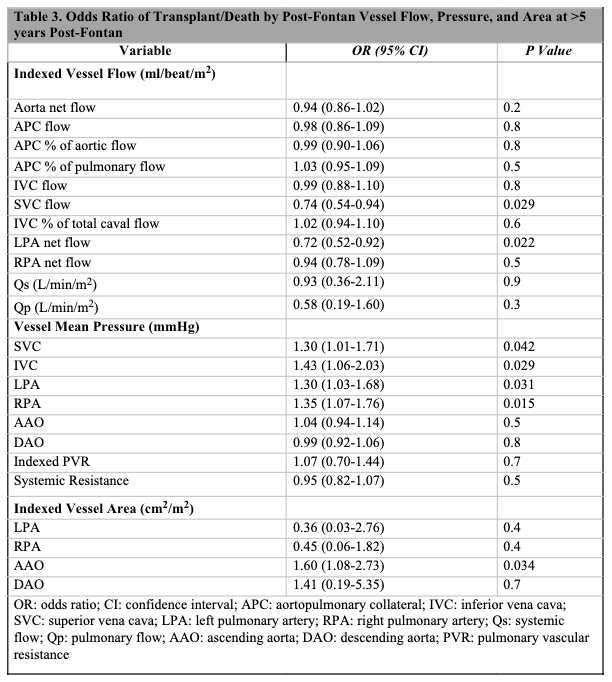
Increased SVC flow and LPA flow at >5 years post-Fontan were both associated with decreased odds ratio (OR) for death/transplant. The following variables at >5 years post-Fontan were associated with increased OR for death/transplant: elevated IVC pressure, elevated SVC pressure, elevated LPA pressure, elevated RPA pressure, and increased AAO area. (Table 3)
Conclusion
This study provides insights into the hemodynamic and morphological properties in a cohort of Fontan patients residing at high-altitude, with shift in flow patterns and changes in vessel pressures over time that are largely consistent with those reported at sea level.1 Additionally, this study identifies several preliminary predictors of post-Fontan transplant and mortality. This exploratory data may be used to direct future studies to enhance prognostic information and ultimately improve long-term outcomes in this patient population. This study had several limitations. We did not collect all clinical data for study participants and may have missed factors that contributed to post-Fontan morbidity, as well as other potential determinants of hemodynamic and morphologic parameters. Selection bias is likely present in that patients who had poor clinical status may have had more follow-up studies, or alternatively patients who experienced early death or transplantation would not have long-term follow-up data recorded.Follow up studies will involve performing subgroup analyses to determine how these post-Fontan changes may differ between the patient populations with HLHS, hypoplastic right heart, and atrioventricular canal defects. Furthermore, additional clinical data will be collected to provide enhanced context to these results.Acknowledgements
No acknowledgement found.References
1. Ghosh RM, Whitehead KK, Harris MA, et al. Longitudinal Trends of Vascular Flow and Growth in Patients Undergoing Fontan Operation. Ann Thorac Surg. Jun 2023;115(6):1486-1492. doi:10.1016/j.athoracsur.2022.07.051Figures