3508
An Information-Theoretic Paradigm in Modelling Diffusion-Weighted Imaging of Prostate Cancer: EDDIE (Entropy of Divergence of DWI Decay Curve)1Department of Urology, Turku University Hospital, Turku, Finland, 2University of Turku, Turku, Finland, 3Department of Diagnostic Radiology, University of Turku, Turku, Finland, 4Radiology Enterprise Service Group, Mass General Brigham, Boston, MA, United States, 5Department of Pathology, Turku University Hospital, Turku, Finland, 6Siemens Healthineers, Helsinki, Finland, 7Department of Medical Physics, Turku University Hospital, Turku, Finland
Synopsis
Keywords: Radiomics, Radiomics, diffusion-weighted imaging (DWI), repeatability, magnetic resonance imaging (MRI)
Motivation: Typically, diffusion-weighted imaging (DWI) modelling is assumption-based using e.g. exponential models, but nonparametric (data-based) methods have not been explored.
Goal(s): We propose a information-theoretic paradigm for DWI modelling which results in a novel radiomics for DWI of prostate cancer (PCa).
Approach: The proposed radiomics, EDDIE (entropy of divergence of DWI decay curve) is formulated as entropy of information lost from approximating a reference by DWI decay curves. It is subjected to classification of clinically significant and insignificant PCa using test-retest DWI datasets of 78 patients.
Results: EDDIE achieved an AUC score of 0.77 and an ICC (3,1) of 0.78 which indicates good repeatability.
Impact: The proposed approach is nonparametric (assumption-free), interpretable (mathematically and physically meaningful) and complete (higher-order measurement). These may contribute towards more accurate and efficient DWI modelling. Besides, the associated novel radiomics could help ushering in more information-theoretic developments in this field.
Introduction
Diffusion-weighted imaging (DWI) has been used to detect and characterize prostate cancers (PCa) which remains one of the most common cancers among men 1. Traditionally, prostate DWI is fitted using Gaussian diffusion model which gives rise to the apparent diffusion coefficient ($$$ADC_m$$$) map 2. To account for non-Gaussian effects, various models have been proposed including biexponential and kurtosis models 3. In this work, we propose a nonparametric approach for DWI modelling which makes no a priori assumption about the DWI decay. Based on information theory, the proposed model is derived directly from the data which results in a novel radiomics for DWI of PCa.Method
We begin by noting that the DWI decay curve $$$s=f(b)$$$ is a mathematical function of $$$b$$$-values. This allows the application of information theory which deals with statistical distributions (functions) in DWI modelling. That said, we express $$$s$$$ by the amount of information lost when $$$s$$$ is used to approximate a chosen reference $$$s_r$$$. Mathematically, this is given by the extended Kullback-Leibler (eKL) divergence 4 of $$$s_r$$$ from $$$s$$$, which can be interpreted as the projection $$$\triangleright s$$$ of $$$s$$$ onto $$$s_r$$$:$$\begin{align} \triangleright s &\stackrel{\text{def}}{=} \sqrt{\mathrm{eKL}(s_r \| s)} \\&= \sqrt{\mathrm{KL}(s_r \| s) + \|s\| - \|s_r\|} \\&= \sqrt{\int_{b=0}^{b_\mathrm{max}} s_r(b) \log \frac{s_r(b)}{s(b)} db + \int_{b=0}^{b_\mathrm{max}} s(b) db - \int_{b=0}^{b_\mathrm{max}} s_r(b) db} \end{align}$$
Above, the square root is employed due to the quadratic nature of eKL divergence 5. In accordance to the principle of maximum entropy 6, the optimal solution is given by $$$s_r=\arg \max h(\triangleright s)$$$ where $$$h(\triangleright s)$$$ is the entropy 7 of the resulted $$$\triangleright s$$$ for a given set $$$S$$$ of DWI decay curve. By expressing 8 $$$s=\|s\|\bar{s}$$$ and $$$s_r=\|s_r\|\bar{s}_r$$$ , $$$\triangleright s=\sqrt{(\triangleright \bar{s})^2 + (\triangleright \|s\|)^2}$$$ can be mathematically split into “shape” $$$\triangleright \bar{s}$$$ and “intensity” components $$$\triangleright \|s\|$$$ as defined by:
$$\begin{align} \triangleright \bar{s} &= \sqrt{\|s_r\| \mathrm{KL}(\bar{s_r} \| \bar{s})} \\
\triangleright \|s\| &= \sqrt{\|s_r\|(\log \frac{\|s\|}{\|s_r\|} + \frac{\|s\|}{\|s_r\|} - 1)} \end{align}$$
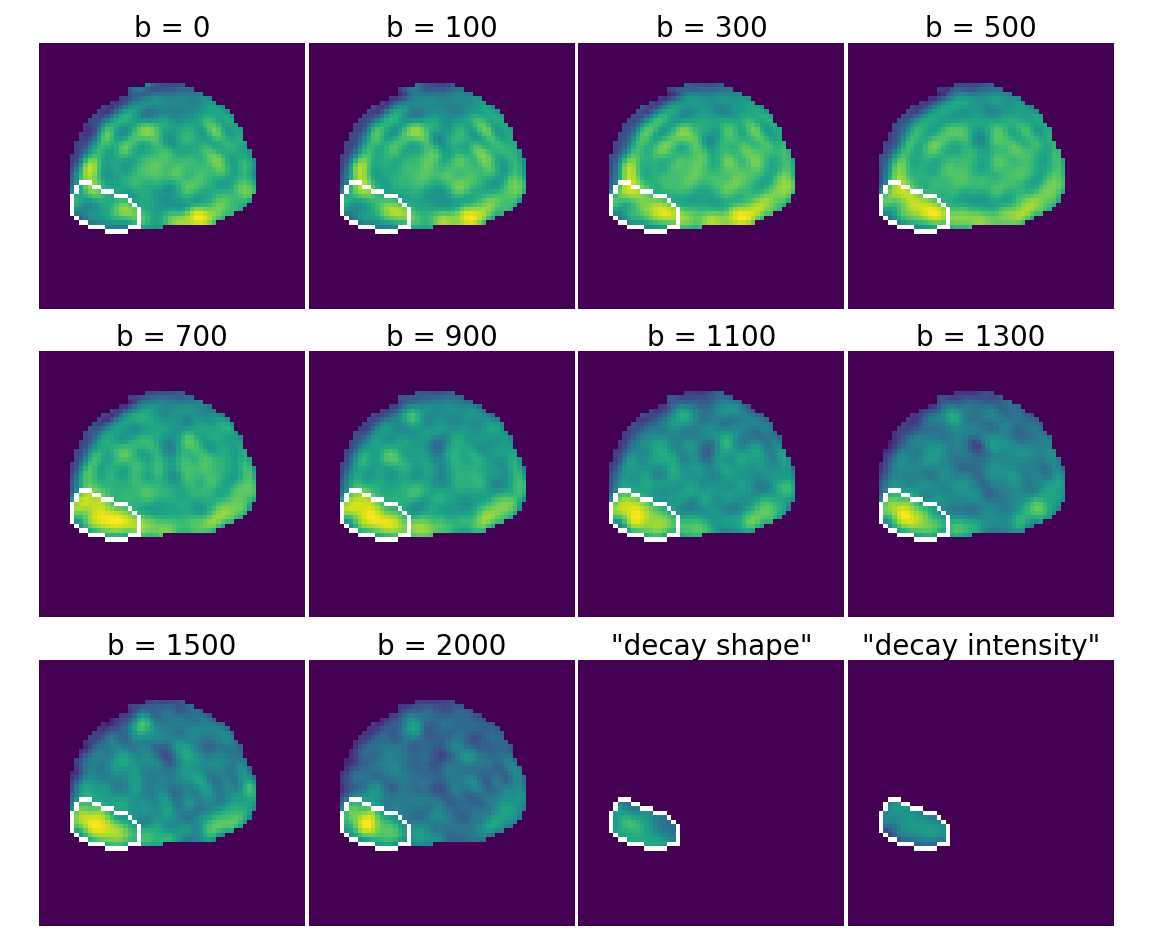
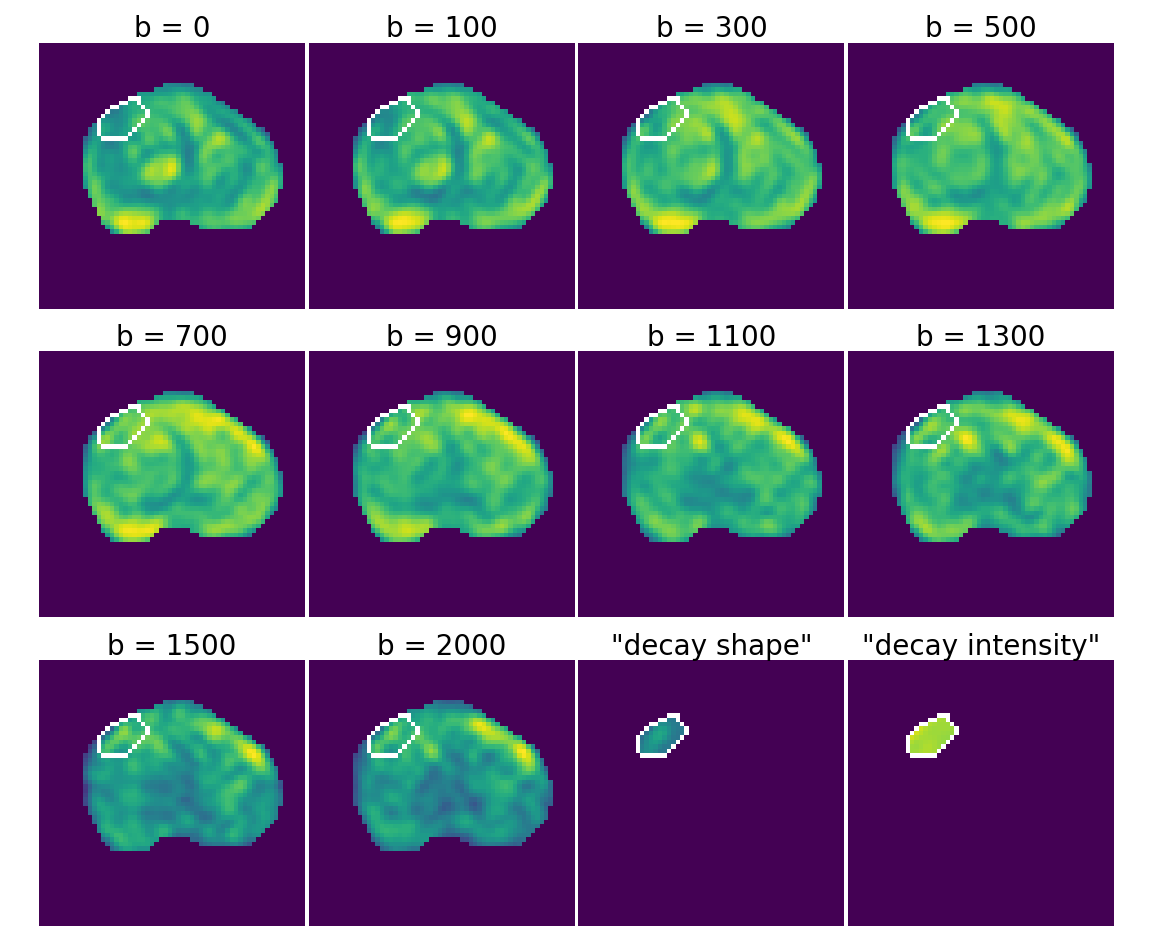
Accordingly, $$$\triangleright \bar{s}$$$ and $$$\triangleright \|s\|$$$ could be roughly interpreted as the instantaneous and overall attenuation respectively as illustrated in Figures 1 and 2. A nonparametric expression, they constitute a higher-order characterization of the underlying water diffusion (in contrast, the Gaussian model is just a first-order approximation). For a given region of interest (ROI) e.g. a lesion, the joint entropy $$$h(\triangleright \bar{s}, \triangleright \|s\|)$$$ is taken as our proposed novel radiomic feature named EDDIE (entropy of divergence of DWI decay curve) which dictates the variability of the associated $$$S$$$. To assess the performance of the proposed approach, we subjected EDDIE to the classification of clinically significant and insignificant (Gleason grade groups 1 vs. >1) PCa. We processed 119 lesions in 78 subjects from a DWI dataset 9 of test-retest prostate MRI scans consisting of DWI acquired using a single-shot SE epi sequence with TR/TE 3141 ms / 51 ms, FOV 250$$$\times$$$250 mm2, acquisition/reconstruction matrix 100$$$\times$$$99 / 224$$$\times$$$224, slice thickness 5 mm, diffusion gradient timing ($$$\Delta$$$) 24.5 ms, diffusion gradient duration ($$$\delta$$$) 12.6 ms, 12 $$$b$$$-values of (number of signal averages) 0 (2), 100 (2), 300 (2), 500 (2), 700 (2), 900 (2), 1100 (2), 1300 (2), 1500 (2), 1700 (3), 1900 (4), 2000 (4) s/mm2.
Result
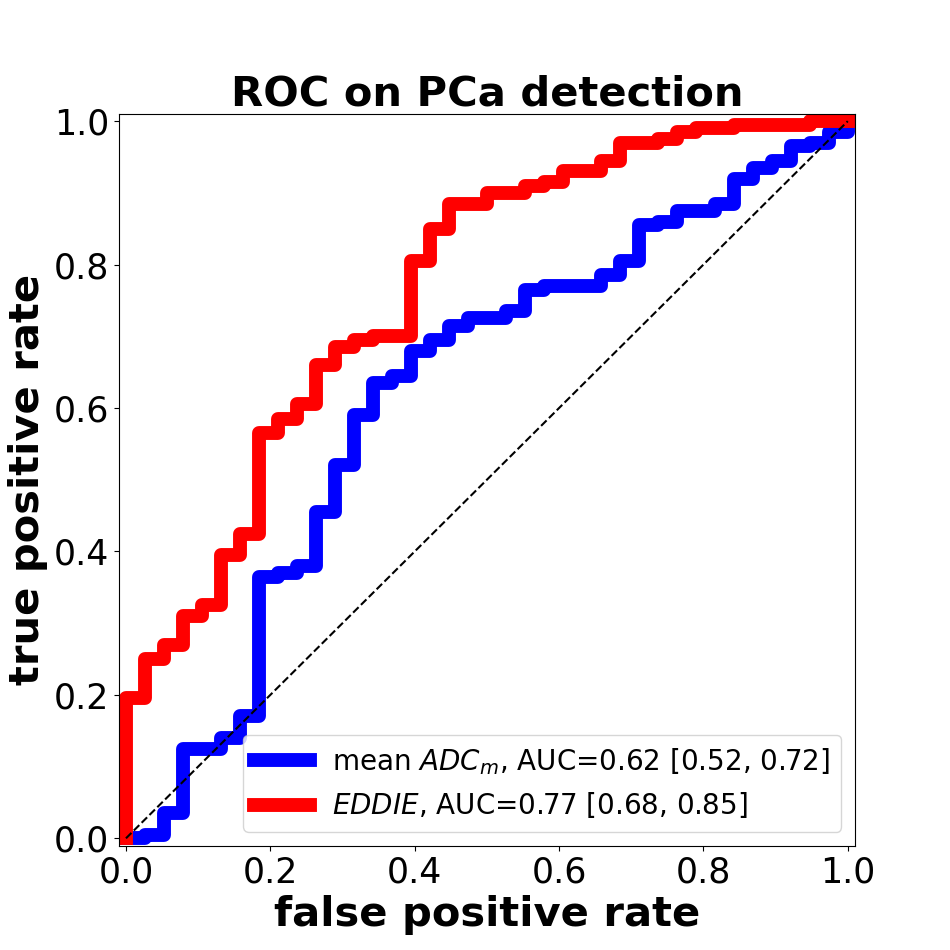
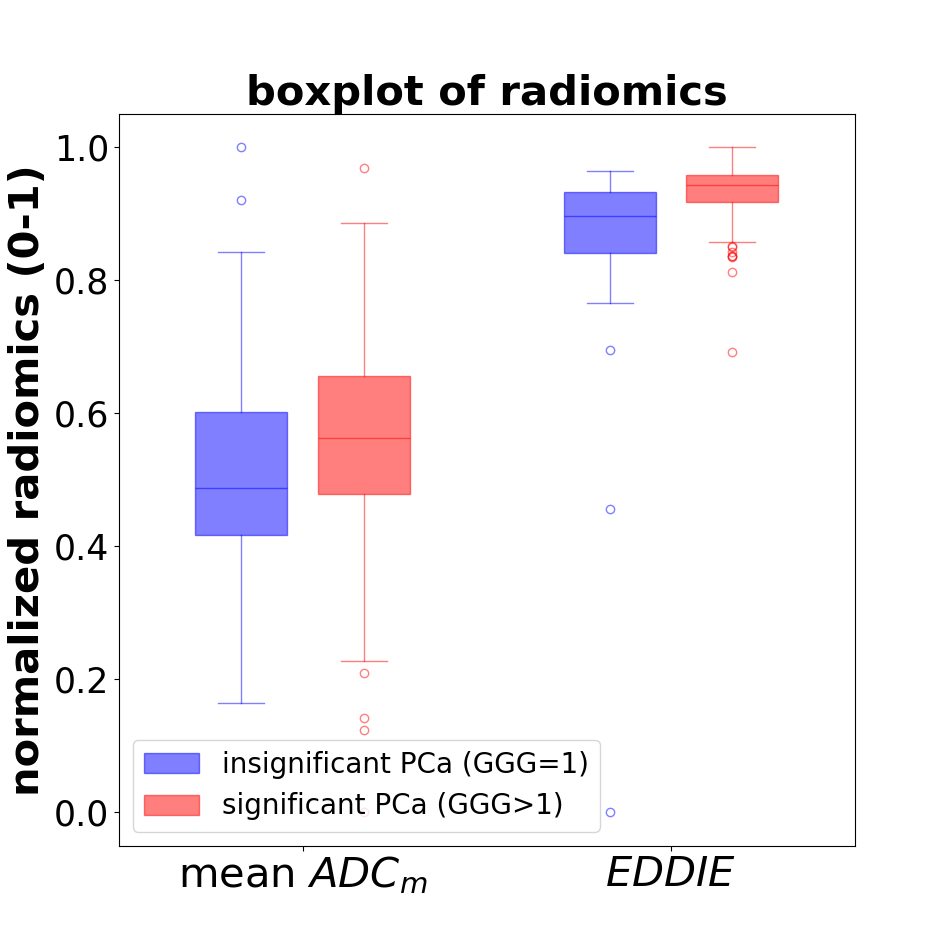
Upon analysing the ROC (receiver operating characteristic) curve as shown in Figure 3, the AUC (area under ROC curve) score of EDDIE was 0.77 with an 95% confidence interval of [0.68, 0.85]) for the classification of significant/insignificant PCa. This marks a +23.4% improvement compared to baseline approach (AUC = 0.62, [0.52, 0.72], with statistically significant difference of 0.009) by taking the mean of the $$$ADC_m$$$ map calculated with $$$b$$$-values up to 500 s/mm2. The intraclass correlation coefficient ICC (3,1) of EDDIE was 0.78, [0.70, 0.84], considered to be of good repeatability 10. Figure 4 shows the boxplots of normalized mean $$$ADC_m$$$ and EDDIE which helps visualizing the latter's improved class separability.Discussion
The potential benefits of the proposed approach are threefold: 1) nonparametric: the DWI modelling is free from any assumptions (exponential, kurtosis, etc.) about the DWI decay and is completely data-based; 2) interpretable: the eKL divergence is a mathematical projection which conveys information about instantaneous and overall attenuation; and 3) complete: EDDIE (a measure of entropy) constitutes a higher-order description of the data spread/variability (in contrast e.g. variance is only statistically meaningful for normal distribution). As a result, the approach may contribute towards more accurate DWI modelling and radiomic feature extraction.Conclusion
The proposed novel radiomics, EDDIE, demonstrated good repeatability and potential for PCa detection. Future studies will employ other organs, and more exhaustive evaluation together with other conventionally used DWI radiomics.Acknowledgements
Harri Merisaari was supported by Academy of Finland (#26080983); Rui Jian Chu was supported by Cancer Society of Finland.
References
1. Siegel R, Naishadham D, Jemal A. Cancer statistics, 2012. CA Cancer J Clin. 2012;62:10–29.
2. Stejskal EO. Use of spin echoes in a pulsed magnetic-field gradient to study restricted diffusion and flow. J Chem Phys. 1965;43:3597–3603.
3. Toivonen J, Merisaari H, Pesola M, et al. Mathematical models for diffusion-weighted imaging of prostate cancer using b values up to 2000 s/mm(2): correlation with Gleason score and repeatability of region of interest analysis. Magn Reson Med. 2015;74(4):1116-1124.
4. Nielsen F. On a Generalization of the Jensen–Shannon Divergence and the Jensen–Shannon Centroid. Entropy. 2020;22(2):221.
5. Banerjee A, Merugu S, Dhillon I, Ghosh J. Clustering with Bregman Divergences. J Mach Learn Res. 2005;6:1705–1749.
6. Jaynes ET. Information theory and statistical mechanics. Phys. Rev. 1957;106:620–630.
7. Leonenko N, Kozachenko L. Sample estimate of the entropy of a random vector. Problemy Peredachi Informatsii. 1987;23:9–16.
8. Chu RJ, Richard N, Chatoux H, Fernandez-Maloigne C, Hardeberg JY. Hyperspectral Texture Metrology Based on Joint Probability of Spectral and Spatial Distribution. IEEE Trans Image Process. 2021;30:4341-4356.
9. Merisaari H, Taimen P, Shiradkar R, et al. Repeatability of radiomics and machine learning for DWI: Short-term repeatability study of 112 patients with prostate cancer. Magn Reson Med. 2020;83(6):2293-2309.
10. Koo TK, Li MY. A Guideline of Selecting and Reporting Intraclass Correlation Coefficients for Reliability Research [published correction appears in J Chiropr Med. 2017 Dec;16(4):346]. J Chiropr Med. 2016;15(2):155-163.
Figures