3492
Impaired glymphatic system function in individuals with Alzheimer's disease demonstrated by DTI-ALPS index1Medical Imaging, Affiliated Hospital and Medical School of Nantong University, Nantong, China, 2Philips Healthcare, Shanghai, China
Synopsis
Keywords: DWI/DTI/DKI, Brain, Glymphatic system
Motivation: Alzheimer's disease (AD) is a progressive neurodegenerative disorder that primarily affects the brain and leads to diffusion impairment.
Goal(s): To evaluate the alterations of glymphatic function in AD and explore its association with cognition and blood biomarkers.
Approach: We investigate the functionality of glymphatic system (GS) in patients with AD using diffusion tensor imaging analysis along with the perivascular space (DTI-ALPS).
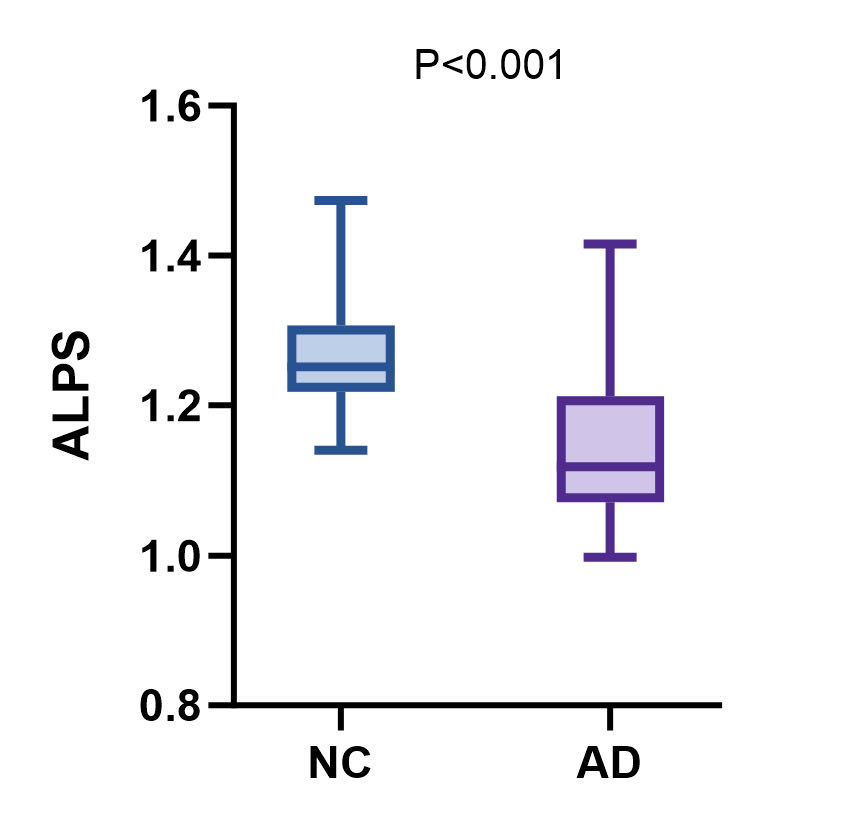
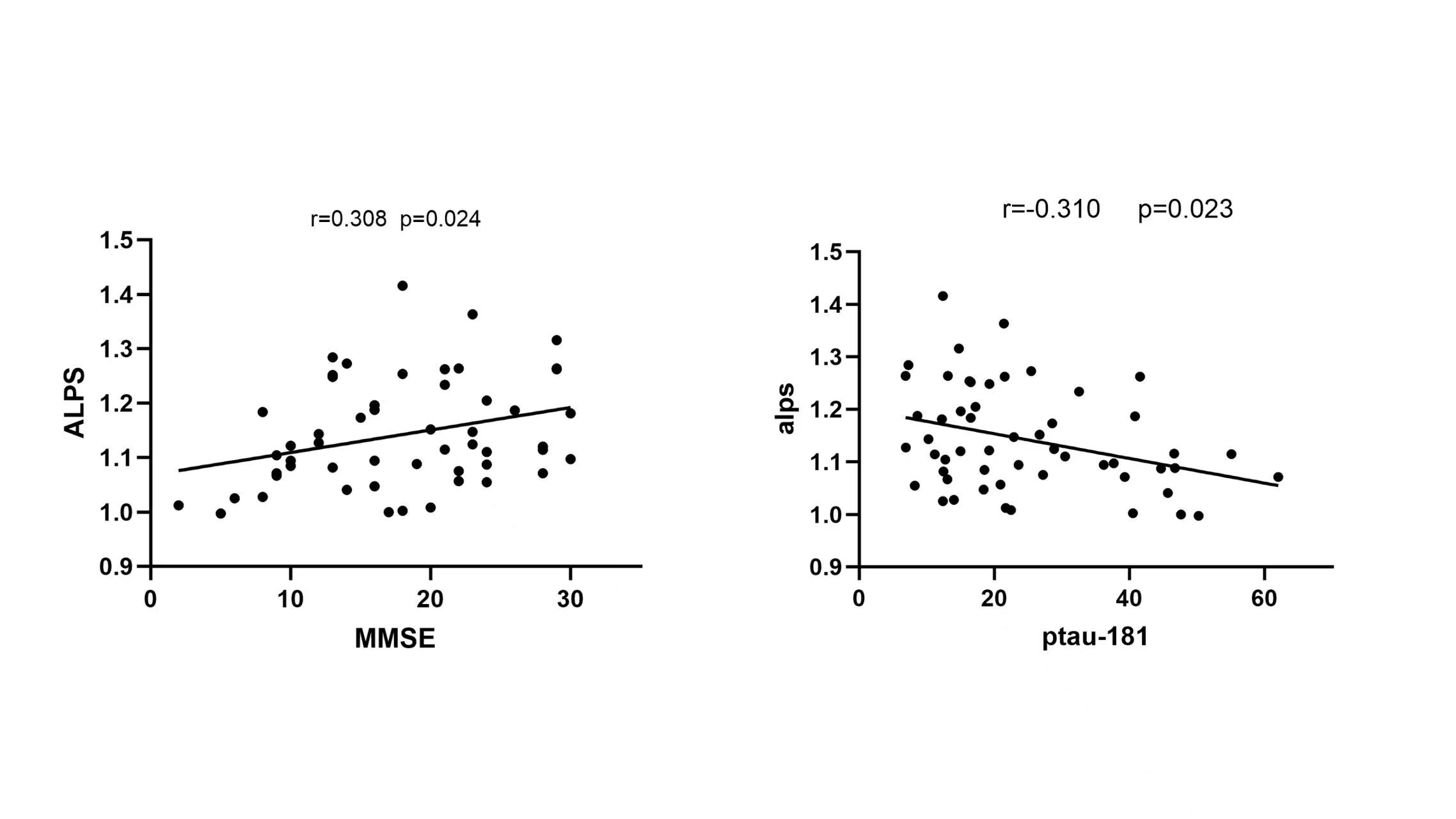
Results: Individuals with AD had a significantly lower ALPS index compared to the healthy controls. Moreover, the decreased ALPS index was associated with impaired cognitive function, as reflected through the Mini-Mental State Examination (MMSE) score and higher blood biomarker ptau-181 levels.
Impact: The results demonstrate that the feasibility of DTI-ALPS, which can be used for research on glymphatic system function in AD patients. ALPS-index is expected to become a promising imaging marker and may provide novel targets for clinical diagnosis of AD.
Introduction
Alzheimer's disease, the most common form of dementia, is characterized by the presence of abnormal protein deposits in the brain. The accumulation of beta-amyloid plaques and neurofibrillary tangles, or in other words, twisted fibers consisting of tau protein disrupts the normal brain cell function, leading to memory loss, cognitive decline, and behavioral changes1,2. Iliff et al. (2012) introduced the concept of the glymphatic system to explore the mechanism of abnormal protein production and clearance. The system enhances the clearance of waste materials by facilitating the exchange of substances between the cerebrospinal fluid and interstitial fluid3. In 2017, Taoka et al. introduced DTI-ALPS, a novel non-invasive method for investigating glymphatic function4. Subsequently, this technique has been applied to various diseases. This study aims to investigate the relationship between glymphatic system function and clinical biomarkers, including cognitive assessment scale and blood protein levels through DTI-ALPS.Methods
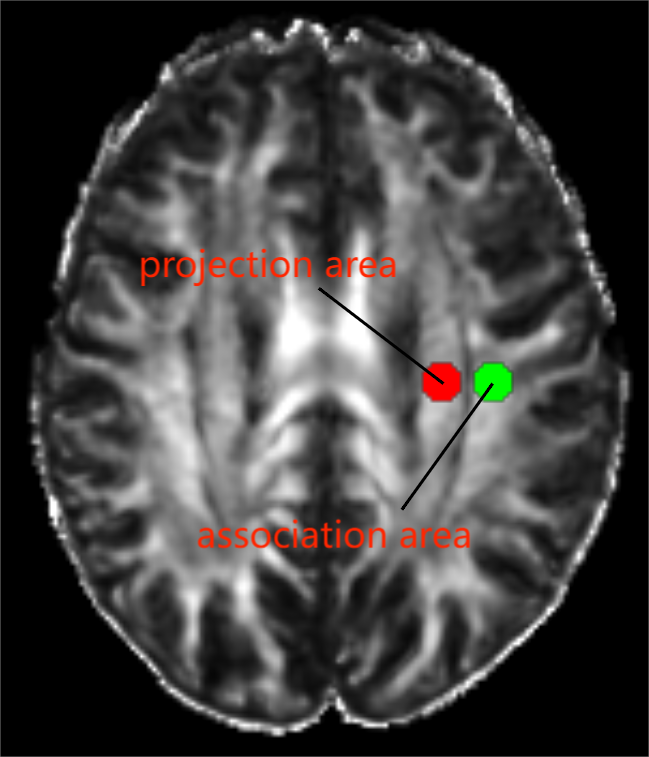
This study enrolled 54 AD patients diagnosed through clinical assessment and 23 age-and-sex-matched healthy controls. All subjects underwent DTI scanning on a 3.0T MRI scanner(DISCOVERY MR750w, GE MEDICAL SYSTEM, USA)with a 24-channel head coil. We processed DTI images using FSL to generate fractional anisotropy (FA) maps and diffusivity maps along the x–, y–, and z–axes, which were registered into the JHU-ICBM-FA-1mm template to automatically identify the ROIs5. Four spherical ROIs were placed in the projection and association fibers (Figure 1). Then, the DTI-ALPS index was calculated using the formula by Taoka et al.(2017). The diffusivities and the clinical characteristics were compared between the two groups by using the two-sample t test and chi-square test. Correlations between DTI-ALPS and MMSE, blood ptau-181, and blood Aβ1-42 were assessed through Pearson or Spearman correlation analyses.Results
There was no significant difference in gender and age among the two groups. Compared to healthy controls, AD patients exhibited lower ALPS index(p<0.001, Figure 2). The DTI-ALPS showed a significant positive correlation with the MMSE score(r=0.308, p=0.024) and was negatively associated with blood ptau-181(r=-0.310.p=0.023, Figure 3). However, no marked difference was observed between the ALPS index and blood Aβ1-42 in AD patients.Discussion
This study employs statistical analysis to investigate the changes of the glymphatic system in AD patients. The lower DTI-ALPS index, significantly correlated with the decreased MMSE score, reflects the dysfunction of glymphatic system in Alzheimer's disease. Furthermore, we found significant negative correlation between blood ptau-181 and the ALPS index in this study. Amyloidβ and tau deposits are the hallmark pathological features of Alzheimer’s disease. The elevation of blood ptau-181, regarded as a cheaper and more easily available tool than CSF and PET biomarkers, can provide high diagnostic accuracy for Alzheimer’s disease, supported by numerous researches6. In conclusion, the DTI-ALPS may have the potential to distinguish and diagnose Alzheimer’s disease based on our findings in the future.Acknowledgements
This work was supported by the Affiliated Hospital and Medical School of Nantong University.References
1. Graff-Radford J, Yong KXX, Apostolova LG, et al. New insights into atypical Alzheimer's disease in the era of biomarkers. Lancet Neurol. 2021;20(3):222-234.
2. Harrison IF, Ismail O, Machhada A, et al. Impaired glymphatic function and clearance of tau in an Alzheimer's disease model. Brain. 2020;143(8):2576-2593.
3. ff JJ, Wang M, Liao Y, et al. A paravascular pathway facilitates CSF flow through the brain parenchyma and the clearance of interstitial solutes, including amyloidβ. Sci Transl Med. 2012;4(147):147ra11.
4. Taoka T, Masutani Y, Kawai H, et al. Evaluation of glymphatic system activity with the diffusion MR technique: diffusion tensor image analysis along the perivascular space (DTI-ALPS) in Alzheimer’s disease cases. Jpn J Radiol. 2017;35:172-8.
5. Liu X, Barisano G, Shao X, et al. Cross-Vendor Test-Retest Validation of Diffusion Tensor Image Analysis along the Perivascular Space (DTI-ALPS) for Evaluating Glymphatic System Function. Aging and disease. 2023.
6. Karikari TK, Pascoal TA, Ashton NJ, et al. Blood Phosphorylated Tau 181 as a Biomarker for Alzheimer’s Disease: A Diagnostic Performance and Prediction Modelling Study Using Data from Four Prospective Cohorts. Lancet Neurol. 2020;19(5): 422-433.
Figures