3490
Memory impairment is associated with glymphatic dysfunction in hemodialysis patients1Hainan General Hospital, Haikou, China, 2MR Research Collaboration, Siemens Healthineers, Guangzhou, China
Synopsis
Keywords: Diffusion Analysis & Visualization, Kidney
Motivation: Glymphatic function assessed by diffusion tensor image analysis along the perivascular space (DTI-ALPS) index might be associated with cognitive function.
Goal(s): To examine the glymphatic function in patients who receive regular hemodialysis and its relationship with clinical indices.
Approach: Partial correlation analysis was applied to assess the relationship between ALPS index and clinical markers with age and sex as covariates.
Results: Left ALPS index is positively correlated with immediate recall scores after adjusting for age and gender.
Impact: Glymphatic function and hemoglobin levels are associated with memory dysfunction in hemodialysis patients, offering a potential way to improve memory function in this population.
Introduction
The concept of the glymphatic system, a comprehensive perivascular network encompassing the entire brain, is responsible for the exchange of cerebrospinal fluid and interstitial fluid, playing a pivotal role in the brain's waste clearance mechanism. Changes to this crucial system could significantly impact its ability to remove waste. Recently, a newly developed technique named diffusion tensor image analysis along the perivascular space (DTI-ALPS) index, has been developed to evaluate the glymphatic system's functionality in a non-invasive manner through the use of diffusion MRI imaging 1. Cognitive impairments are a frequent complication among patients with end-stage renal disease, with reported prevalence rates ranging from 31% to 70% 2. Cognitive impairment incidences may escalate even further in patients undergoing hemodialysis. Yet, exploring how glymphatic function correlates with specific cognitive domains in these patients is lacking. This study aims to examine the glymphatic function in regular hemodialysis patients compared to healthy controls. Besides, the study will explore the associations between glymphatic function and clinical indices.Method
All MRI data were acquired with a 3T MR scanner (TIM Skyra, Siemens Medical Solutions, Erlangen, Germany). Data were obtained from 69 patients and 79 healthy control individuals from the Hainan General Hospital. Every participant underwent diffusion tensor imaging (DTI) scan with single-shot echo-planar imaging using the following settings: slices = 75; slice thickness = 2 mm; repetition time = 11,600 milliseconds; TE = 78 milliseconds; FOV = 224 × 224 mm2; diffusion directions = 64 with b = 1000 s/mm2; 10 volumes with non-diffusion gradients (b = 0); and bandwidth = 1718 Hz/Px. The DTI-ALPS methodology was employed to evaluate the functioning of the glymphatic system in individuals 3. This technique measures diffusivity along the perivascular space (PVS), comparing it with diffusivity along projection and association fibers. These measurements are taken at the level of the lateral ventricle bodies, where the orientation of the PVS is orthogonal to the ventricular walls, predominantly extending in the left-right direction (along the x-axis) on the axial plane. This orientation is also perpendicular to the direction of projection fibers (along the z-axis) and association fibers (along the y-axis).Consequently, diffusivity along the x-axis, when contrasted with that of projection and association fibers, can be indicative of PVS diffusivity. To quantify glymphatic system activity, the ALPS index is calculated. A higher ALPS index is associated with better glymphatic function. California Verbal Learning Test-II (CVLT-II) was employed to measure memory function. CVLT-II contains 5 subscales, including immediate recall (trials1_5), short-delay cued recall (SDCR), short-delay free recall (SDFR), long-delay free recall (LDFR), and long-delay cued recall (LDCR). Partial correlation analysis was applied to assess the relationship between ALPS index and clinical markers with age and sex as covariates.Results
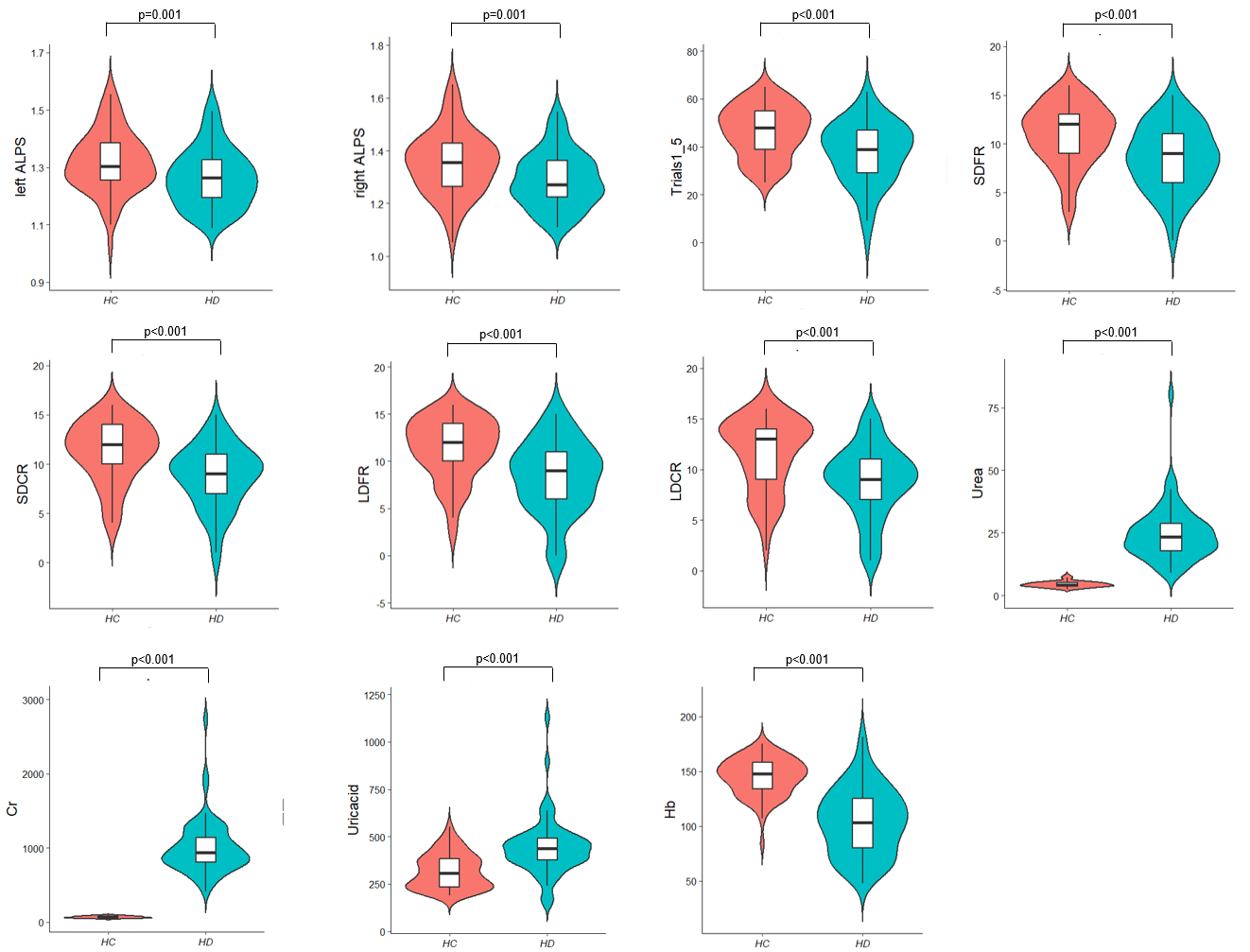
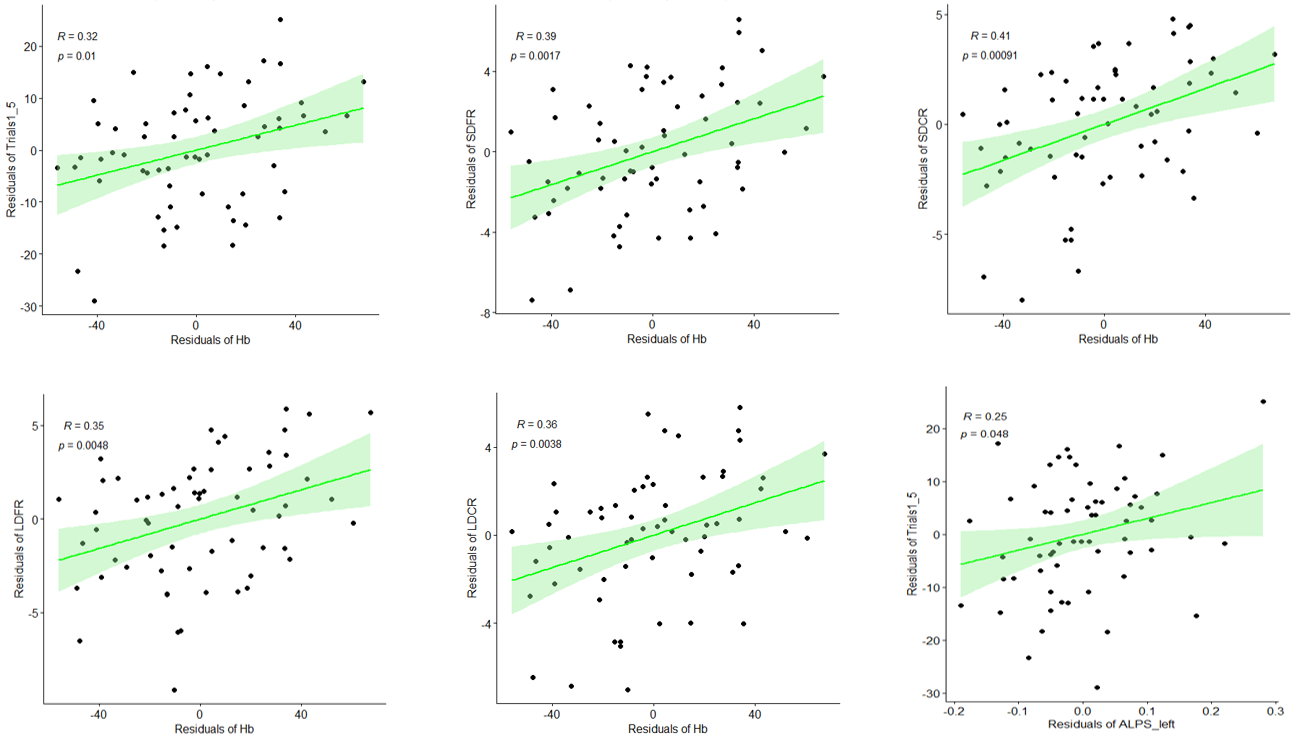
As shown in Figure 1, hemodialysis patients showed significantly lower left and right ALPS-index than healthy controls. The hemodialysis patients had significantly lower scores in tirals1_5, SDFR, SDCR, LDFR, and LDFR than the healthy controls. As shown in Figure 2, trials1_5 was positively associated with the left ALPS index in hemodialysis patients after controls for age and sex. There was no statistically significant association between the ALPS index and other clinical markers. The tirals1_5, SDFR, SDCR, LDFR, and LDFR were positively correlated with hemoglobin levels even after adjusting for age and sex.Conclusion
The present study demonstrated a significantly lower ALPS index in hemodialysis patients, which is associated with memory dysfunction. The dysfunction of the glymphatic system may play an important role in the memory decline in hemodialysis patients.Acknowledgements
This project was supported by the Program of Hainan Association for Science and Technology Plans to Youth R &D Innovation (QCXM201919), National Natural Science Foundation of China (81971602, 82160327, and 82271977), the Key Science and Technology Project of Hainan Province (ZDYF2021SHFZ239), the Hainan Academician Innovation Platform Fund, and the Hainan Province Clinical Medical Center.References
1. Taoka, T. & Naganawa, S. (2020) Glymphatic imaging using MRI, J Magn Reson Imaging, 51, 11-24.
2. Sharma, A., Yabes, J., Al Mawed, S. et al. (2016) Impact of Cognitive Function Change on Mortality in Renal Transplant and End-Stage Renal Disease Patients, Am J Nephrol, 44, 462-472.
3. Taoka, T., Masutani, Y., Kawai, H. et al. (2017) Evaluation of glymphatic system activity with the diffusion MR technique: diffusion tensor image analysis along the perivascular space (DTI-ALPS) in Alzheimer's disease cases, Jpn J Radiol, 35, 172-178.
Figures