3470
Unifying b-tensor encoding with compartmental-exchange: A novel analysis framework applied to double diffusion encoding1Lund University, Lund, Sweden, 2Brigham and Women's Hospital, Boston, MA, United States
Synopsis
Keywords: Diffusion Modeling, Microstructure, water exchange, double diffusion encoding
Motivation: Microstructure imaging with diffusion MRI is substantially improved by going beyond single diffusion encoding, but the methods using such data are divergent. In particular, theories unifying b-tensor encoding and water exchange are lacking.
Goal(s): To develop and validate a theory applicable for detecting microscopic anisotropy and diffusional exchange with encoding strategies going beyond conventional diffusion MRI.
Approach: Theoretical predictions were compared with results from Monte Carlo simulations of diffusion in exchanging Gaussian environments.
Results: Theory and simulations agreed well, except when violating the assumptions of the theory. We show when and why the diffusional kurtosis decrease and when it increases due to exchange.
Impact: We identified a key condition in which exchange leads to increased signal. This condition is similar to that incorporated in neurite exchange models. Our work thus offers new experimental designs of relevance for microstructure imaging of gray matter.
Introduction
Non-conventional encoding expands the capabilities of diffusion MRI. For example, q-space trajectory imaging (QTI) allows estimation of microscopic anisotropy1,2 and double diffusion encoding (DDE) with parallel gradients and variable mixing times allow for estimation of exchange.3 However, the two approaches have no straightforward unification. This has caused contradictory results, for example, concerning orthogonal DDE with variable mixing times.4 This work introduces a theory for free waveform encoding of exchange in multi-Gaussian systems, extending QTI, and validates it through Monte Carlo simulations and a DDE protocol.Theory
We expand the framework of Ning et al5 to include diffusion tensors rather than scalar diffusivities, which yields the following expression for the directionally averaged signal in a system of multiple environments in local exchange,$$\ln~S/S_0~=~-b_{ij}\cdot{\langle{d_{ij}}\rangle}+\tfrac{1}{2}\langle{b_{ijkl}^2(k)\cdot{c_{ijkl}'}}\rangle+\tfrac{1}{2}{b_{ij}}{b_{kl}}\cdot{c_{ijkl}}$$
where $$$b^2_{ijkl}(k)$$$ is the exchange-sensitized “square” of the b-tensor, defined according to
$$b_{ijkl}^2(k)=\int\int{q_{ij}^2(t_1)q_{kl}^2(t_2)}\exp(-k|t_1-t_2|)dt_1dt_2$$
Here, $$$b_{ij}$$$ is the b-tensor, $$$\langle{d_{ij}}\rangle$$$ is the average diffusion tensor, $$$c_{ijkl}'$$$ is the diffusion tensor covariance of a local system in exchange, $$$\langle\cdot\rangle$$$ averages across local systems, and $$$c_{ijkl}$$$ is the tensor covariance across local average diffusion tensors.1 Note that the covariance terms split into these two terms when there is a difference across local systems in exchange.
Importantly, the “squared b-tensor” becomes more anisotropic with increasing exchange. For example, in DDE with negligible exchange during the gradient pulses, we get
$$b_{ijkl}^2(k)=b_{ij}^{(1)}b_{kl}^{(1)}+b_{ij}^{(2)}b_{kl}^{(2)}+\left(b_{ij}^{(1)}b_{kl}^{(2)}+b_{ij}^{(2)}b_{kl}^{(1)}\right)\exp(-k\cdot{t_m})$$
where $$$b_{ij}^{(n)}$$$ is the b-tensor from the n:th (1st or 2nd) encoding block. The sum of last two tensor terms (that is weighted with the exponential exchange factor) is more isotropic than the sum of the first two tensor terms. Thus, the “squared b-tensor” becomes more anisotopic with exchange. This has important consequences, as we will see in the simulations.
Methods
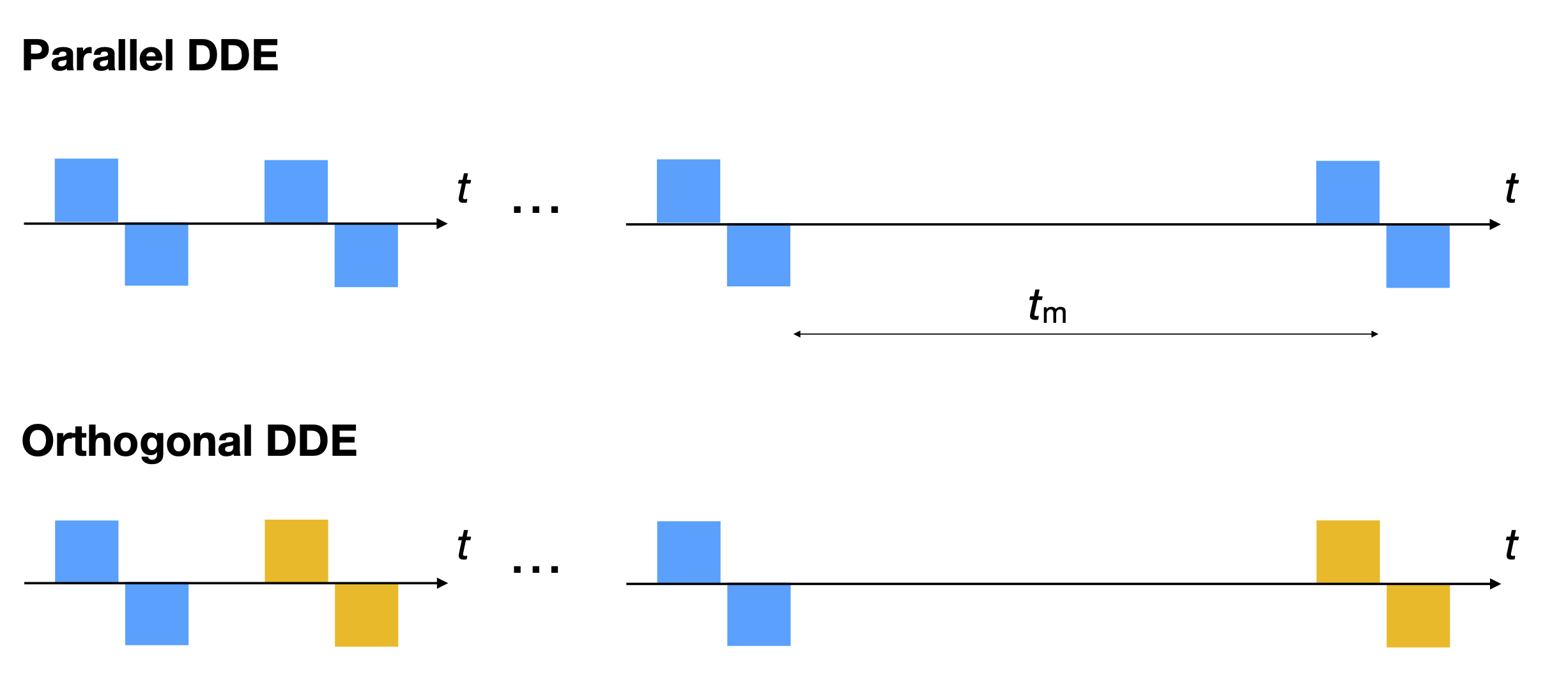
Monte Carlo simulations with 50k particles were performed, in systems comprised of multiple environments with Gaussian diffusion in exchange.5 Different scenarios were investigated, featuring dispersion in isotropic diffusivities, anisotropy with orientation dispersion, and exchange, in various combinations. Each simulation featured two types of diffusion tensors, each with 50% of the particles. The diffusion encoding protocol comprised a comprehensive double diffusion encoding sequence with settings defined in Fig. 1. For each mixing time, the diffusional variance (kurtosis) was estimated by fitting a third-order polynomial to the logarithm of the signal (to reduce bias from higher-order terms), which was then compared with the one predicted by the theory.Results
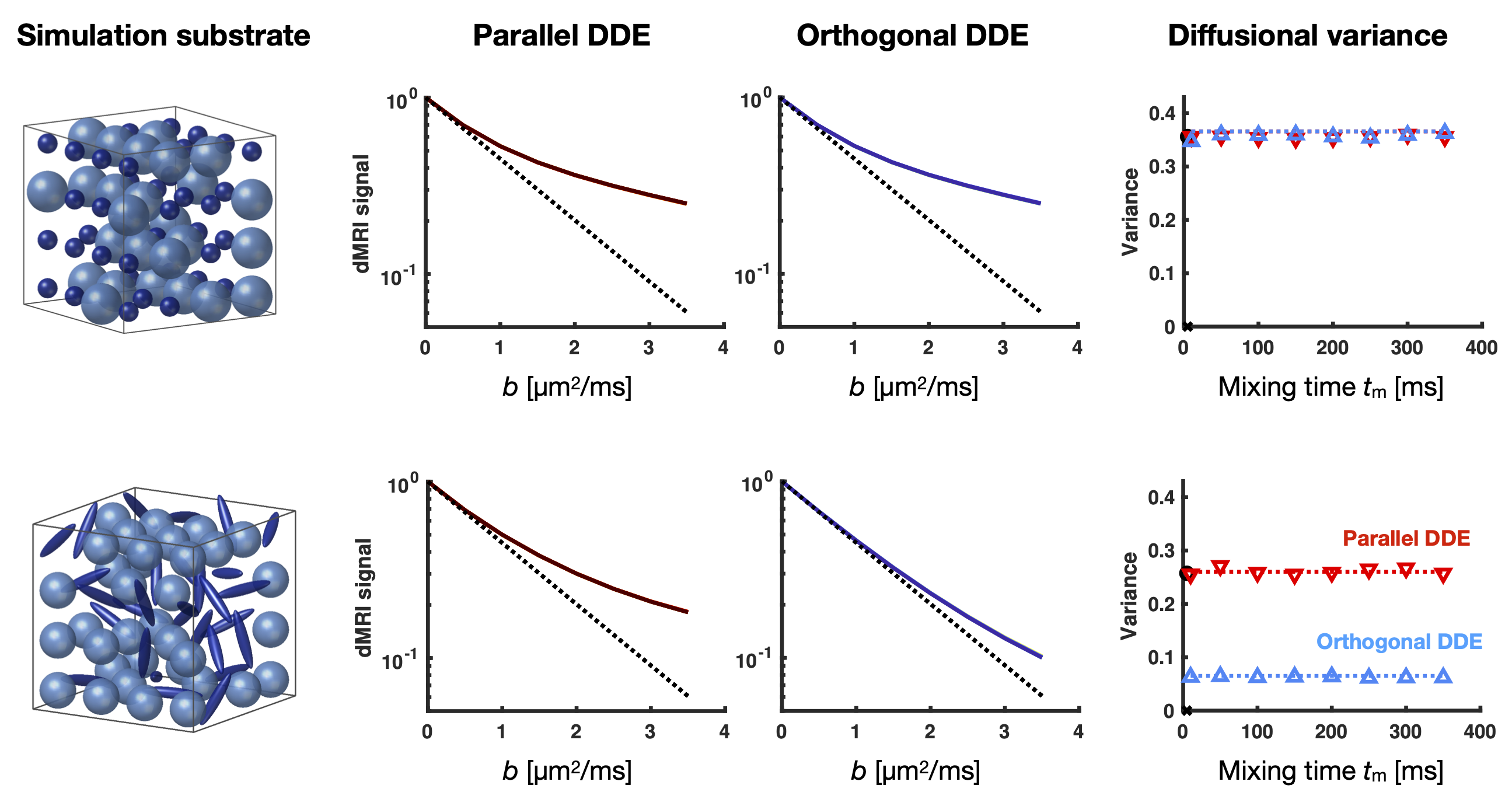
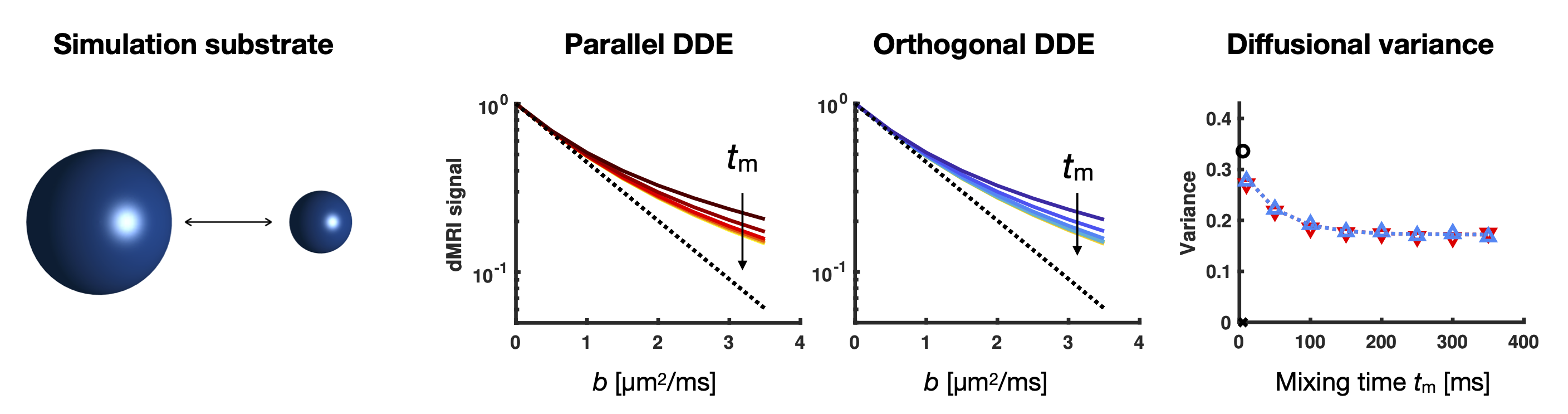
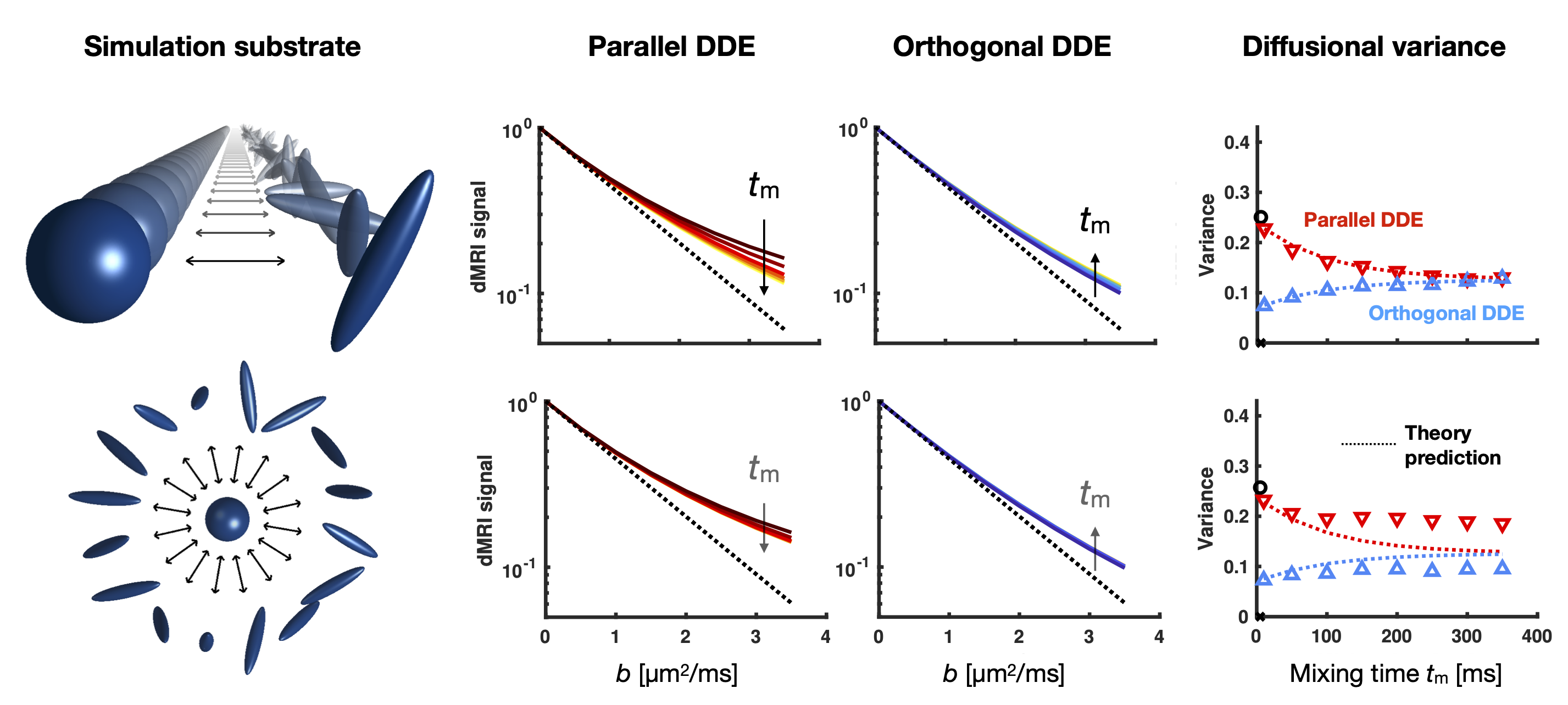
In systems without exchange, the signal-versus-b curves and the estimated diffusional variance (i.e. unnormalized kurtosis) do not depend on the mixing time (Fig 2). Lower diffusional variance was found with orthogonal DDE the anisotropic system only. In a system with exchange between two isotropic environments, there was a clear reduction in signal and diffusional variance with increasing mixing times (Fig. 3), as predicted by Eq. 1. In systems with anisotropic diffusion, reduced diffusional variance was observed for parallel DDE, while the opposite pattern was observed for orthogonal DDE (Fig. 4) – in alignment with the theory (Eq. 2). When exchange was allowed between anisotropic domains, via an isotropic domain, this effect remained, but with reduced magnitude.Discussion
In systems without exchange, the diffusional variance from both parallel and orthogonal DDE were independent of the mixing time, as expected. With exchange, an exponential decline in both variances were found for all cases, except for the case with anisotropic environments and orthogonal DDE gradients. This corroborates previous findings for orthogonal DDE in simulations on a cubic grid.4 Furthermore, these results illustrate that orthogonal DDE with variable mixing time produces an increasing anisotropic variance only in systems comprised of anisotropic domains in exchange. As such, it could be used to verify the accuracy of models such as the “neurite exchange imaging”,6 which assumes that neurites manifest as anisotropic domains in exchange. Therefore, the results here are of immediate use for current work exploring modelling of gray matter microstructure. The theory also complements the correlation tensor imaging approach,7 which is defined for a pair of mixing times only, and thus cannot be applied to a protocol with variable mixing times. A limitation of the current work is that restricted diffusion is not considered, although it is straight forward to expand on previous work that have considered this in the scalar case.8Acknowledgements
This research was funded by: VR (Swedish Research Council) (grant numbers 2016–03443, 2020–04549 and 2021–04844), eSSENCE (grant number 6:4), Cancerfonden (The Swedish Cancer Society) (grant numbers 2019/474 and 22 0592 JIA) and NIH (National Institutes of Health) (grant numbers R01NS125781, R01MH074794 and P41EB015902).References
1. Westin, Carl-Fredrik, et al. "Q-space trajectory imaging for multidimensional diffusion MRI of the human brain." Neuroimage 135 (2016): 345-362.
2. Szczepankiewicz, Filip, Carl-Fredrik Westin, and Markus Nilsson. "Gradient waveform design for tensor-valued encoding in diffusion MRI." Journal of Neuroscience Methods 348 (2021): 109007.
3. Lasič, Samo, et al. "Apparent exchange rate mapping with diffusion MRI." Magnetic resonance in medicine 66.2 (2011): 356-365.
4. Khateri, Mohammad, et al. "What does FEXI measure?." NMR in Biomedicine 35.12 (2022): e4804.
5. Ning, Lipeng, et al. "Cumulant expansions for measuring water exchange using diffusion MRI." The Journal of chemical physics 148.7 (2018).
6. Jelescu, Ileana O., et al. "Neurite Exchange Imaging (NEXI): A minimal model of diffusion in gray matter with inter-compartment water exchange." NeuroImage 256 (2022): 119277.
7. Henriques, Rafael Neto, Sune Nørhøj Jespersen, and Noam Shemesh. "Correlation tensor magnetic resonance imaging." Neuroimage 211 (2020): 116605.
8. Chakwizira, Arthur, et al. "Diffusion MRI with pulsed and free gradient waveforms: effects of restricted diffusion and exchange." NMR in Biomedicine 36.1 (2023): e4827.
Figures