3461
Time-dependent diffusion in one-dimensional disordered media decorated by permeable membranes1Department of Mathematics, Linköping University, Linköping, Sweden, 2Spin Nord AB, Linköping, Sweden, 3Department of Biomedical Engineering, Linköping University, Linköping, Sweden, 4Section on Quantitative Imaging and Tissue Sciences, NICHD, National Institutes of Health, Bethesda, MD, United States
Synopsis
Keywords: Diffusion Modeling, Modelling, disorder, time-dependent diffusion
Motivation: Characterizing water diffusion in its long-time regime is relevant to most medical applications of diffusion MRI. However, this process is challenging to model even for a one-dimensional structure with semipermeable membranes.
Goal(s): Developing methods that predict the asymptotic instantaneous diffusivity from the bulk diffusivity and the membranes’ locations and permeabilities.
Approach: We studied the problem theoretically and expressed the instantaneous diffusivity as an infinite sum. An independent numerical scheme is developed. Several types of disorder in the membranes’ positions were considered.
Results: Our findings show excellent agreement with simulations. Our methods provide an alternative means for studying time-dependent diffusion.
Impact: This report provides an improved understanding of how tissue organization and disorder may affect water diffusivity, thus making it relevant to diffusion MR studies characterizing tissue microstructure. We also provide methods for readily estimating the instantaneous diffusivity.
Introduction
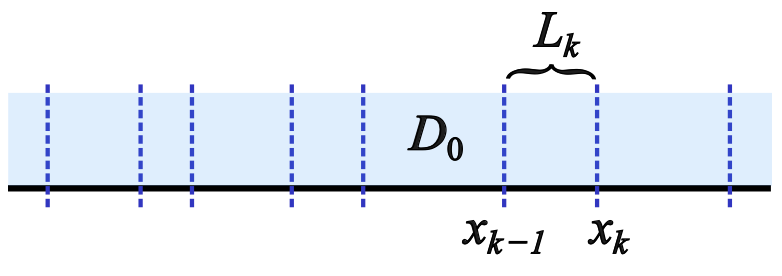
The water diffusion coefficient is an MR-measurable quantity whose value and time-dependence are influenced by the surrounding medium. Earlier studies in the porous media literature [1,2] have shown that the short-time evolution of the diffusion coefficient is sensitive to the surface-to-volume ratio, while its long-time behavior is determined by the tortuosity and size of the structures. In studies aiming to characterize the microstructure of tissues, the permeability of the membranes is accounted for [3]. Considering the size of the cells, bulk diffusivity of water, and the timescales afforded by conventional MR measurements, the long-time asymptote of the diffusion coefficient as well as how such long-time behavior is approached are critical [1,4]. The latter could indicate the type of disorder present [5].Here, we visit the simplistic one-dimensional model of permeable membranes with random spacings as illustrated in Figure 1.
Methods
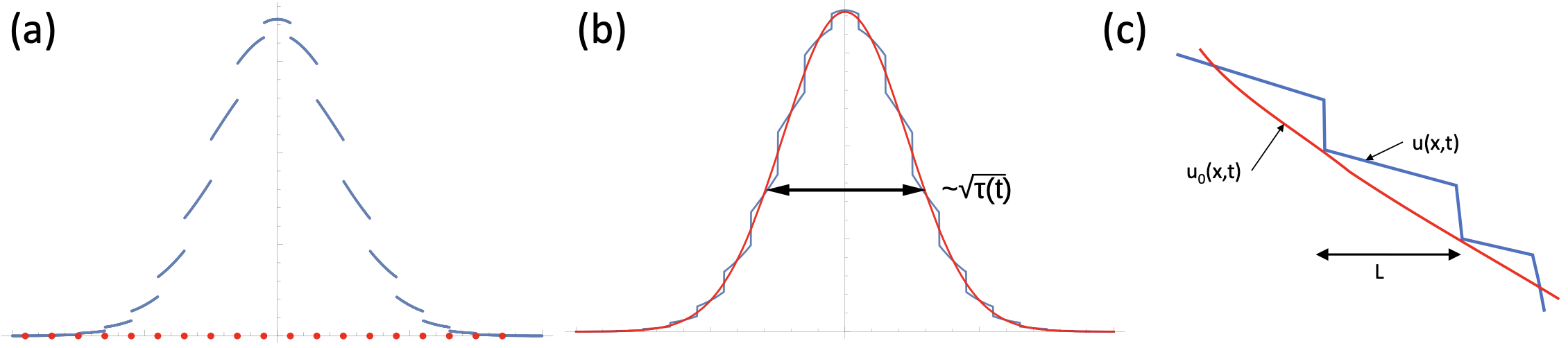
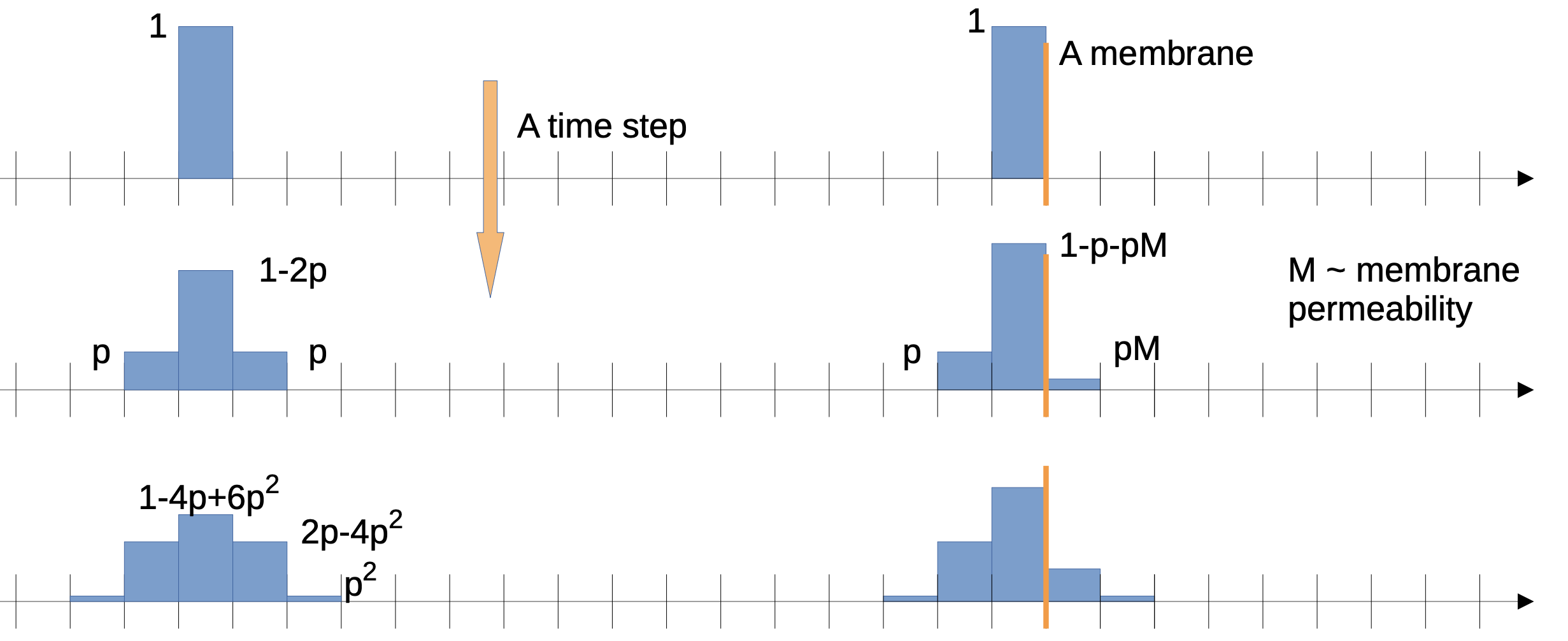
We studied the long-time dynamics of the quantity $$$u(x,t)$$$, which is the probability that a particle initially at the origin traverses to position $$$x$$$ over a time interval $$$t$$$ (see Figure 2). This quantity is well-represented by a Gaussian at long times [6]. One-half of the time-dependent variance of this Gaussian is denoted by $$$\tau(t)$$$, which is determined by requiring that the (time- and position-dependent) slope of the Gaussian is adapted to the time evolution of $$$u(x,t)$$$ by a fitting based on the diffusivity, membrane positions, and the membrane permeabilities. The time derivative of $$$\tau(t)$$$ yields the instantaneous diffusivity $$$D_\mathrm{inst}(t)$$$.We also devised an independent numerical simulation framework, which is summarized in Figure 3. The domain is divided into equal-sized bins, and the particle concentration profile, which is initially confined to one such bin, is expressed as a vector. The time evolution for a small time-interval is expressed as a matrix product taking into consideration the possible exchange through the membrane with permeability $$$M$$$. Repeated multiplication by this matrix allows for estimation of the particle distribution at any time.
Results and Discussion
After lengthy derivations, we found that the convergence of the instantaneous diffusivity to its eventual value $$$D_\infty$$$ [7] is governed by$$\frac{D_\mathrm{inst}(t)-D_\infty}{D_\infty}=\frac{D_0}{ML}\left(1-\sum_k\frac{x_k^2 L}{4\sqrt{\pi}\,\tau^{3/2}(t)}\mathrm{e}^{-\frac{x_k^2}{4\tau(t)}} \right)\;,$$
where $$$D_0$$$ is the bulk diffusivity and $$$L$$$ is the mean separation between adjacent membranes. For disordered media, the positions $$$x_k$$$ become stochastic variables.
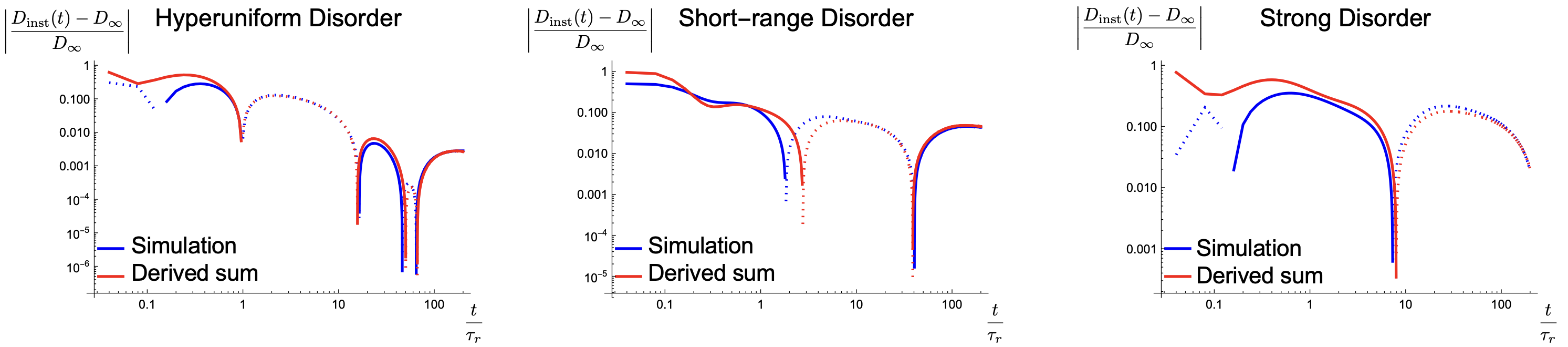
To assess whether our analytical derivation and computational framework provide consistent results at long diffusion times, we considered realizations of system configurations exhibiting hyperuniform disorder, short-range disorder, and strong disorder [5]. Figure 4 illustrates the result for a particular realization of each of these disorders. As expected, the two methods provide indistinguishable results at long times.
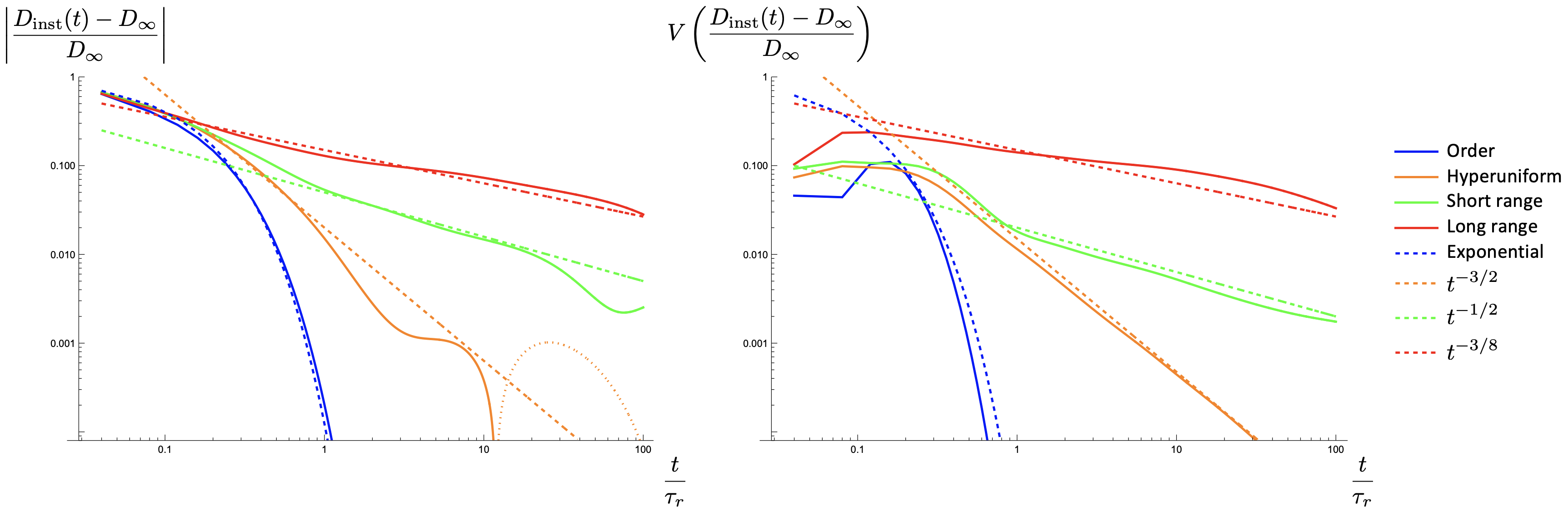
We also considered scenarios involving 200 different membrane realizations for each of the disorder classes. These simulations are compared with the asymptotic formulas derived, and also with our analytical results. We find excellent agreement between our model and our simulations; the latter results are shown in Figure 5. The approach of $$$D_\mathrm{inst}$$$ to $$$D_\infty$$$ appears to deviate somewhat from the power-law relations in the long-time regime suggested in the recent literature [5], most notably in the case of hyperuniform disorder. We also studied the variance of the quantity $$$(D_\mathrm{inst}-D_\infty)/D_\infty$$$, which seems to exhibit the same power-law. These findings are obtained by simulations of all disorder classes, and also the numerical evaluation of the sum above for the case of hyperuniform disorder.
Conclusion
With our approach, we present an easy-to-understand model which predicts the asymptotic instantaneous diffusivity for a one-dimensional structure with membranes located according to various statistical models. We expect our methods to facilitate the study of mechanisms that influence the time-dependence of the diffusion process, which ultimately determines the MR signal obtained via different diffusion encoding gradient waveforms.Acknowledgements
The authors acknowledge support from the Center for Neuroscience and Regenerative Medicine (CNRM) under the auspices of the Henry M. Jackson Foundation (HJF). PJB was supported by the Intramural Research Program (IRP) of the Eunice Kennedy Shriver National Institute of Child Health and Human Development (NICHD). MH and EÖ were supported by the Swedish Research Council (Dnr 2022-04715).References
1. de Swiet TM, Sen PN. Time dependent diffusion coefficient in disordered medium. J Chem Phys. 1996;104:206-209.
2. Latour LL, Mitra PP, Kleinberg RL, et al. Time-dependent diffusion coefficient of fluids in porous-media as a probe of surface-to-volume ratio. J Magn Reson A. 1993;101:342-346.
3. Latour LL, Svoboda K, Mitra PP, et al. Time-dependent diffusion of water in a biological model system. Proc Natl Acad Sci USA. 1994;91:1229-1233.
4. Sen PN. Time-dependent diffusion coefficient as a probe of the permeability of the pore-wall. J Chem Phys. 2003;119:9871-9876.5.
5. Novikov DS, Jensen JH, Helpern JA, et al. Revealing mesoscopic structural universality with diffusion. Proc Natl Acad Sci USA. 2014;111(14):5088-5093.
6. Powles JG, Mallett MJD, Rickayzen G, et al. Exact analytic solutions for diffusion impeded by an infinite array of partially permeable barriers. Proc R Soc Lond A. 1992;436:391-403.
7. Crick F. Diffusion in embryogenesis. Nature. 1970;225:420-422.
Figures