3435
Static and dynamic functional connectivity of the amygdala and serotoninergic activity following bright light in subthreshold depression1The First Affiliated Hospital of Jinan University, Guangzhou, China, 2MR Research,GE Healthcare, Beijing, China
Synopsis
Keywords: Functional Connectivity, fMRI (resting state), Bright light therapy, amygdala, subthreshold depression, serotoninergic system
Motivation: The presence of subthreshold depression significantly increases the likelihood of developing major depressive disorder and is linked to a higher burden of illness and suicide risk.
Goal(s): The objective of this clinical trial was to evaluate the relationship between BLT and the functional connectivity (FC) alterations of the amygdala, as well as the serotoninergic distribution in subthreshold depression.
Approach: Subthreshold depression subjects were randomly divided into two groups: the BLT group and the placebo group.
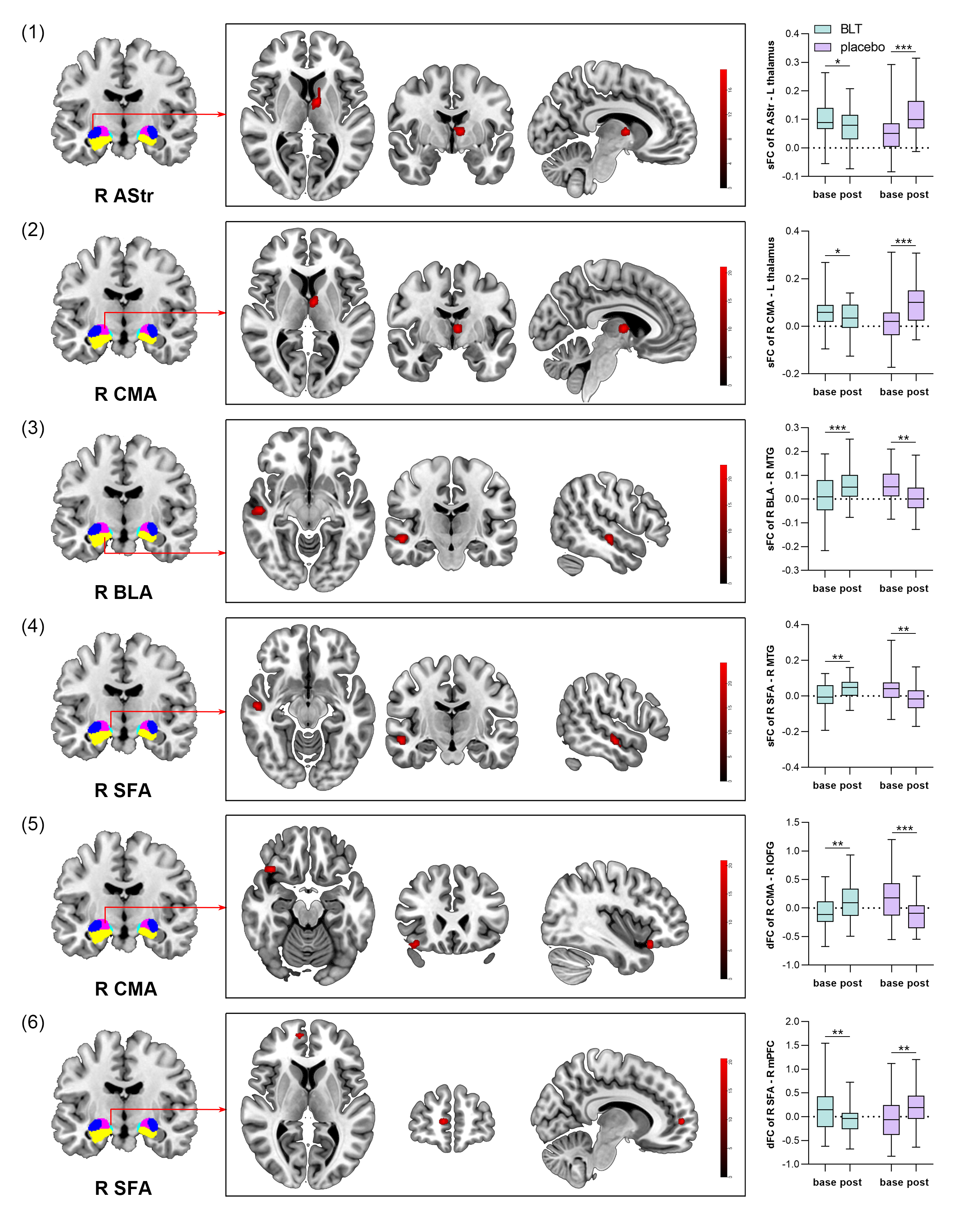
Results: BLT group showed increased sFC of right basolateral amygdala (BLA)/superficial amygdala (SFA)-right middle temporal gyrus and dFC of right centralmedial amygdala and right inferior orbital frontal gyrus.
Impact: These findings indicated that BLT could relieve depressive symptoms and alter FC of the amygdala in subthreshold depression (StD). Combining baseline sFC and dFC of the amygdala may have the potential to assess the effectiveness of BLT in treating StD.
Abstract
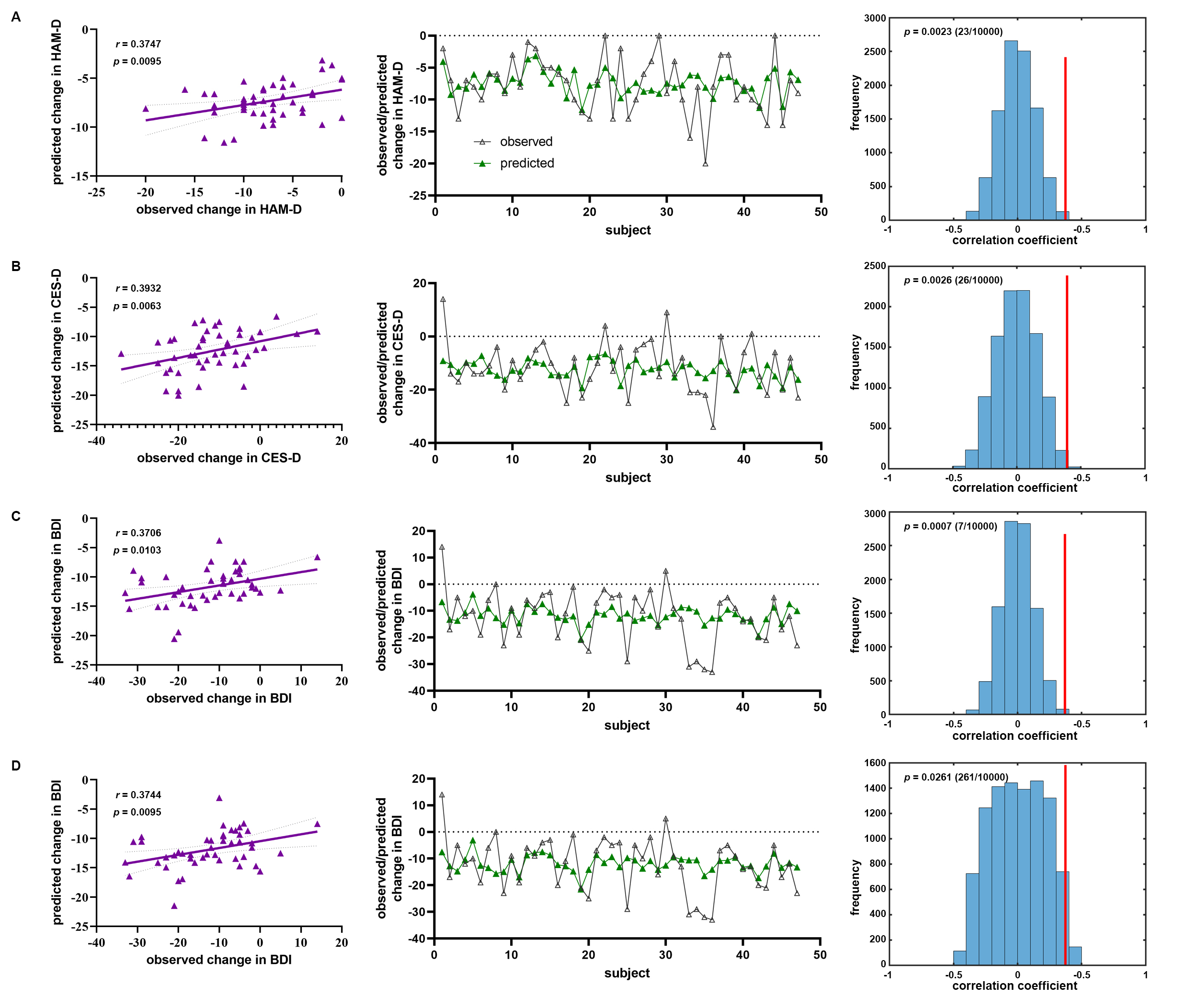
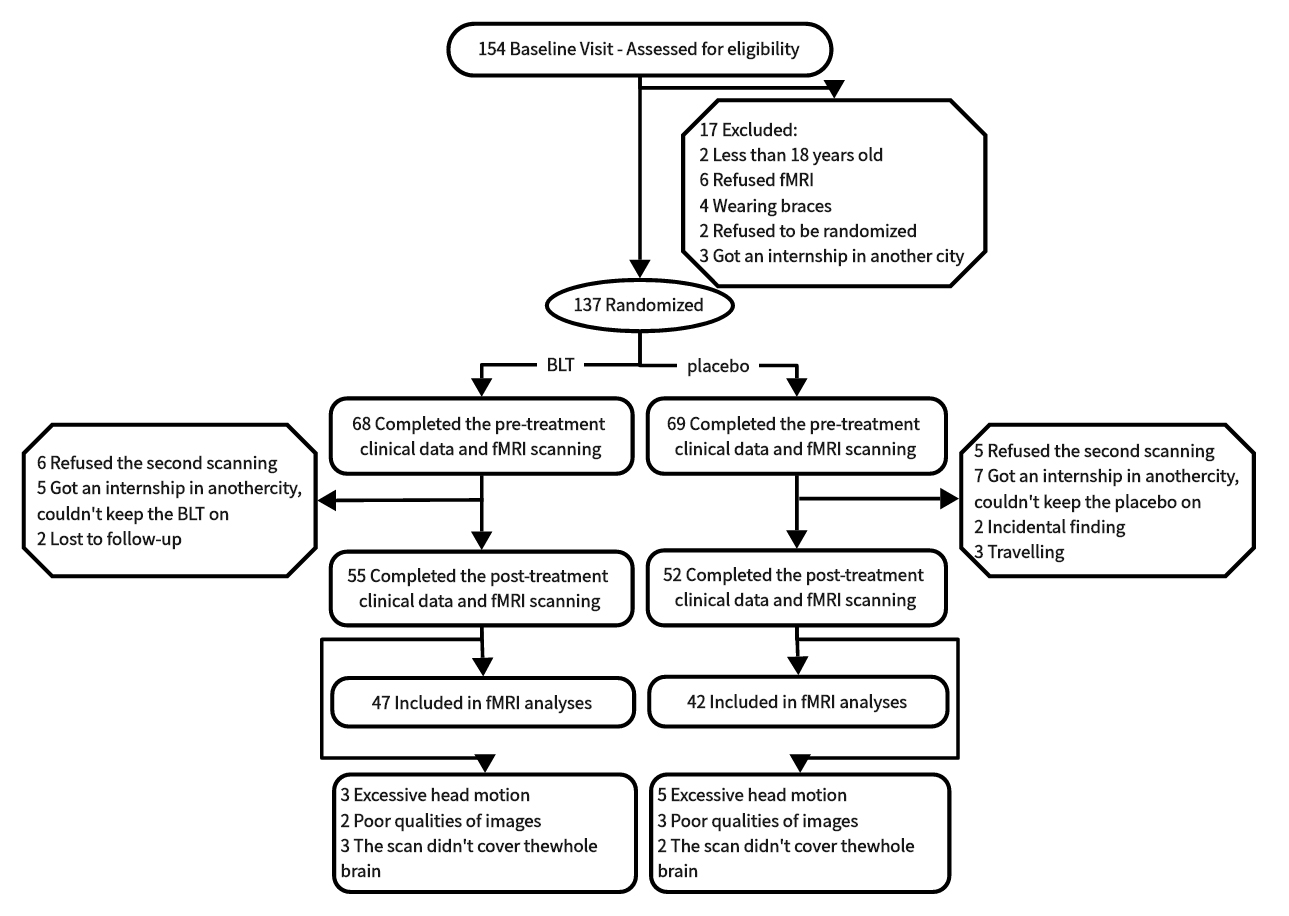
Background: The presence of subthreshold depression significantly increases the likelihood of developing major depressive disorder and is linked to a higher burden of illness and suicide risk. Although the neural mechanism of bright light therapy (BLT) remains unclear, it is considered as an effective intervention for subthreshold depression. The amygdala has been shown to play a critical role in depression. And light has been associated with the serotoninergic system. The objective of this clinical trial was to evaluate the relationship between BLT and the functional connectivity (FC) alterations of the amygdala, as well as the serotoninergic distribution in subthreshold depression. Methods: Subthreshold depression subjects were randomly divided into two groups: the BLT group (N = 47) and the placebo group (N = 42). The Hamilton Depression Rating Scale (HDRS) was the main measure of outcome, while the Centre for Epidemiologic Studies Depression Scale (CESD) and Beck Depression Inventory (BDI) served as secondary measures, which were evaluated before and after 8 weeks. The participants also underwent resting-state functional magnetic resonance imaging before and after 8 weeks. Seed-based whole-brain static FC (sFC) and dynamic FC (dFC) analyses of the bilateral amygdala and their subfields were conducted. Besides, a multivariate regression model was utilized to predict HDRS, CESD and BDI scores alterations after BLT. In addition, the JuSpace toolbox was employed to compute the correlations between sFC/dFC of the amygdala subfields and the serotoninergic system activity both in the BLT and the placebo group. Results: BLT group showed decreased CESD score and HDRS score from pre-treatment to post-treatment compared to the placebo group. Also, compared to baseline, BLT group showed increased sFC of right basolateral amygdala (BLA)/superficial amygdala (SFA)-right middle temporal gyrus (MTG) and dFC of right centralmedial amygdala (CMA) and right inferior orbital frontal gyrus, and decreased sFC of right amygdalostriatal transition (AStr)/CMA- left thalamus and dFC of right SFA- right medial prefrontal cortex after intervention. Changes in sFC of the right BLA-right MTG showed positive correlation with changes in BDI score before and after BLT. Moreover, combining the baseline sFC and dFC of the amygdala could predict HDRS, CESD and BDI changes after BLT intervention. Additionally, compared to baseline, sFC of the right BLA alterations after BLT were significantly associated with spatial distribution of 5HT1a and 5-HT2a receptors, while dFC of the right CMA alterations after BLT were significantly associated with spatial distribution of 5HT1a receptor. Conclusions: These findings indicated that BLT could relieve depressive symptoms and alter FC of the amygdala in subthreshold depression. Combining baseline sFC and dFC of the amygdala may have the potential to assess the effectiveness of BLT in treating subthreshold depression. Moreover, FC changes of the amygdala with the serotoninergic system after BLT may underline the antidepressant mechanisms of BLT.Acknowledgements
The study was supported by grants from the National Natural Science Foundation of China (81671670, 81971597, and 82172530); National Key Research and Development Project (2020YFC2005700); Key-Area Research and Development Program of Guangdong Province (2020B1111100001). The funding organizations play no further role in study design, data collection, analysis and interpretation and paper writing.References
Allen, E. A., Damaraju, E., Plis, S. M., Erhardt, E. B., Eichele, T., & Calhoun, V. D. (2014). Tracking whole-brain connectivity dynamics in the resting state. Cereb Cortex, 24, 663-676. Amunts, K., Kedo, O., Kindler, M., Pieperhoff, P., Mohlberg, H., Shah, N. J., . . . Zilles, K. (2005). Cytoarchitectonic mapping of the human amygdala, hippocampal region and entorhinal cortex: intersubject variability and probability maps. Anat Embryol (Berl), 210, 343-352. Baumeister, H. (2012). Inappropriate prescriptions of antidepressant drugs in patients with subthreshold to mild depression: time for the evidence to become practice. J Affect Disord, 139, 240-243. Buntrock, C., Ebert, D. D., Lehr, D., Smit, F., Riper, H., Berking, M., & Cuijpers, P. (2016). Effect of a Web-Based Guided Self-help Intervention for Prevention of Major Depression in Adults With Subthreshold Depression: A Randomized Clinical Trial. Jama, 315, 1854-1863. Bzdok, D., Laird, A. R., Zilles, K., Fox, P. T., & Eickhoff, S. B. (2013). An investigation of the structural, connectional, and functional subspecialization in the human amygdala. Hum Brain Mapp, 34, 3247-3266. Calhoun, V. D., Miller, R., Pearlson, G., & Adali, T. (2014). The chronnectome: time-varying connectivity networks as the next frontier in fMRI data discovery. Neuron, 84, 262-274. Chen, G., Chen, P., Gong, J., Jia, Y., Zhong, S., Chen, F., . . . Wang, Y. (2022). Shared and specific patterns of dynamic functional connectivity variability of striato-cortical circuitry in unmedicated bipolar and major depressive disorders. Psychol Med, 52, 747-756. Chen, P., Chen, G., Zhong, S., Chen, F., Ye, T., Gong, J., . . . Wang, Y. (2022). Thyroid hormones disturbances, cognitive deficits and abnormal dynamic functional connectivity variability of the amygdala in unmedicated bipolar disorder. J Psychiatr Res, 150, 282-291. Cuijpers, P., Pineda, B. S., Ng, M. Y., Weisz, J. R., Muñoz, R. F., Gentili, C., . . . Karyotaki, E. (2021). A Meta-analytic Review: Psychological Treatment of Subthreshold Depression in Children and Adolescents. J Am Acad Child Adolesc Psychiatry, 60, 1072-1084. Cuijpers, P., & Smit, F. (2004). Subthreshold depression as a risk indicator for major depressive disorder: a systematic review of prospective studies. Acta Psychiatr Scand, 109, 325-331. Cuijpers, P., Smit, F., Oostenbrink, J., de Graaf, R., Ten Have, M., & Beekman, A. (2007). Economic costs of minor depression: a population-based study. Acta Psychiatr Scand, 115, 229-236. Cuijpers, P., Vogelzangs, N., Twisk, J., Kleiboer, A., Li, J., & Penninx, B. W. (2013). Differential mortality rates in major and subthreshold depression: meta-analysis of studies that measured both. Br J Psychiatry, 202, 22-27. Davey, C. G., & McGorry, P. D. (2019). Early intervention for depression in young people: a blind spot in mental health care. Lancet Psychiatry, 6, 267-272. Demyttenaere, K., & De Fruyt, J. (2003). Getting what you ask for: on the selectivity of depression rating scales. Psychother Psychosom, 72, 61-70. Drevets, W. C. (2003). Neuroimaging abnormalities in the amygdala in mood disorders. Ann N Y Acad Sci, 985, 420-444. Dukart, J., Holiga, S., Rullmann, M., Lanzenberger, R., Hawkins, P. C. T., Mehta, M. A., . . . Eickhoff, S. B. (2021). JuSpace: A tool for spatial correlation analyses of magnetic resonance imaging data with nuclear imaging derived neurotransmitter maps. Hum Brain Mapp, 42, 555-566.Figures