3374
The Staging of Lower Limb Venous Thrombosis using DANTE-MP2RAGE Sequence: A Comparative Analysis1Radiologist, The First Pepole's Hospital of Qinzhou, Qinzhou, China, 2Radiologist, The first People's hospital of Qinzhou, Qinzhou, China, 3Radiologist, Guangdong Provincial People's Hospital, Guangzhou, China, 4MR Research Collaboration, Beijing, China, 5MR Research Collaboration, Siemens Healthineers, Beijing, China
Synopsis
Keywords: Blood Vessels, Vessels, MP2RAGE;Venous thrombosis;T1 mapping;Dante
Motivation: The aim of this work was to investigate fast T1-mapping for the characterization of deep vein thrombosis
(DVT).
Goal(s): Discuss the research value of Dante-MP2RAGE technology in venous thrombosis of the lower extremities
Approach: Select 15 patients with venous thrombosis in the lower extremities and analyze the correlation between the T1 value formed by Dante-MP2RAGE and the stage of venous thrombosis in the lower extremities.
Results: DANTE-MP2RAGE is related to venous thrombosis in the lower extremities and provides an accurate T1 value。
Impact: Without injecting contrast agents, it provides an effective quantitative indicator for the staging of venous thrombosis in the lower extremities.
Introduction
The formation of Deep Venous Thrombosis (DVT) is a prevalent clinical condition, often resulting in long-term complications such as lower limb pain and swelling, which significantly impair the quality of life for affected individuals[1]. The objective of this study is to investigate the potential research value of MP2RAGE technology in the detection of lower limb venous thrombosis and to analyze the relationship between the T1 value of MP2RAGE formation and the staging of lower limb venous thrombosis.Methods
To reduce the effect of blood flow on thrombosis, the delayed alternating nutation adjustment excitation (DANTE) [2] is employed in the MP2RAGE sequence as a blood flow inhibition module. The T1 values obtained using both DANTE-MP2RAGE and MP2RAGE sequences, as well as the lumen signal, are compared to evaluate the efficacy of blood flow inhibition. For this study, 15 patients diagnosed or suspected of having lower extremity venous thrombosis through ultrasound were included for magnetic resonance imaging(MRI) examination using a 3T MR scanner (Skyra, Siemens Healthcare, Erlangen, Germany). The BTI sequence was applied to locate the thrombus[3]. The middle section of the thrombus was scanned using both the DANTE-MP2RAGE and MP2RAGE sequences. Subsequently, a T1 map was automatically generated in-line. The two attending physicians delineated the area of interest on the T1 map according to the shape of the thrombosis, and multiple measurements of the T1 value were taken to derive an average value. The patients with lower limb deep vein thrombosis were classified into three groups based on the duration of clinical symptoms and the diagnosis results of BTI images: acute DVT patients (≤14 days), subacute DVT patients (15-30 days), and chronic DVT patients (> 30 days)[4]. The distribution range of T1 values in each stage was analyzed. The signal-to-noise ratio of thrombus (SNR thrombus) and normal blood (SNR normal blood) were calculated, along with the contrast noise ratio of the thrombus (CNR thrombus-to-blood). Furthermore, the image quality and the T1 values obtained from the DANTE-MP2RAGE and MP2RAGE sequences were compared.Results
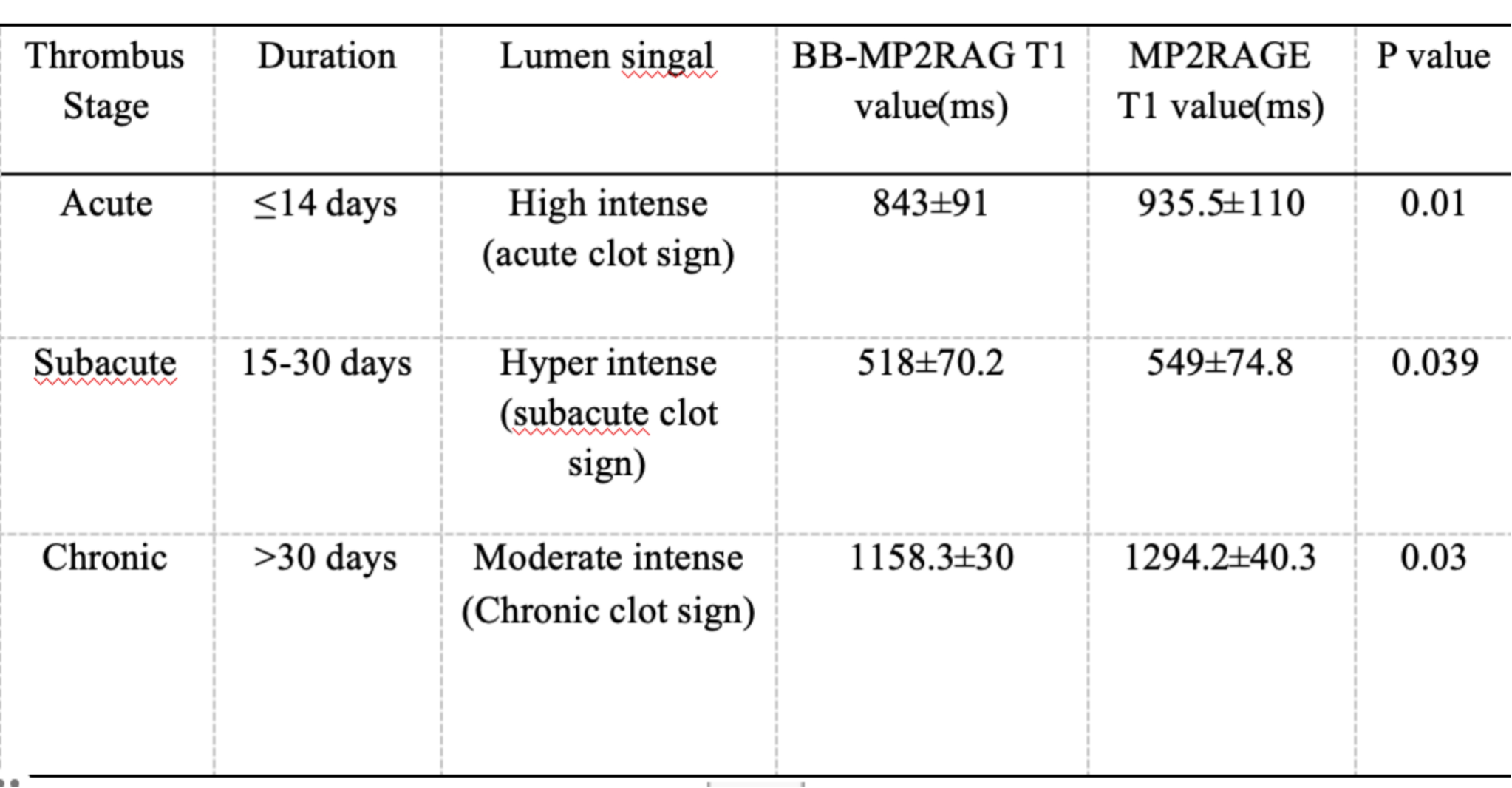
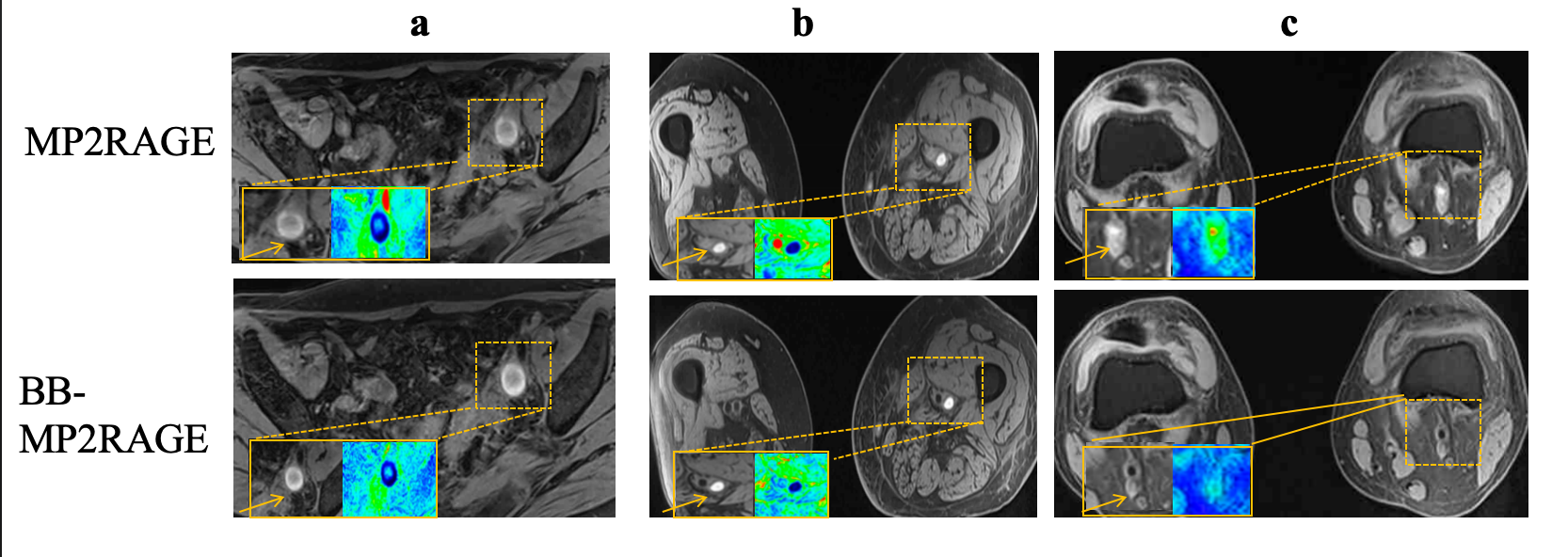
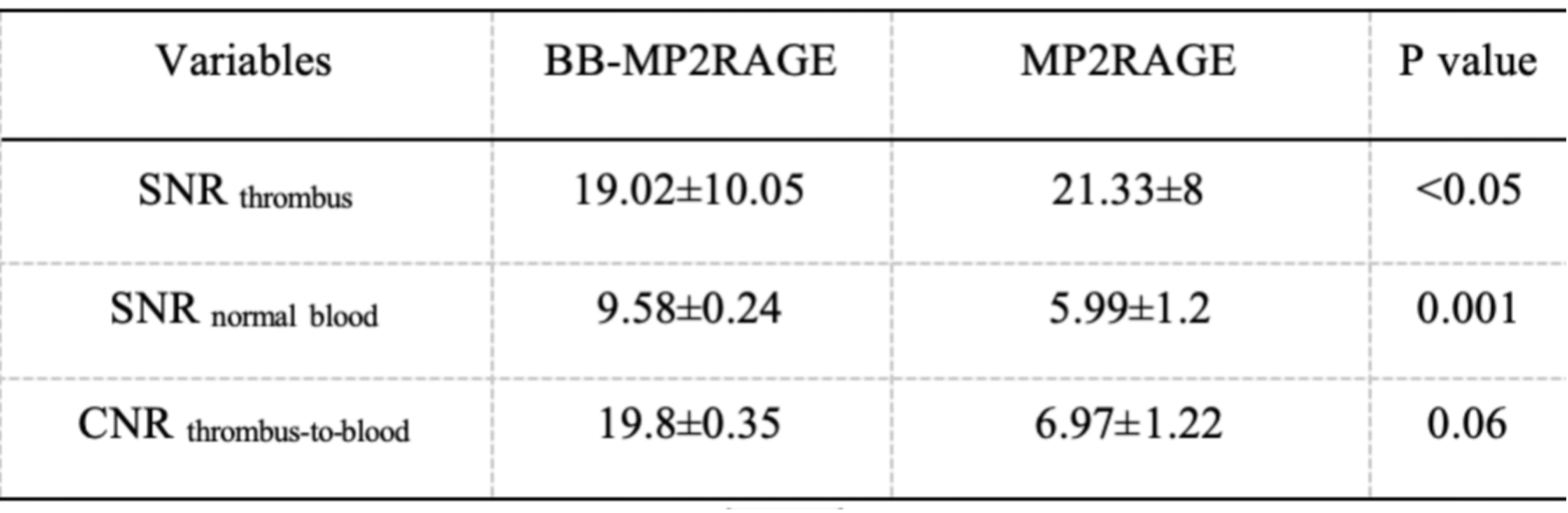
The results showed that methemoglobin concentration in venous thrombus varied at different stages of thrombus formation, resulting in different T1 values as measured by MP2RAGE. There was a linear relationship between methemoglobin concentration and the corresponding T1 shortening, with lower levels of methemoglobin in the acute stage and higher levels in the subacute stage. Moreover, in chronic stage, the thrombus was replaced by tissue with a lower methemoglobin content[5], resulting in decreased T1 values. The accuracy of T1 values obtained from both the DANTE-MP2RAGE and conventional MP2RAGE sequences, as determined through data collection, was found to be significantly different (P<0.05). Specifically, in cases of acute thrombus, the T1 values were843±91ms and 935.5±110ms, respectively; for subacute thrombus, the values were 518±70.2ms and 549±74.8ms; and for chronic thrombus, the values were 1158.3±30ms and 1294.2±40.3ms;.(Table1). Additionally, it was observed that DANTE-MP2RAGE effectively suppressed arterial and venous blood signals, resulting in an improved static tissue-blood noise ratio (Table 2,3)[6].Conclusions
DANTE-MP2RAGE technology enables the identification of different components within lower limb venous thrombosis, offering accurate T1 values. This finding suggests that DANTE-MP2RAGE has the potential to serve as an effective quantitative tool for the staging of lower limb venous thrombosis, eliminating the need for injecting contrast agents.Acknowledgements
We thank all the participants and the Scientific Cooperation Department of Siemens Healthiness for their support.References
[1] Fowkes, FJ, Price, JF, Fowkes, FG. Incidence of diagnosed deep vein thrombosis in the general population: systematic review. EUR J VASC ENDOVASC. 2003; 25 (1): 1-5.
[2] Ishida, S, Kimura, H, Takei, N, et al. Separating spin compartments in arterial spin labeling using delays alternating with nutation for tailored excitation (DANTE) pulse: A validation study using T2 -relaxometry and application to arterial cerebral blood volume imaging. MAGNET RESON MED. 2021; 87 (3): 1329-1345.
[3] Yang, X, Wu, F, Liu, Y, et al. Diagnostic performance of MR black-blood thrombus imaging for cerebral venous thrombosis in real-world clinical practice. EUR RADIOL. 2021; 32 (3): 2041-2049.
[4] Xie, G, Chen, H, He, X, et al. Black-blood thrombus imaging (BTI): a contrast-free cardiovascular magnetic resonance approach for the diagnosis of non-acute deep vein thrombosis. J CARDIOVASC MAGN R. 2017; 19 (1): 4
[5] Saha, P, Andia, ME, Modarai, B, et al. Magnetic resonance T1 relaxation time of venous thrombus is determined by iron processing and predicts susceptibility to lysis. CIRCULATION. 2013; 128 (7): 729-736.
[6]Li, L, Miller, KL, Jezzard, P. DANTE-prepared pulse trains: a novel approach to motion-sensitized and motion-suppressed quantitative magnetic resonance imaging. MAGNET RESON MED. 2012; 68 (5): 1423-38.
Figures