3298
An fMRI-based investigation for financial decision-making from Neurofinance perspective1Department of NMR, All India Institute of Medical Sciences, New Delhi, India, 2Department of Neurology, All India Institute of Medical Sciences, New Delhi, India, 3University School of Management Studies, Guru Gobind Singh Indraprastha University, New Delhi, India
Synopsis
Keywords: Task/Intervention Based fMRI, fMRI (task based), IGT, Neurofinance
Motivation: Neurofinance has shown great opportunity for researchers in the field of finance to understand the financial decision-making process at the neurological level.
Goal(s): To investigate the decision-making process through fMRI technique using IOWA Gambling task to understand the significance of education (financial management education in this study) for acquiring financial literacy skills for better financial decision making.
Approach: fMRI technique is used to identify the brain activation patterns for acquisition of financial literacy skills and further exploring the role of training on learning, memory.
Results: We identified areas with association of memory and learning during financial decision-making via IGT task.
Impact: Neuroscience provides the foundation for comprehending affective influences on financial decisions. In recent years, neurological, behavioural and cognitive approaches have given economics and finance an impetus and has led to the emergence of the disciplines in Neurofinance and Neuroeconomics.
Background
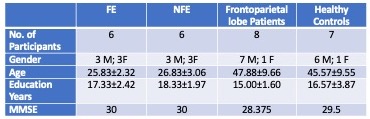
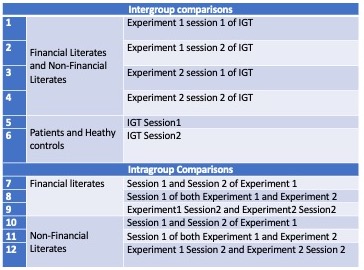
Neurofinance aims to understand investor behavior and financial decision-making processes, particularly in global investments. Financial literacy is crucial for informed decisions about borrowing, investing, and saving. This study aims to determine if formal financial management education is necessary for individuals with neurofinance perspectives. Inter-group and Intra-group analysis is performed to check for training, learning, or memory effects for Financial Literates (FL), who have a finance and accounting background and have studied financial management and financial markets as subjects (at least once in their lifetime) and Non-financial Literates (NFL) who do not have a finance and accounting background and have never studied financial management and financial markets as subjects. Additionally, subjects with Fronto-parietal lesion patients are selected because these are ‘experiments of nature’1 and fronto-parietal network subserves the cognitive function and working memory2,3. So, it is imperative to understand the financial behaviour when the function for this network is masked and the role of fronto-parietal region in financial decision-making.Methods
A baseline effect (to knock off the card effect) after 50 trials and in beginning of experiment. Modified Iowa gambling task, with a baseline presented for 28 seconds (14 seconds for display of cards (any of the four card locations randomly) and 14 seconds for fixation (+) sign), followed by random cards with gain/loss for 100s. Each trial event is separated by six seconds for stimulus representation, motor response, planning and execution of the decision.Data acquisitionScans are carried out using a 32 channel head coil in a 3T MR scanner (Ingenia 3T, M/s Philips Medical Systems). The response of the joystick coupled to Lumina Controller (Cedrus 3G, USA) were recorded. Whole brain 3D T1W1 using TFE sequence is used for overlaying BOLD activation. The data is processed using SPM (Statistical Parametric Mapping, version SPM12) using standard pipeline4.Results and discussion
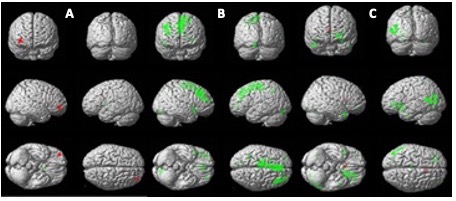
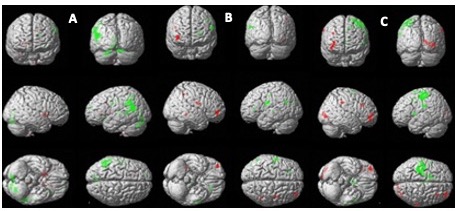
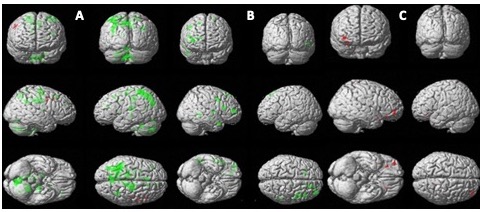
We observed hyperactivation in the Caudate in Financial Literate and hypoactivation in the Middle Frontal Gyrus in NFL groups (Figure 1), possibly attributed to goal-oriented decision making 5,6 and increased attentional control. Further, the activation of insula, medial frontal gyrus, precentral gyrus, superior frontal gyrus (Figure 1B) can be attributed to its role in decision making during uncertainty. Figure 1C depicts brain activation in FL in anterior cingulate, caudate, and middle temporal gyrus.Non-Financial Literates exhibited activation in Lateral global Pallidus (Figure 2A) implying hoarding behaviour during decision making. Activations in caudate body, cingulate gyrus, inferior parietal lobule, post central gyrus, precentral gyrus, superior frontal gyrus, and thalamus were observed for Financial Literates. The study also highlights the impact of learning and memory areas on processing risk. The effect of learning and memory areas for processing risk is seen in the intragroup analysis of Financially Literates (Session 2 of experiment 1 w.r.t. session 2 of experiment 2).
Training effects in Financial Literates revealed BOLD signal in only Middle Frontal Gyrus and Precentral Gyrus (Figure 3A) playing a role in both the sessions. Additionally, Intra-Group brain activations of Non-Financial Literates exhibited hyperactivations in Middle Frontal Gyrus and Anterior Cingulate, Cingulate Gyrus, Superior/ Medial/ Middle Frontal Gyri, Precentral Gyrus, Superior/ Middle Temporal Gyri (Figure 3C).
Middle occipital gyrus activation was prominent in fronto-parietal patients with respect to healthy controls. Patients exhibited activation in insula, parahippocampal gyrus, claustrum, thalamus, middle frontal gyrus, precuneus, medial frontal gyrus, post central gyrus, lentiform nucleus for emotional processing and integration of information for decision making and healthy controls revealed activation in caudate.
Conclusion
The brain activity involved in financial decision-making observed by modified IGT task in this study revealed the involvement of cognitive and affective systems of brain by significant activations in fronto-parietal network and limbic system of patients. Activity in caudate depicting learning, memory and emotions was observed in healthy control group.Acknowledgements
The funding from Department of Health Research, Govt. India is acknowledged (Grant No. R.11012/24/2023-GIA/HR)References
1. Vaidya, A. R. & Fellows, L. K. The Neuropscyhology of Decision-Making: A view From the Frontal Lobes. in Decision Neuroscience: An Integrative Perspective 1–422 (2016).
2. Fassbender, C. et al. The role of a right fronto-parietal network in cognitive control: Common activations for ‘Cues-to-Attend’ and response inhibition. Journal of Psychophysiology vol. 20 (2006).
3. Darki, F. & Klingberg, T. The role of fronto-parietal and fronto-striatal networks in the development of working memory: A longitudinal study. Cereb. Cortex 25, 1587–1595 (2015).
4. Friston, K. J. Introduction: Experimental design and statistical parametric mapping. (2003).
5. Monchi, O., Petrides, M., Strafella, A. P., Worsley, K. J. & Doyon, J. Functional role of the basal ganglia in the planning and execution of actions. Ann. Neurol. 59, 257–264 (2006).
6. Grahn, J. A., Parkinson, J. A. & Owen, A. M. The cognitive functions of the caudate nucleus. Prog. Neurobiol. 86, 141–155 (2008).
7. Baron-Donovan, C., Wiener, R. L., Gross, K. & Block-Lieb, S. Financial literacy teacher training: A multiple-measure evaluation. J. Financ. Couns. Plan. 16, 63–75 (2005).
8. Hastings, J. S., Madrian, B. C. & Skimmyhorn, W. L. Financial literacy, financial education, and economic outcomes. Annu. Rev. Econom. 5, 347–373 (2013).
9. Huston, S. J. Measuring Financial Literacy. J. Consum. Aff. 44, 296–316 (2010).
10. Mandell, L. & Klein, L. S. The Impact of Financial Literacy Education on Subsequent Financial Behavior. J. Financ. Couns. Plan. 20, 15–24 (2009).
11. Muñoz-Murillo, M., Álvarez-Franco, P. B. & Restrepo-Tobón, D. A. The role of cognitive abilities on financial literacy: New experimental evidence. J. Behav. Exp. Econ. 84, (2020).
Figures