3295
Deep Learning based Phase Correction with Noise and Artifacts Removal for MERGE1GE Healthcare, Waukesha, WI, United States, 2GE Healthcare, Houston, TX, United States, 3GE Healthcare, Menlo Park, CA, United States
Synopsis
Keywords: New Signal Preparation Schemes, Data Processing
Motivation: Multiple Echo Recombined Gradient Echo (MERGE) images are inherently complex-valued, and motion, field inhomogeneities, etc. could cause echo-to-echo background phase variations. Filter-based phase correction often results in signal cancellation.
Goal(s): To remove echo-to-echo phase variations for complex echo combination and improve the in-plane resolution and SNR of complex combined image
Approach: We used a deep-learning-based phase correction to improve complex echo combination and apply AIR Recon DL to further improve the in-plane resolution and SNR
Results: Deep learning based phase correction minimized signal cancellation and enabled robust complex echo combination With AIR Recon DL, MERGE images showed improved resolution and SNR.
Impact: With improved image quality, it could improve the visualization, segmentation and measurement of tissue of interest, improving diagnosis, treatment response monitoring, etc.
Introduction
Multiple Echo Recombined Gradient Echo (MERGE) is a spoiled T2*-weighted sequence, offering a mixture of T1, proton density (PD), and T2*-weighting and providing good contrast of spinal cord and cartilage [1,2]. However, the image quality highly depends on the choice of acquisition parameters, including echo times, number of echoes and number of signal averages (NEX), etc. The variability in image quality impacts the reliability of the postprocessing and analysis, such as measurement, segmentation, etc. Therefore, it is critical to obtain high quality MERGE images with high in-plane resolution and SNR. Deep learning based denoising is an effective method to improve the SNR of MERGE. Among various deep learning based denoising methods, complex-valued DL denoising methods have shown to be more effective than magnitude-based DL denoising methods. However, the individual echoes of MERGE are magnitude reconstructed and then combined using the sum of squares. Performing denoising on each echo is not only time consuming but also suffers from the potential risk of losing contrast details. Another echo combination method is complex echo combination, which requires robust phase correction. Low-pass filters are often used for the estimation of background phase for complex signal averaging and echo combination based on the assumption that the background phase is smooth. However, motion, chemical shift, field inhomogeneity, etc. introduce rapid phase changes. Lossing these high-frequency phase information in the low-pass filter based phase correction could result in signal cancellation and artifacts. Recently, a DL based phase correction method has been proposed, which can capture both the low frequency and high frequency phase features to provide robust phase correction [3]. In this work, we investigate complex-echo combined MERGE using DL Phase Correction and combined it with deep learning reconstruction to further improve the in-plane resolution and SNR of MERGE.Methods
2D MERGE images of different anatomies, including C-spine, ankle joint, shoulder, and knee, were acquired in 20 patients on GE 1.5T and 3T scanners (SIGNA Artist, SIGNA Architect and SIGNA Hero, GE HealthCare, Waukesha, WI) with IRB approval and written informed consent. The images were acquired with the following parameters, Matrix Size = 256x160 to 320x320, Slice Thickness = 2.5-3.4 mm, Flip Angle = 20o, Bandwidth = 88.7-162.7Hz/px, and Number of echoes = 3 – 4. DL Phase Correction (DLPC) generates a high-quality phase (high resolution and SNR) for phase correction, and it was trained from a database of over 10,000 images with various SNR levels and background phases. DL-based phase correction [3] and DL-based denoising [4] were embedded in the reconstruction pipeline to generate MERGE images using different reconstruction method from each raw MR data. In this work, we compared different MERGE processing pipelines including: 1) product MERGE with Sum of Squares (SoS) magnitude echo combination; 2) DL denoising on images from each echo followed by SoS echo combination; 3) Complex data echo combination with Fermi filter-based phase correction followed by DL denoising on the echo combined image; 4) Complex data echo combination with DL based phase correction (DLPC) followed by DL denoising.Results and Discussion
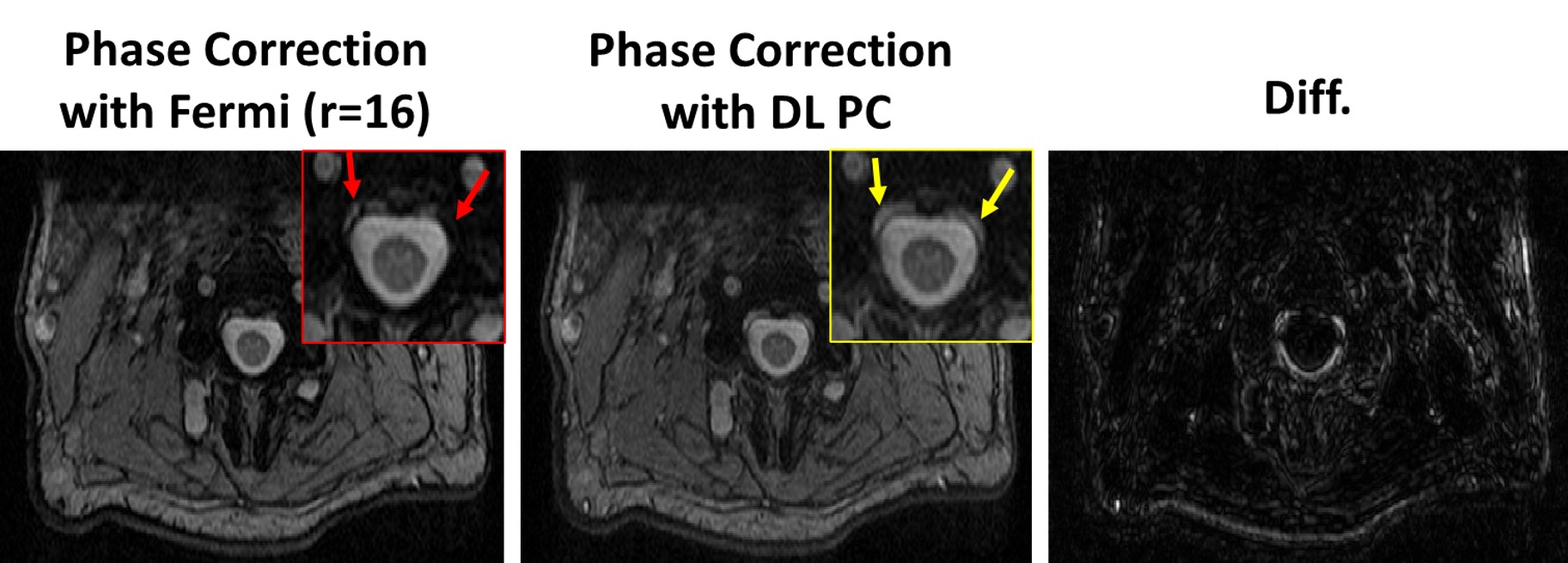
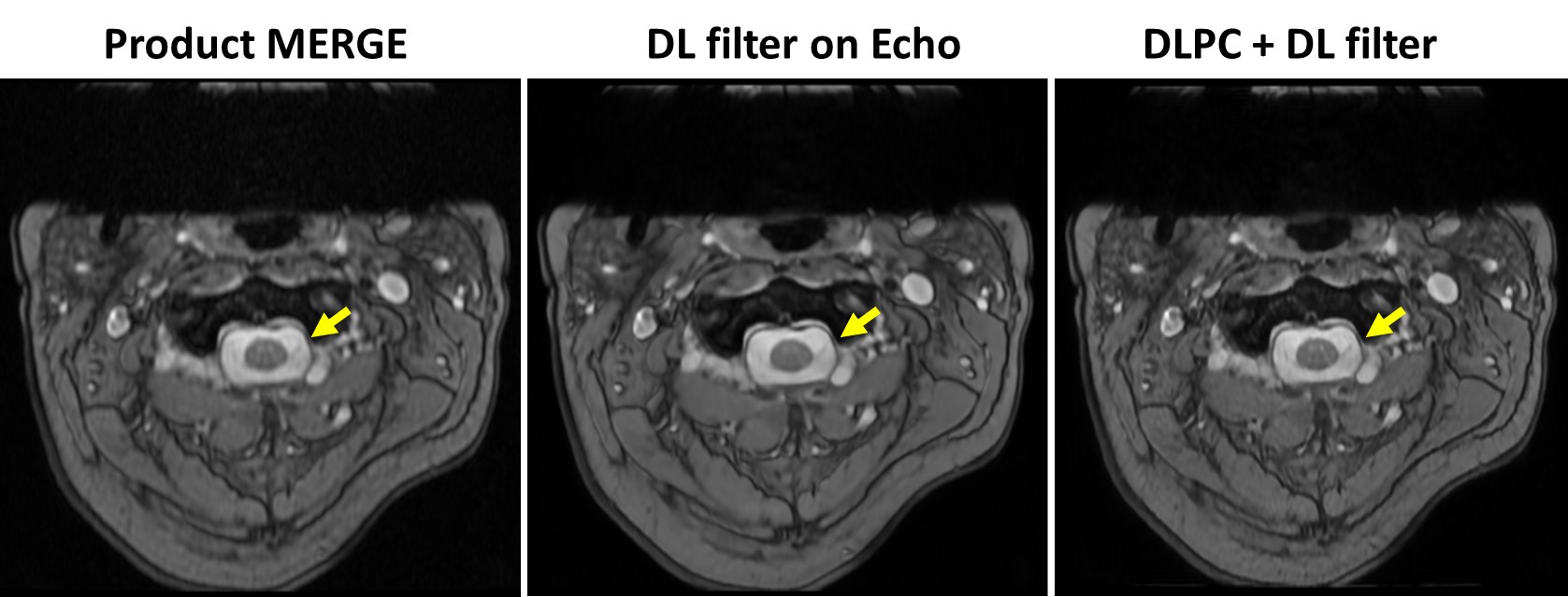
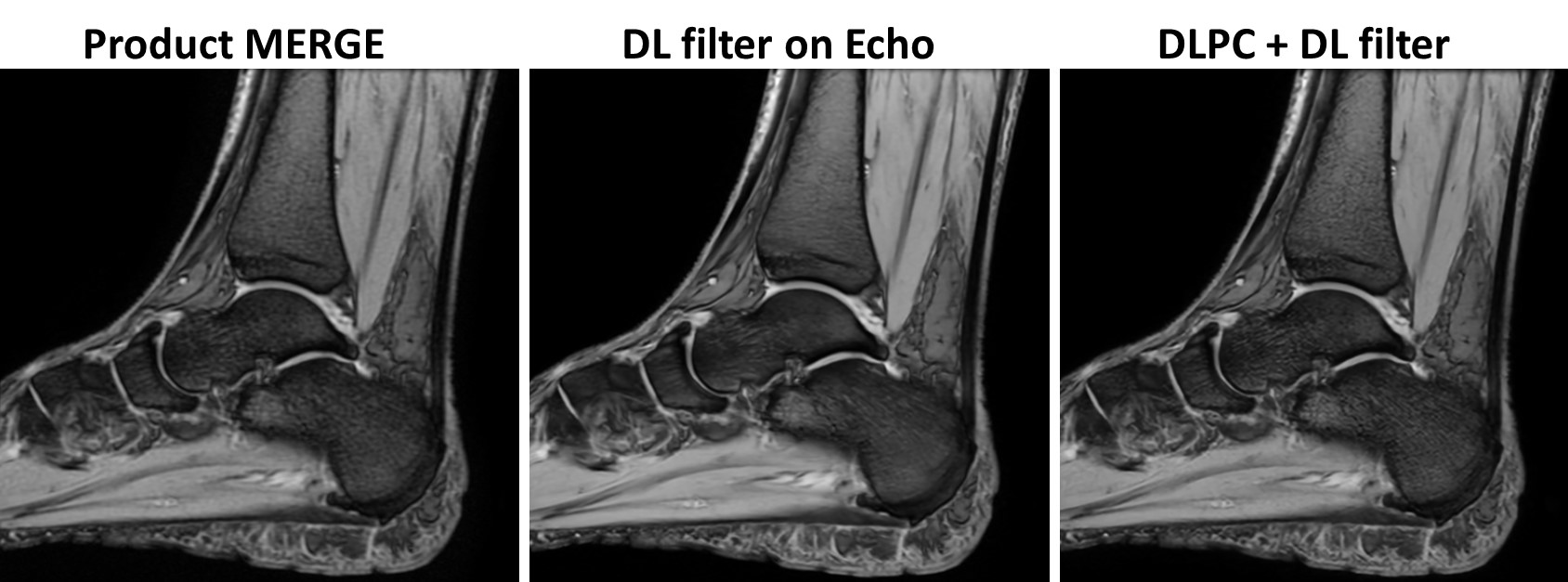
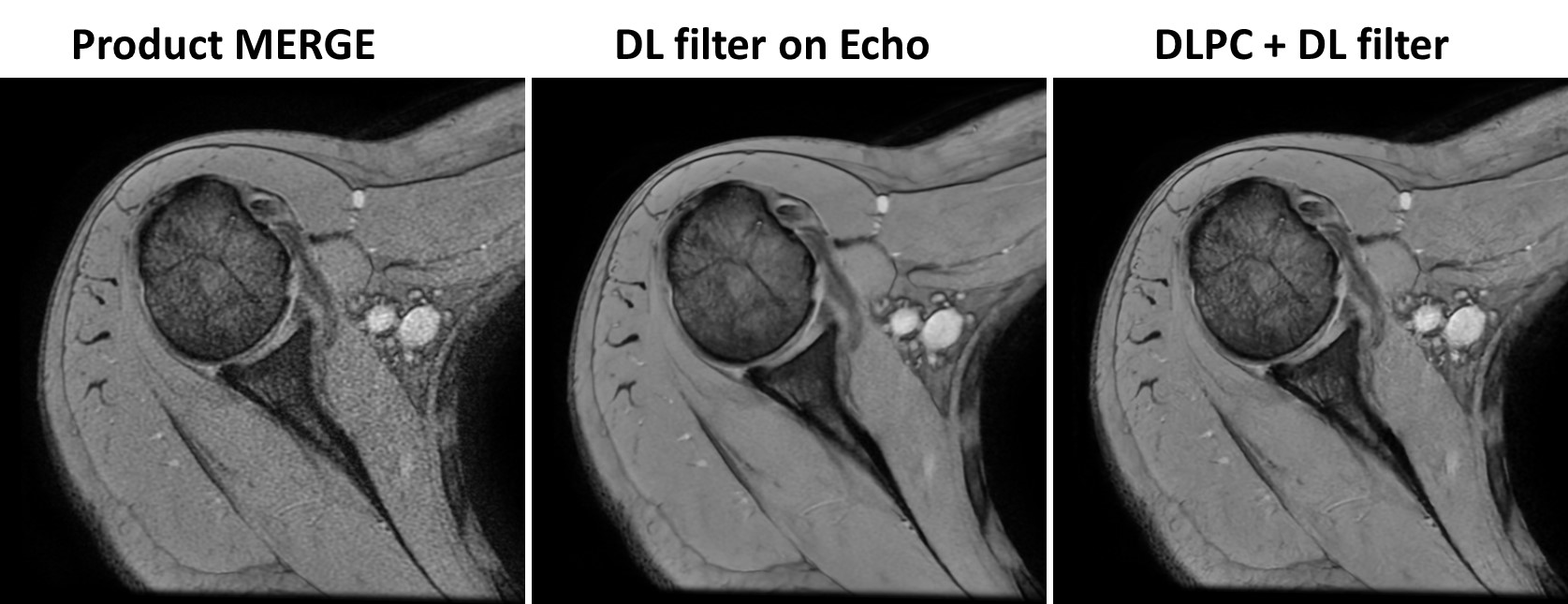
Fermi filter-based phase correction resulted in loss of anatomical structures in areas that have rapid phase changes, as shown in Figure 1. DL based phase correction can capture these rapid phase changes and provide robust phase correction, minimizing signal cancellation in those challenging areas. Applying denoising on each echo results in over-smoothing in the final combined MERGE image. This is due to applying DL denoising multiple times, which not only increases processing time, but is also prone to loss of details on later echoes that have much lower SNR due to T2* decay. DL PC enables robust complex echo combination, minimizing artifacts while maintaining Gaussian noise distribution. With robust complex echo combination, it provides high quality input to DL denoising, simplifying the denoising problem. Combining DL PC and DL denoising improves the in-plane image resolution and SNR, as shown in figures 2, 3 and 4.Conclusion
The 2D MERGE image in-plane resolution, sharpness and SNR are well improved with DL PC combined with DL denoising. DL PC with DL denoising showed the potential to improve the image quality of 2D MERGE imaging.Acknowledgements
No acknowledgement found.References
[1]Martin N et al. Comparison of MERGE and axial T2-weighted fast spin-echo sequences for detection of multiple sclerosis lesions in the cervical spinal cord. AJR 2012; 199:157–162.
[2] Merkel R et al. Combined MR data acquisition of multicontrast images using variable acquisition parameters and k-space data sharing. IEEE Trans Med Imaging 2003; 22:806-823.
[3] Xinzeng Wang, et al. Robust Complex Signal Averaging for Diffusion Weighted Imaging. ISMRM. 2023; 3963
[4] Marc Lebel, et al. Performance characterization of a novel deep learning-based MR image reconstruction pipeline. arXiv:2008.06559. 2020
Figures