3291
Improved fat suppression of cervical spine T2 weighted TSE images using enhanced slice-selective gradient reversal (enhanced LIPO)1Radiology, Eastern Chiba Medical Center, Chiba, Japan, 2Philips Japan, Tokyo, Japan, 3Eastern Chiba Medical Center, Chiba, Japan, 4Philips Australia & New Zealand, North Ryde, Australia
Synopsis
Keywords: New Trajectories & Spatial Encoding Methods, Artifacts, fat suppresstion
Motivation: CHESS and its derivative SPIR hybrid techniques are nonuniform fat suppression occurs farther away from the isocenter of B0. These effects are common in the cervical spine and other cervical regions.
Goal(s): We hypothesized that using LIPO-Only (LION) technique can be extended for T2-TSE with further optimization to increase the robustness of fat suppression.
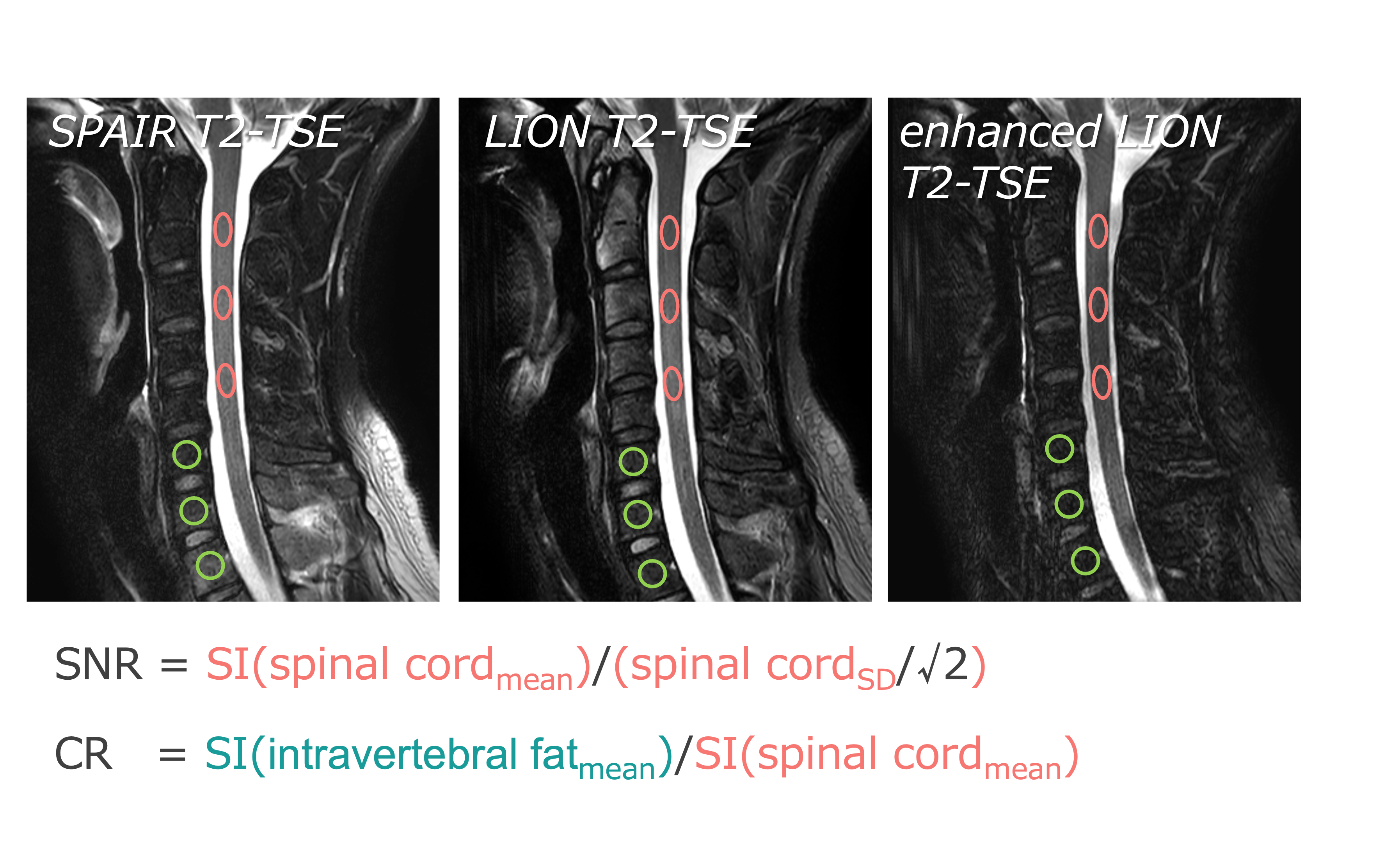
Approach: CR was calculated with ROIs placed on the spinal cord and vertebral intravital fat where fat suppression failure is most likely to occur. SNR were calculated with ROIs placed in spinal cord.
Results: Combining T2-TSE with enhanced LION improves the robustness of fat suppression.
Impact: These results suggested that enhanced LION T2-TSE improved the robustness of fat suppression and possible to maintain SNR equivalent to the conventional SPAIR T2-TSE. Further investigation is needed to improve the SNR with enhanced LIPO TSE.
Purpose
Various pathologies in the spine usually appear on T2 weighted images (T2WI) with high signal intensity similar to the fat signal.[1] Therefore, fat tissues may obscure underlying disease that may involve the spine, such as metastases, primary neoplasms, direct extension of adjacent neoplasms, diffuse or focal degeneration, and inflammatory conditions. Thus, robust and uniform fat suppression for T2WI is critical for accurate diagnosis on MR imaging of the spine.[2] CHESS and its derivative SPIR hybrid techniques are heavily dependent on homogeneity of the main magnetic field (B0) and radiofrequency magnetic field (B1); hence, nonuniform fat suppression occurs farther away from the isocenter of B0.[3] These effects are common in the cervical spine and other cervical regions.Slice selection gradient reversal (SSGR, LIPO) [4] technique is commonly used for DWI in combination with fat-suppression pre-pulse (SPIR/SPAIR) to increase the robustness of fat suppression at high fields. Recently, it has been published that using LIPO-only (LION) DWI can improve the decrease in signal-to-noise ratio (SNR) caused by pre-pulse type fat suppression methods.[5,6] We hypothesized that using LION technique can be extended for T2-TSE with further optimization to increase the robustness of fat suppression. In this study, we compared the fat suppression quality of LION T2-TSE in the cervical vertebrae among the conventional method (SPAIR T2-TSE) and conventional LION T2-TSE, the proposed method (enhanced LION T2-TSE) to investigate their clinical usefulness.Methods
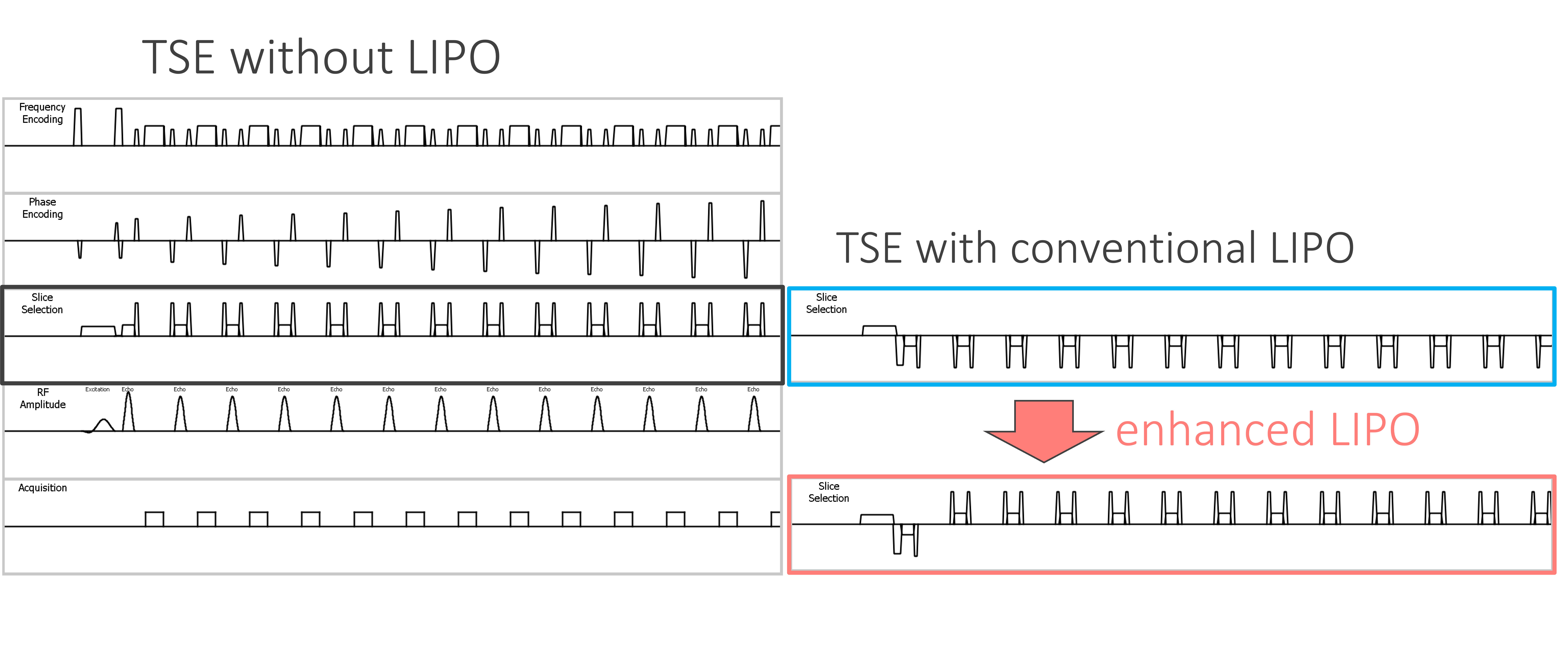
The extent of displacement of the fat slice relative to the water slice (D) is defined by D=∂*B0/Gz, where ∂ is relative chemical Shift (ppm), B0 is field strength (T), and Gz is slice selection gradient amplitude (mT/m). To prevent the B0 inhomogeneity effects for robust LIPO performance, the ratio between excitation and refocusing selection gradient strengths has been optimized to increase the fat slice shifts from the excitation and refocusing pulses with respect to water in this study.Furthermore, we have modified the slice selection gradient polarity was re-inverted from the second refocusing pulse (Fig.1) to further enhance the fat suppression during the echo train.Volunteers were examined on 3.0T whole-body clinical systems (Ingenia CX, Philips Healthcare, Best, the Netherland) with a 20ch Head-neck coil. The study was approved by the local IRB, and written informed consent was obtained from all subjects.A total of 5 volunteer underwent 3 datasets of T2-TSE, including conventional SPAIR T2-TSE, LION T2-TSE, and enhanced LION T2-TSE to evaluate the performance fat suppression. All TSE-DWI was acquired in the cervical spine with sagittal direction with the following parameters: TR = 4000 ms, TE = 100 ms, FOV = 160*230 mm2 , Matrix = 248*285 mm2, 13 slices, slice thickness = 3 mm.Contrast ratio (CR) was calculated with ROIs placed on the spinal cord and the C6, C7, and Th1 vertebral intravital fat where fat suppression failure is most likely to occur. SNR were calculated with ROIs placed in spinal cord.(Fig.2) In qualitative analysis, we used two types of indices: fat suppression uniformity and spinal cord and vertebral clarity of cervical spine for 5 healthy volunteers. 3 radiological technologists assessed the qualitative indices in the fat suppression T2-TSE images visually using a 4-point grading scale.Results and Discussion
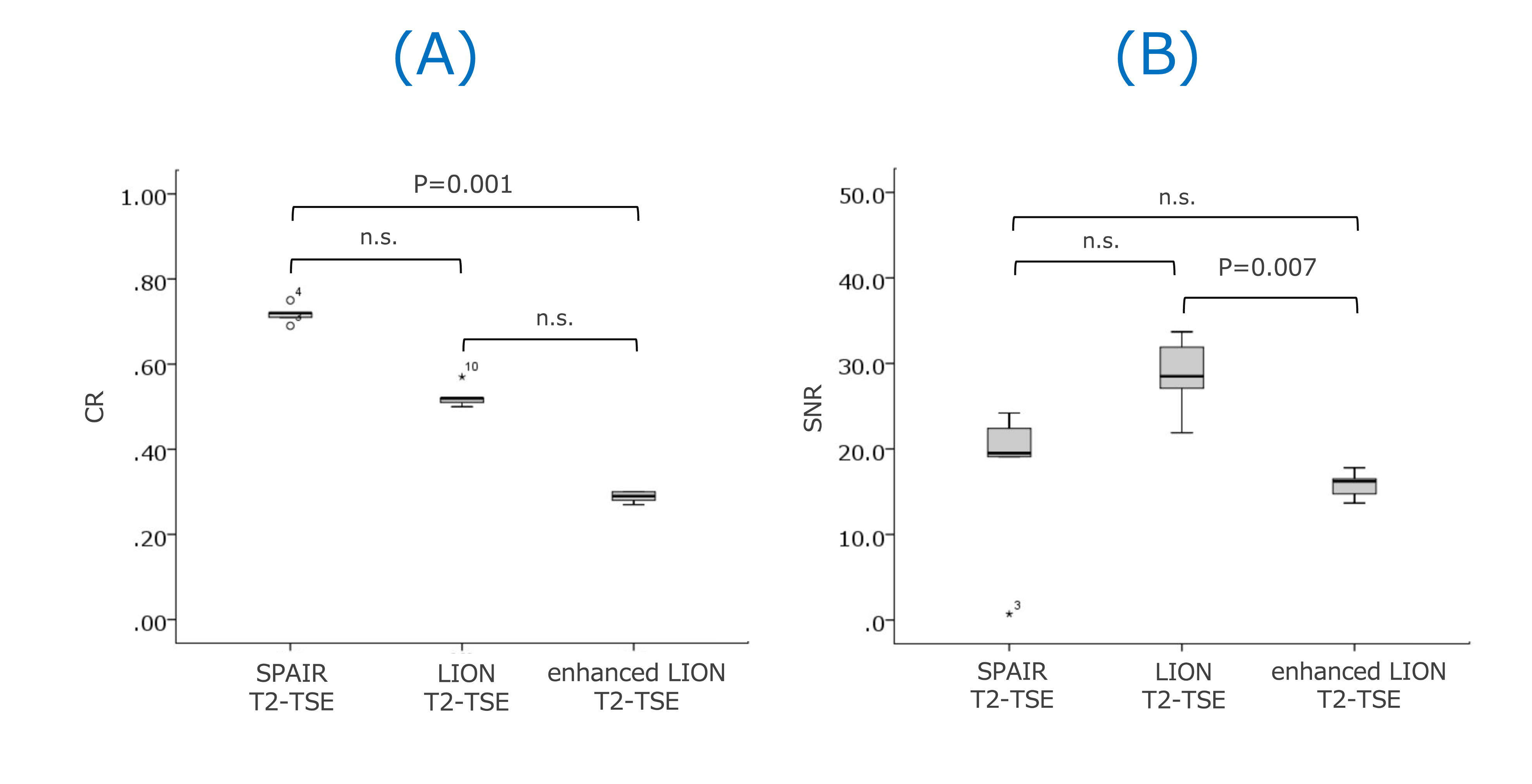
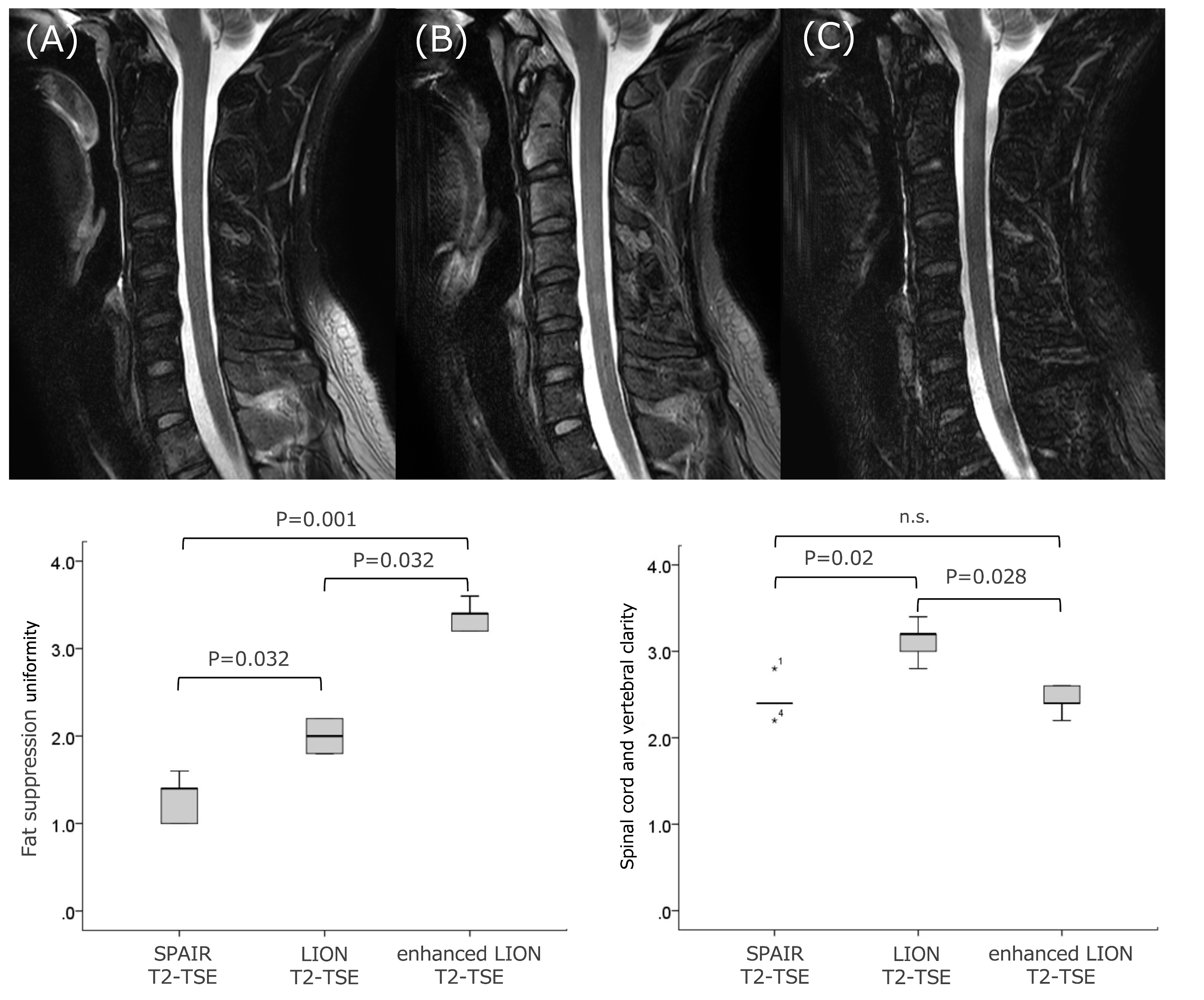
CR was lower for the enhanced LION T2-TSE than for the other two methods. Furthermore, the SNR of the enhanced LION T2-TSE was significantly lower than that of the LION T2-TSE but no significant differences between the SPAIR T2-TSE.(Fig.3) In the qualitative analysis, fat suppression uniformity were significantly higher in enhanced LION T2-TSE than in SAPIR T2-TSE and LION T2-TSE. Spinal cord and vertebral clarity of the enhanced LION T2-TSE was significantly lower than that of the LION T2-TSE but no significant differences between the SPAIR T2-TSE.(Fig.4)These results suggested that enhanced LION T2-TSE improved the robustness of fat suppression and possible to maintain SNR equivalent to the conventional SPAIR T2-TSE. Further investigation is needed to improve the SNR with enhanced LIPO TSE.Conclusion
Combining T2-TSE with enhanced LION improves the robustness of fat suppression.Acknowledgements
No acknowledgement found.References
1.Vertinsky AT et al. Cutting-edge imaging of the spine. Neuroimaging Clin N Am. 2007; 17:117–136.
2. Ai-Jun Ren et al. MR Imaging of the Spine at 3.0T with T2-Weighted IDEAL Fast Recovery Fast Spin-Echo Technique. Korean Journal of Radiology 2012; 13(1): 44-52.
3.S. Gaddikeri et al. Optimal Fat Suppression in Head and Neck MRI: Comparison of Multipoint Dixon with 2 Different Fat-Suppression Techniques, Spectral Presaturation and Inversion Recovery, and STIR.AJNR Am JNeuroradiol 2018;39:362–68
4.Nagy Z et al. Efficient fat suppression by slice-selection gradient reversal in twice-refocused diffusion encoding. Magn Reson Med. 2008 Nov;60(5):1256-60.
5.Murayama D et al. Reduced acquisition time of female pelvis diffusion weighted imaging (DWI) using LIPO-only (LION) DWI. ISMRM2023; 2960.
6.Sakai T et al. Volume isotropic thin-slice high-quality brain DWI with no fat-suppression pre-pulse. ISMRM2023; 3970.
Figures