3288
Ultra-fast radial encoding with oscillating gradients: Potential of a high performance ultrasound gradient insert1Division of Medical Physics, Department of Diagnostic and Interventional Radiology, University Medical Center Freiburg, Faculty of Medicine, University of Freiburg, Freiburg, Germany, 2Bruker BioSpin MRI GmbH, Ettlingen, Germany
Synopsis
Keywords: New Trajectories & Spatial Encoding Methods, New Trajectories & Spatial Encoding Methods
Motivation: Radial sampling offers motion-robust, high bandwidth MRI with incoherent undersampling, but suffers from inefficient k-space sampling. 3D radial acquisitions can be accelerated using non-conventional gradient trajectories.
Goal(s): To investigate the potential improvements in point spread function and acquisition time for radial encoding using oscillating gradients.
Approach: Radial spokes are modified to a conical helix trajectory using external sinusoidal gradients to increase sampling efficiency. Acceleration potential and PSF were calculated using numerical simulations. Proof-of-principle phantom measurements were performed at 3T using a field camera.
Results: Radial sampling with oscillating gradients improves PSF and allows for an up to 5-fold acceleration.
Impact: This study demonstrates first high-frequency conical helix spokes in 3D using high frequency oscillating gradients. Using external ultrasound (>20kHz) gradients, the proposed trajectory can significantly improve the PSF for both low-resolution and high-resolution protocols while providing extremely high acceleration factors.
Introduction
Radial sampling offers motion-robust, high bandwidth, and silent MRI with incoherent undersampling potential. However, in radial MRI outer k-space regions are highly undersampled compared to the k-space centre [1]. Spiral [2], cone [3], and rosette [4] trajectories require longer encoding times to reach the same kmax as radial spokes. Furthermore, they are limited by peripheral nerve stimulation (PNS), the gradient slew rate, and acoustic noise [5]. Recently, an additional 4th gradient coil with very high slew rates (>5000T/m/s) was used to modulate the Cartesian readout [6]. This oscillating gradient was adapted to radial encoding in a 2D numerical phantom simulation [1], and 2D radial MRI using amplitude modulated oscillating gradients was demonstrated in a phantom study [5].In this work, amplitude-modulated dual oscillating gradients were used to form a 3D oscillating spoke, i.e., a conical helix. When generated with high performance external gradients, conical helix trajectory can improve sampling efficiency and enables high temporal resolution. For a broad range of parameters, the point-spread-function (PSF) of conical helix trajectory was simulated. Proof-of-principle phantom measurements were performed using the MRI system gradients and a field camera.
Methods
In 3D conical helix readout, amplitude-modulated sinusoidal gradients GOsc,x, GOsc,y are driven simultaneously orthogonal to the readout gradient Gr:$$G_{Osc,x}(t) = \frac{G_{Osc}t}{T_{enc}}\sin(2\pi f_{Osc} t)$$
$$G_{Osc,y}(t) = \frac{G_{Osc}t}{T_{enc}}\cos(2\pi f_{Osc} t)$$
$$G_{z}(t) = G_{r}$$
where GOsc is the peak amplitude of the oscillating gradients and fOsc is the oscillation frequency, forming k-space coverage as in Fig.1. The effect of GOsc and fOsc on the PSF of the 3D conical helix sampling was calculated for different Gr,Tenc, and number of spokes Nspokes . A high-resolution (FOV=128mm, Voxel size=(0.25mm)3, Base-resolution=512, Nspokes ={10000, 2000}, TR/TE={3, 5}/0.2ms, Tenc={2.1, 4.1}ms) and a low-resolution (FOV=128mm, Voxel size=(2mm)3, Base-resolution=64 with Nspokes={1000, 200}, TR=1ms withTenc=0.65ms) protocol were investigated. The reference radial trajectory was realized by Gosc=0. For PSF calculation and image reconstruction, regridding operator was applied using a Kaiser-Bessel kernel without any post-processing or filters.
Phantom MRI measurements were performed at a 3T clinical system (Prisma, Siemens). A radial UTE sequence (Nspokes=100000, BR=256, TR/TE=2.8/0.2ms, Tenc=0.69ms) was used as reference. Both radial and conical helix (Gosc=20mT/m, fOsc=1kHz, Gr=2mT/m) trajectories were tested for Nspokes={100, 500, 1000}. Gradient trajectories were recorded using a dynamic field camera (Skope, Switzerland).
Results
In Fig.2, representative PSF maps are selected and shown for Tenc={2.1/ 4.1}ms. Minimum FWHM for the simulated PSF was observed as 0.434mm with Gr=40mT/m, Nspokes=10000, GOsc=400mT/m, fOsc=1kHz. For Tenc=2.1ms, GOsc≥100mT/m can improve the PSF by approximately 10%. For Tenc=4.1ms, the improvement is slightly better than 10%. fOsc> 20kHz offers silent and PNS-free encoding, yet, not necessarily a better PSF for all parameters. The benefit of using ultrasound frequency (≥20kHz) is observed only for GOsc≥100mT/m.For the low-resolution protocol as shown in Fig.3, where TR/Tenc=1ms/0.65ms, as in high-resolution result, conical helix trajectory can improve the PSF by approximately 10% for GOsc≥ 100mT/m, while increasing fOsc increases FWHM of PSF. Note, to generate proper oscillations in shorter Tenc, higher fOsc is required, where fOsc>20 kHz is preferable, and silent encoding might be possible.
For fOsc≤2kHz, conical helix trajectories could be generated using system gradients at GOsc=10mT/m without major deviations from the ideal trajectory. Phantom images (Fig.4) were reconstructed using the k-space trajectory (Fig.1d) obtained from the dynamic field camera. Compared to radial spokes, higher acceleration can be afforded using conical helix trajectory. With the same Nspokes, the conical helix trajectory can results in less blurring, achieving SSIM of 0.917, 0.882, 0.718 for 1000, 500, 100 spokes while radial trajectory achieves 0.877, 0.781, 0.643 correspondingly. For both radial and conical helix trajectory, artefacts are visible, which might be improved using a random distribution of the conical helix spokes and iterative reconstruction.
Discussion
Conical helix trajectories are currently limited by the system hardware. A high-performance external gradient system with Gmax≥100mT/m and fOsc≥20kHz is needed to demonstrate the potential of the proposed trajectory. This study shows, that an efficient gradient coil system that can support high frequency oscillations (≥20kHz) and maximum gradient strength of GOsc≥100mT/m can potentially accelerate total acquisition time by 5-fold. For the simulated case of 1000 spokes with 1ms and Gr=40mT/m, a single volume data can be acquired in 1s with a voxel size of (2mm)3. Conical helix trajectory can acquire the same volume in 0.2s with 200 spokes at GOsc=200mT/m, which might enable studies of fast physiologic events.For simplicity, fOsc was fixed and GOsc,x, GOsc,y were linearly modulated. However, in principle, a dual axis external gradient can create more complex trajectories, which are optimized to achieve higher accelerations with better PSF.
Acknowledgements
No acknowledgement found.References
[1] Ahmad, R., Potter, L., & Kuppusamy, P. (2009). "Oscillating radial trajectories for reduced undersampling artifacts." In Proceedings of the 17th Annual Meeting of ISMRM (p. 575).
[2] C. B. Ahn, J. H. Kim and Z. H. Cho, "High-Speed Spiral-Scan Echo Planar NMR Imaging-I," in IEEE Transactions on Medical Imaging, vol. 5, no. 1, pp. 2-7, March 1986, doi: 10.1109/TMI.1986.4307732.
[3] Johnson, K.M. (2017), Hybrid radial-cones trajectory for accelerated MRI. Magn. Reson. Med., 77: 1068-1081. https://doi.org/10.1002/mrm.26188
[4] Likes, Richard S. "Moving gradient zeugmatography." No. US 4307343. 1981.
[5] Serhat Ilbey, Sebastian Littin, Feng Jia, Niklas Wehkamp, Philipp Amrein, Maxim Zaitsev, Michael Bock, and Ali Caglar Özen. 2023. “Ultra-Fast Radial MRI with Silent Oscillating Gradients.” In Proc. Intl. Soc. Mag. Reson. Med. 32, 4798. Toronto, ON. https://www.ismrm.org/23/program-files/D-36.htm.
[6] Versteeg, E, Klomp, DWJ, Siero, JCW. A silent gradient axis for soundless spatial encoding to enable fast and quiet brain imaging. Magn Reson Med. 2021; 87: 1062–1073. https://doi.org/10.1002/mrm.29010.
Figures
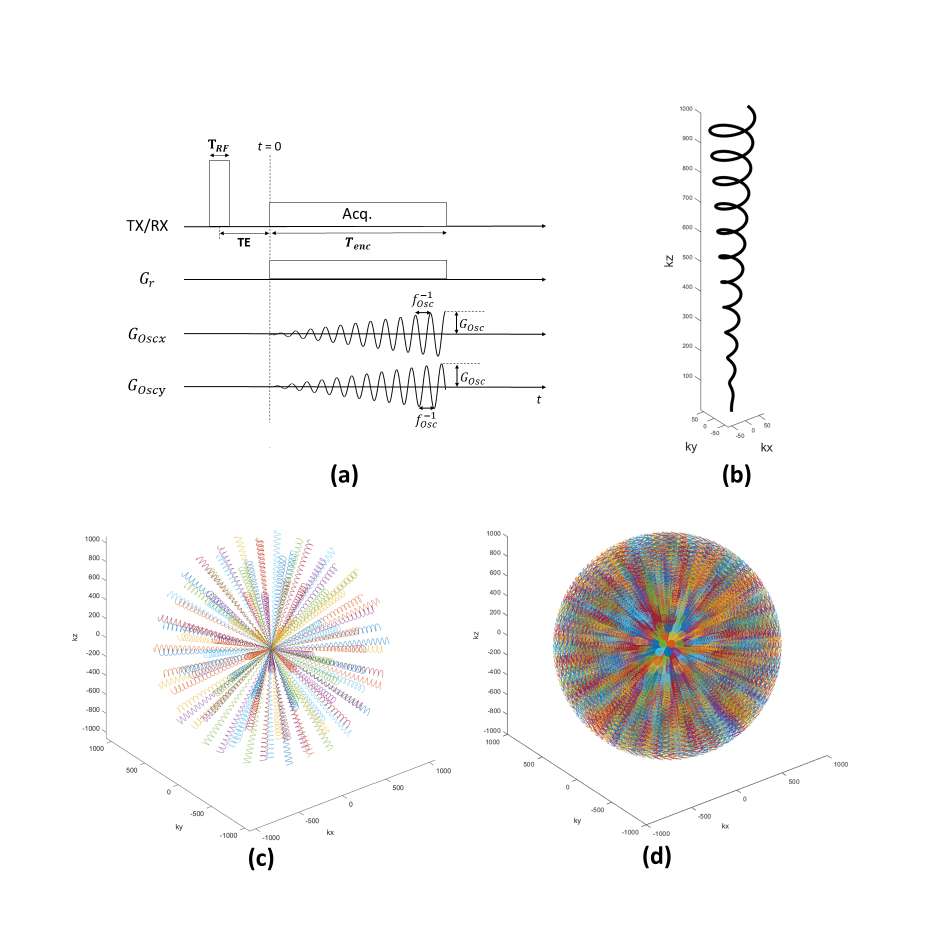
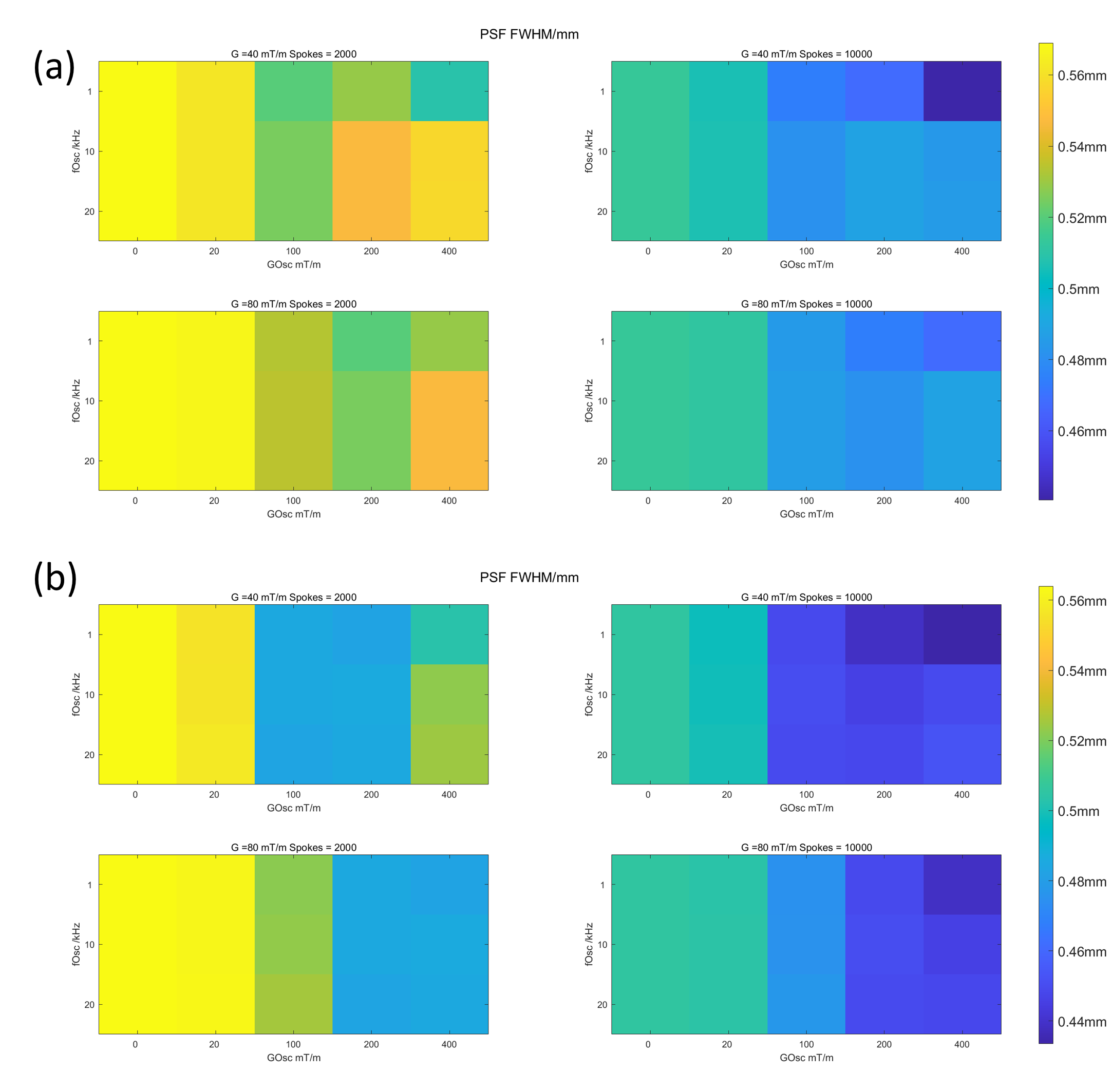
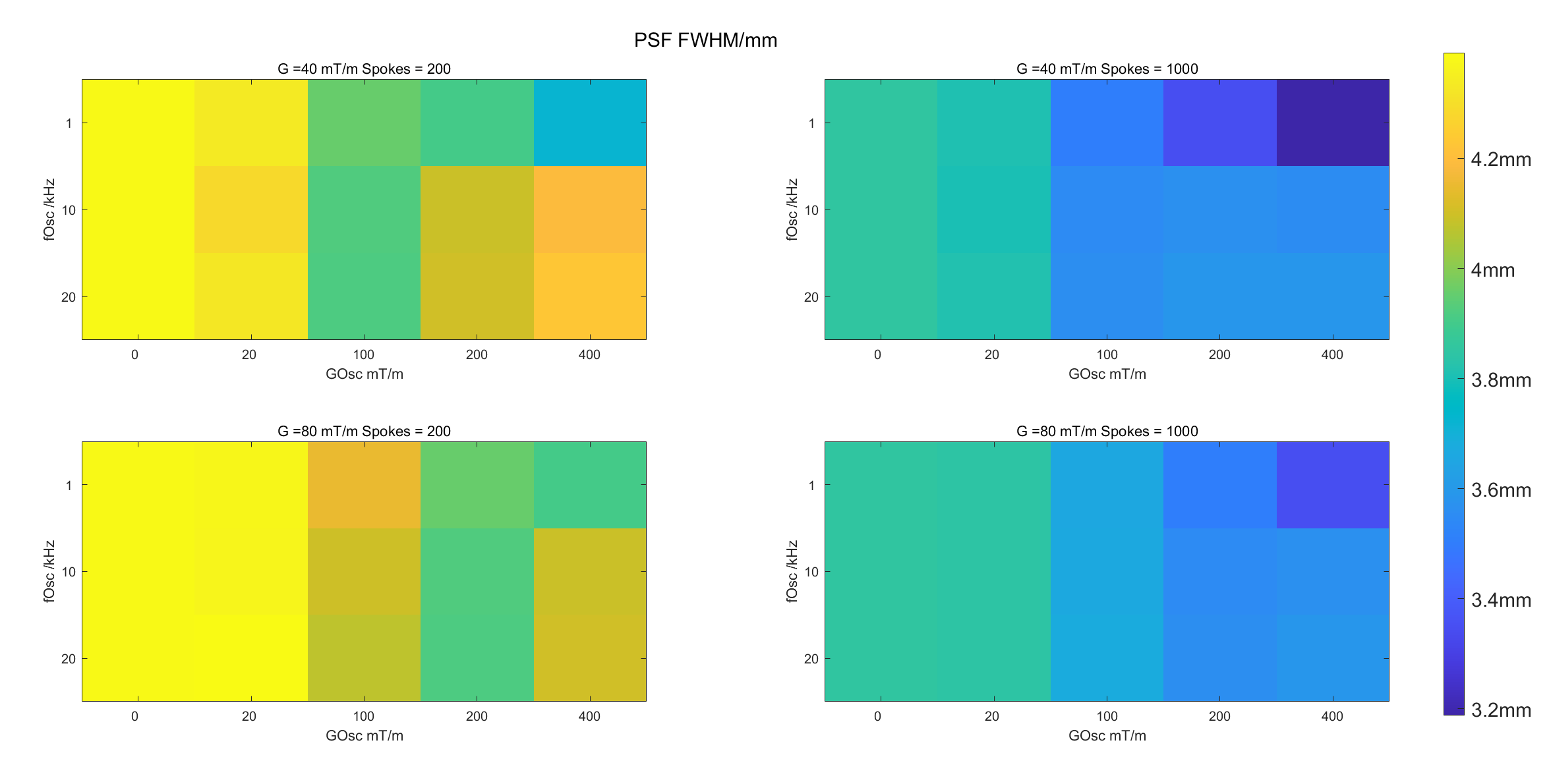
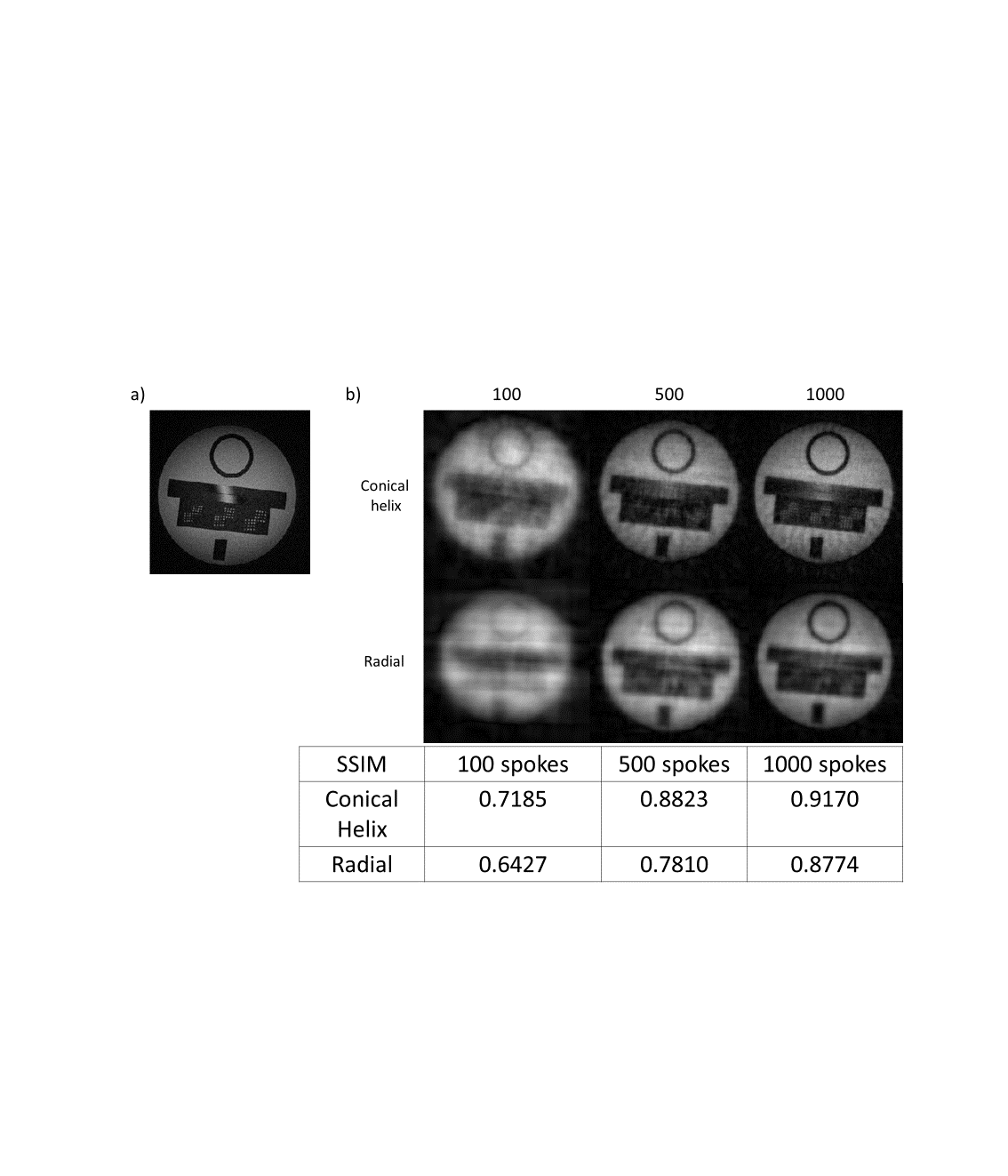
Fig.4: Phantom images reconstructed from (a) a radial trajectory (Nspokes=100000, as reference) and (b) with an conical helix trajectory (first row) and radial trajectory (second row). Both trajectories were tested with 100, 500 and 1000 spokes. For evaluation of image quality, SSIM (Structural similarity) is calculated between each image and the reference image.