3286
Reducing ringing artifacts in dynamic pulmonary MRI with a golden-step based interleaving approach for 3D ultra-short TE acquisition1School of Biomedical Engineering, Shanghai Jiao Tong University, Shanghai, China, 2Central Research Institute, United Imaging Healthcare, Shanghai, China
Synopsis
Keywords: New Trajectories & Spatial Encoding Methods, Data Acquisition, Interleaved acquisition, Ringing artifacts
Motivation: In 3D radial ultra-short TE based dynamic pulmonary MRI, 3D radial k-space is usually segmented into multiple interleaves for interleaved acquisition. Motion-resolved k-space data are obtained subsequently by retrospectively binning using respiratory signals. Diaphragm drifting has been commonly observed during the scan, resulting in non-uniform spherical distribution of sampling density in motion-resolved k-space and ringing artifacts in reconstructed images.
Goal(s): To reduce ringing artifacts in motion-resolved images.
Approach: A golden-step based interleaving approach is proposed to mitigate adversary effect of diaphragm drifting.
Results: Ringing artifacts in dynamic images acquired with conventional interleaving approach are significantly reduced in that acquired with proposed interleaving approach.
Impact: Using golden-step based interleaving approach, uniform motion-resolved k-spaces can be obtained even under severe diaphragm drifting. This proposed approach has potential to reduce ringing artifacts in other non-Cartesian acquisitions and applications, such as bSSFP-based free-breathing cardiac MRI and real-time MRI.
Introduction
In 3D radial ultra-short TE (UTE) based dynamic pulmonary MRI, 3D radial k-space with spiral phyllotaxis pattern is commonly segmented into multiple interleaves in data acquisition.1,2 Dynamic motion-resolved images can be reconstructed from the motion-resolved k-space data obtained by retrospectively binning using the respiratory signals. However, in the presence of severe diaphragm drifting,3 non-uniform distribution of motion-resolved k-space data, usually manifests as local or regular holes in k-space, may lead to streaking and ringing artifacts in the final reconstructed images.4In this study, we propose a new golden-step based interleaving approach for spiral phyllotaxis pattern to reduce ringing artifacts induced by diaphragm drifting. Using this approach, the first spoke of successive interleaves are arranged incoherently with golden step rather than sequentially along polar direction. The proposed golden-step based interleaving approach is compared with conventional sequential interleaving approach by combining these two approaches with a UTE sequence. The imaging performance of these two approaches are evaluated on phantom and healthy subjects.
Methods
The formulation of half-echo spiral phyllotaxis pattern in 3D spherical coordinates is:5$$\varphi_{n}=\frac{2\pi}{360}\cdot{n}\cdot\varphi_{gold},$$
$$\theta_{n}=\left\{\begin{matrix}{\frac{\pi}{2}\cdot\sqrt{\frac{2n}{N}},~~~~~~~~~~~~~~~~1\leq{n}\leq\frac{N}{2}}\\{\pi-\frac{\pi}{2}\cdot\sqrt{\frac{2(N-n)}{N}},\frac{N}{2}\leq{n}\leq{N}}\end{matrix}\right..$$
Here, $$${n}$$$ is the spoke index whose value is from 1 to $$${N}$$$ .$$$\varphi_{n}$$$ is the azimuthal angle of the $$${n}$$$th spoke. Golden angle $$$\varphi_{gold}=137.51{^\circ}$$$ .$$$\theta_{n}$$$ is the polar angle of the $$${n}$$$th spoke.
In interleaved acquisition, $$$N = I\cdot{S}$$$ spokes are straightforwardly segmented into $$$I$$$ interleaves with $$$S$$$ spokes per interleaf. Every $$$I$$$th spoke is arranged into the same interleaf. Using conventional sequential interleaving approach, the spoke index $$${n}$$$ belonging to the $$${i}$$$th interleaf can be expressed as:
$$n=i+I\cdot{s},~~~~s=0,~1,~2\cdots(S-1).$$
However, in golden-step based interleaving approach, the spoke index belonging to the $$${i}$$$th interleaf are:
$$n=GoldenStep(i)+I\cdot{s},~~~~s=0,~1,~2\cdots(S-1).$$
In which $$$GoldenStep$$$ is calculated based on golden ratio:6
$$GoldenStepNonInterger(i)=mod\left({\frac{I}{GR}\cdot{i},~I}\right),~~~~i=1,~2,~3\cdots{I},$$
$$GoldenStep=sortIndex\left(sortIndex(GoldenStepNonInterger)\right).$$
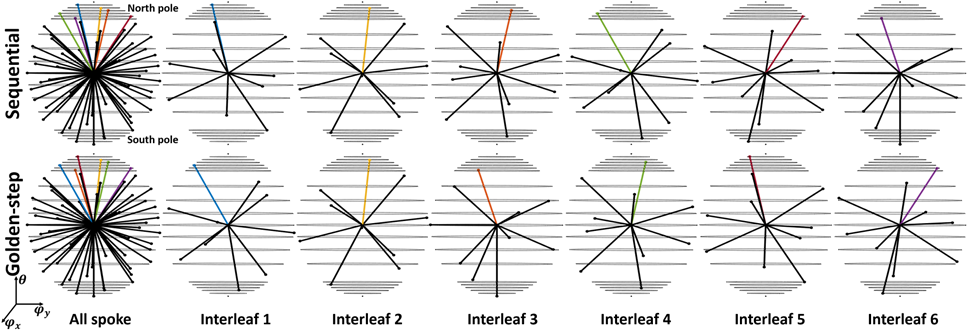
Here, $$$mod\left({a,b}\right)$$$ outputs the remainder of $$$a$$$ with respect to $$$b$$$. Golden ratio $$$GR$$$ equals to 1.618. Sorting operator $$$sortIndex\left({array}\right)$$$ outputs the arrangement indices of $$$array$$$ in ascending order. Figure 1 illustrates an example of two interleaving approaches with $$$I=6$$$ and $$$S=10$$$.
A superior-inferior (SI) navigated UTE sequence1 was combined with sequential and golden-step based interleaving approaches separately for data acquisition. A resolution phantom and 4 healthy subjects were scanned on a 3T MRI scanner (uMR790; UIH, Shanghai, China). The scan parameters were: FOV = 320$$$\times$$$320$$$\times$$$320 mm3, isotropic resolution = 1 mm, TE = 60 $$$\mu$$$s, TR = 3 ms, flip angle = 4$$${^\circ}$$$, and the scan time for each interleaving approach was 10.5 minutes including 4000 interleaves with one SI navigator and 50 imaging spokes each.
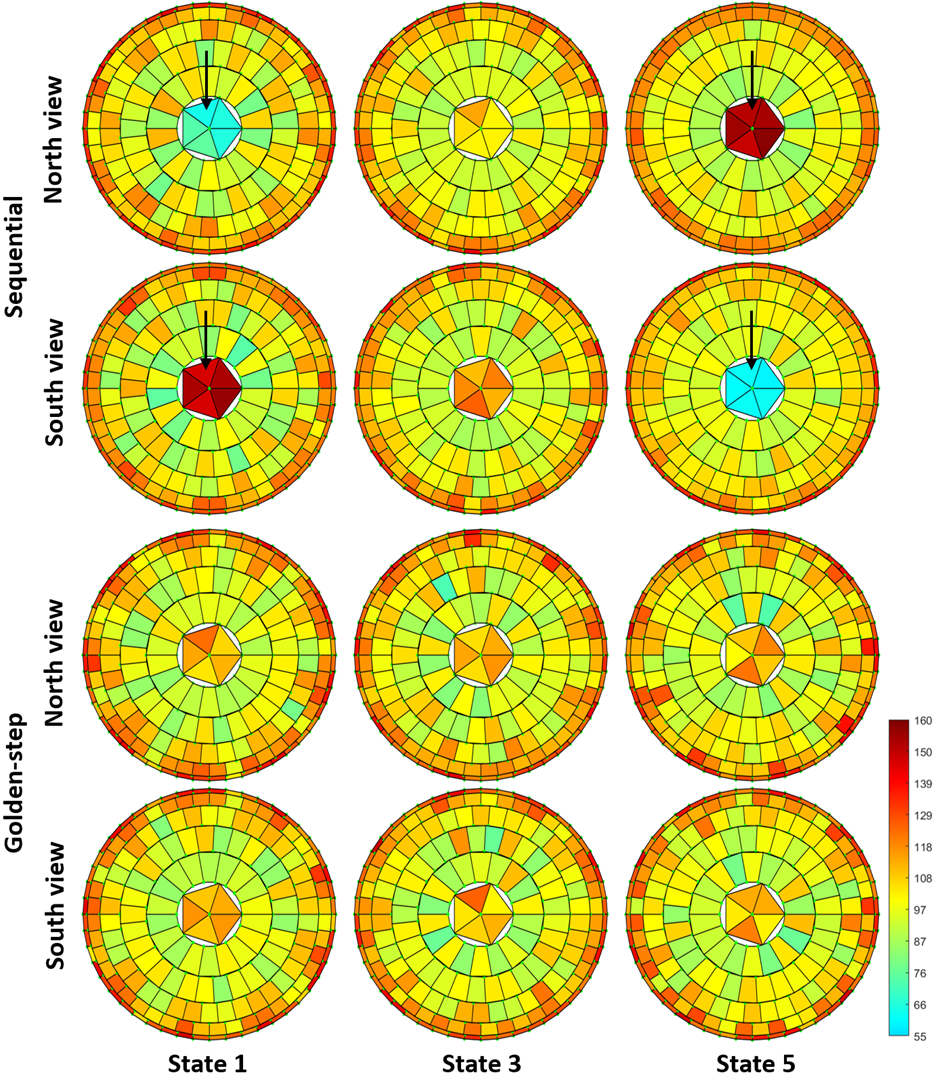
In motion-resolved reconstruction, five motion-resolved k-spaces were obtained by binning all interleaves into different motion states from end-expiration (EE) to end-inspiration (EI). Dynamic images were reconstructed by performing nonuniform FFT on the motion-resolved k-space data. In order to investigate the uniformity of spherical distribution of sampling density in 3D radial k-space, the 3D sphere was divided into 364 regions with approximately equal areas using the method of equal-solid-angle.7 The number of the spoke endpoints within each equal-solid-angle region was counted for the motion-resolved k-spaces.
Results
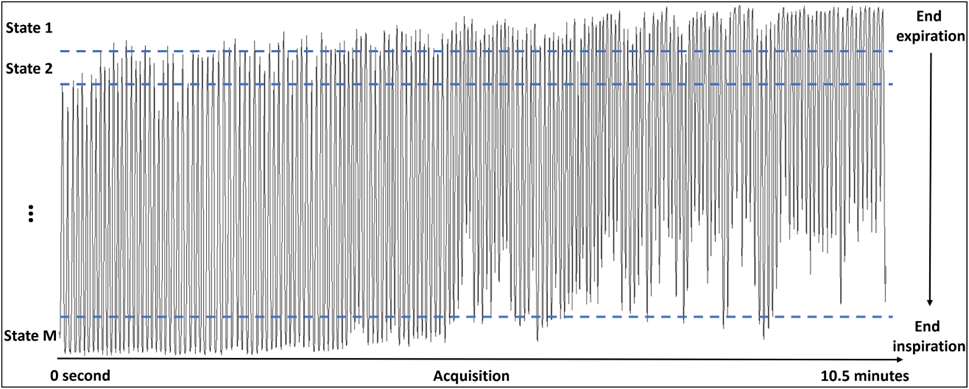
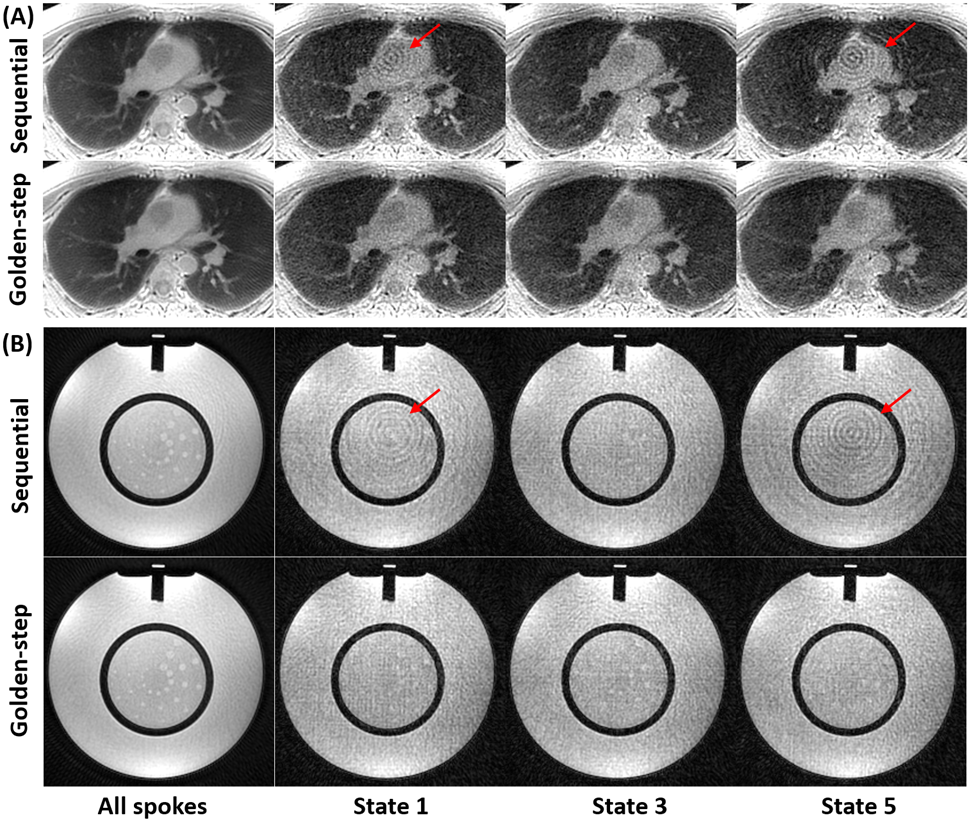
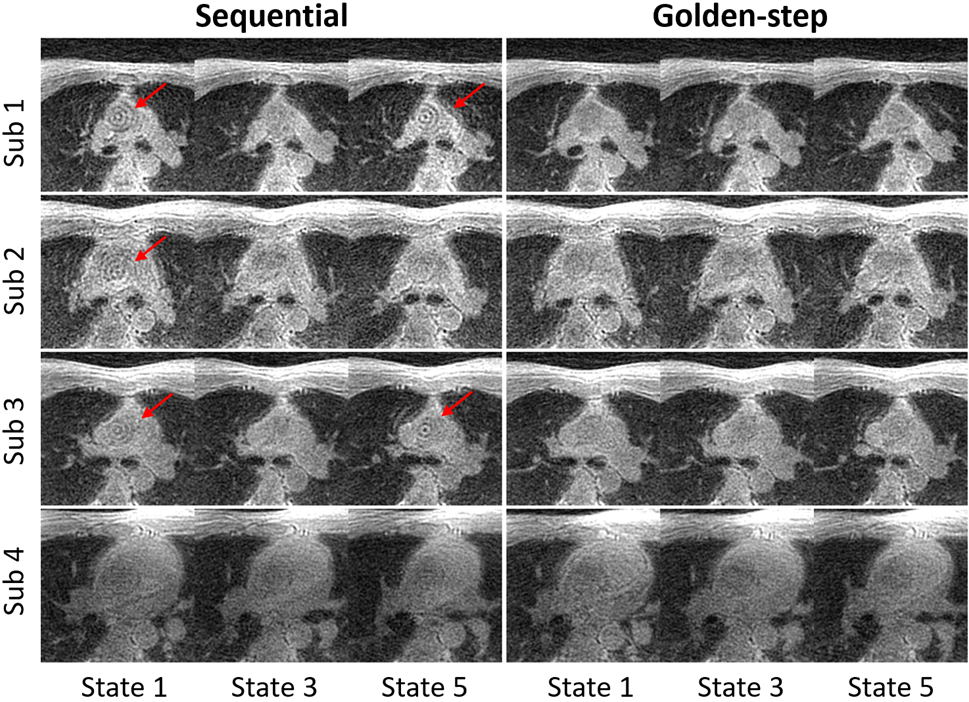
The respiratory curve influenced by diaphragm drifting during a sequential interleaved scanning of a typical subject is shown in Figure 2. The spherical distribution of sampling density of the motion-resolved k-spaces obtained by retrospectively binning based on this respiratory curve are illustrated in Figure 3 both in north-pole and south-pole views. In golden-step based approach, the number of endpoints at the north and south poles keep approximately the same in all respiratory states compared to that of end-expiratory and end-inspiratory states in sequential approach.Figure 4 shows the images of a typical subject (A) and the phantom (B). In the presence of severe diaphragm drifting, ringing artifacts were observed in the images at end-expiratory and end-inspiratory states using sequential approach as indicated by the red arrows. These ringing artifacts were substantially reduced in the images using golden-step based approach for all respiratory states. Motion-resolved images of all 4 subjects are illustrated in Figure 5. Ringing artifacts were observed in the images acquired with sequential approach, indicated by the red arrows. These ringing artifacts were greatly reduced in the images acquired using the proposed golden-step based approach.
Conclusion
A new golden-step based interleaving approach is proposed to obtain uniform distribution of motion-resolved k-spaces in dynamic pulmonary MRI. In the presence of severe diaphragm drifting, ringing artifacts observed in dynamic images acquired with sequential approach were significantly reduced in that acquired with the proposed interleaving approach. The proposed approach has potential to reduce ringing artifacts in other non-Cartesian k-space acquisitions, such as bSSFP-based free-breathing cardiac MRI and real-time MRI.Acknowledgements
This study is supported by the National Key Research and Development Program (2016YFC0103905), the National Natural Science Foundation of China (81627901), and the Shanghai Science and Technology Commission Explorer Program (22TS1400300). This study is also supported in part by an internship granted by the United Imaging Healthcare (Z.D.).References
1. Ding Z, Cheng Z, She H, Liu B, Yin Y, Du YP. Dynamic pulmonary MRI using motion-state weighted motion-compensation (MostMoCo) reconstruction with ultrashort TE: A structural and functional study. Magn Reson Med 2022;88(1):224-238.
2. Feng L, Delacoste J, Smith D, Weissbrot J, Flagg E, Moore WH, Girvin F, Raad R, Bhattacharji P, Stoffel D, Piccini D, Stuber M, Sodickson DK, Otazo R, Chandarana H. Simultaneous Evaluation of Lung Anatomy and Ventilation Using 4D Respiratory-Motion-Resolved Ultrashort Echo Time Sparse MRI. J Magn Reson Imaging 2019;49(2):411-422.
3. Taylor AM, Jhooti P, Firmin DN, Pennell DJ. Automated monitoring of diaphragm end-expiratory position for real-time navigator echo MR coronary angiography. J Magn Reson Imaging 1999;9(3):395-401.
4. Park J, Shin T, Yoon SH, Goo JM, Park JY. A radial sampling strategy for uniform k-space coverage with retrospective respiratory gating in 3D ultrashort-echo-time lung imaging. NMR Biomed 2016;29(5):576-587.
5. Piccini D, Littmann A, Nielles-Vallespin S, Zenge MO. Spiral phyllotaxis: the natural way to construct a 3D radial trajectory in MRI. Magn Reson Med 2011;66(4):1049-1056.
6. Feng L. Golden-Angle Radial MRI: Basics, Advances, and Applications. J Magn Reson Imaging 2022;56(1):45-62.
7. Glover GH, Pauly JM, Bradshaw KM. Boron-11 imaging with a three-dimensional reconstruction method. Journal of Magnetic Resonance Imaging 1992;2(1):47-52.
Figures