3280
Optimizing resting state fMRI data quality using Component Analysis based on Standard-deviation Attenuation (CASA) denoising1Department of R&D Advanced Applications, Olea Medical, La Ciotat, France
Synopsis
Keywords: fMRI Analysis, fMRI (resting state), Denoising, thermal noise, data preprocessing
Motivation: Noise sources, including thermal noise, affect signal-to-noise ratio (SNR) in resting-state fMRI, limiting utility and impact of this type of data.
Goal(s): This study aims at enhancing data quality by integrating Component Analysis based on Standard-deviation Attenuation (CASA) technique with standard denoising methods.
Approach: Employing rs-fMRI data from 19 controls, we compared the regression of motion, white matter and CSF signals (MWC approach) and the integrated CASA denoising + MWC approach, based on tSNR and RSN comparison.
Results: The study showed significant enhancement in tSNR employing CASA + MWC approach and led to RSNs free from artifact-related patterns seen with the MWC method.
Impact: Resting-state fMRI data with our Component Analysis based on Standard-deviation Attenuation (CASA) denoising have greater signal quality and reduced contribution of unstructured thermal noise, which is greatly beneficial for reliably evaluating functional connectivity in resting state fMRI studies.
Introduction
Resting state functional magnetic resonance imaging (rs-fMRI) is a crucial tool for exploring human brain’s function at rest. Yet, its poor signal-to-noise ratio (SNR) remains a substantial hurdle1, hindering its utility and impact. This study introduces Fast Fourier Transform (FFT) Component Analysis based on Standard-deviation Attenuation (CASA), a variation of CASA2,3 denoising already used for CEST2 and Diffusion Tensor Imaging (DTI)3 data, aimed at mitigating thermal noise in MRI data. Our goal is to improve signal quality and enhance rs-fMRI results.Methods
We used rs-fMRI data of nineteen healthy subjects from the UCLA phenomics dataset4, acquired on a 3T Siemens Trio scanner using a T2*-weighted echoplanar-imaging sequence (34 slices, thickness=4 mm, TR/TE=2000/30ms, flip angle=90°, 152 volumes). Anatomical images were also used.Initial preprocessing steps, performed with FMRIPrep5, included skull-stripping, volume realignment, slice timing correction, co-registration to the T1-weighted reference, and normalization to standard MNI152 space. This initial output, referred to as the 'non-denoised approach,' underwent denoising via two distinct methodologies:
- MWC approach, which involved regressing 24 motion-related parameters and mean WM and CSF signals;
- FFT CASA + MWC approach: we first performed FFT CASA denoising to reduce thermal noise. We decomposed rs-fMRI signal of each voxel into components representing the different frequencies of the signal. Afterwards, for each component, with the CASA rate2 we calculated the strength of the spatial Gaussian smoothing to be applied to that component. After smoothing the components, the data were recovered by calculating the inverse FFT for each voxel in the temporal domain. Finally, we applied the MWC approach.
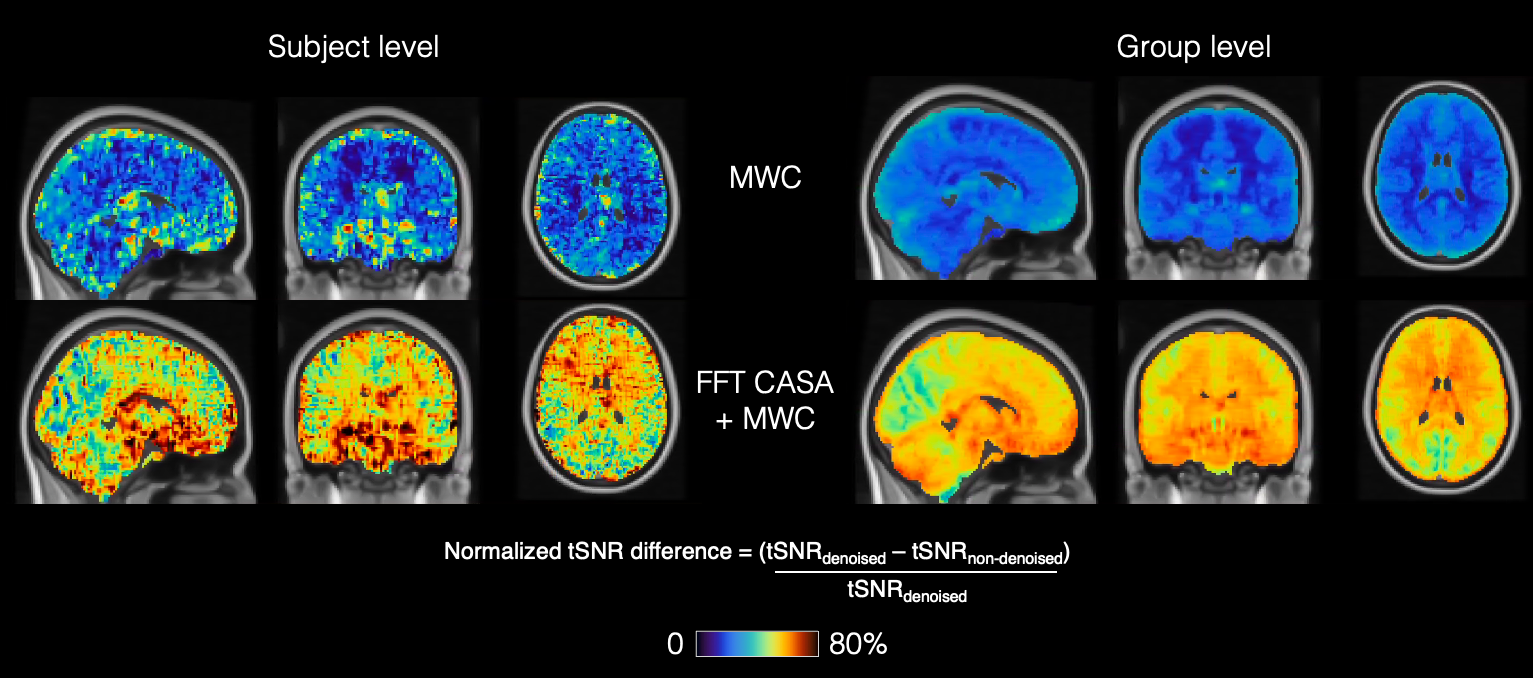
We assessed voxel-wise normalized temporal SNR (tSNR) difference, estimated as (tSNRdenoised–tSNRnon-denoised)/tSNRdenoised, and mean normalized tSNR difference within the grey matter (GM), which was compared between datasets using paired t-tests. We also extracted group-specific resting-state networks (RSNs) within each dataset using group-ICA and compared the number and quality of these networks.
Results
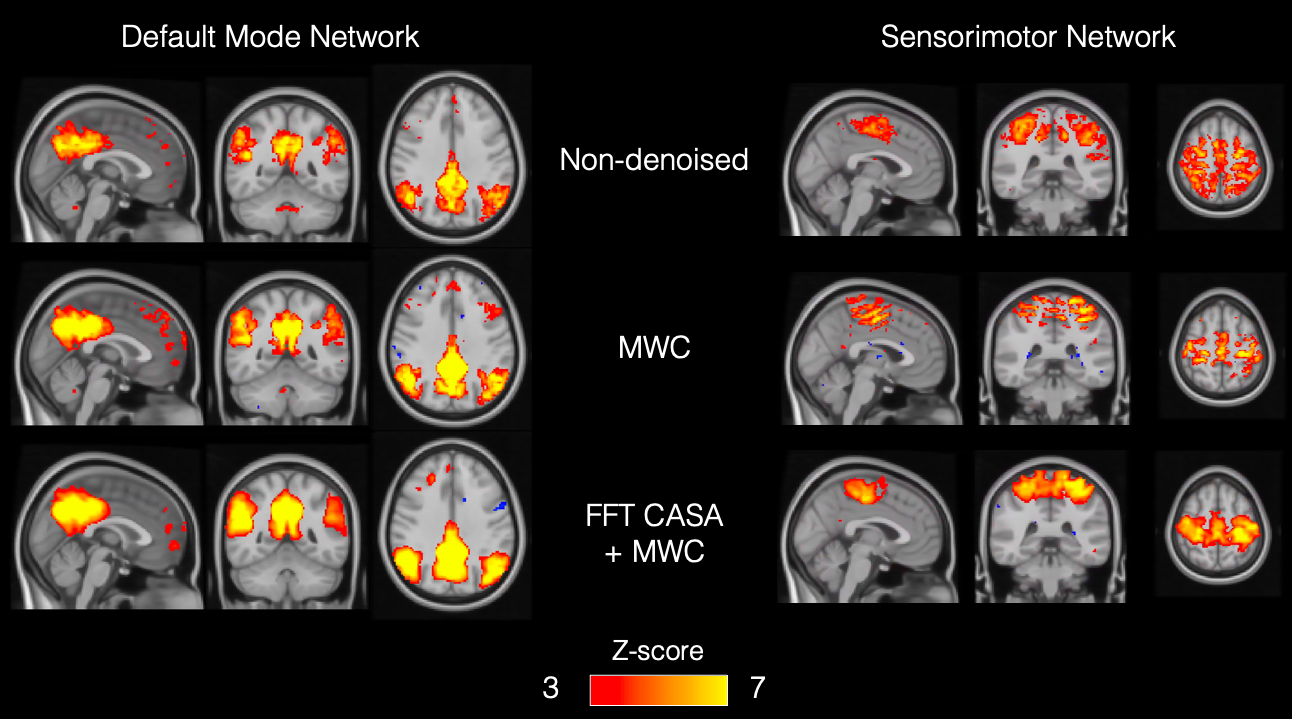
The normalized tSNR difference between denoised and non-denoised data (Fig.1) highlighted a greater tSNR enhancement for the FFT CASA + MWC approach (55±5% higher than non-denoised data) compared to the MWC approach (26±7%) (t-stat=28.3, p<0.001). Remarkably, unlike the MWC method, the FFT CASA + MWC method revealed a significant tSNR increase also in the brainstem, which is typically greatly susceptible to signal corruption.Fig.2 illustrates two prominent RSNs, the Default Mode Network (DMN) and the Sensorimotor Network (SMN), extracted from each dataset using the group-ICA. The RSNs derived from the non-denoised and MWC denoised datasets displayed spurious correlations and artifact-related patterns, especially within the SMN. Conversely, the dataset denoised with the FFT CASA + MWC method produced clearer networks, free from visible artifacts. Furthermore, while the non-denoised data allowed extraction of only 5 BOLD components out of the estimated 20, denoising with MWC and FFT CASA + MWC methods resulted in the extraction of 7 and 11 distinct components, respectively.
Discussion
Our preliminary findings revealed that the combination of FFT CASA denoising with the standard MWC approach demonstrated superior performance compared to the application of MWC alone, substantially improving tSNR also in regions traditionally prone to signal corruption, suggesting its efficiency in addressing signal integrity within these areas. Moreover, our study examined the impact of denoising methods on RSNs, highlighting marked differences in the extracted networks. We found a clear improvement in the quality of RSNs extracted from datasets denoised with the FFT CASA + MWC method, while the MWC denoised dataset exhibited spurious correlations and residual artifacts, particularly evident within the SMN but also present in other networks not reported here. The FFT CASA + MWC method also provided a clearer and increased identifiability of more distinct BOLD components.Conclusion
Our preliminary investigation has highlighted the benefit of using FFT CASA denoising strategy for improving tSNR of BOLD data and enhancing the RSN extraction, emphasizing the promising potential of refined denoising methodologies targeting thermal noise in advancing the fMRI data quality.Acknowledgements
References
- Teeuw, J. et al. Reliability modelling of resting-state functional connectivity. Neuroimage 231, 117842, doi:10.1016/j.neuroimage.2021.117842 (2021).
- Casagranda, S. et al. Principal Component selections and filtering by spatial information criteria for multi-acquisition CEST MRI denoising. In Proceedings of the 31st Annual Meeting of the ISMRM 2022. Abstract 2080.
- Zucchelli, M. et al. Component Analysis based on Standard-deviation Attenuation (CASA): a new algorithm for the denoising of Diffusion MRI data. In Proceedings of the 32st Annual Meeting of the ISMRM 2023. Abstract 1136.
- Poldrack, R. A. et al. A phenome-wide examination of neural and cognitive function. Sci Data 3, 160110, doi:10.1038/sdata.2016.110 (2016).
- Esteban, O. et al. fMRIPrep: a robust preprocessing pipeline for functional MRI. Nat Methods 16, 111-116, doi:10.1038/s41592-018-0235-4 (2019).
Figures