3272
Fourier-based arterial spin labeling (ASL) data analysis robust against abrupt and periodic artifacts1Department of Bio and Brain Engineering, Korea Advanced Institute of Science and Technology, Daejeon, Korea, Republic of
Synopsis
Keywords: Data Processing, Arterial spin labelling
Motivation: ASL data has distinct feature in Fourier domain, potentially enabling development of Fourier-based ASL data analysis.
Goal(s): To introduce a Fourier-based method to analyze ASL data including fMRI data and verify the robustness to abrupt and periodic artifacts.
Approach: Contribution of the abrupt artifacts in the perfusion frequency component was estimated and eliminated to recover the perfusion signal. For the robustness to the periodic artifacts, weighted regression was applied for correlation calculation in the ASL fMRI analysis.
Results: The Fourier-based ASL analysis yielded higher SNR in abrupt artifacts and more robust fMRI maps with periodic artifacts.
Impact: The proposed Fourier-based ASL analysis method is robust to various artifacts, yielding higher SNR and more robust fMRI maps. The study demonstrated for the first time that ASL perfusion fMRI data can be analyzed in Fourier domain, providing new perspectives.
INTRODUCTION
A previous study1 showed that arterial spin labeling (ASL) data can be analyzed in the Fourier domain. It revealed that the perfusion signal in ASL is confined to a single frequency component ($$$X_{N/2}$$$), from which a method was introduced to compensate for abrupt artifacts. This study aims to improve the performance of the abrupt-artifact compensation method and to extend the Fourier analysis to ASL-based functional MRI (fMRI). Furthermore, based on the characteristic frequency range of the ASL functional response in task-based fMRI, we propose a novel ASL fMRI analysis method that offers robustness against periodic artifacts such as cardiac motion and respiration.METHOD
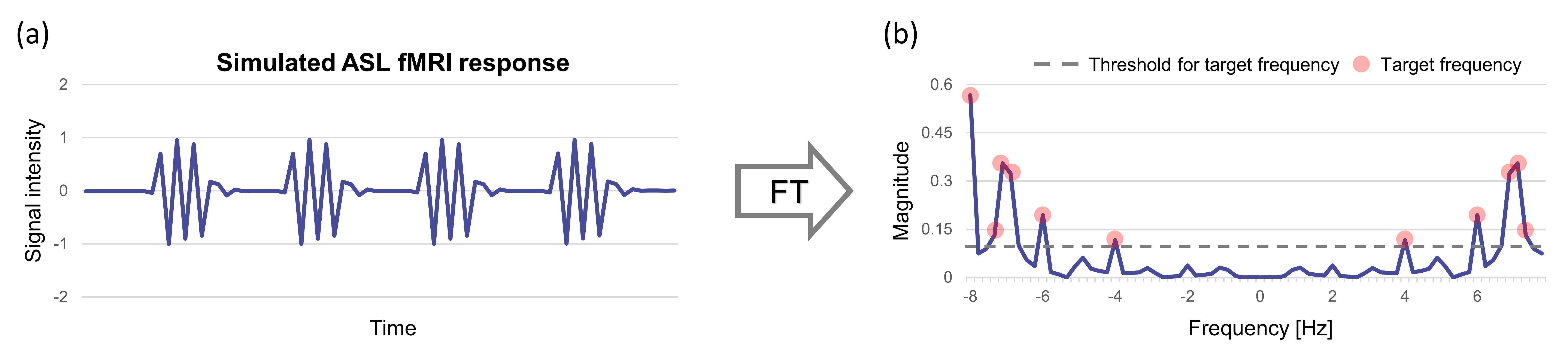
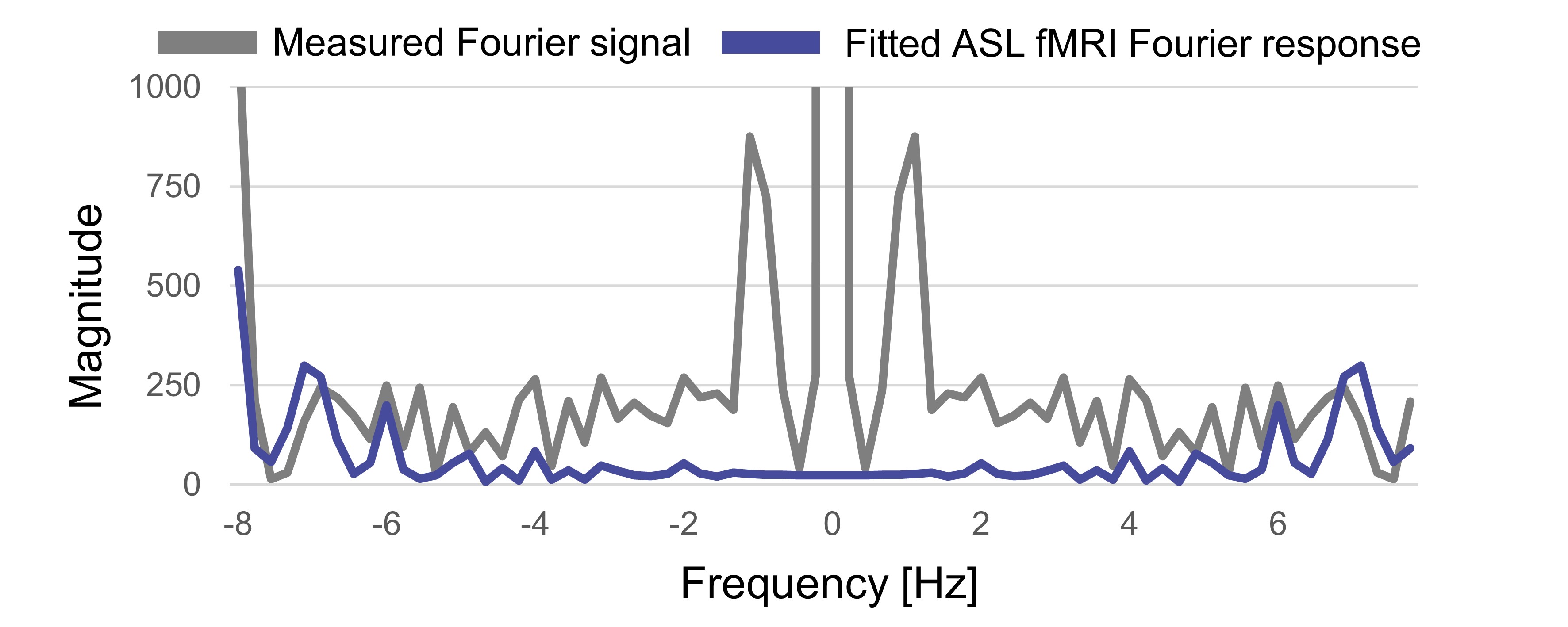
(Compensation of abrupt artifacts) The perfusion-weighted image (PWI) was obtained by the 3D EPI pseudo-continuous ASL at 3T MRI (Siemens, Skyra). Then, abrupt artifacts were added with random magnitude at random time points. The added artifacts can change the $$$X_{N/2}$$$ value in Fourier domain, where the perfusion signal is confined1, potentially spoiling the PWI. Therefore, estimating and subtracting the $$$X_{N/2}$$$ value of artifacts ($$$X'_{N/2}$$$) from $$$X_{N/2}$$$ can recover the PWI1. Assuming that the non-perfusion signals vary smoothly, $$$X'_{N/2}$$$ can be estimated by the following objective function. $$X'_{N/2}=\underset{X_{N/2}}{argmin}{\sum_{i=3}^{N-2}{std(S\left(i-2:i+2;X_{N/2}\right))}}$$ Time series was reconstructed by the given $$$X_{N/2}$$$. Time points of abrupt artifacts were preliminarily determined by z-score method2 and then the artifact magnitudes were mitigated to $$$mean+1.5std$$$ of ordinary time points3. Standard deviations were calculated within a moving window of 5 time points ($$$S\left(i-2:i+2;X_{N/2}\right)$$$), and then summed across different window locations. $$$X'_{N/2}$$$ was determined as the value minimizing this objective function.(ASL fMRI processing) The ASL fMRI experiment was conducted at 7T MRI (Siemens, Terra) for a single subject. The subject gazed at a flickering checkerboard (27s) and rested (45s), repeating this cycle four times. The ASL fMRI data was processed by FSL’s motion correction4. The process for ASL fMRI data analysis in Fourier domain was as follows: First, both the measured time signal and simulated ASL fMRI response were Fourier-transformed. (Figure 1) Secondly, the target frequency range was determined from the ASL fMRI frequency response as frequency components having $$$mean+0.5std$$$ or higher magnitude. (Figure 1.b) Lastly, the correlations between the signal and response were measured voxel-wise in Fourier domain by weighted-least squares (Figure 2), which minimized the following error function:$$\hat{y}\ =\ \beta_0+\beta_1x+\varepsilon$$$$error\ =\ \sum_{i=1}^{N}{w_i\left(y_i-{\hat{y}}_i\right)^2}$$ where $$$y_i$$$ and $$${\hat{y}}_i$$$ are measured and regressed magnitudes at each frequency, $$$w_i$$$ is weight for each frequency, and $$$N$$$ is the number of points in Fourier domain. $$$w_i$$$ is determined as 5 for the target frequencies, 0 for 0 Hz component, and 1 for the others. $$$\beta_0$$$ and $$$\beta_1$$$ are estimates that minimize the error function, and $$$\beta_1$$$ indicates the correlation with the ASL fMRI response ($$$x$$$). For comparison, correlations were also calculated in the temporal domain by least squares.
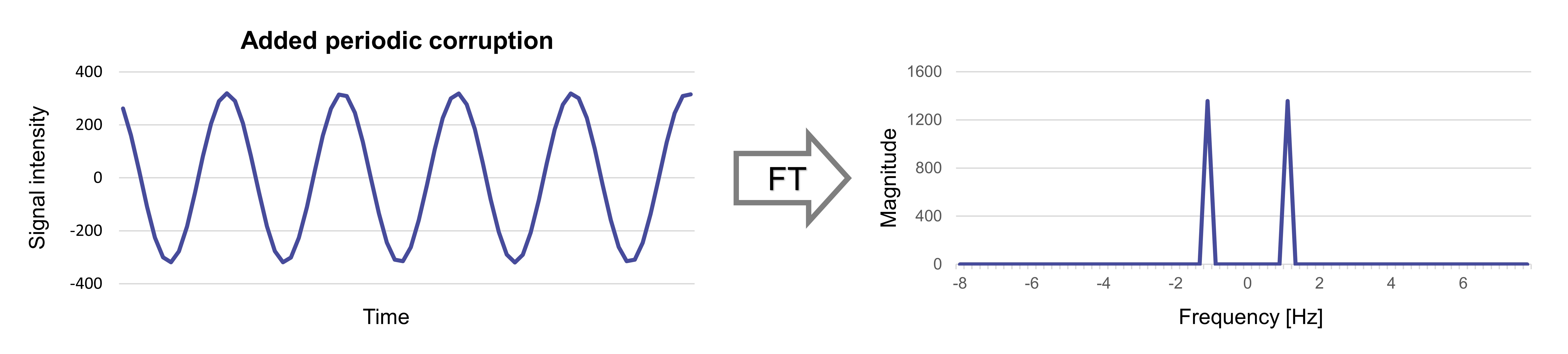
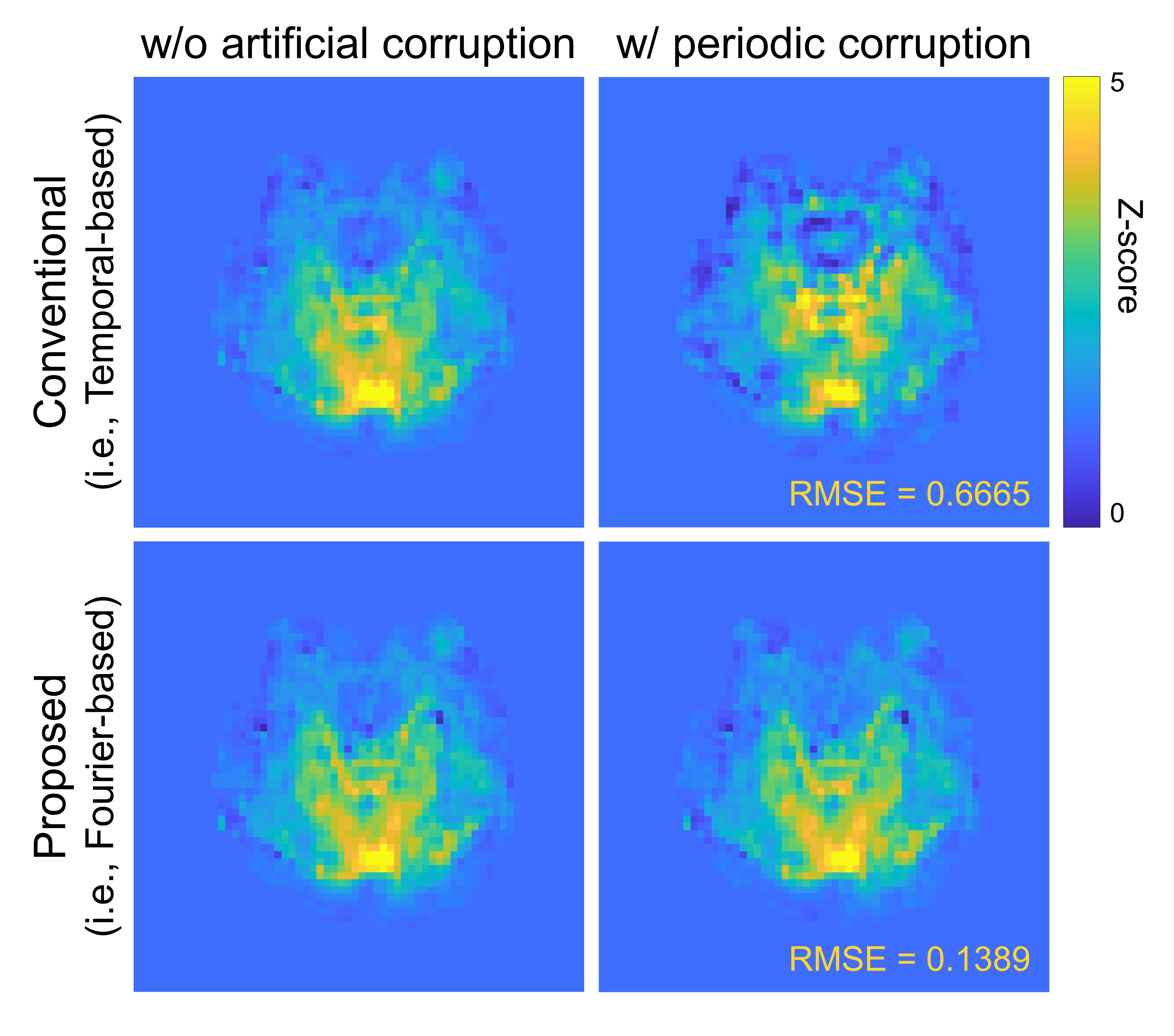
(Artificial periodic artifacts) An 1 Hz periodic artifact, mimicking the cardiac motion, was artificially generated to test the robustness of the proposed method and added to the measured data. (Figure 3) The corrupted data was processed by both the conventional and proposed methods.
(Evaluation) The robustness to the abrupt and periodic artifacts was quantitatively evaluated by SNR and root mean square error (RMSE).
RESULT AND DISCUSSION
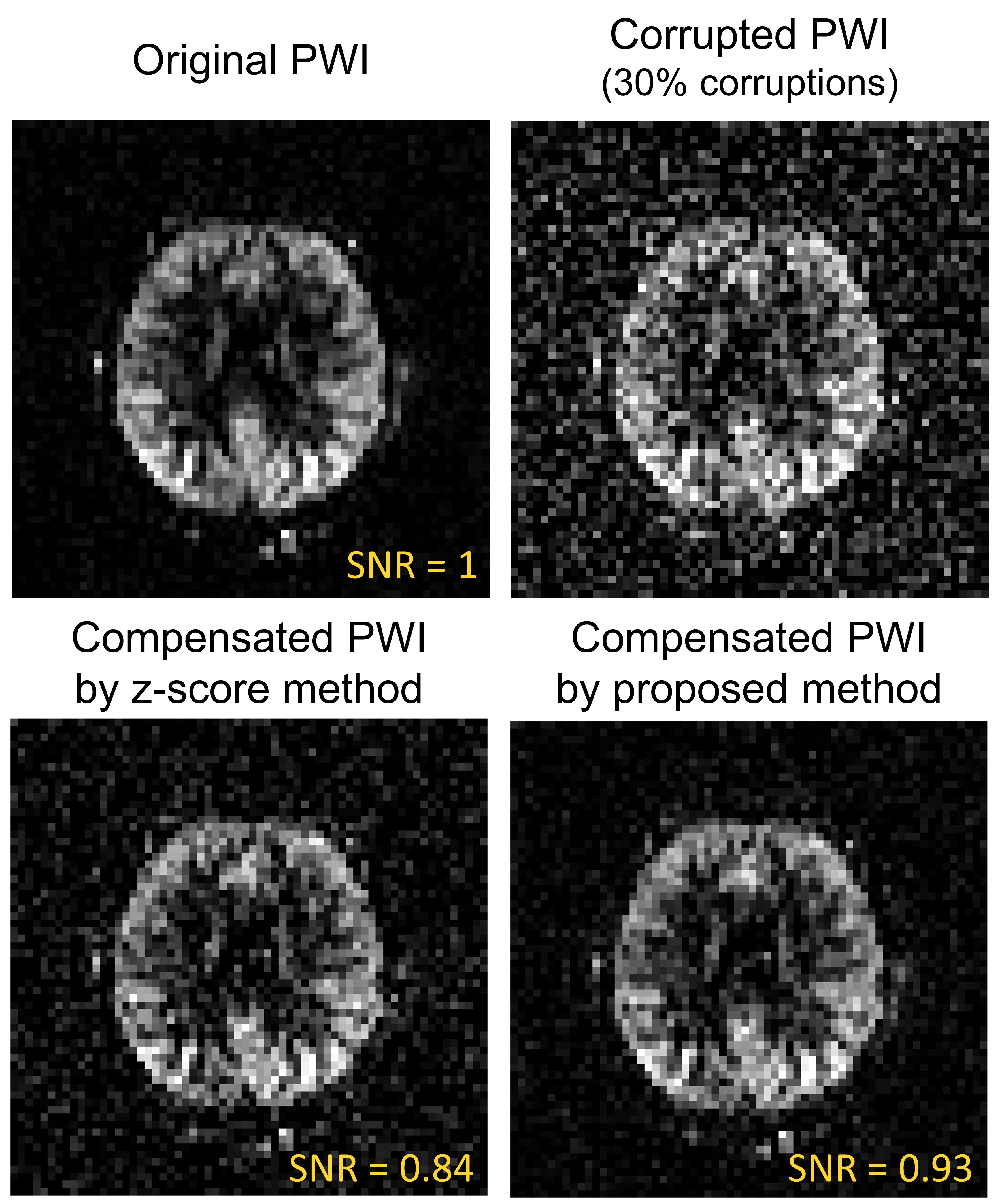
Figure 4 shows that the proposed method for compensation of abrupt artifacts had superiority over the conventional z-score method. Since the proposed method does not eliminate the outlier timepoints, it can maintain the SNR. Figure 5 shows that the proposed Fourier-based method generated fMRI maps similar to those obtained using the conventional temporal-based method. This indicates that ASL fMRI data can be analyzed not only in temporal domain but also in Fourier domain, demonstrated for the first time in this study, to our knowledge. The advantage of the Fourier-based method was verified by the corrupted data with periodic signals. In the conventional temporal-based method, calculated fMRI maps were different between the cases without and with periodic artifacts (RMSE = 0.6665), implying the sensitivity to the given artifact. On the other hand, the Fourier-based method produced almost the same fMRI maps (RMSE = 0.1389) between the two cases, proving robustness to the periodic artifacts for the fMRI data processing.CONCLUSION
Processing ASL data in Fourier domain can facilitate development of analysis methods robust against various artifacts such as abrupt and periodic artifacts. These methods took advantage of distinctive features of some artifacts that appear as a simple form in Fourier domain. Furthermore, beyond its robustness to artifacts, analysis in Fourier domain also holds the potential to offer new perspectives on ASL data including fMRI, making it a promising ASL analysis technique.Acknowledgements
No acknowledgement found.References
1. Hwang S-H, Park SH. A novel Fourier-based perspective to analyze and compensate for corruption in arterial spin labeling MRI. 2023 ISMRM & SMRTANNUAL MEETING & EXHIBITION; 2023; Toronto, Canada.
2. Tan H, Maldjian JA, Pollock JM, et al. A fast, effective filtering method for improving clinical pulsed arterial spin labeling MRI. Journal of Magnetic Resonance Imaging: An Official Journal of the International Society for Magnetic Resonance in Medicine. 2009;29(5):1134-1139.
3. Maumet C, Maurel P, Ferré J-C, Barillot C. Robust estimation of the cerebral blood flow in arterial spin labelling. Magnetic resonance imaging. 2014;32(5):497-504.
4. Jenkinson M, Beckmann CF, Behrens TE, Woolrich MW, Smith SM. Fsl. Neuroimage. 2012;62(2):782-790.
Figures