3266
Deep learning-based scrubbing of fMRI data and its applications on delineating infant brain functional development trajectories1School of Biomedical Engineering, ShanghaiTech University, Shanghai, China, 2Shanghai Clinical Research and Trial Center, Shanghai, Shanghai, China
Synopsis
Keywords: Data Processing, fMRI
Motivation: Noise and artifacts significantly corrupt fMRI data.
Goal(s): It has a significant potential in enhancing research outcomes for challenging populations like children and older subjects whose data prone to have noise, facilitating reliable fMRI studies.
Approach: We present a deep learning-based Automatic fMRI Scrubbing via Graph Attention (ASGA), to perform fMRI data “scrubbing” by automatically identifying and removing contaminated volumes. To achieve this, we firstly design an easy-to-implement carpet plot-based labeling tool for human labelling, which is fed to ASGA model training. By applying ASGA to two large-cohort studies (BCP and CBCP).
Results: our method effectively removed noise-contaminated volumes without human interference.
Impact: Compared to other fMRI data censoring approaches, ASGA is automatic, targeting on general noise and artifacts, can better enhance fMRI analysis accuracy and research outcomes, especially useful for challenging populations such as children, older subjects, and patients.
Introduction
During fMRI scans, noise contamination from factors like subject motion, respiration, and scanner instability is common. Scrubbing or data censoring is widely used to remove these contaminated volumes from the data1.Carpet plot offers a visual representation for the assessment of fMRI quality, aiding in identifying artifacts and unwanted signals1. It is a two-dimensional gray-scale map, with each horizontal line representing the time series of each voxel or brain region. By inspecting vertical stripes on the carpet plot, fMRI data preprocessing quality can be evaluated. However, the feasibility of using the carpet plot for data scrubbing was not investigated. Manually scrubbing contaminated volumes according to stripes on the carpet plot requires intensive human labor, introducing bias and errors.
We introduce a novel, deep learning-based automatic fMRI scrubbing method, Automatic fMRI Scrubbing via Graph Attention (ASGA), to perform fMRI data “scrubbing” by automatically identifying and removing contaminated volumes from carpet plot, enhancing fMRI analysis accuracy and research outcomes.
Methods
We first developed a MATLAB toolbox with GUI for easy manual annotation of “bad volumes” according to significant “vertical strips” on carpet plots. With the help of the carpet plot, users can evaluate the effect of scrubbing on functional connectivity results in a real-time fashion. The annotations will be fed into our automatic scrubbing model. During the annotation process, the following guidelines should be considered: 1) abrupt or slow global signal changes indicate noise and artifacts, taking an appearance of vertical strips on carpet plot; 2) two reference time courses, global mean signal, and framewise variability, were presented to facilitate decision making; 3) functional connectivity matrix after a successful data scrubbing should become more sparse and structured (Fig. 1).With annotated data, we then designed a supervised model, ASGA, for automatic fMRI scrubbing. The flowchart and model details are depicted in the Fig. 2. Specifically, regional averaged preprocessed fMRI time series are extracted based on certain parcellation scheme (e.g., AAL) for gray-scale carpet plot. The carpet plot is then fed into the decision model consisting of feature abstraction with 1D-CNN for a latter dual-attention mechanism focusing on both temporal (temporal GAT) and spatial features (feature GAT) of the complex fMRI time series, before a Gated Recurrent Unit (GRU)-based variational auto-encoder for time series self-reconstruction and a prediction model (with fully connected layers) for predicting features at the next time point based on the current time point. This capability facilitates the model’s comprehension of the interconnections among diverse features and harnesses this comprehension for anomaly detection. Two loss functions, reconstruction loss and predicting loss (KL divergence), were jointly optimized for anomaly score prediction. With the threshold iteratively derived from the training set, anomaly scores for all time points can be binarized, reaching the scrubbing decision.
To test the performance of ASGA, we used a large-scale infant fMRI cohort from the Baby Connectome Project (BCP, 283 infants aged 0-5, 570 fMRI scans). The data was divided into training, validation, and testing sets at a 7:2:1 ratio. We further tested the effectiveness of ASGA on a new infant fMRI cohort (China BCP, 90 infants aged (0-6) years. We compared our method with common scrubbing strategies, framewise displacement (FD)2 and DVARS3 regarding the functional connectivity results and derived developmental curves.
Results
Our ASGA model resulted in a scrubbing accuracy of 95% recall, 92% precision, and a F1-score of 0.93 on the testing set from the BCP data. Fig. 3 shows that, compared to FD and DVARS scrubbing, ASGA preserved more fMRI volumes. With noisy volumes accurately removed, ASGA generated more reasonable functional connectivity estimates. Figs. 4-5 show that ASGA effectively removed noise contaminated fMRI volumes and resulted in better (more compact scatter plots) brain connectivity developmental trajectories than other scrubbing methods did.Discussion and Conclusions
Compared to other data censoring approaches, ASGA is automatic, effectively targeting on noise and artifacts, and can better enhance fMRI analysis accuracy and research outcomes, making it especially useful for fMRI studies challenging populations such as children, older subjects, and patients. ASGA has been implemented in standard preprocessing pipeline for a large-scale CBCP study.Acknowledgements
This work is partially supported by the STI 2030—Major Projects (2022ZD0209000), Shanghai Zhangjiang National Innovation Demonstration Zone Special Funds for Major Projects “Human Brain Research Imaging Equipment Development and Demonstration Application Platform” (ZJ2018-ZD-012), Shanghai Pilot Program for Basic Research—Chinese Academy of Science, Shanghai Branch (JCYJ-SHFY-2022-014), Open Research Fund Program of National Innovation Center for Advanced Medical Devices (NMED2021ZD-01-001), Shenzhen Science and Technology Program (KCXFZ20211020163408012), and Shanghai Pujiang Program (21PJ1421400).
References
1. Esteban, O., Markiewicz, C. J., Blair, R. W., Moodie, C. A., Isik, A. I., Erramuzpe, A., ... & Gorgolewski, K. J. (2019). fMRIPrep: a robust preprocessing pipeline for functional MRI. Nature methods, 16(1), 111-116.
2. Power J D, Mitra A, Laumann T O, et al. Methods to detect, characterize, and remove motion artifact in resting state fMRI[J]. Neuroimage, 2014, 84: 320-341.
3. Afyouni S, Nichols T E. Insight and inference for DVARS[J]. NeuroImage, 2018, 172: 291-312.
Figures
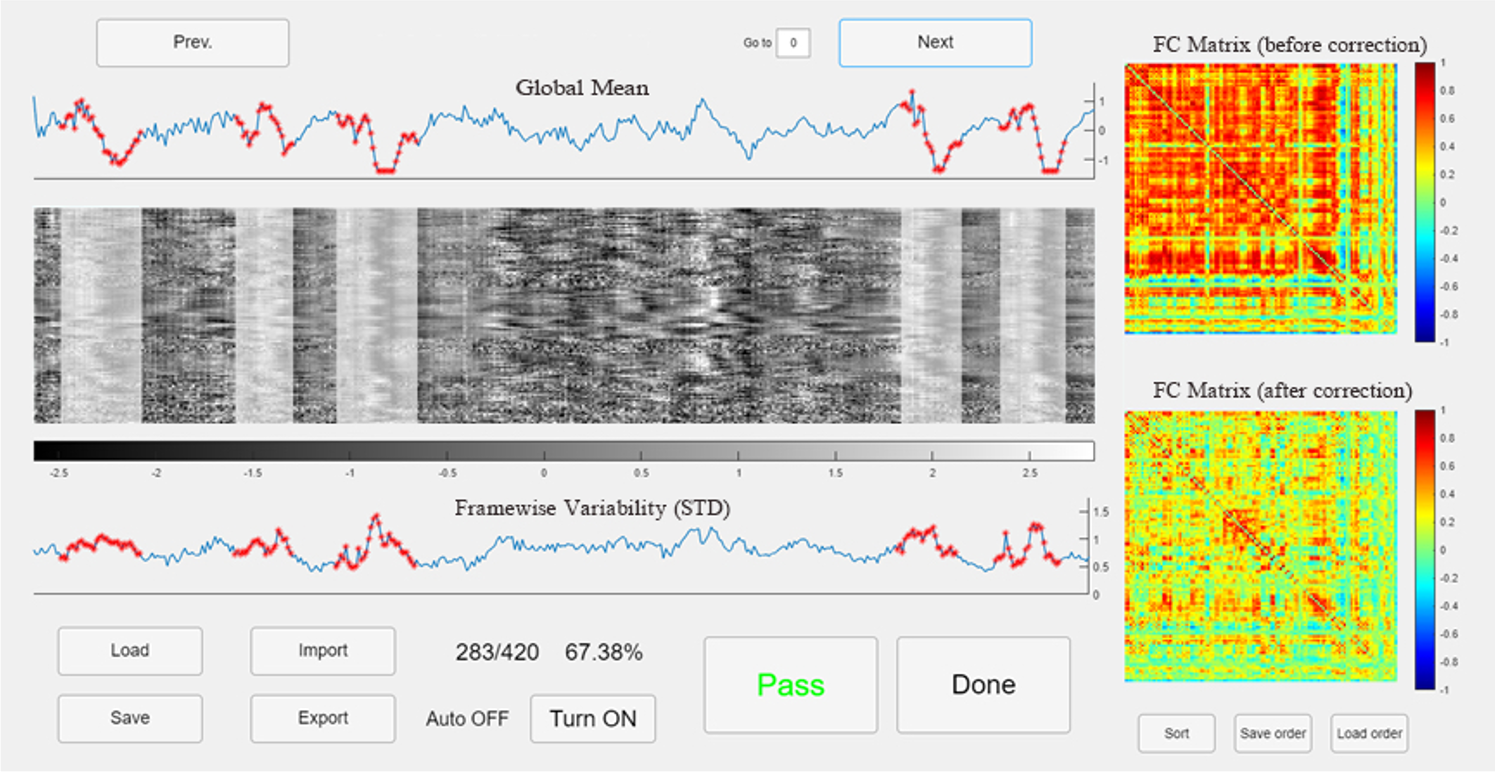
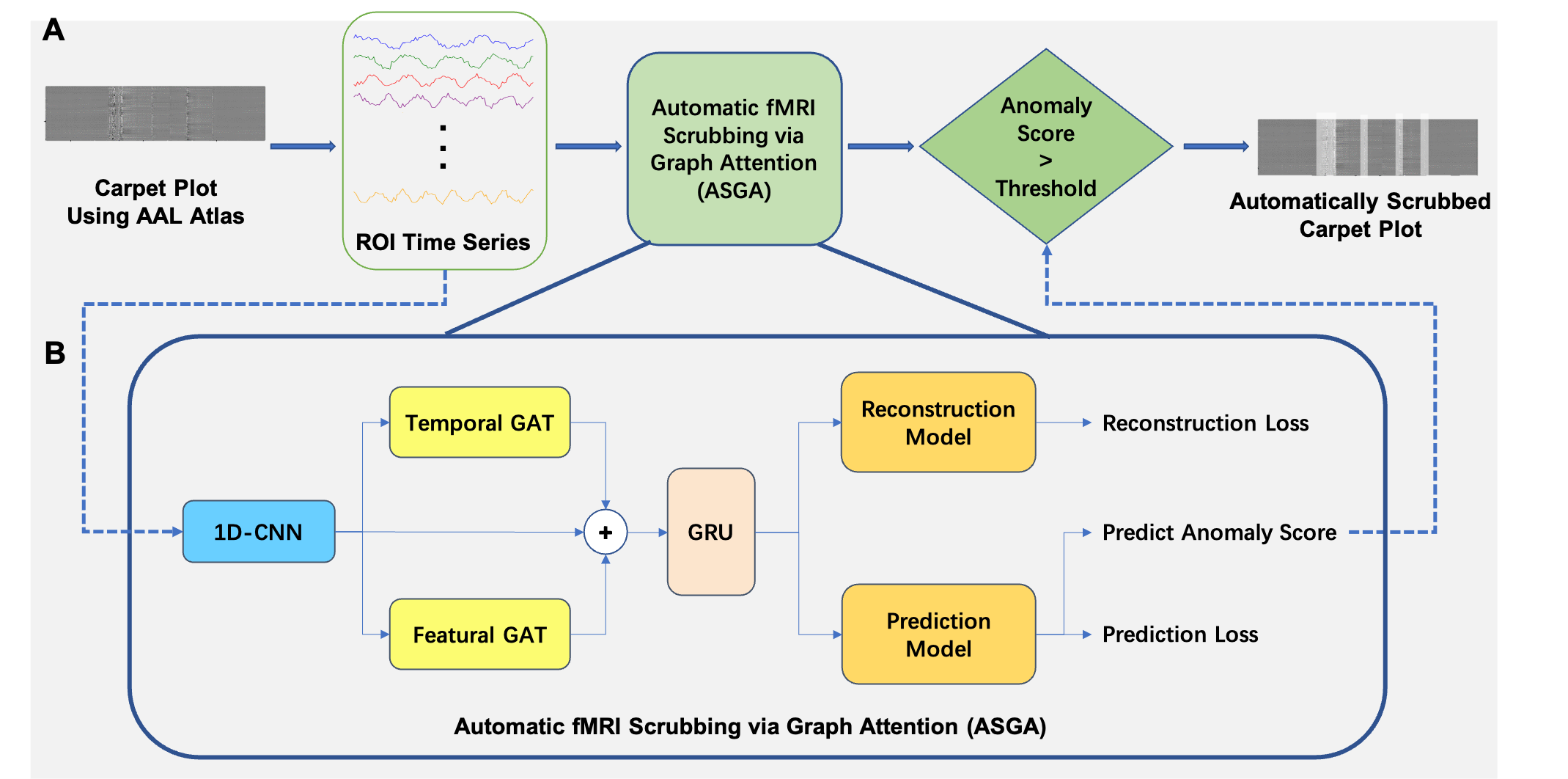
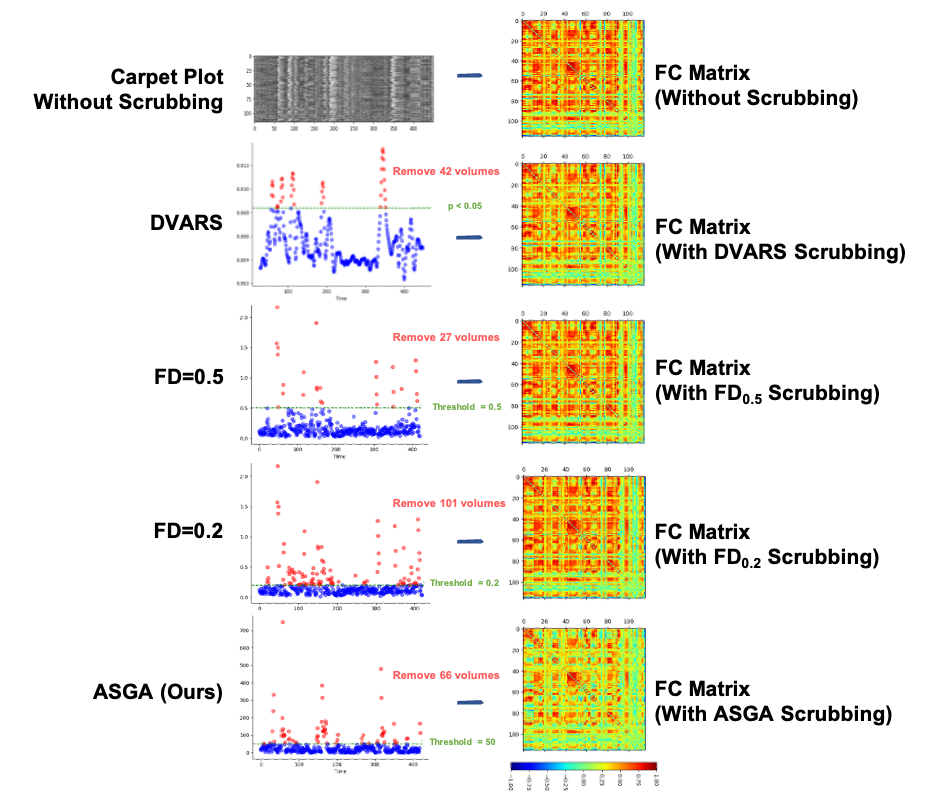
Fig. 3 Comparison of different scrubbing methods, and the derived functional connectivity matrices after scrubbing. Red dots indicate detected noise contaminated fMRI volumes. For reference, the carpet plot and the functional connectivity matrix without any data scrubbed were shown.
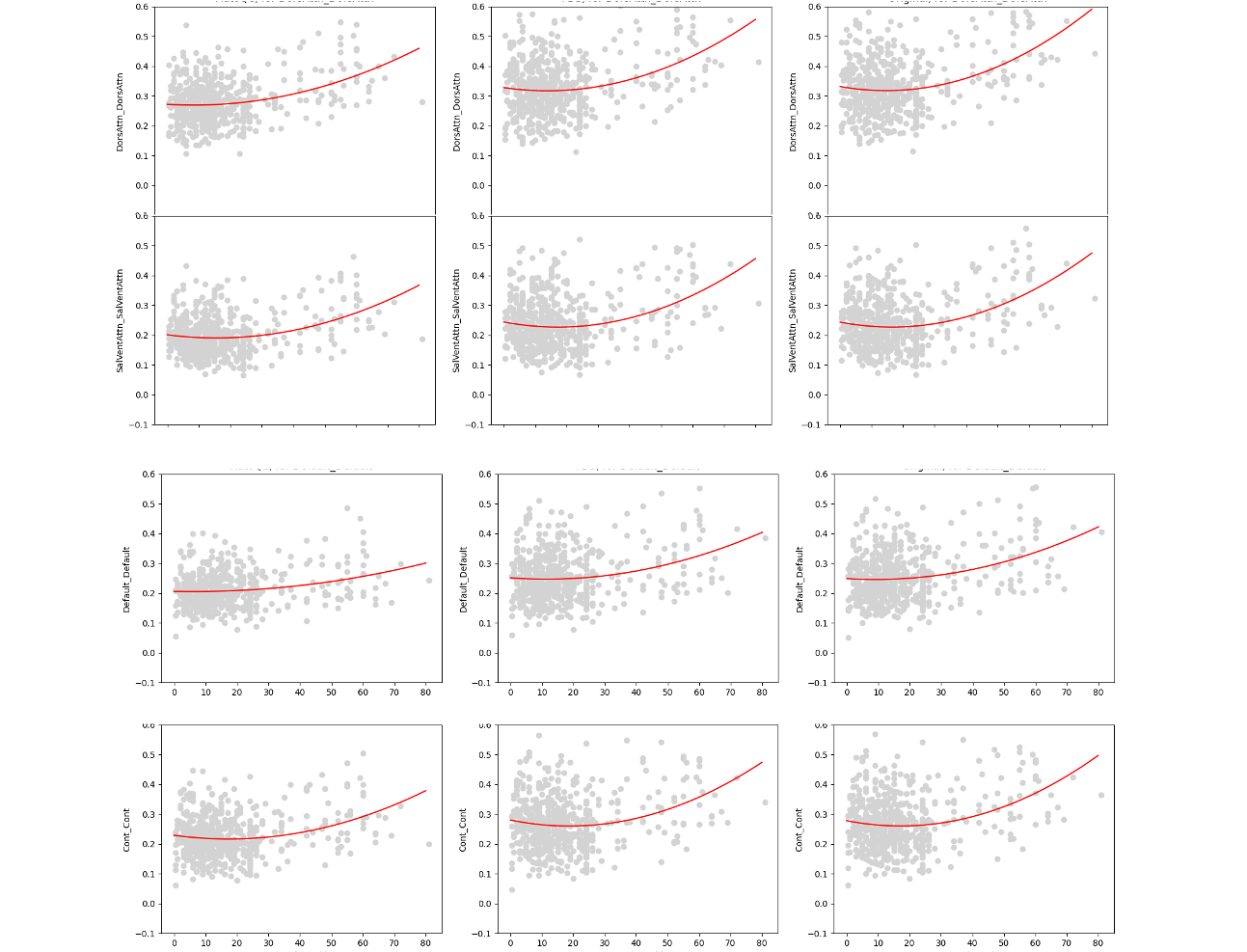
Fig. 4 Exemplary within-subnetwork functional connectivity developmental curves. Our method, compared with those with FD scrubbing and no scrubbing, resulted in more compacted functional connectivity changing curves during early infancy.
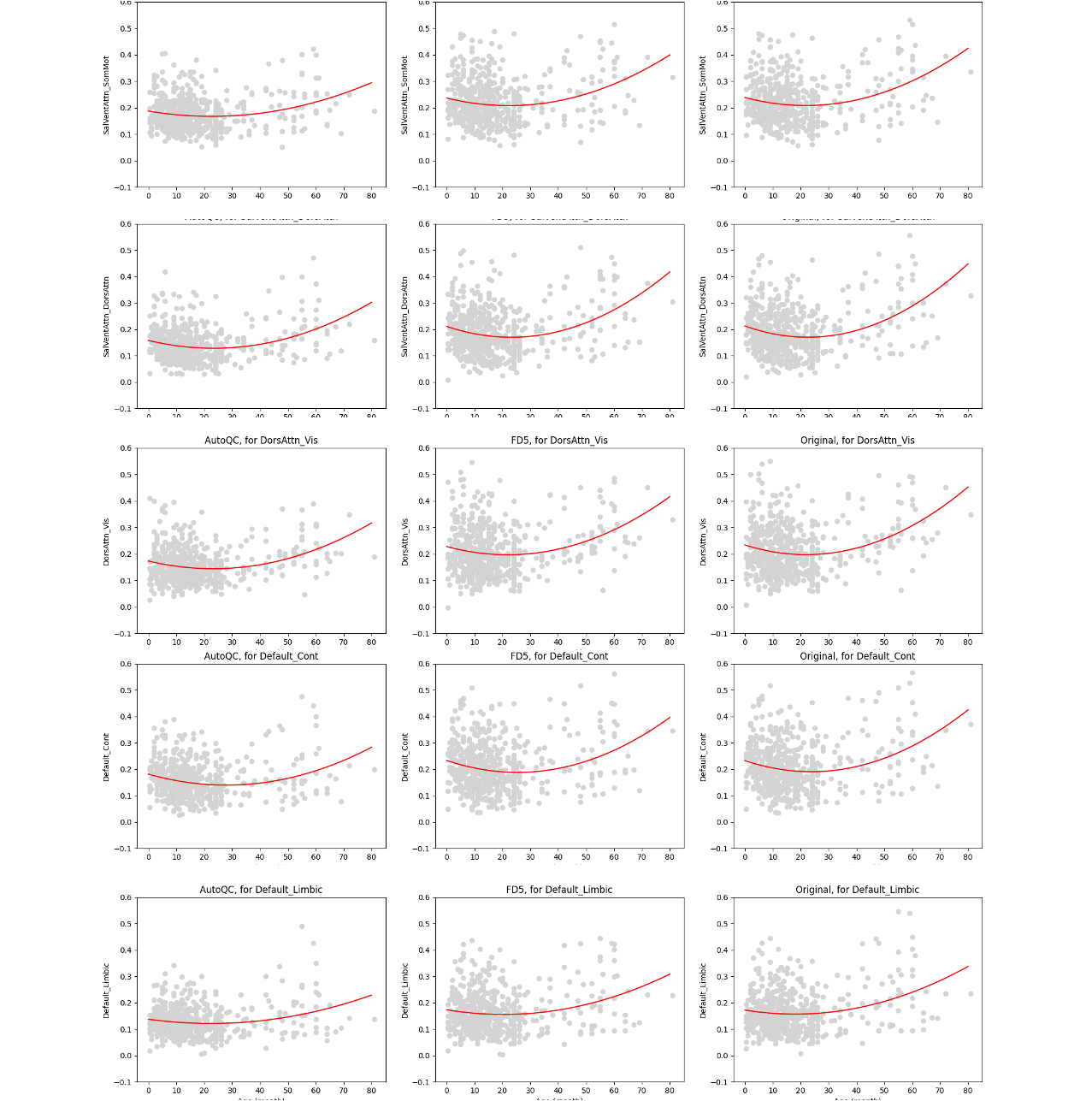
Fig. 5 Exemplary between-subnetwork functional connectivity developmental curves. Our method outperformed FD scrubbing and no scrubbing in terms of scatter plot compactness.