3265
High-Resolution 3D Magnetization-Prepared GRE with Inherent Phase-cycling (iPC MP-GRE)1Radiology, Albert Einstein College of Medicine, and Montefiore Medical Center, Bronx, NY, United States, 2Philips Healthcare, Cambridge, MA, United States, 3Department of Medical Physics, Memorial Sloan Kettering Cancer Center, New York, NY, United States
Synopsis
Keywords: Pulse Sequence Design, Data Acquisition, Image reconstruction, quantitative mapping, fast imaging, compressed sensing, T1rho
Motivation: Magnetization-prepared (MP) 3D gradient-echo (GRE) MRI sequences suffer from T1 relaxation-induced artifacts, necessitating short echo train lengths. Paired phase-cycling (pPC) mitigates this but at the cost of doubled scan time.
Goal(s): This research introduces inherent phase-cycling (iPC) to 3D MP-GRE sequences, aiming to eliminate T1-related artifacts without extending scan time.
Approach: iPC combines random PC+ and PC- acquisitions within a single 3D sequence. It is demonstrated that iPC, coupled with compressed sensing reconstruction, achieves high-resolution imaging without scan time increase.
Results: iPC significantly reduces ghosting and blurring artifacts compared to pPC, with potential applications in accelerated and artifact-free MRI.
Impact: The iPC MP-GRE sequence improves image quality while reducing scan time and complexity. It promises faster, clearer diagnostic imaging, benefiting medical research and patient care, and opens doors to broader applications in quantitative parameter mapping and beyond.
Introduction
Magnetization-prepared (MP) 3D gradient-echo (GRE) sequences are widely used in MRI due to its high imaging efficiency and flexible sequence design for MR contrast manipulation. However, it suffers from signal contaminations from tissue T1 recovery during the GRE readout train, which leads to ghosting and blurring artifacts along the phase encoding directions in the resultant images1. Therefore, a short GRE echo train length (ETL) and a centric (low-high) k-space profile ordering are typically employed2. The contamination can also be eliminated by a paired Phase-Cycling (pPC) scheme at the cost of doubling the scan time3. We introduce here an “inherent phase-cycling” (iPC) strategy for iPC MP-GRE sequences with complementary k-space acquisitions, which combines a random half of positive PC (PC+), and a half of negative PC (PC-) phase-encoding acquisitions in one single 3D sequence. We demonstrated that iPC MP-GRE can achieve high spatial-resolution 3D imaging without increasing scan time.Theory
3D MAPSS sequence with pPC was proposed for high-resolution 3D MP-GRE3. In MAPSS, two independent 3D datasets must be acquired with PC+ and PC-, respectively. In PC+, Mxy(n+) = +A(n)Mprep + B(n), and in PC-, Mxy(n-) = -A(n)Mprep + B(n), where Mprep is the signal from MP, A(n) is the GRE train signal controllable by the RF flip-angle train, and B(n) is the T1 relaxation contaminations along the GRE train. Subtraction of these two datasets will lead to 2×A(n)Mprep with B(n) term eliminated. To avoid two independent 3D acquisitions, PC can be performed by randomly distributed phase-encodings within the same 3D acquisition. If the phase of the AQ receiver is inverted in PC- acquisitions, we will have a single 3D k-space dataset mixed with PC+: Mxy(n+)=+A(n)Mprep + B(n), and -PC-: Mxy(n-) = +A(n)Mprep - B(n), where B(n) can now be treated as noises, readily suppressed by sparsity regularization using compressed sensing or AI-based reconstruction techniques.Methods
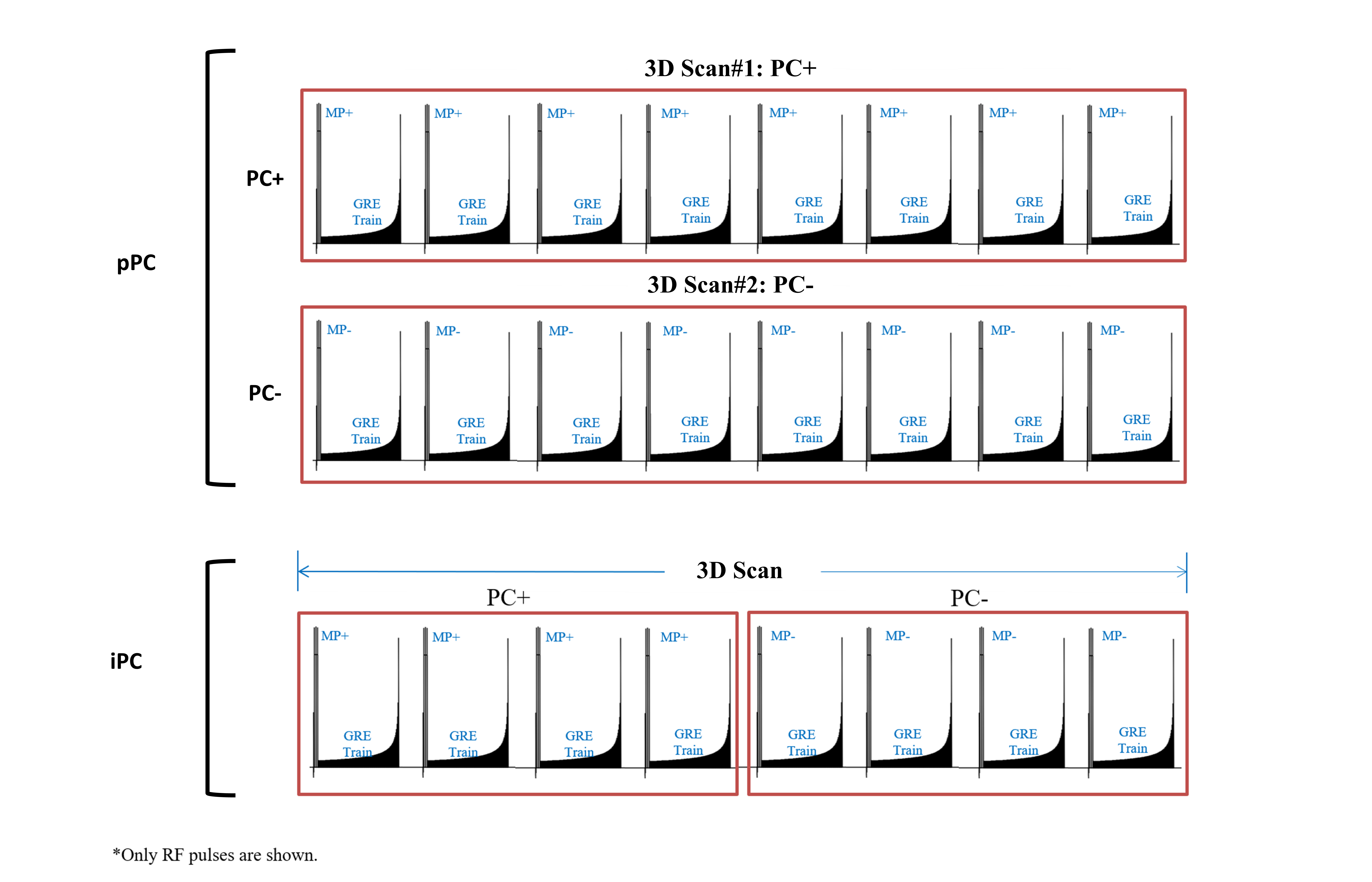
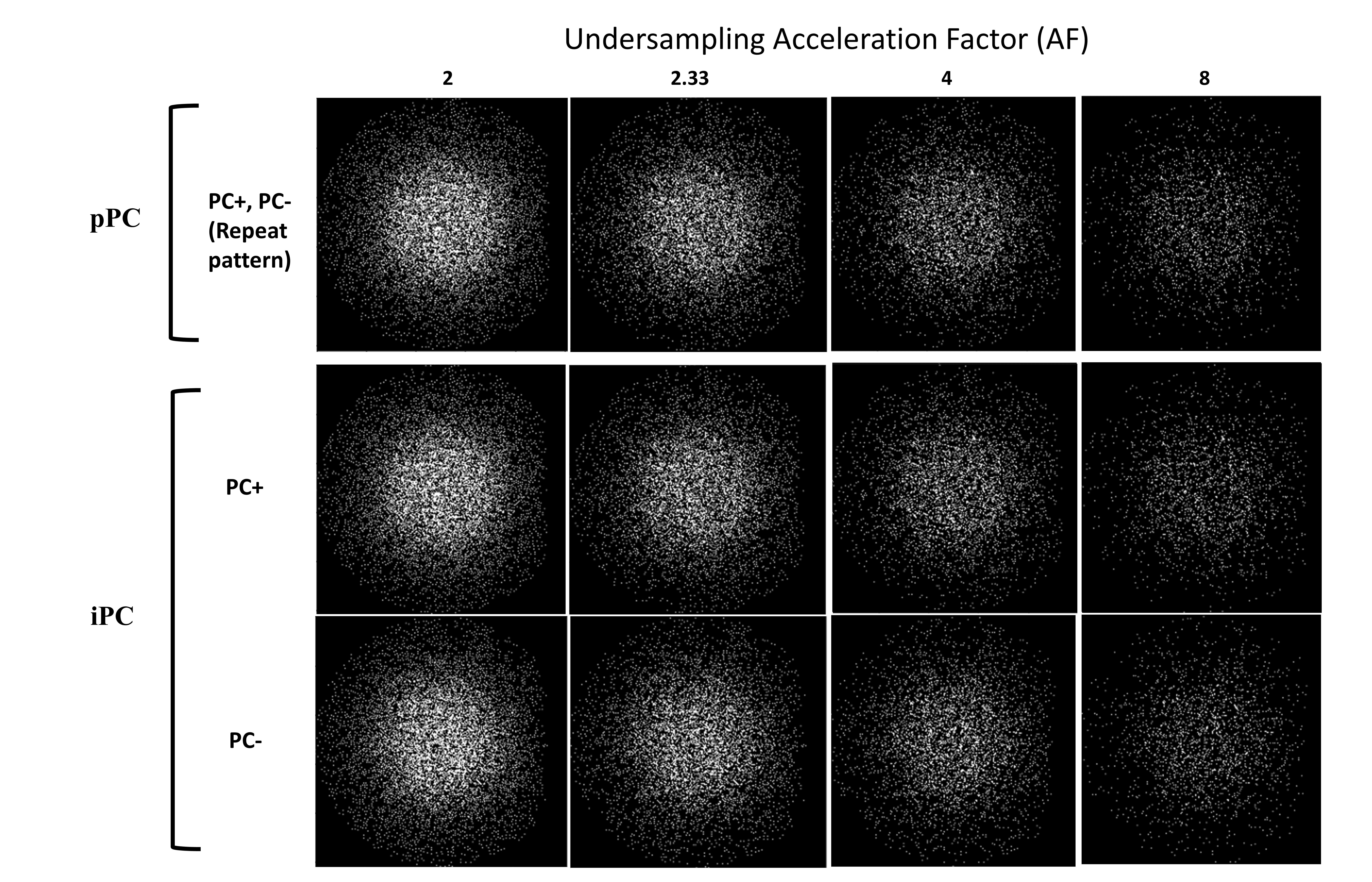
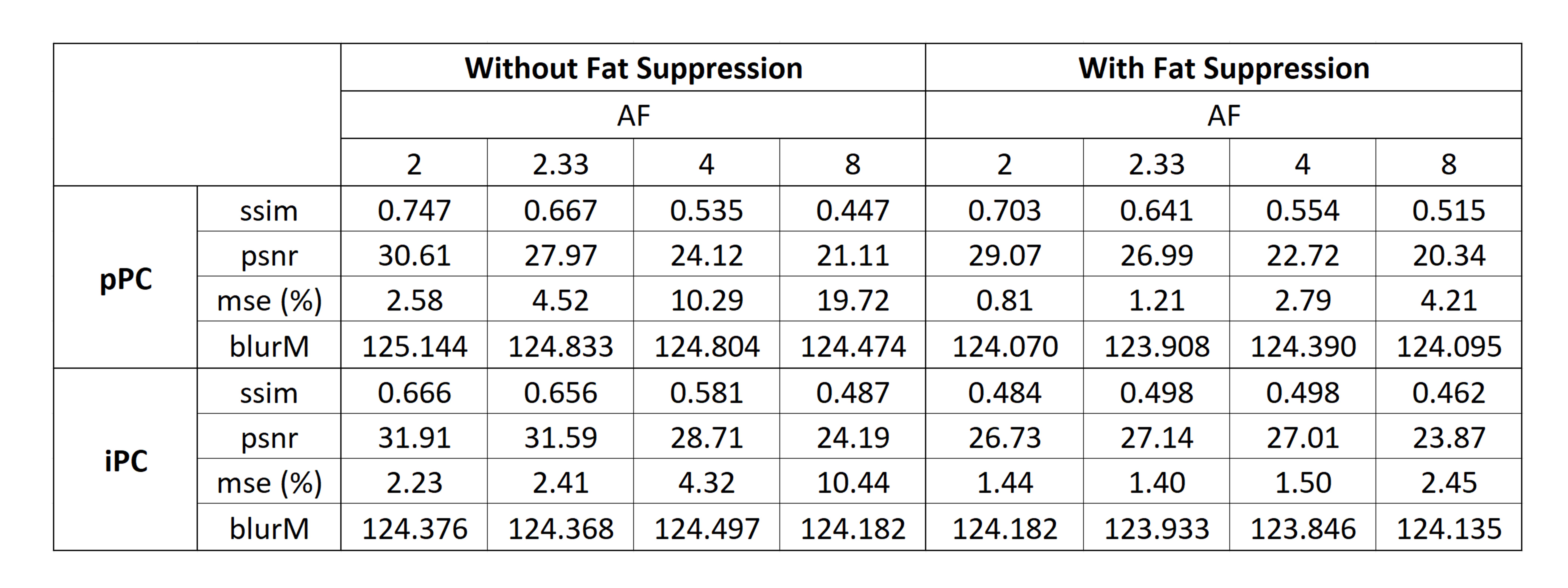
3D T1rho-weighted sagittal knee scans were performed with and without fat suppression (FS) using a T1rho MAPSS sequence with pPC4, and with iPC, which was modified to have half GRE shots (segments) acquired with PC+ and the second half with signal-inverted PC-. The pulse sequence design of both pPC and iPC is shown in Fig.1. Four different ky-kz undersampling acceleration factors (AF) for both cases are shown in Fig.2, giving the same scan duration for fair comparison. Imaging parameters included: FOV=150mm and matrix size of 256 in all three directions, TR/TE=8.7/3.9ms, Tsr=1s, GRE ETL=96 (or 835ms) with centric profile ordering, and T1rho spin-lock time=30ms. A fully sampled pPC dataset (effective AF=0.5) was also obtained as ground truth. All images were reconstructed using BART using standard 3D compressed sensing reconstruction with total variation regularization optimized individually for each sequence5. Reconstructed image quality was compared qualitatively with visual inspection and quantitative evaluation using quantitative metrics including SSIM, PSNR, mean squared error (MSE), and image blur metric (BlurM, lower value is better)6.Results
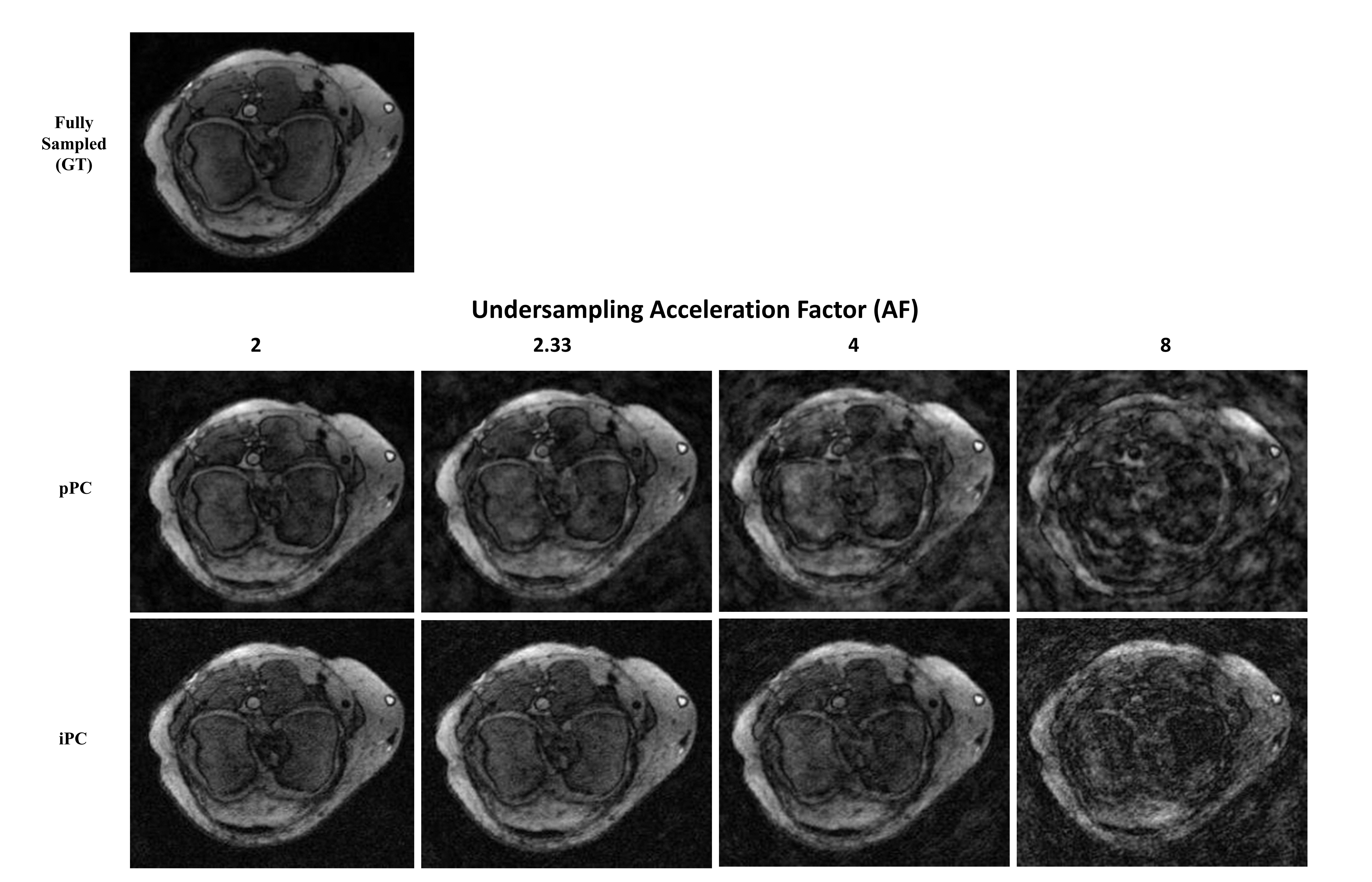
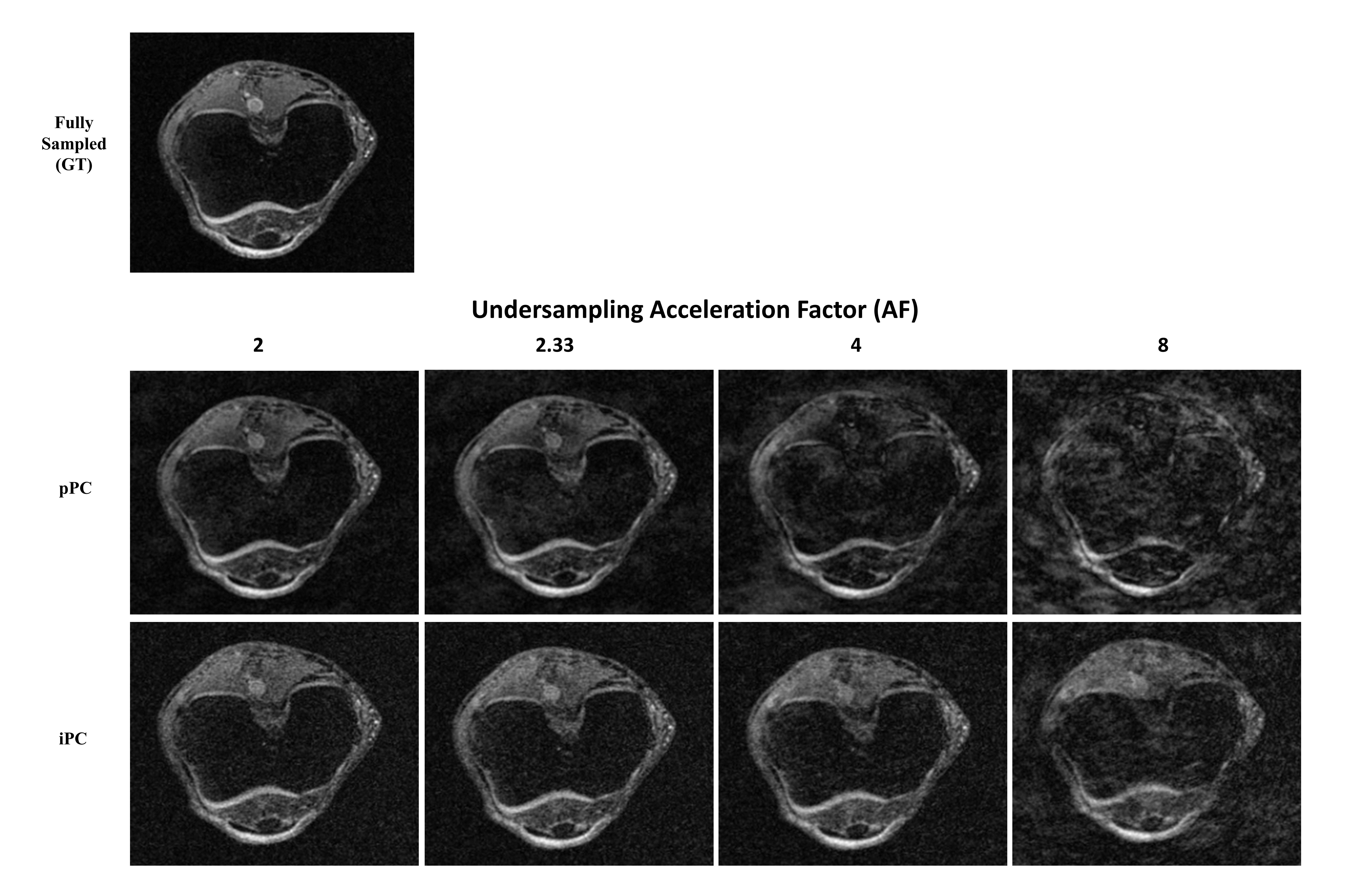
Representative reconstructed pPC and iPC images are shown in Fig. 3 (non-FS) and Fig. 4 (FS). From visual inspection, iPC images are generally slightly noisier but sharper and cleaner compared to the corresponding pPC images, suffering much less from residual aliasing ghosting and blurring artifacts due to k-space undersampling. This is particularly true when AF is high. This observation is consistent for both the non-FS and the FS sequences. Note that fat is completely suppressed for both pPC and iPC in the FS sequence, even with the GRE train length about 3 times of fat T1, confirming the full removal of fat T1-relaxation contaminations using both PC schemes. Quantitative evaluation results are also overall consistent with visual inspection results (Table 1).Discussions
With a minor modification of the original pPC pulse sequence, the new iPC MP-GRE sequence leads to 3D k-space datasets compatible with non-PC sequences, readily reconstructed into 3D images without T1-relaxation contamination using standard CS reconstruction algorithms. Not only does it reduce scan time by half, but also it eliminates the current complexity of data processing for PC+ and PC- datasets. It also circumvents the potential difficulty of motion-correction between the two datasets with different boundary contrasts. The qualitative and quantitative results from a T1rho-weighted sequence confirmed that iPC is advantageous compared to the traditional pPC approach. We believe artificial intelligence-based reconstruction may provide even better and more consistent performance compared to the current compressed sensing-based reconstruction approach. Additionally, much higher acceleration factors can be achieved if higher dimensional datasets are needed, such as in quantitative parameter mapping.Conclusion
Inherent phase-cycling in iPC MP-GRE can have high imaging efficiency without suffering from ghosting/blurring artifacts along the phase-encoding directions.Acknowledgements
No acknowledgement found.References
1. Hsu JJ, Lowe IJ. Spin-lattice relaxation and a fast T1-map acquisition method in MRI with transient-state magnetization. JMR. Aug 2004;169(2):270-8.
2. Mugler JP, 3rd, Epstein FH, Brookeman JR. Shaping the signal response during the approach to steady state in three-dimensional magnetization-prepared rapid gradient-echo imaging using variable flip angles. MRM. Dec 1992;28(2):165-85.
3. Li, X., Han, E.T., Busse, R.F. and Majumdar, S., 2008. In vivo T1ρ mapping in cartilage using 3D magnetization‐prepared angle‐modulated partitioned k‐space spoiled gradient echo snapshots (3D MAPSS). Magnetic Resonance in Medicine: An Official Journal of the International Society for Magnetic Resonance in Medicine, 59(2), pp.298-307.
4. Peng, Q., Wu, C., Kim, J. and Li, X., 2022. Efficient phase‐cycling strategy for high‐resolution 3D gradient‐echo quantitative parameter mapping. NMR in Biomedicine, 35(7), p.e4700.
5. Uecker M, Tamir JI, Ong F, Lustig M. The BART toolbox for computational magnetic resonance imaging. In Proceedings of the 24th Annual Meeting of ISMRM, Singapore, 2016. Doi: 10.5281/ zenodo.592960
6. Marziliano, P., Dufaux, F., Winkler, S. and Ebrahimi, T., 2002, September. A no-reference perceptual blur metric. In Proceedings. International conference on image processing (Vol. 3, pp. III-III). IEEE.
Figures