3263
Why have ZTE or bSSFP when you can have both?1Department of Neuroimaging, King's College London, London, United Kingdom, 2Electrical Engineering and Computer Sciences, University of California, Berkeley, Berkeley, CA, United States
Synopsis
Keywords: Pulse Sequence Design, Pulse Sequence Design, ZTE bSSFP
Motivation: Zero Echo-Time MRI has numerous advantages over conventional pulse sequences but also several drawbacks including inefficient k-space sampling and limited PD/T1 contrasts.
Goal(s): Improving the efficiency, SNR and contrasts available with ZTE.
Approach: Utilising a 3D rosette trajectory to combine the best aspects of the ZTE and bSSFP sequences.
Results: Preliminary data indicating the feasibility of the bSSFP ZTE sequence and highlighting limits imposed by current MR hardware.
Impact: Highly efficient sequences enable more useable data to be acquired in a single scan. We present a combined bSSFP ZTE sequence that pushes efficiency to the limits of typical MR hardware.
Introduction
Efficient MR pulse sequences achieve high signal-to-noise ratio (SNR) per unit time of acquisition. This requires trade-offs in MR physics (maximising transverse magnetization while minimising recovery time) and image formation (sampling k-space uniformly in minimal time). Some applications impose further constraints; for instance, imaging short T2 tissues such as bone require short readouts to capture signal before it decays.Zero Echo-Time (ZTE) is an apparently high efficiency sequence. Excitation occurs while the readout gradient is active, allowing maximal data acquisition time. However, ZTE classically uses straight radial spokes. These oversample the centre of k-space and undersample the edges, reducing the efficiency. Furthermore, they enforce a spoiled gradient-echo contrast, which combined with the low achievable flip-angle due to enforced short excitation pulses, reduces the maximum achievable SNR with ZTE1.
The balanced Steady-State Free Precession (bSSFP) sequence is generally accepted to yield the highest possible SNR per unit time. bSSFP generally uses cartesian trajectories2, although the recent bSTAR sequence utilizes an out-in radial trajectory and Ultra-short Echo-Time (UTE) style excitation3. We used a curved trajectory to balance the gradient moment within TRs of a ZTE sequence, producing a hybrid sequence that exhibits high SNR, minimal dead-time and efficient k-space sampling.
Methods
The design constraints were:- Readout gradient active during transmission (ZTE condition)
- Gradient moment within a TR = zero (bSSFP condition)
- Smooth trajectory to minimize eddy currents and acoustic noise
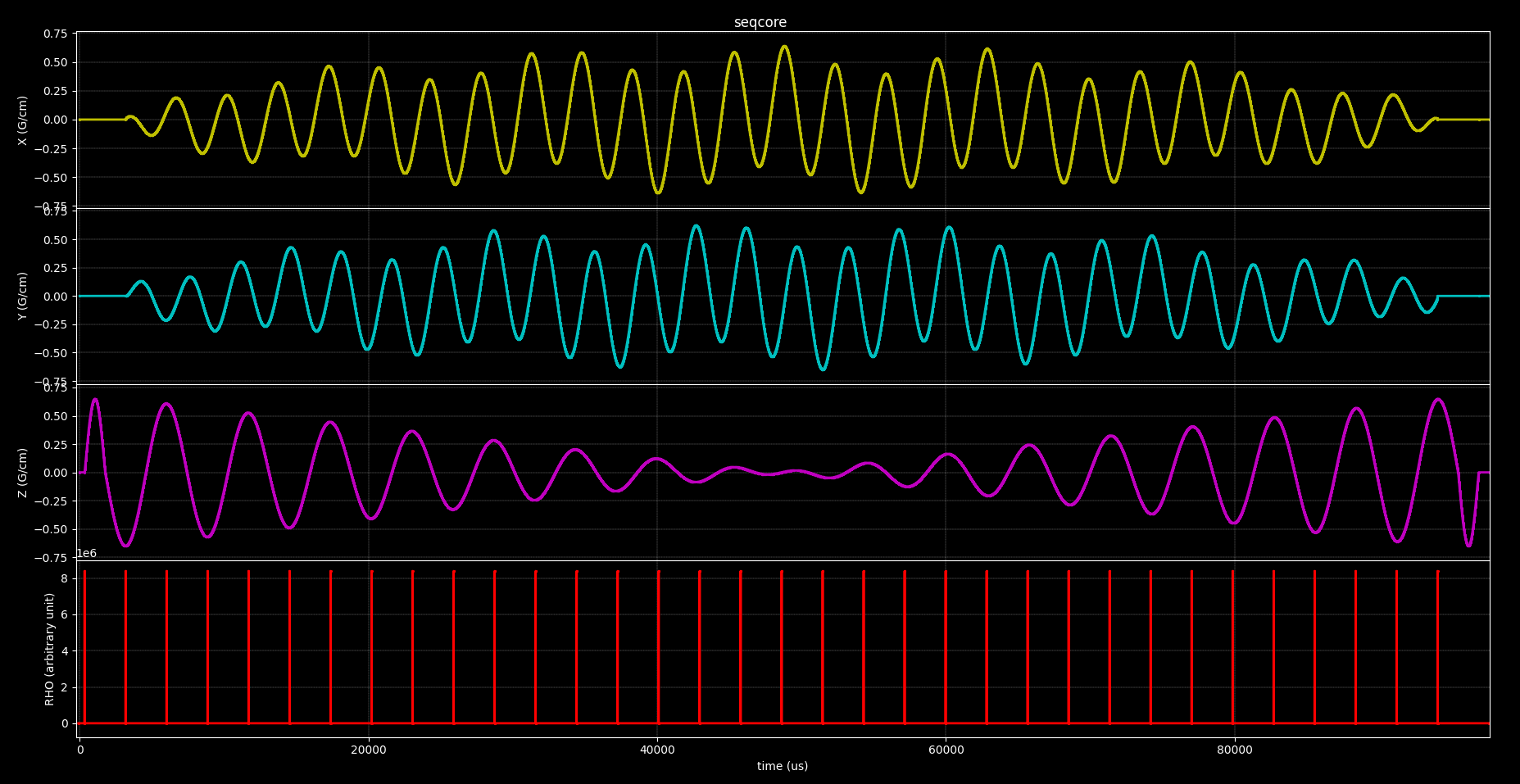
- Segmented sequence due to sequencer limitations
$$ 0 \leq t \leq 1, \alpha_1 = \pi L t, \alpha_2 = M \alpha_1 $$
$$ z = 2t – 1, x = \sqrt(1 – z^2) $$
$$ k = k_{max} [ \sin\alpha_1 \cos\alpha_2 x, \sin\alpha_1 \sin\alpha_2 x, \sin\alpha_1 z]^T $$
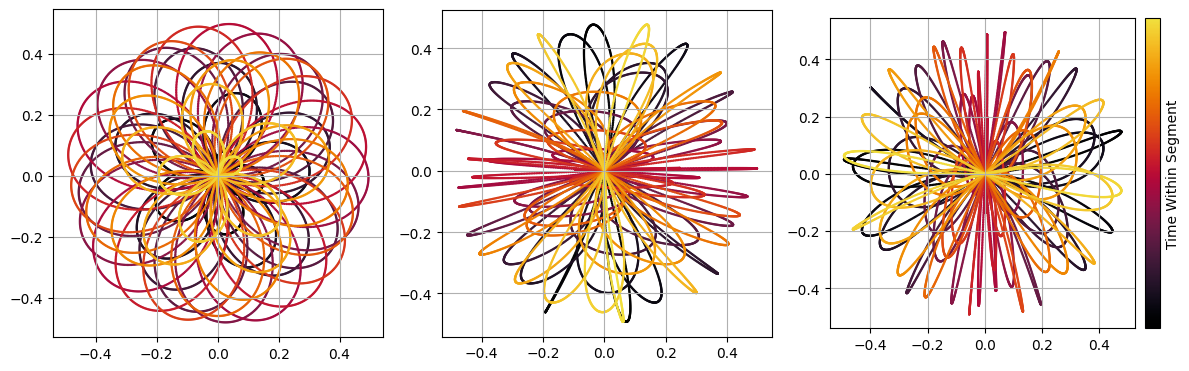
L is the number of petals per segment and M was set to the reciprocal Golden Ratio (0.618). To minimise transients a half + quarter sine played in the TRs before/after the segment, producing balanced gradients that end/start at the correct gradient. An RF pulse is played every N zero crossings of the trajectory (figure 2). N=1 resembles bSTAR with a single petal of the Rosette instead of out-in radial half spokes3. Setting N>1 yields N petals per TR. The trajectory is rotated by 2D golden means between segments6.
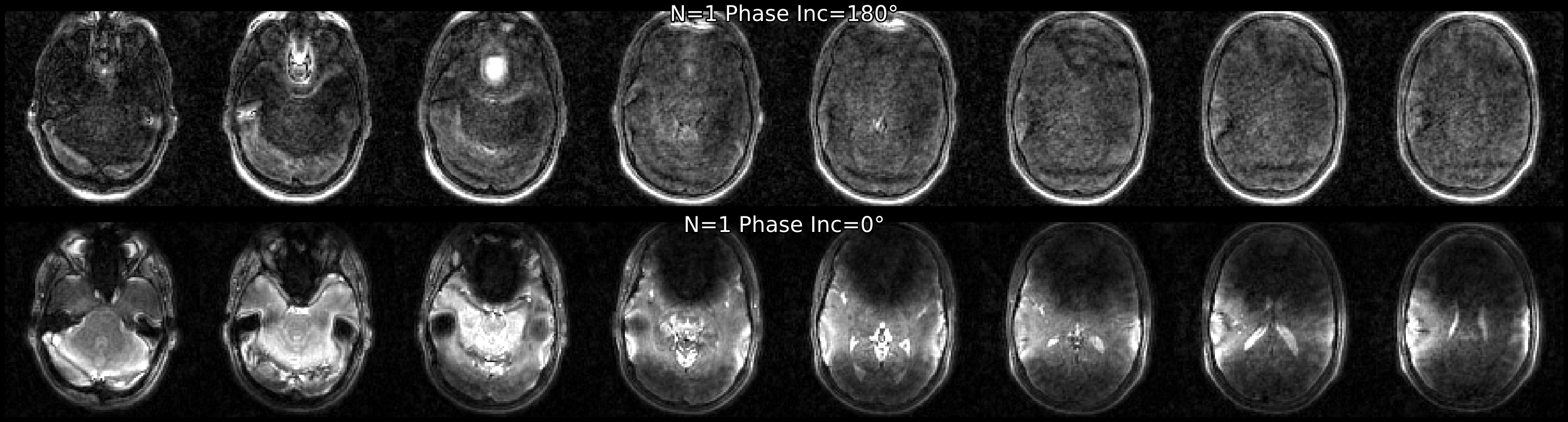
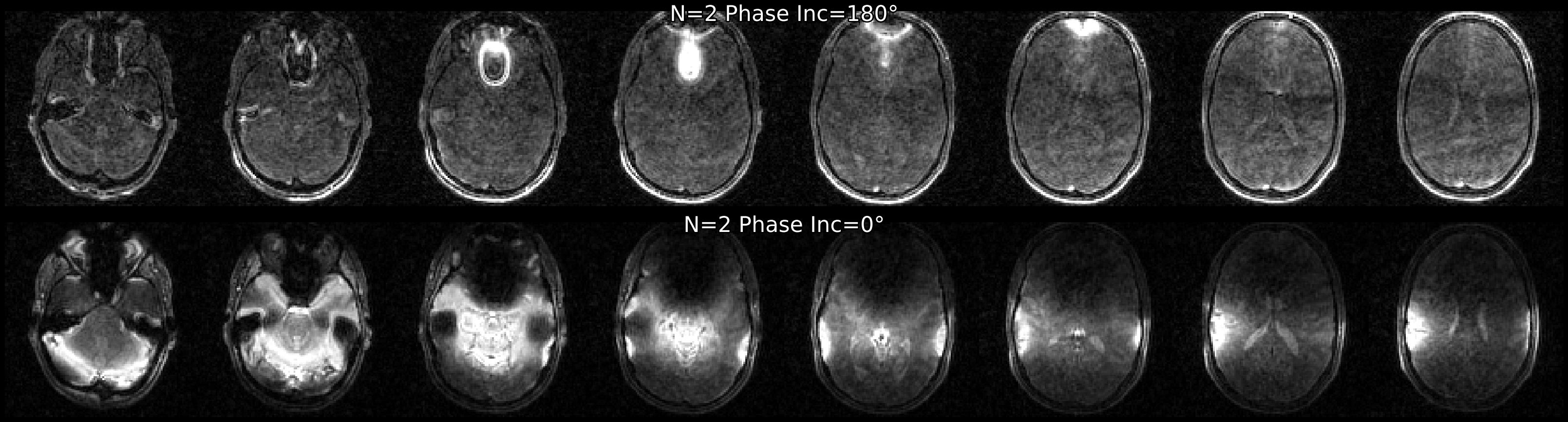
A healthy volunteer was scanned with a 3T magnet and 48 channel head coil (GE Premier). Parameters were bandwidth ±25kHz, 2x read-oversampling, flip-angle 2°, pulse-width 16μs, phase-increment 180° or 0°, 220 points per petal, 2mm isotropic voxel size, 220mm FOV, 768 petals per segment, N=1/2, TR=2.47/4.67ms. Images were reconstructed using the preconditioned LSMR algorithm implemented in the RIESLING toolbox7,8. Sensitivity maps were estimated from low-resolution versions of each scan.
Results
Figures 3 and 4 show the acquired images for N=1 and N=2 respectively, with the two phase increments windowed individually. Unusually for bSSFP, the 0° increment image exhibits better SNR despite pronounced banding artefacts. T2 contrast, with bright CSF signal in ventricles, can be best seen in the N=1 0° image.Discussion
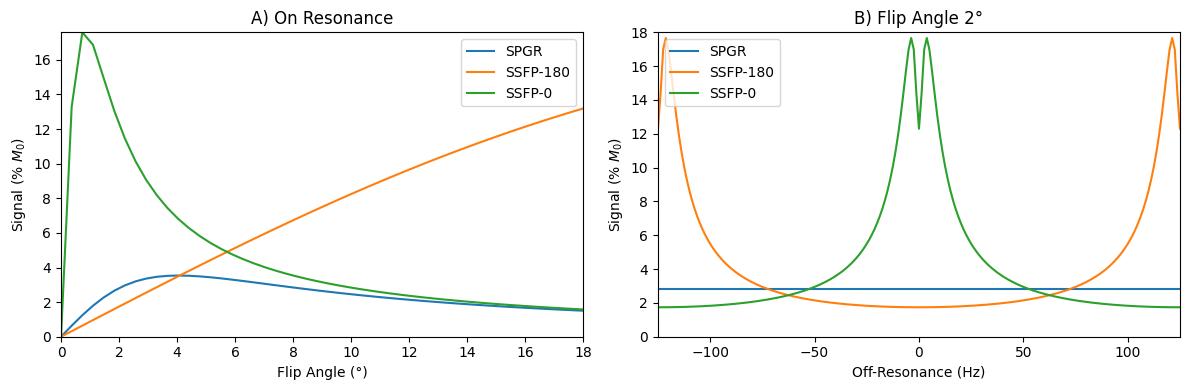
Previously ZTE was considered fixed as a 3D radial spoiled gradient-echo T1-weighted sequence. This work introduces the possibility of acquiring ZTE data with bSSFP-like T2 contrasts, more efficient k-space sampling and higher SNR.Traditionally bSSFP would be acquired with a 180° phase increment and a large flip angle. Due to RF amplifier limits ZTE can only reach small flip angles. This pushes our sequence into a very different regime where banding artefacts yield increased rather than reduced signal (figure 5). Shaped RF pulses could produce a moderate increase in flip angle9, but a more appealing approach is to use frequency-modulation combined with physics-based reconstruction to remove banding artefacts and exploit the observed signal enhancement10,11.
The dead-time for swapping between transmit and receive after the RF pulse was 20μs. However, there is a further 200μs dead time when swapping from receive to transmit at the end of a TR, which is approximately 10% of the sequence. Future developments in sequencer software may eliminate this drawback.
Conclusion
We created a hybrid bSSFP ZTE pulse sequence utilising the Rosette trajectory. Compared to conventional straight-spoke ZTE this improves the k-space sampling pattern and enables new high signal, high contrast images even in the low flip angle regime.Acknowledgements
We appreciate many useful discussions with Emil Ljungberg and Paul Weavers.References
- E. Ljungberg et al., ‘Silent zero TE MR neuroimaging: Current state-of-the-art and future directions’, Progress in Nuclear Magnetic Resonance Spectroscopy, p. 21, 2021, doi: 10.1016/j.pnmrs.2021.03.002.
- O. Bieri, M. Markl, and K. Scheffler, ‘Analysis and compensation of eddy currents in balanced SSFP’, Magnetic Resonance in Medicine, vol. 54, no. 1, pp. 129–137, Jul. 2005, doi: 10.1002/mrm.20527.
- G. Bauman and O. Bieri, ‘Balanced steady‐state free precession thoracic imaging with half‐radial dual‐echo readout on smoothly interleaved archimedean spirals’, Magn Reson Med, vol. 84, no. 1, pp. 237–246, Jul. 2020, doi: 10.1002/mrm.28119.
- D. C. Noll, ‘Multishot rosette trajectories for spectrally selective MR imaging’, IEEE Trans. Med. Imaging, vol. 16, no. 4, pp. 372–377, Aug. 1997, doi: 10.1109/42.611345.
- X. Shen et al., ‘Ultra‐short T 2 components imaging of the whole brain using 3D dual‐echo UTE MRI with rosette k‐space pattern’, Magnetic Resonance in Med, vol. 89, no. 2, pp. 508–521, Feb. 2023, doi: 10.1002/mrm.29451.
- R. W. Chan, E. A. Ramsay, C. H. Cunningham, and D. B. Plewes, ‘Temporal stability of adaptive 3D radial MRI using multidimensional golden means’, Magn. Reson. Med., vol. 61, no. 2, pp. 354–363, Feb. 2009, doi: 10.1002/mrm.21837.
- T. Wood, E. Ljungberg, and F. Wiesinger, ‘Radial Interstices Enable Speedy Low-volume Imaging’, JOSS, vol. 6, no. 66, p. 3500, Oct. 2021, doi: 10.21105/joss.03500.
- T. C. Wood, ‘Algorithms for Least-Squares Noncartesian MR Image Reconstruction’. arXiv, Dec. 13, 2022. Accessed: Nov. 07, 2023. [Online]. Available: http://arxiv.org/abs/2212.06471
- R. Froidevaux, M. Weiger, and K. P. Pruessmann, ‘Pulse encoding for ZTE imaging: RF excitation without dead‐time penalty’, MRM, 2021.
- D. L. Foxall, ‘Frequency‐modulated steady‐state free precession imaging’, Magnetic Resonance in Med, vol. 48, no. 3, pp. 502–508, Sep. 2002, doi: 10.1002/mrm.10225.
- X. Wang, Z. Tan, N. Scholand, V. Roeloffs, and M. Uecker, ‘Physics-based reconstruction methods for magnetic resonance imaging’, Phil. Trans. R. Soc. A., vol. 379, no. 2200, p. 20200196, Jun. 2021, doi: 10.1098/rsta.2020.0196.
Figures