3258
Can Quadruple Quantum Filtering Enhance Lactate Detection?1Center for Medical Physics and Biomedical Engineering, Medical University of Vienna, Vienna, Austria, 2Institute of Life Course and Medical Sciences, University of Liverpool, Liverpool, United Kingdom
Synopsis
Keywords: Pulse Sequence Design, Spectroscopy, J-editing lactate
Motivation: Metabolites exhibiting J-coupling (like lactate) can be selectively detected against overlapping signals using multi-quantum filtering (MQF). Accurate modelling of such spin systems under realistic RF and gradient pulses is crucial for optimizing signal yield, background suppression and quantification.
Goal(s): Improve MQF sequences to mitigate the inherent 50 % signal loss of double-quantum filters.
Approach: The effect of realistic RF-pulses (hard/selective, various phases) and gradients on an AX3 system’s higher-order coherences was investigated. Semi-LASER-based spin-echo sequences were simulated in pyGAMMA and tested on a 7T scanner.
Results: Quadruple-quantum coherences maintain near-100 % signal, outperforming traditional DQF. Simulations and phantom experiments agreed within 6 %.
Impact: Quadruple-quantum filtering of lactate can retain its full signal, promising faster and more precise lactate quantification in human tissues. This could significantly improve the monitoring of glycolytic and oxidative metabolism and thus the understanding of underlying mechanisms in disease.
INTRODUCTION
Multiple quantum filtering (MQF) sequences are typically used to either suppress dominant single-quantum coherences or harness double-quantum coherence pathways, while preserving the signal of a target spin system1. The MQF for an AX3 system (i.e. lactate, CH: 4.1 ppm, CH3: 1.3 ppm, J = 6.93 Hz) is classically achieved by a spin-echo (TE = 1/2 J), followed by a hard 90° pulse to enter, and a selective 90°(CH) pulse to exit, higher quantum coherences. A pair of gradients (moment ratio 1:2) accomplishes double quantum filtering (DQF)2,3, by dephasing unwanted coherences while rephasing the target signal. However, DQF suffers from 50 % signal loss2,3. Here, we investigate the mechanisms for MQF using pyGAMMA4 for simulations, while optimizing phases and pulse selectivity to potentially circumvent the signal loss created by DQF.METHODS
We implemented semi-LASER3-based spin-echo sequences for simulations and for experiments (Fig. 1A) on a whole-body 7T scanner (Terra-Dot-Plus, Siemens, Erlangen, Germany), using a 2-channel 1H calf coil5. Various RF pulse combinations (regarding selectivity and phases) and spoiling gradient moments were evaluated, keeping timing constant. Density matrix and resulting signal were assessed directly after the 90° MQF entry pulse, to gauge the signal that incompletely converted to non-visible MQ-states (i.e. unfiltered coherences), and after the 90° MQF exit pulse, representing target signal recovery. For each simulation, transverse magnetisation and phase profiles were reconstructed based on the mean observable value of spin operator applied on the density matrix. Excitation and refocussing of a 1 cm slice was simulated using gradient amplitudes for real pulses (as used on the scanner), and the density matrix was calculated across this slice in discrete steps. The transverse magnetisation- and phase profiles for each combination were compared to the classical DQF scheme (Fig. 1B). The simulations were validated against MQF single-shots acquisitions in a 160 mM lactate phantom, using 7 cm slice thickness.RESULTS
The simulated relative signal intensities for CH3 are shown in Fig. 2. Pulse combinations favouring the evolution through quadruple quantum coherences (QQC, Fig. 2, red box) yield almost full signal, while those resulting in an evolution of a blend of zero- and double-quantum coherences suffer ~50 % signal loss (blue box). Phantom experiments (cf. Figs. 3B,D and 4B,D) matched simulations within 6 % or better.For MQF sequences with 50 % signal attenuation (Fig. 3A), a phase- and amplitude modulation occurs across the slice as soon as a first spoiling gradient g1 is applied. Note that this modulation frequency is proportional to the spoiling gradient moment, but ~50 % net signal is retained across the slice. System evolution under chemical shifts during the delay tm, together with the MQF exit pulse, define whether the target system will be converted to states with visible single quantum coherences or non-visible states. The application of a second gradient g2 with opposite polarity but with the same moment, unravels the phase roll acquired from the first spoiler gradient but yields no signal, since the spin system presents antiphase spatial regions (not shown). The classical scheme (i.e. g2 = –2 g1) leads to inverting the phase roll (see phase slopes in Fig. 3A,C) resulting in the same ~50 % signal loss as in Fig. 3A.
This phase- and amplitude modulation is not visible when evaluating MQFs creating QQC, i.e. quadruple quantum filtering (QQF). As depicted in Figure 4A,C, these QQC converted back to single quantum coherences independently of gradients and free evolution (i.e. magnetisation and phase profiles do not change with spoiling gradient amplitude).
DISCUSSION
The performance of QQFs shows promise due to their complete signal recovery, markedly outperforming classical MQFs in sensitivity. For an AX3 system, QQC exhibit a different behaviour than pathways produced by DQF. In a DQF, the spoiling gradient between entry and exit pulse leads to a phase accrual across the slice. Hence the appearance of phase- and amplitude modulation, which can be re-wound using a second gradient. In contrast, QQC exhibits a remarkable independence of phase evolution to return to the observable state. Strict proof of this is challenging, but the product operator formalism offers a plausible explanation, suggesting that the system's transition to the highest coherence order yields the most symmetrical quantum state transformations. Nonetheless, it remains to be shown how unwanted coherences from lipids and outer-volume contamination created by the non-localized QQF exit (CH3)x pulse can be removed, e.g. using phase cycling.Acknowledgements
Austrian Science Fund (FWF) project No. P 35305-BReferences
1. Lee, Seung-Cheol, et al. "Coherence pathway analysis of J-coupled lipids and lactate and effective suppression of lipids upon the selective multiple quantum coherence lactate editing sequence." Biomedical Physics & Engineering Express 8.3 (2022): 035004.
2. Trimble, Laird A., et al. "Lactate editing by means of selective-pulse filtering of both zero-and double-quantum coherence signals." Journal of Magnetic Resonance (1969) 86.1 (1990): 191-198.
3. Niess, Fabian, et al. "3D localized lactate detection in muscle tissue using double‐quantum filtered 1H MRS with adiabatic refocusing pulses at 7 T." Magnetic Resonance in Medicine 87.3 (2022): 1174-1183.
4. Smith, S. A., et al. "Computer simulations in magnetic resonance. An object-oriented programming approach." Journal of Magnetic Resonance, Series A 106.1 (1994): 75-105.
5. Goluch S, Kuehne A, Meyerspeer M, et al. A form-fitted three channel phosphorus 31P, two channel 1H transceiver coil array for calf muscle studies at 7 T. Magn Reson Med. 2015;73(6):2376-2389. doi:10.1002/mrm.25339
Figures
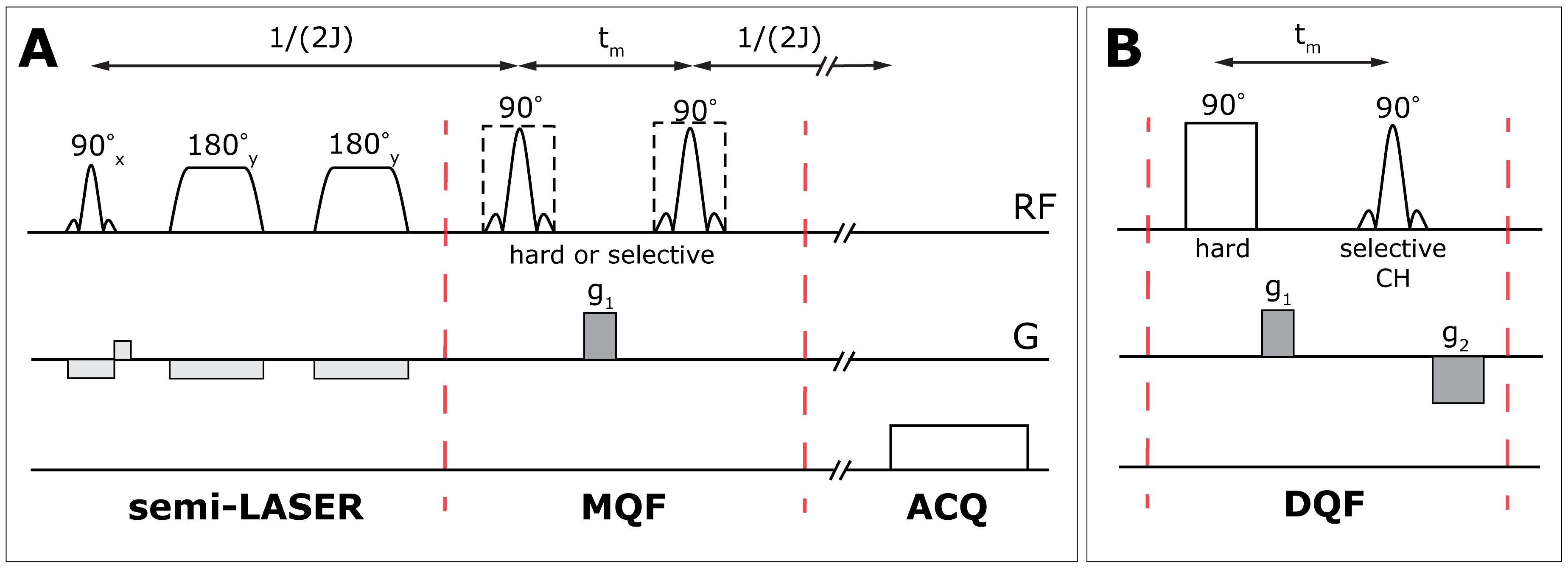
Fig. 1. (A) semi-LASER-based spin-echo (90° Hamming-filtered sinc, 2.6 ms, BW = 3.3 kHz, 180° smoothed chirp, 4.6 ms, BW = 5.0 kHz) and MQF components, (selective 5-lobe sinc, 3.0 ms, BW = 2.2 kHz or hard 4.7 ms, BW = 1.4 kHz). The semi-LASER RF pulses are centred at 2.8 ppm, MQF RFs were targeted on the required group of lactate by shifting the centre of pulse bandwidth by half of flat-top profile region (not touching lactate’s other group). (B) classical DQF sequence (usually, g2 = 2·g1).
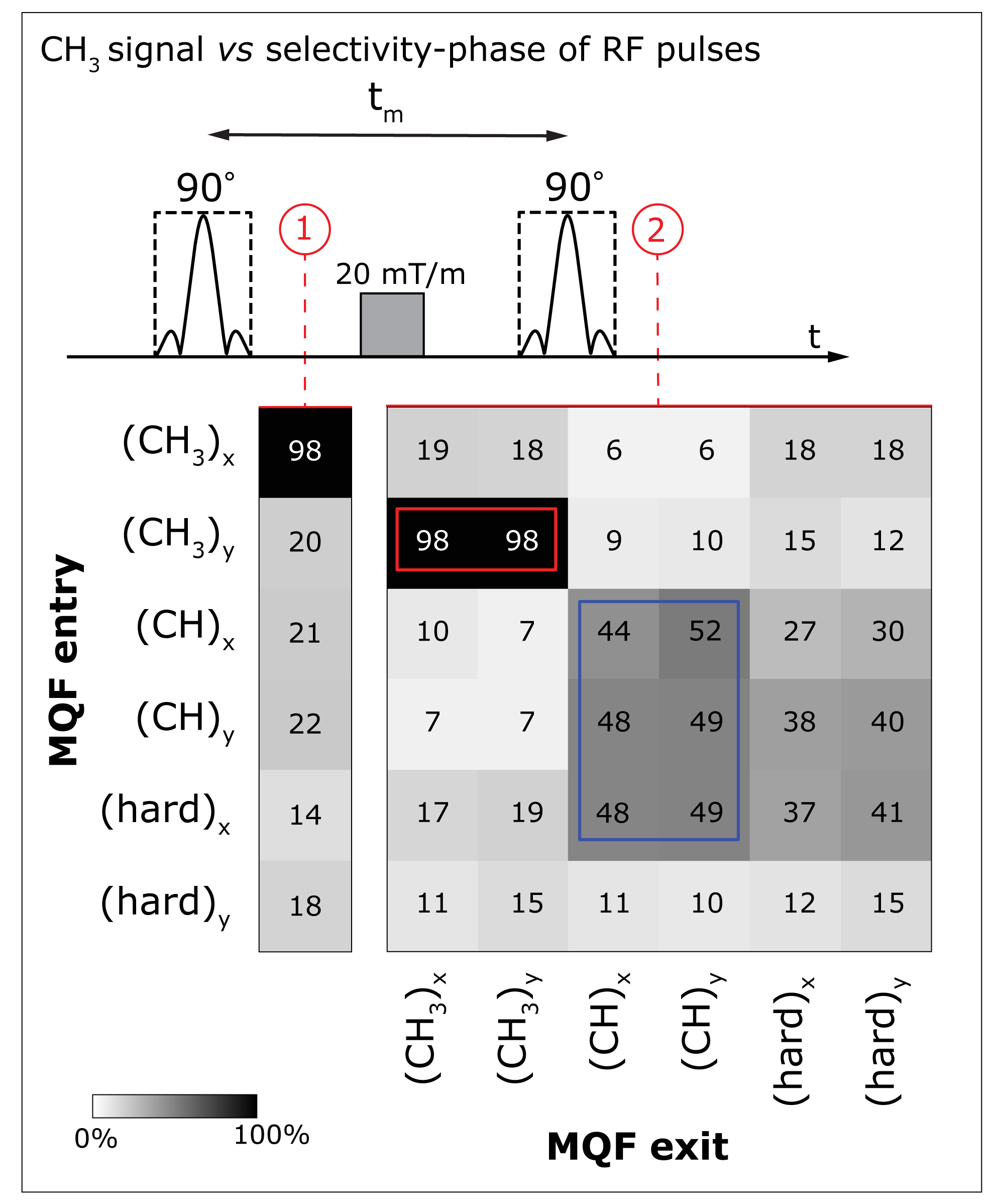
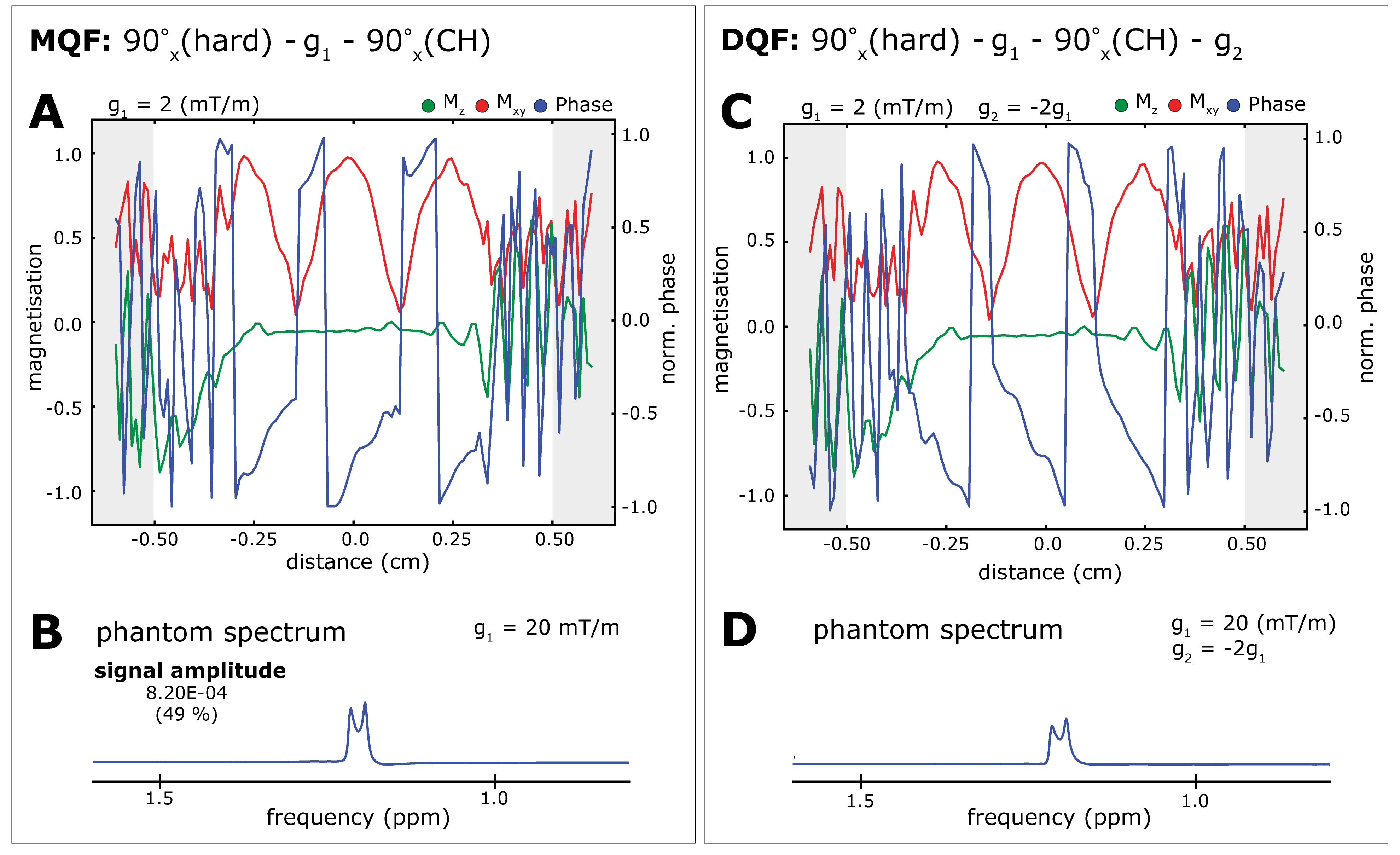
Fig. 3. Magnetisation and phase profiles for DQF. The simulated magnetisation (red) and phase (blue) profiles for a DQF sequence with (A) and without (C) a second gradient. The respective phantom spectra are shown below (B, D). For illustrative purposes of the phase- and amplitude-modulation (frequency of the modulation), lower gradient moments were used in simulation than in measurements. The signal amplitude was estimated with AMARES and normalized to the maximum signal (as described in Fig. 2).
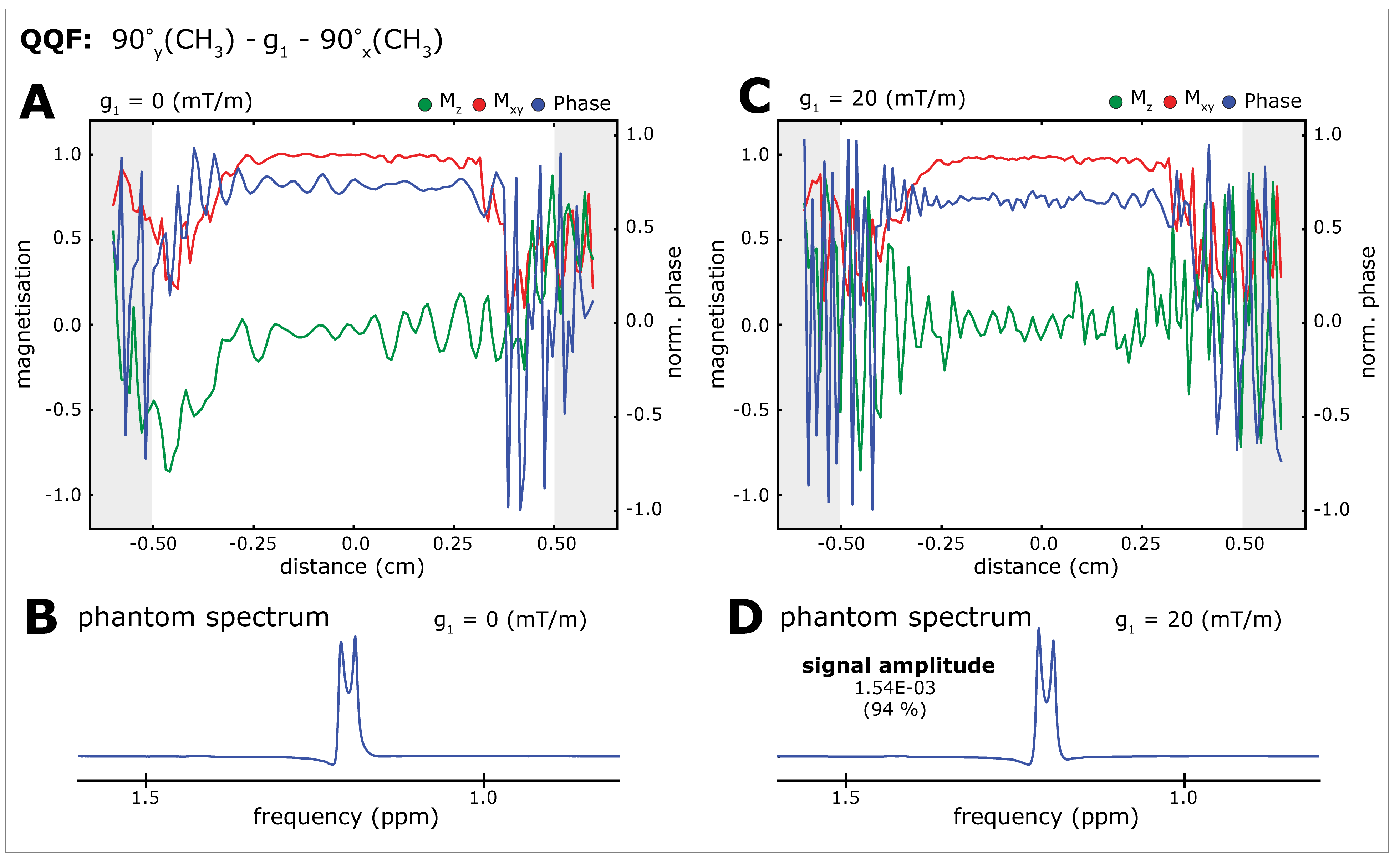
Fig. 4. Magnetisation and phase profiles for QQF. The simulated magnetisation (red) and phase (blue) profiles for a QQF sequence with (A) and without (C) dephasing gradient during tm. The respective phantom spectra are shown below (B, D). Note the flat magnetisation profile across the slice. The signal amplitude was estimated with AMARES and normalized to the maximum signal (as described in Fig. 2).