3247
Pulse Sequence Design for Gradient Arrays in MRI1Department of Electrical and Electronics Engineering, Bilkent University, Ankara, Turkey, 2National Magnetic Resonance Research Center, Bilkent University, Ankara, Turkey
Synopsis
Keywords: Pulse Sequence Design, Pulse Sequence Design, Gradient Array
Motivation: Gradient arrays are superior compared to the conventional MR coils. However, there exists no pulse sequence design algorithm for the optimum use of the gradient array.
Goal(s): This work proposes a novel pulse sequence design schema for the optimum use of the gradient arrays
Approach: The algorithm utilizes a waveform optimization method. This method provides the shortest trapezoidal pulses with three inputs: the area to cover, starting and ending amplitudes.
Results: The algorithm is fit for any gradient array weight matrix with an arbitrary number of channels. It can provide the shortest timing values for any imaging plane while preserving the hardware limits.
Impact: There exists no pulse sequence design algorithm for the optimum use of the gradient array. We present a novel algorithm fit for any gradient array weighting with an arbitrary number of channels while providing the shortest timing values.
Introduction
Gradient arrays are gaining popularity in the MRI community with their superior performance and flexibility compared to conventional gradient coils1-6. The gradient array technology can be used to excite multiple slices simultaneously using a single RF pulse2. It can mitigate the B1+ inhomogeneity3, reduce the power loss on the cryostat due to gradient-induced eddy currents4, and increase peripheral nerve stimulation thresholds by adjusting the volume of interest with flexible gradient linearity levels5. All of these studies involve the generation of optimized current weightings that flow through each channel. Nevertheless, there is currently no pulse sequence design algorithm that optimally utilizes the gradient array. This research introduces a novel pulse sequence design framework for gradient arrays. The algorithm we propose leverages the waveform optimization method7 to create an optimized pulse sequence that capitalizes on the advantages offered by gradient array technology. This algorithm is adaptable to gradient array weightings with any number of channels, making it capable of delivering the shortest TE and TR values for any imaging plane while preserving hardware constraints.Methods
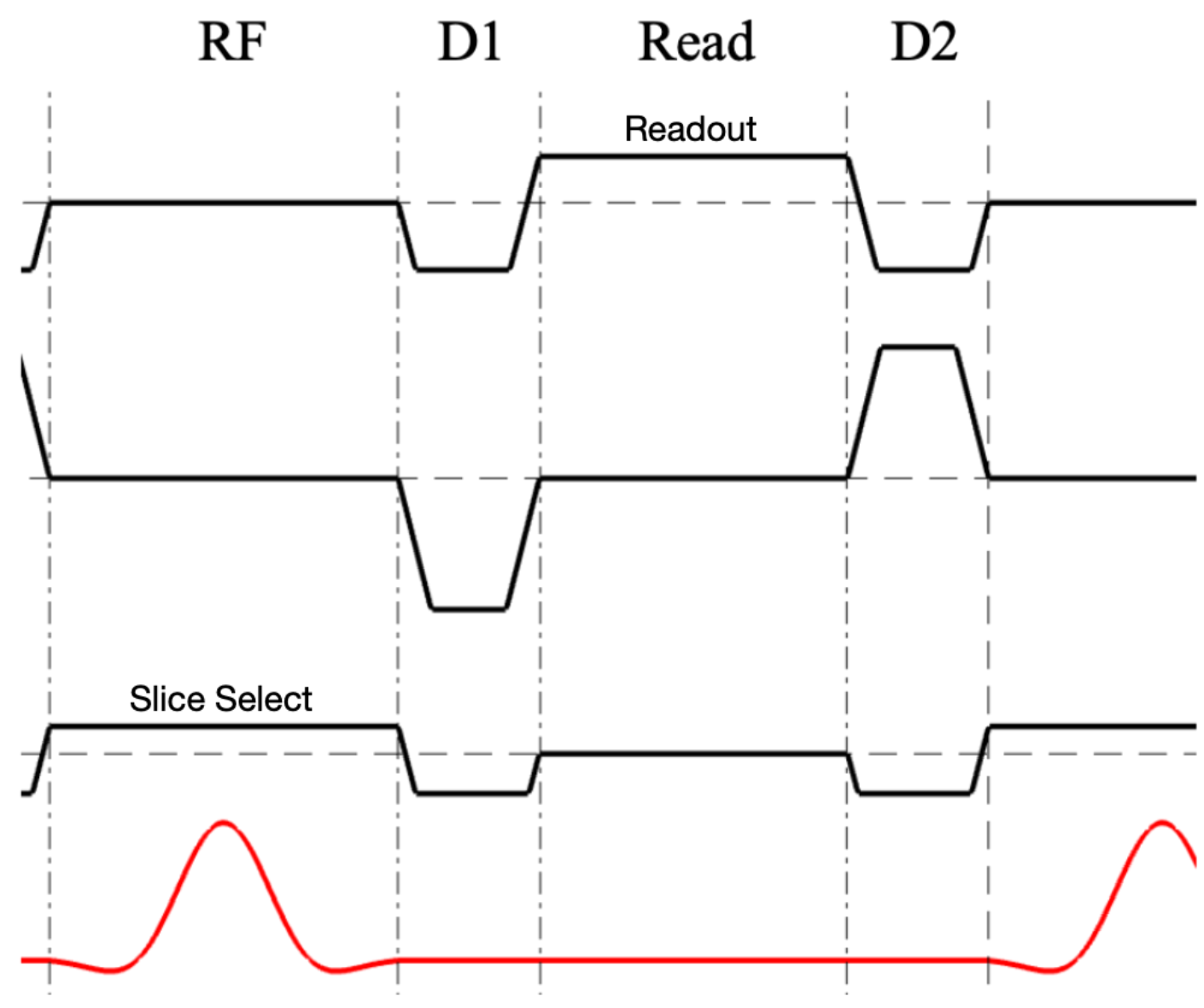
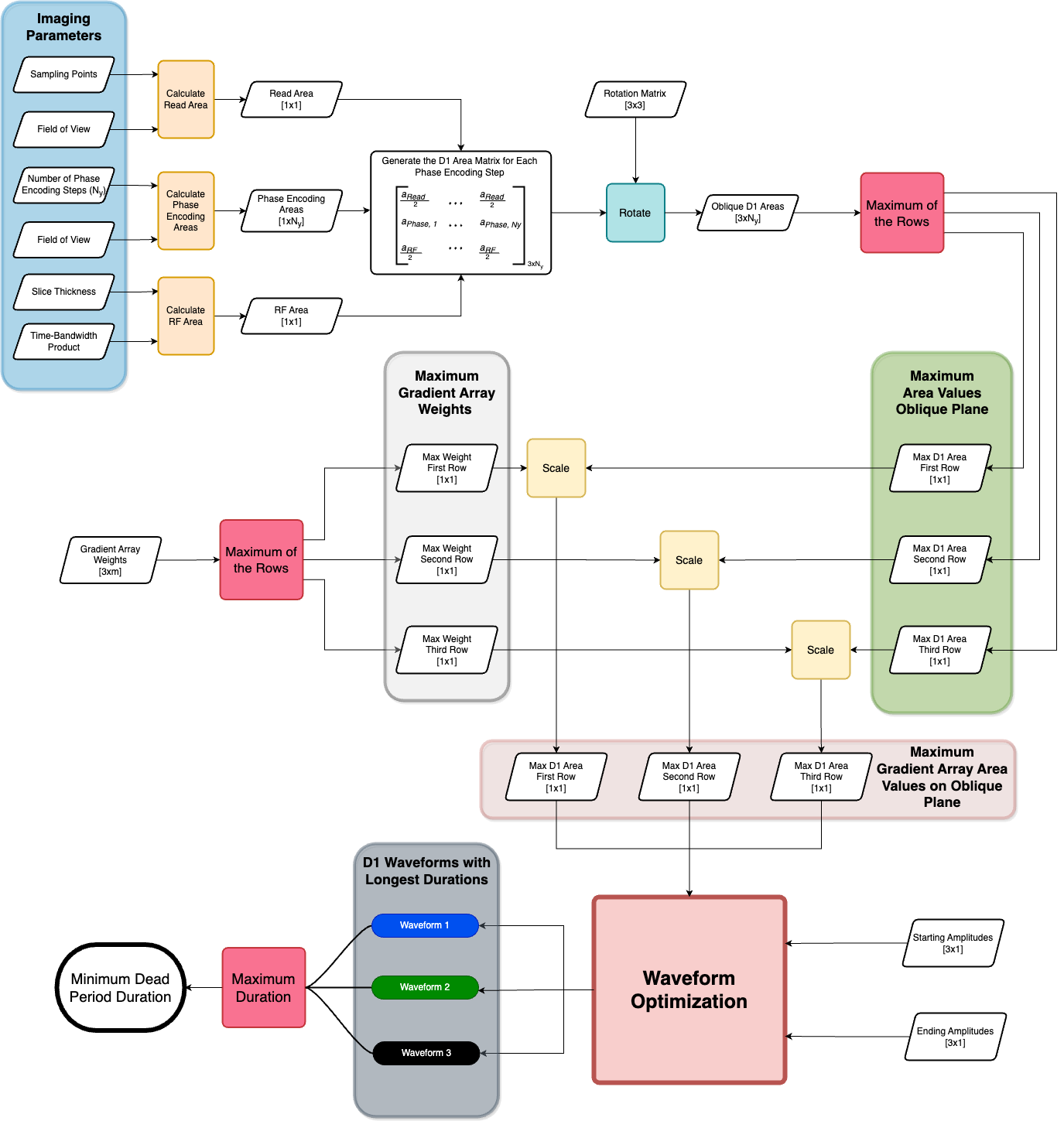
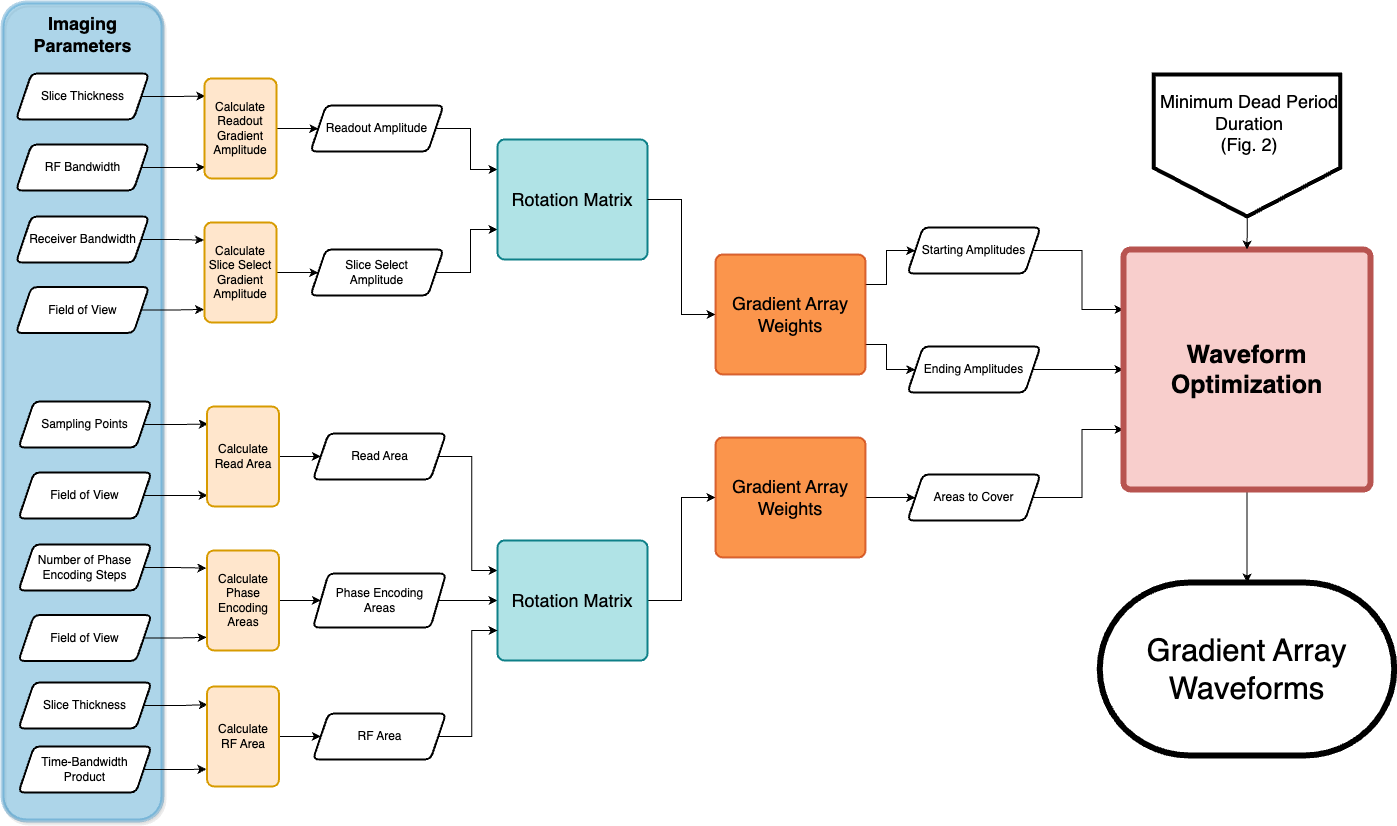
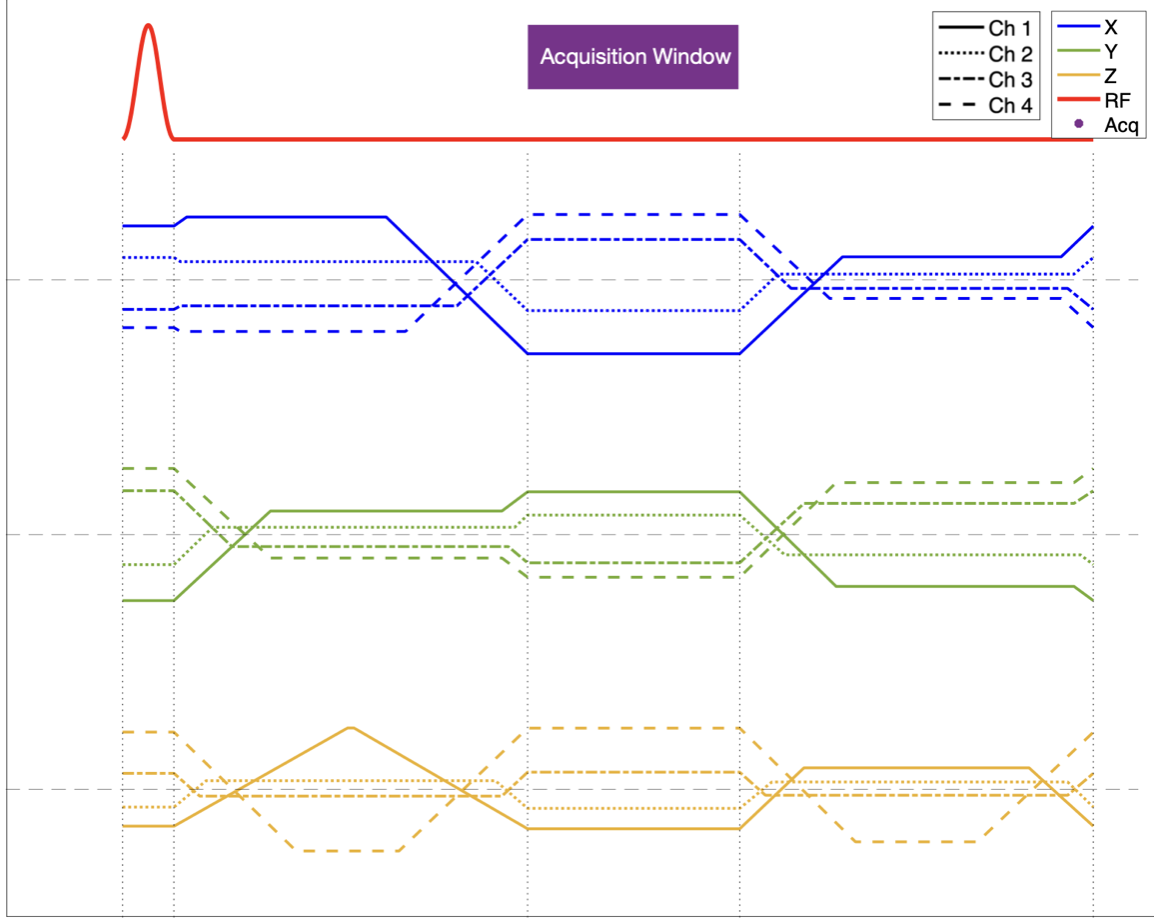
In Reference [7], a method was introduced to generate pulse sequence waveforms in the physical coordinates (x, y, and z) rather than designing them in the logical coordinate system (slice, read, and phase encoding directions). We have expanded and adapted this method to be suitable for generating waveforms for gradient array coils. The array weightings used in this study are taken from a 288-channel body coil optimized for increasing the PNS thresholds5,6. We consider a standard balanced steady-state free precession (bSSFP) pulse sequence, as shown in Figure 1, and applied our newly developed algorithm to this sequence on Pulseq framework8. The imaging parameters are assumed as maximum gradient of 40 mT/m, maximum slew rate of 200 T/m/s, 360 mm FOV, matrix size 192×144, 8-mm slice thickness, 70° flip angle, 3 kHz/Pixel receiver bandwidth. Our algorithm follows a specific sequence of steps. Firstly, it takes the imaging parameters and calculates the amplitudes and areas of the slice selection, readout, and phase encoding gradients. In the subsequent step, considering the orientation of the imaging plane, these amplitudes and areas are rotated and then scaled using the array weightings to derive the corresponding amplitudes for the array channels. These results are then utilized as inputs (area, starting, and ending amplitudes) for the waveform optimization algorithm, which generates the dead periods (the intervals between the slice selection and readout). Because the phase encoding areas change with each TR, the dead-period waveforms will have varying durations. However, we need a constant dead-period duration. Since each of the optimized waveforms already represents the shortest possible duration, the longest dead-period is chosen as the constant one (Figure 2), and in the last step, the dead-period waveforms are updated accordingly. By following the same procedure for every TR, the gradient array pulse sequence can be generated (Figure 3).Results
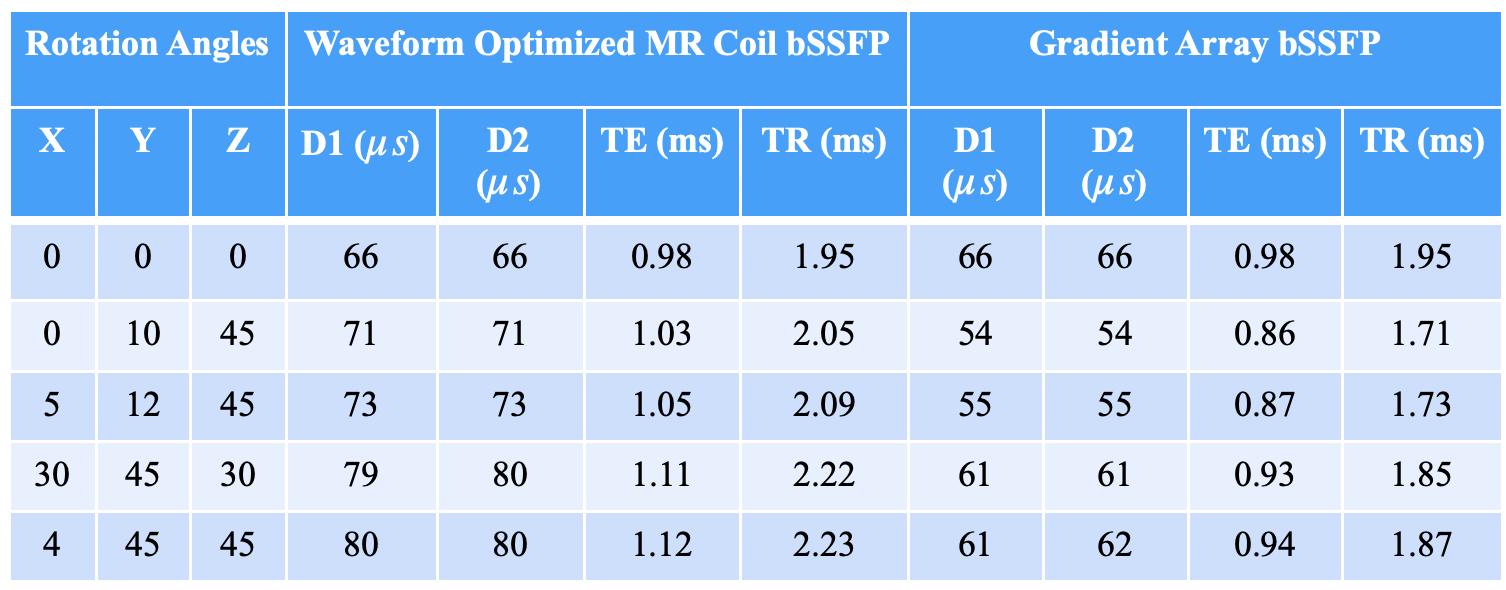
Figure 4 illustrates the dead-periods (D1 and D2), TE and TR parameters of the bSSFP sequence in five distinct imaging planes for two cases: 1) optimized for a conventional coil using the algorithm proposed in Ref [7], 2) optimized for the gradient array using our proposed method. The array coil parameters exhibit the shortest timing values. Depending on the orientation of the scan plane, the dead-periods of the array coil can be reduced by up to 25% compared to the conventional coil. Consequently, transitioning from conventional coils to an array configuration further decreases the minimum possible TE and TR values for the given imaging parameters by up to 17%. An example of the optimized array pulse sequence (bSSFP) is displayed in Figure 5.Conclusion and Discussion
This study introduced a novel pulse sequence design algorithm tailored for gradient array coils. The algorithm effectively manages imaging parameters to produce time-optimized waveforms for gradient array coils with any number of channels. Here, we applied the proposed algorithm to generate the bSSFP sequence waveforms; however, it can be adapted to other sequences as well. It is important to note that this proof-of-concept study did not consider peripheral nerve stimulation concerns related to slew rates or investigate the coupling between the channels; however, these considerations can be addressed by incorporating the array weighting optimization into our algorithm. The algorithm presented here serves as a foundation with potential for further enhancement and is not currently suitable for actual scans.Acknowledgements
No acknowledgement found.References
1) F. Jia et al., “Performance evaluation of Matrix Gradient Coils,” Magnetic Resonance Materials in Physics, Biology and Medicine, vol. 29, no. 1, pp. 59–73, 2015. doi:10.1007/s10334-015-0519-y
2) K. Ertan, S. Taraghinia, A. Sadeghi, and E. Atalar, “A z‐gradient array for simultaneous multi‐slice excitation with a single‐band RF Pulse,” Magnetic Resonance in Medicine, vol. 80, no. 1, pp. 400–412, 2017. doi:10.1002/mrm.27031
3) K. Ertan and E. Atalar, “Simultaneous use of linear and nonlinear gradients for B1+ inhomogeneity correction,” NMR in Biomedicine, vol. 30, no. 9, 2017. doi:10.1002/nbm.3742
4) M. Takrimi and E. Atalar, “A z‐gradient array coil with a dedicated active‐shielded array coil for MRI,” Magnetic Resonance in Medicine, vol. 88, no. 6, pp. 2718–2731, 2022. doi:10.1002/mrm.29390
5) Babaloo R, Takrimi M, Atalar E, editors. Minimum Electric Field Gradient Array Body Coil with Adjustable Regions of Linearity. In Proceedings of the Annual Meeting of ISMRM; Toronto, Canada, 2023. Abstract 599.
6) Babaloo R, Takrimi M, Atalar E, editors. Increasing Peripheral Nerve Stimulation Thresholds Using Gradient Array Coils. In Proceedings of Joint Annual Meeting of ISMRM-ESMRMB; London, UK, 2022. Abstract 580.
7) E. Atalar and E. R. McVeigh, “Minimization of dead‐periods in MRI pulse sequences for imaging oblique planes,” Magnetic Resonance in Medicine, vol. 32, no. 6, pp. 773–777, 1994. doi:10.1002/mrm.1910320613
8) K. J. Layton et al., “Pulseq: A rapid and hardware-independent Pulse Sequence prototyping framework,” Magnetic Resonance in Medicine, vol. 77, no. 4, pp. 1544–1552, 2016. doi:10.1002/mrm.26235
Figures