3245
Parallel contrast imaging from multi-echo SSFP1Department of Bioengineering, Imperial College London, London, United Kingdom, 2Medical Biophysics, University of Toronto, Toronto, ON, Canada, 3Wellcome Centre for Integrative Neuroimaging, University of Oxford, Oxford, United Kingdom, 4Department of Electrical and Computer Engineering, Boise State University, Boise, ID, United States, 5Centre for Care Research and Technology, UK Dementia Research Institute, London, United Kingdom
Synopsis
Keywords: Pulse Sequence Design, Pulse Sequence Design
Motivation: Multi-echo steady-state acquisitions (Dual/Triple Echo Steady State) allow for the acquisition of multi-contrast images, but only in a sequential manner, which is time-inefficient, and requires substantial gradient spoiling to avoid banding artifacts.
Goal(s): Our goal was to introduce an alternative multi-contrast acquisition with parallel imaging capabilities.
Approach: By exploiting the effects of partial RF spoiling in Fluctuating Equilibrium MR (FEMR) imaging, we devised a novel acquisition strategy enabling simultaneous acquisition of aliased multi-contrast images and their subsequent reconstruction via SENSE.
Results: Implemented in 3D, our approach yields multiple images in one acquisition while providing flexibility over the acquired imaging contrasts.
Impact: This new acquisition strategy offers more time-efficient multi-contrast imaging while also reducing gradient requirements in comparison to existing approaches, creating new opportunities for rapid quantitative imaging experiments in healthy and diseased tissue.
Introduction
Multi-echo steady-state free precession (SSFP) acquisitions (DESS1, TESS2, MESS3) allow the acquisition of multiple image contrasts corresponding to different signal components (configuration states or ’F-states’, $$$F\in\mathbb{Z}$$$), which can be combined to produce quantitative maps of T1 and T2 in a time-efficient way. However, these images must be acquired separately (i.e. with individual ADC events), and require large gradient moments to refocus higher order F-states. This limits the minimum TR, and introduces diffusion effects which bias quantitation1.Here we introduce an alternative, high-efficiency approach in which we acquire multiple aliased image contrasts (from different F-states) that overlap within a single readout (ADC) window, and separate them with parallel imaging
Theory
Manipulating F-state signalsBy modifying gradient spoiling in SSFP we can control the number of F-states measured in a single acquisition (’k-space aliasing’4), while manipulating their individual phase evolutions between successive excitations through quadratic RF phase cycling5
By adjusting the quadratic RF phase increment ($$$\phi_{q}$$$) the steady-state magnetisation can be made N-periodic (i.e. it repeats for every $$$N^{th}$$$ excitation). The simplest case where $$$N=2$$$ was introduced as Fluctuating Equilibrium MR (FEMR6), where the magnetisation fluctuates between odd and even excitations (Figure 1). In this regime, the measured signal can be described as 2 distinct summations across the F-state signal components, $$$S_{F}$$$:
$$S_{even}=\sum_{F}S_{F}\;\;and\;\;S_{odd}=\sum_{F}(-1)^{F}S_{F}\tag{1}$$
which can be combined by addition or subtraction to isolate half of the signal components:
$$ S_{add}\underbrace{=}_{S_{even}+S_{odd}}\sum_{even\;F}2S_{F}\;\;and\; \;S_{sub}\underbrace{=}_{S_{even}-S_{odd}}\sum_{\;odd\;F}2S_{F}\tag{2}$$
which provides an SNR boost of $$$\sqrt{2}$$$ over a single measurement of either $$$S_{add}$$$ or $$$S_{sub}$$$. Here we propose a combination of partial RF spoiling and parallel imaging to go one step further, and separate out individual F-state signals from $$$S_{add}$$$ and $$$S_{sub}$$$.
FEMR with partial RF spoiling
By including a small quadratic RF phase cycling term ('partial RF spoiling'7), $$$\phi_{par}$$$, the phase of each F-state increases with each excitation. After the $$$n^{th}$$$ excitation, the phase modulation is linear with the F-state order: $$$\widetilde{S}_{F,n}=\widetilde{S}_{F,1}e^{inF\phi_{par}}$$$. This is illustrated in Figure 1, and gives rise to the following behaviour for even ($$$2n$$$) and odd ($$$2n+1$$$) TRs:
$$ S_{even}=\sum_{F}\widetilde{S}_{F}e^{i2nF\phi_{par}}\;\;\;and\;\;S_{odd}=\sum_{F}(-1)^{F}\widetilde{S}_{F}e^{i(2n+1)F\phi_{par}}\tag{3}$$
which, after addition or subtraction, becomes:
$$S_{add}\underbrace{=}_{S_{even}+S_{odd}}\sum_{F}\widetilde{S}_{F}e^{i2nF\phi_{par}}(1+(-1)^{F}e^{iF\phi_{par}})\;\;and\;\;S_{sub}\underbrace{=}_{S_{even}-S_{odd}}\sum_{F}\widetilde{S}_{F}e^{i2nF\phi_{par}}(1-(-1)^{F}e^{iF\phi_{par}})\tag{4}$$
Provided that $$$\phi_{par}$$$ remains small, the 2 sub-problems highlighted in equations (2) now become:
$$S_{add}\underbrace{\approx}_{e^{iF\phi_{par}}\approx 1}\sum_{\;even\;F}2\widetilde{S}_{F}e^{i2nF\phi_{par}}\;\;and\;\;S_{sub}\underbrace{\approx}_{e^{iF\phi_{par}}\approx 1}\sum_{\;odd\;F }2\widetilde{S}_{F}e^{i2nF\phi_{par}}\tag{5}$$
If we follow a linear phase encoding pattern then the per-TR phase modulation in equations (5), $$$e^{i2nF\phi_{par}}$$$, corresponds to a linear phase ramp in k-space, and hence a relative shift of each F-state component in image space. As a result, we obtain several image contrasts in a single ADC event, all shifted relative to each other. This becomes a familiar parallel imaging problem where we can isolate each contrast via SENSE8. Figure 2 shows a schematic of the acquisition/reconstruction scheme.
SNR efficiency
Several factors impact SNR efficiency: noise-amplification (g-factor) from SENSE; effects of partial RF spoiling on the $$$S_{F}$$$ components (Figure 1), and asymmetric sampling of some F-state signals. In comparison to a traditional multi-echo steady-state acquisition with the same asymmetric sampling, the SNR efficiency for each F-state image reconstructed from a set of $$$N_F$$$ F-state images can be defined as:
$$SNR_{proposed}(F,\phi_{par})=\frac{SNR_{traditional}(F)}{\xi_{F}(\phi_{par})g}.\sqrt{N_F}\tag{6}$$
where $$$N_F$$$ F-states are measured either simultaneously (proposed) or separately (traditional), and $$$\xi_{F}$$$ accounts for the change in $$$S_{F}$$$ with partial RF spoiling: $$$|S_{F,\phi_{par}>0}|=\xi_{F}|\widetilde{S}_{F,\phi_{par}=0}|$$$ (Figure 1)
Methods
Two healthy volunteers were scanned on a 3T Siemens MAGNETOM Verio (Erlangen, Germany) with a 32Rx head coil. The modified 3D FEMR sequence was implemented with $$$N_F=3$$$ ($$$S_{-1}$$$, $$$S_{0}$$$ , $$$S_{1}$$$) across the whole head. Varying $$$\phi_{par}$$$ were then tested, along with matched TESS sequences (under same partial RF spoiling) for comparison. Finally, Monte Carlo simulation was performed to measure noise amplification from the SENSE reconstruction under the same aliasing scenarios as the experiments, with $$$N_F=3$$$.Results and Discussion
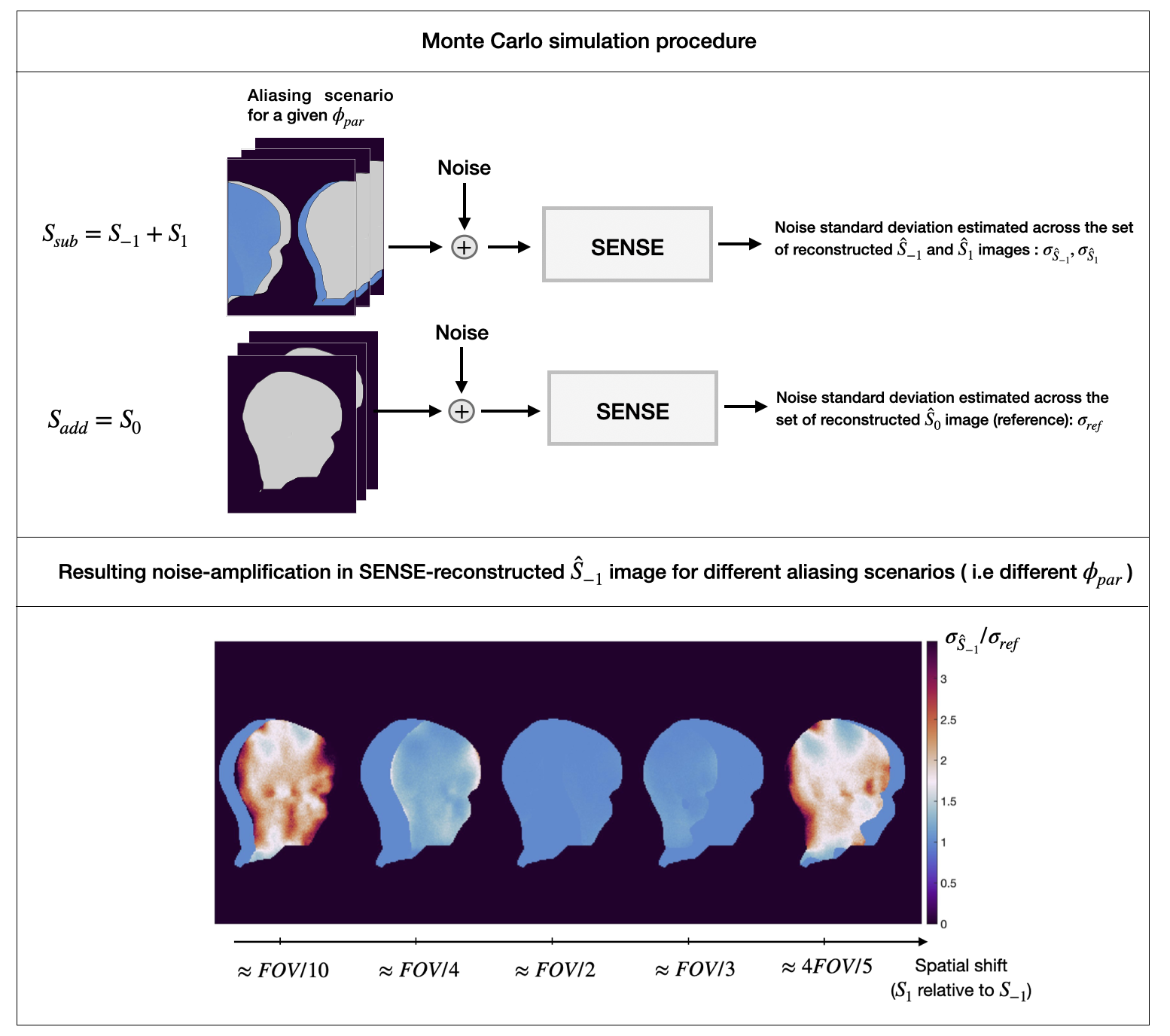
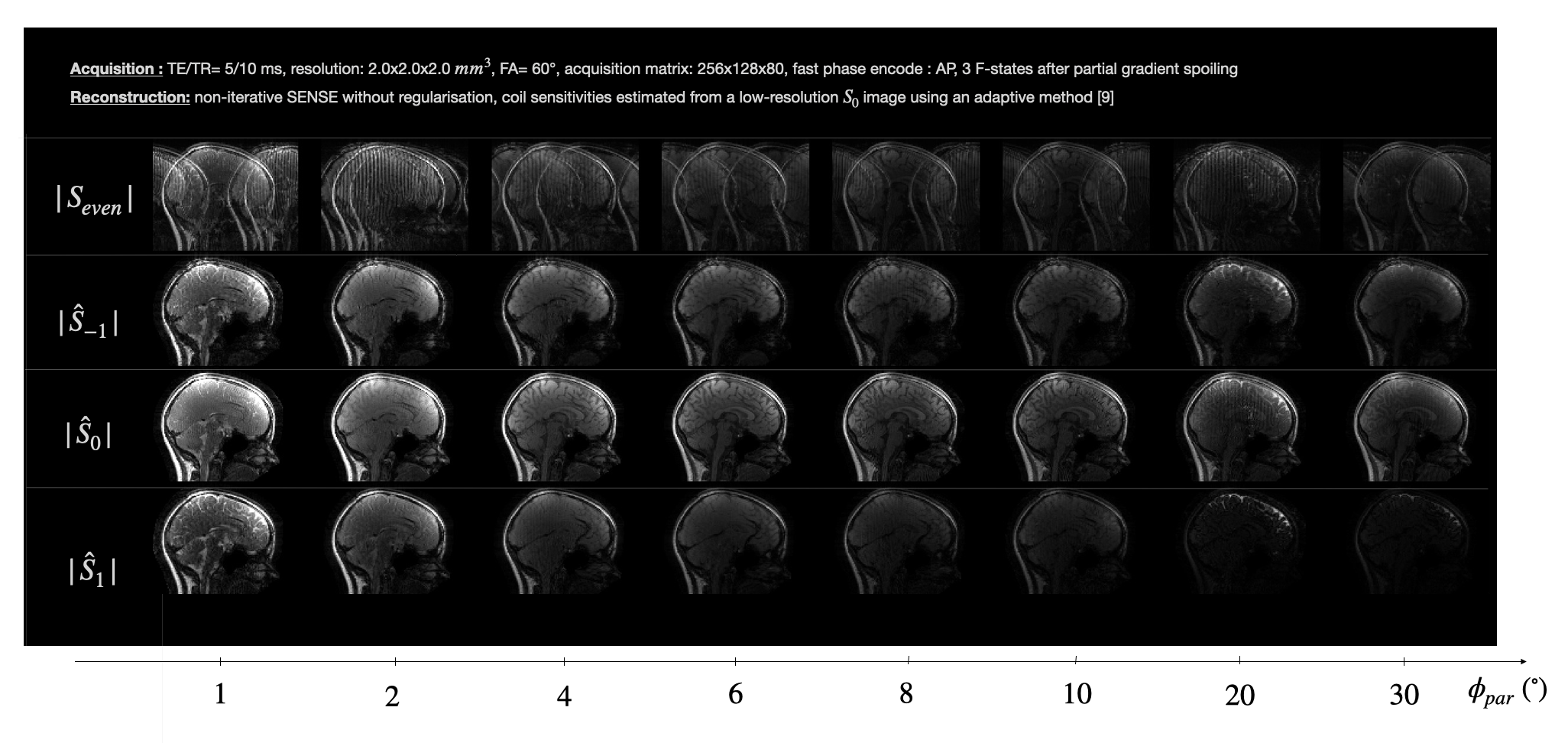
The Monte Carlo simulations (Figure 3) suggest that the optimal aliasing scenario corresponds to a $$$FOV/2$$$ separation between the aliased $$$F_{-1}$$$ and $$$F_1$$$ images. This can be achieved in practice by appropriate choice of $$$\phi_{par}$$$.Figure 4 shows the reconstructed F-state images obtained with varying $$$\phi_{par}$$$. Notably, $$$\phi_{par}$$$ provides control over image contrast, a feature exploited in partial spoiling experiments7. However, for larger $$$\phi_{par}$$$ the simplification in equations (5) is no longer valid, affecting SENSE performance. There is therefore a trade-off between controlling the image contrast and optimising the SENSE reconstruction.
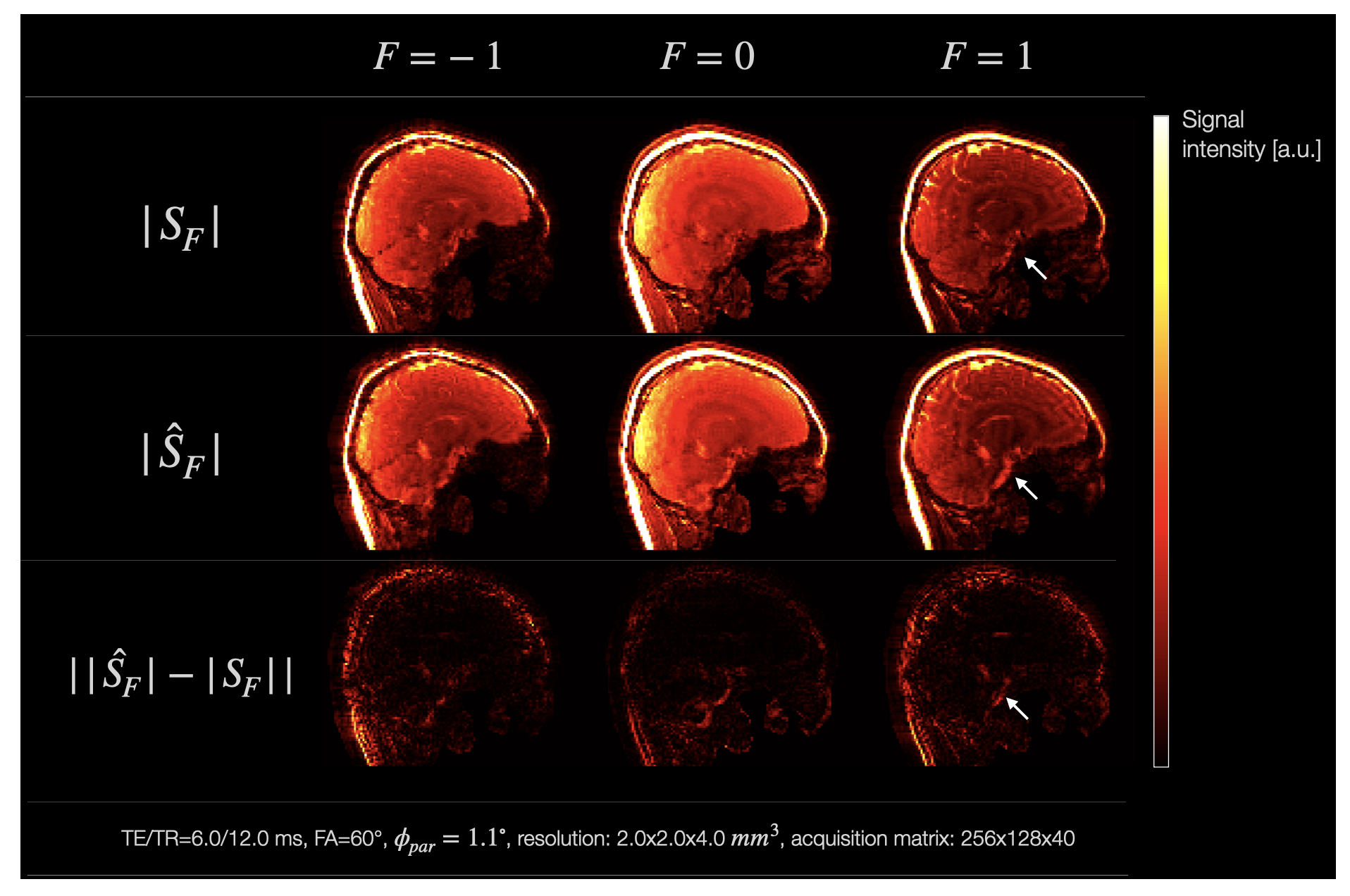
Finally, a comparison between ground truth F-state images and the proposed approach is presented in Figure 5, showing close agreement.
Conclusion
Here we introduce parallel contrast imaging, which improves the efficiency of multi-echo steady-state sequences by sampling all echoes simultaneously in a contrast-aliased acquisition. This provides new opportunities for fast multi-contrast imaging experiments while also reducing gradient requirements.Acknowledgements
We acknowledge generous support from The Wellcome Trust (220473/Z/20/Z), The Edmond J Safra Foundation, UK Dementia Research Institute, NIHR Imperial Biomedical Research Centre, and National Institutes of Health (R01EB002524).References
1. Sveinsson B, Chaudhari AS, Gold GE, Hargreaves BA. (2017) A simple analytic method for estimating T2 in the knee from DESS. Magn Reson Imaging., 38:63-70.
2. Heule R, Ganter C, Bieri O. (2014) Triple echo steady-state (TESS) relaxometry. Magn Reson Med., 71(1):230-7.
3. Zijlstra F, Seevinck PR. (2021) Multiple-echo steady-state (MESS): Extending DESS for joint T2 mapping and chemical-shift corrected water-fat separation. Magn Reson Med., 86(6):3156-3165.
4. Lally PJ, Chiew M, Statton B, et al. (2022) SNR-efficient SSFP with k-space aliasing . Proc. Intl. Soc. Mag. Reson. Med., 30:0503.
5. Lally PJ, Chiew M, Matthews PM, et al. (2023) SNR-efficient, motion-robust multi-echo SPGR with k-space aliasing. Proc. Intl.Soc. Mag. Reson. Med.,31:0531
6. Vasanawala SS, Pauly JM and Nishimura DG. (1999) Fluctuating equilibrium MRI. Magn. Reson. Med., 42: 876-883.
7. Ganter C. (2006) Steady state of gradient echo sequences with radiofrequency phase cycling: analytical solution, contrast enhancement with partial spoiling. Magn Reson Med., 55(1):98-107
8. Pruessmann KP, Weiger M, Scheidegger MB, Boesiger P. (1999) SENSE: sensitivity encoding for fast MRI. Magn Reson Med.;42(5):952-62.
9. Walsh DO, Gmitro AF, Marcellin MW. (2000) Adaptive reconstruction of phased array MR imagery. Magn Reson Med.,43(5):682-90.
Figures
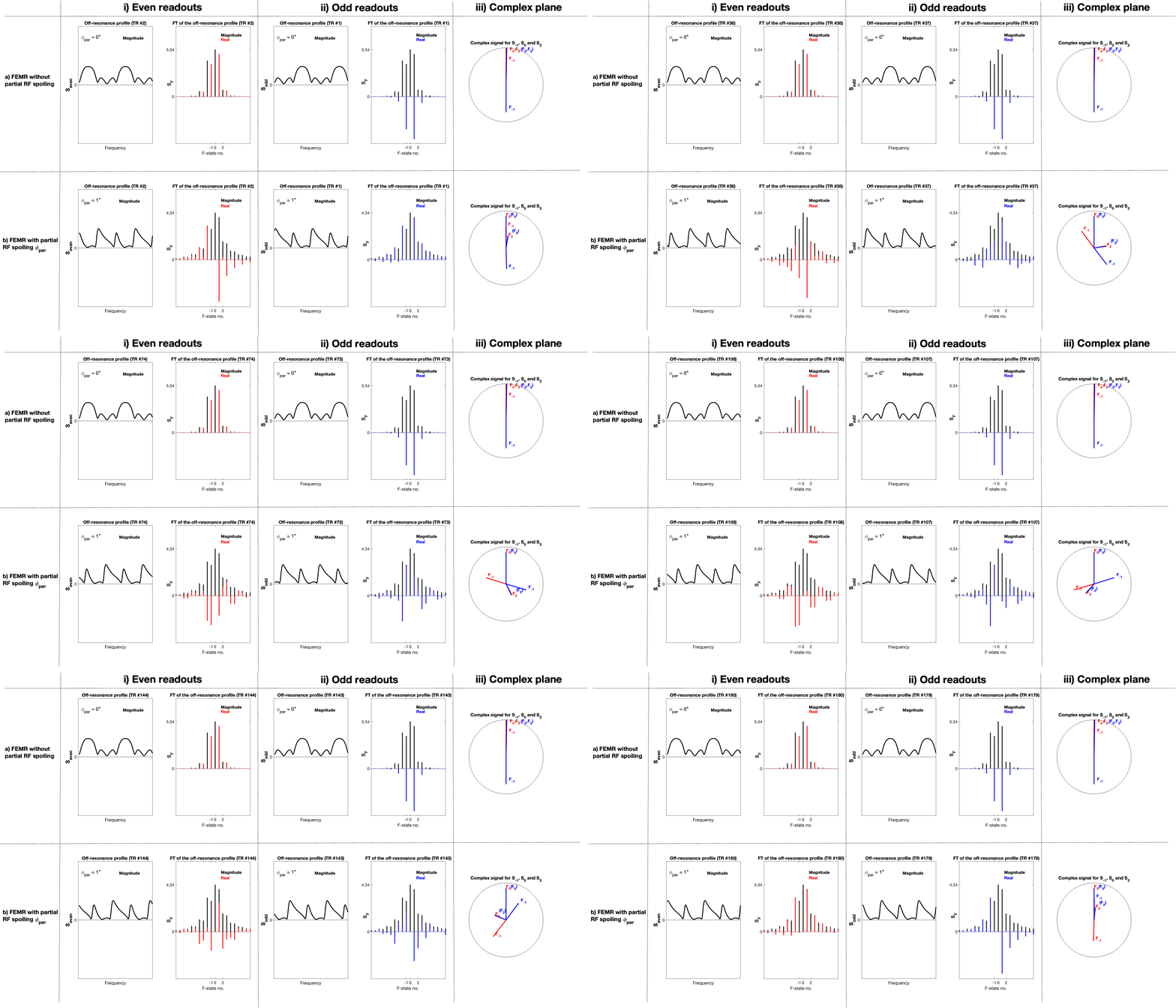
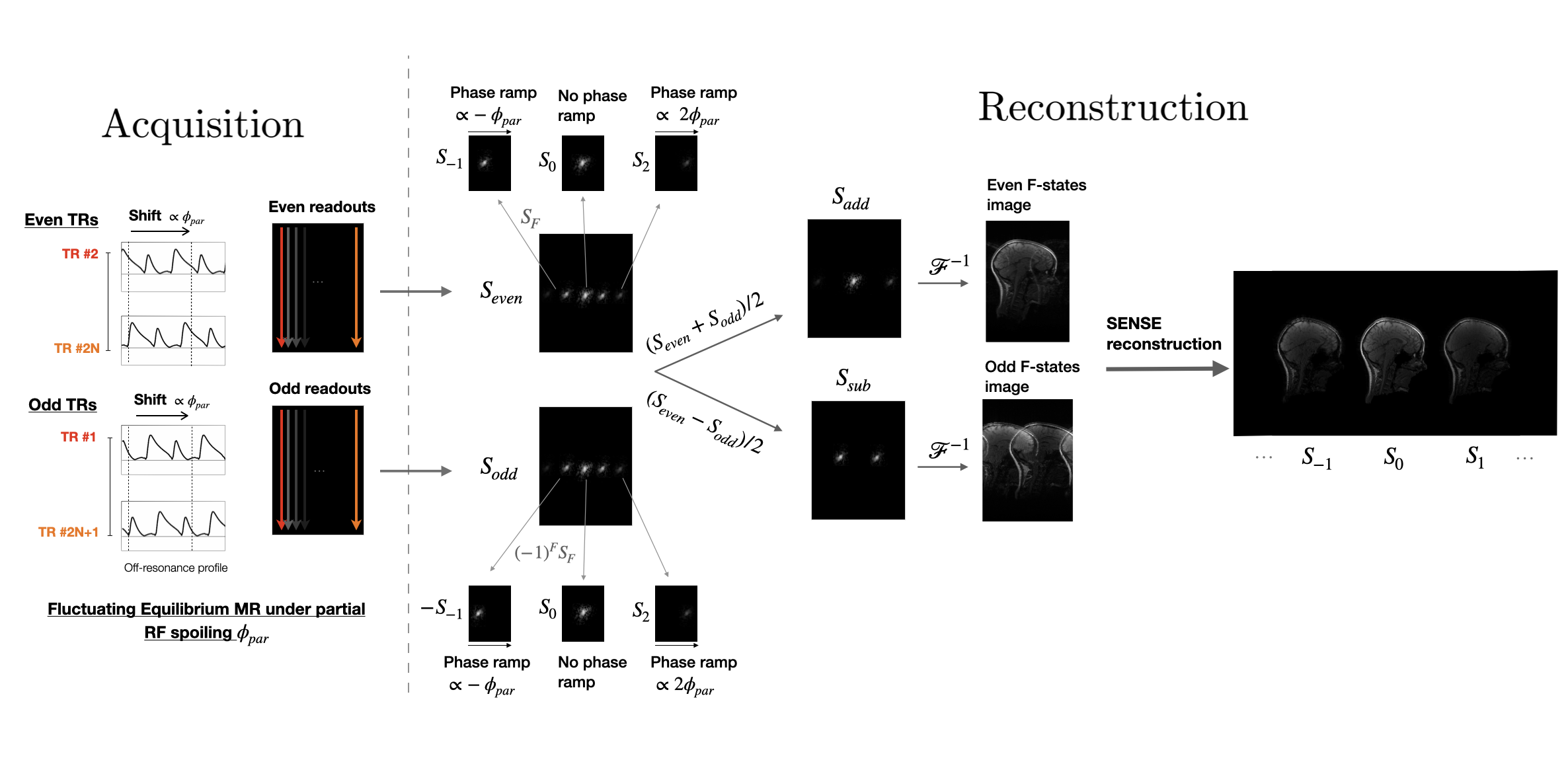
Figure 2: Illustrating the acquisition/reconstruction process used. Acquisition: With partial RF spoiling ($$$\phi_{par}$$$), the off-resonance profile is shifted throughout the acquisition. Reconstruction: In k-space, this results in applying a separate phase ramp to each F-state signal $$$S_{F}$$$, and so a differential spatial shift in image space. After linear combination of even and odd TR signals for subdividing the initial problem, the F-states components appears then all shifted relative to each other in image space and then can be separated with SENSE.