3243
Arbitrary Pulse Sequence Execution with Pulseq on Philips MRI Scanners1Brigham & Women's Hospital, Harvard Medical School, Boston, MA, United States, 2Philips, Nashville, TN, United States, 3Vanderbilt University Medical Center, Nashville, TN, United States, 4Philips Healthcare, Cambridge, MA, United States, 5Division of Medical Physics, Department of Radiology, University Medical Center Freiburg, Freiburg, Germany, 6fMRI Laboratory and Biomedical Engineering, University of Michigan, Ann Arbor, MI, United States, 7Department of Radiology, Brigham & Women's Hospital, Harvard Medical School, Boston, MA, United States, 8Athinoula A. Martinos Center for Biomedical Imaging, Massachusetts General Hospital, Charlestown, MA, United States, 9Department of Radiology, Harvard Medical School, Boston, MA, United States, 10Fetal-Neonatal Neuroimaging and Developmental Science Center, Boston Children’s Hospital, Harvard Medical School, Boston, MA, United States, 11Department of Radiology, Boston University Medical School, Boston, MA, United States, 12Department of Neurobiology, Boston University Medical School, Boston, MA, United States, 13Department of Biomedical Engineering, Case School of Engineering, Case Western Reserve University, Cleveland, OH, United States
Synopsis
Keywords: Data Acquisition, Pulse Sequence Design
Motivation: To enable execution of open-source vendor-agnostic pulse sequences on Philips MRI scanners.
Goal(s): To develop a Pulseq interpreter for Philips scanner.
Approach: An intelligent Philips Pulseq interpreter, denoted "p2p" (Pulseq to Philips), was implemented in MATLAB. It converts Pulseq-generated .seq files into a format compatible with Philips sequence objects.
Results: The p2p interpreter was tested with sequences that included arbitrary gradient waveforms including custom spiral waveforms and crusher waveforms spelling out the words ‘Philips Pulseq’, GRE and DW-EPI scans evaluated in phantoms and in vivo.
Impact: Open-source Pulseq format sequences can be executed with minimal adaptations on Philips scanners. The p2p Pulseq Philips interpreter completes the set of interpreters required to implement harmonized pulse sequences across the three major vendor platforms.
Introduction
Pulseq is a cross-vendor software for MATLAB and Python [1,2] that enables users to build MRI pulse sequences with portable code. Pulseq further defines the format for .seq files, generated by lists of events that can be executed on Siemens and GE MRI scanners using vendor-specific interpreters [3]. However, Pulseq interpreters for Philips scanners are still in their infancy. Roos et al. [4] recently introduced a Philips Pulseq interpreter but their work highlighted challenges of extended RF and ADC dead times that are unique to Philips scanners. These can result in additional time overhead for each Pulseq block, which is undesirable for sequences such as Diffusion Weighted Echo Planar Imaging (DW-EPI). We report an intelligent Philips Pulseq interpreter that is capable of consolidating Pulseq blocks to minimize dead times. The interpreter is demonstrated in generating arbitrary gradient waveforms and gradient-recalled echo (GRE) and DW-EPI acquisitions.Methods
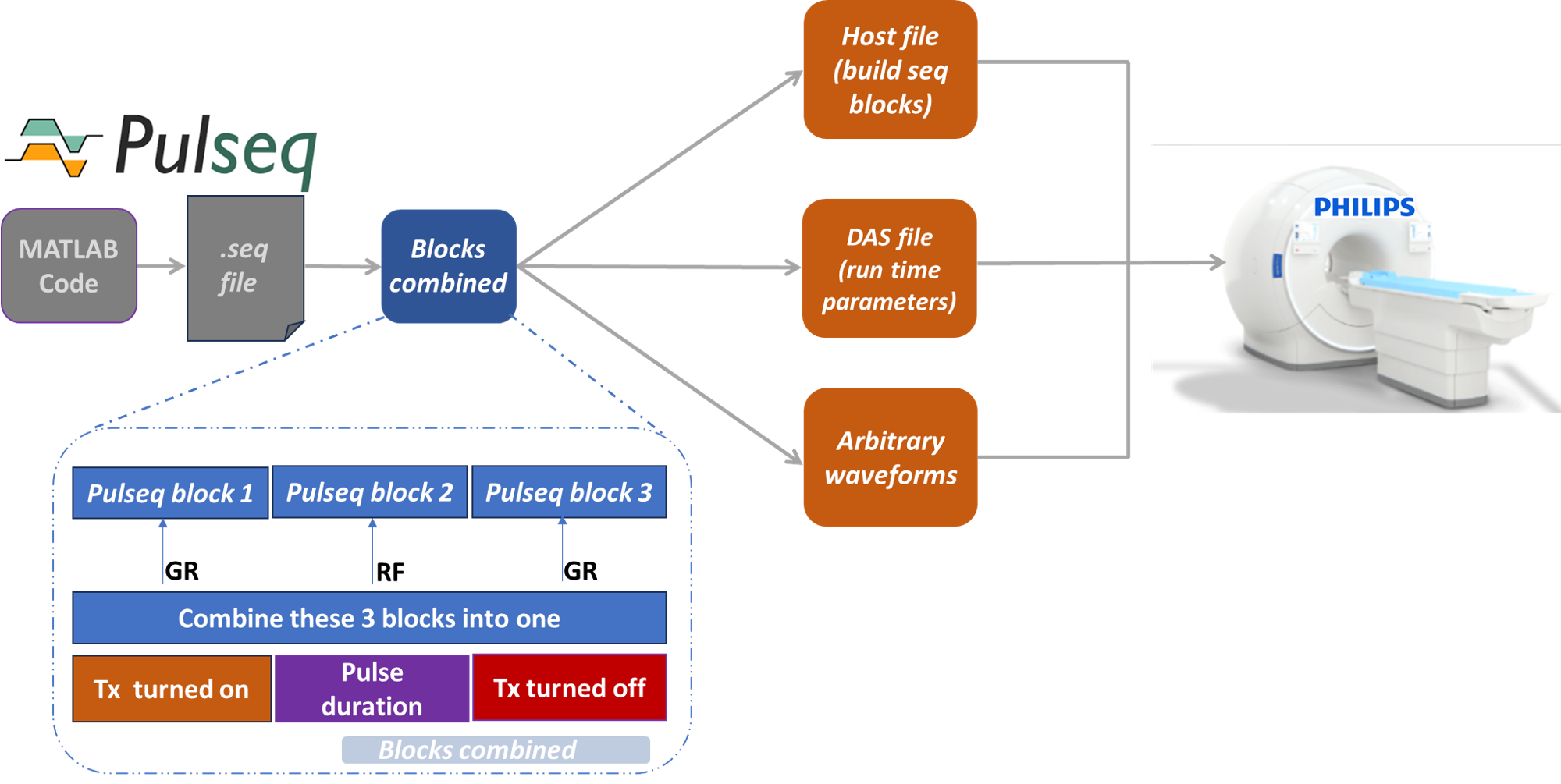
The new Philips Pulseq interpreter, denoted "p2p" (Pulseq to Philips), was implemented in MATLAB. In this method, .seq files are transformed to an intermediate format, where blocks containing RF and ADC components are merged with time-adjacent blocks whenever possible to minimize dead times as shown in Figure 1. After combining the blocks, the sequence is converted into host PC and DAS (Data Acquisition System) files, where the DAS file contains the sequence events and object runtime attributes to be executed/varied by the real-time computer and the host PC file contains 100 blocks of sequence information for standard vendor safety and hardware limit checks, as well as information about scan duration and required reconstruction memory. The attributes of the sequence objects are then dynamically modified at runtime using the parameters (DAS file) generated by the interpreter.The p2p interpreter was tested with sequences that included arbitrary gradient waveforms including externally defined spiral waveforms and crusher waveforms spelling out the words ‘Philips Pulseq’. Single-slice gradient-recalled echo (12 deg flip, 220 x 220 matrix size, 220 x 220 x 3 mm FOV, 400ms TR, 5 ms TE) and multislice DW-EPI (220 x 220 x 75 mm FOV, 30 slices, 88 x 88 matrix size, 5 s TR, 70 ms TE, 0.75 partial Fourier) pulse sequences were further created and used to image phantoms and two healthy human subjects on a Philips 3T MRI scanner (MR 7700, Philips Healthcare, Best, Netherlands), with offline image reconstruction.
Results
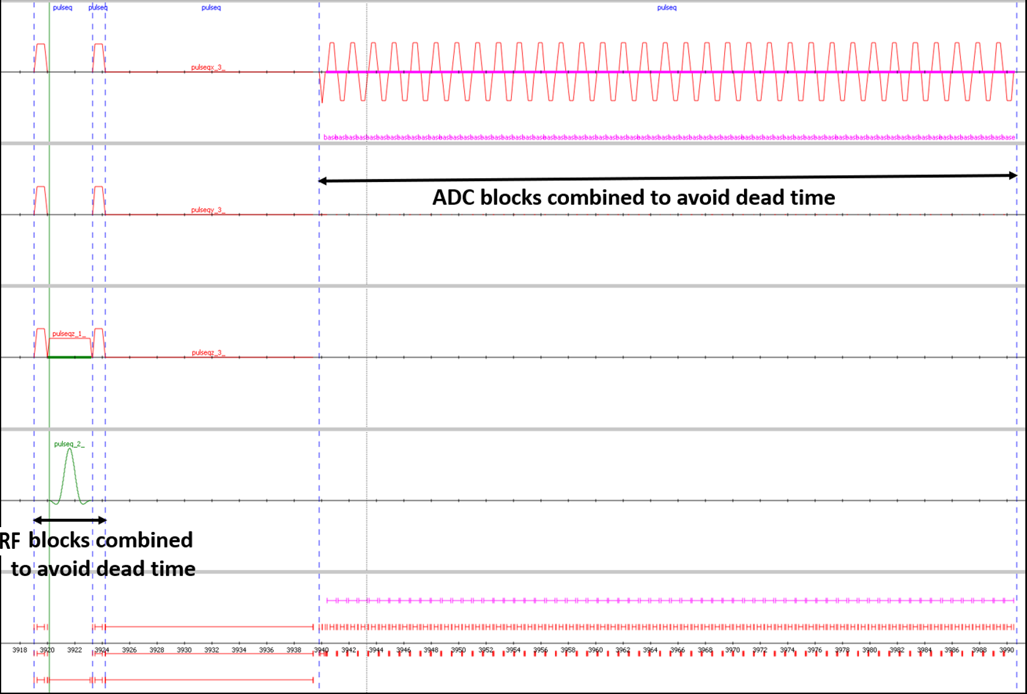
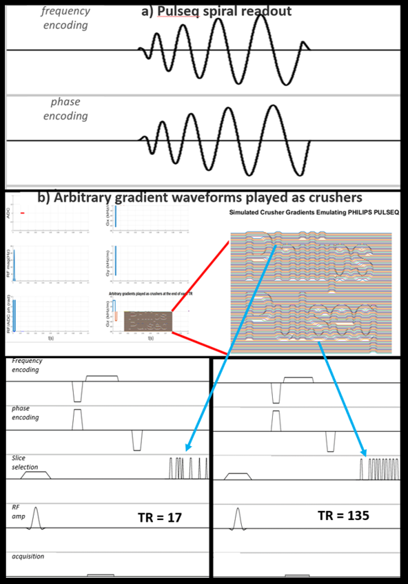
Figure 2 shows how the p2p interpreter combined an RF transmit block with a gradient block (delineated by the blue dotted lines, representing a single block executed on the Philips scanner) in a gradient-echo EPI sequence so that the dead time for RF coil detuning and amplifier unblanking could occur simultaneously with the gradient. The figure further shows how the interpreter combined ADC blocks in the sequence’s EPI readout so they could share a single front-end time for coil detuning. This resulted in a total readout length of 45 ms, 39% shorter than a readout without optimization which would have included 0.44 ms of dead time for each echo.Figure 3a shows the arbitrary gradient waveform results including a spiral pulse sequence in the vendor-provided sequence viewer. Figure 3b shows a gradient-echo sequence with crushers spelling ‘Philips Pulseq’ across TRs, also in the vendor-provided viewer. A sequence comprising over 60,000 blocks was executed on the scanner without issues.
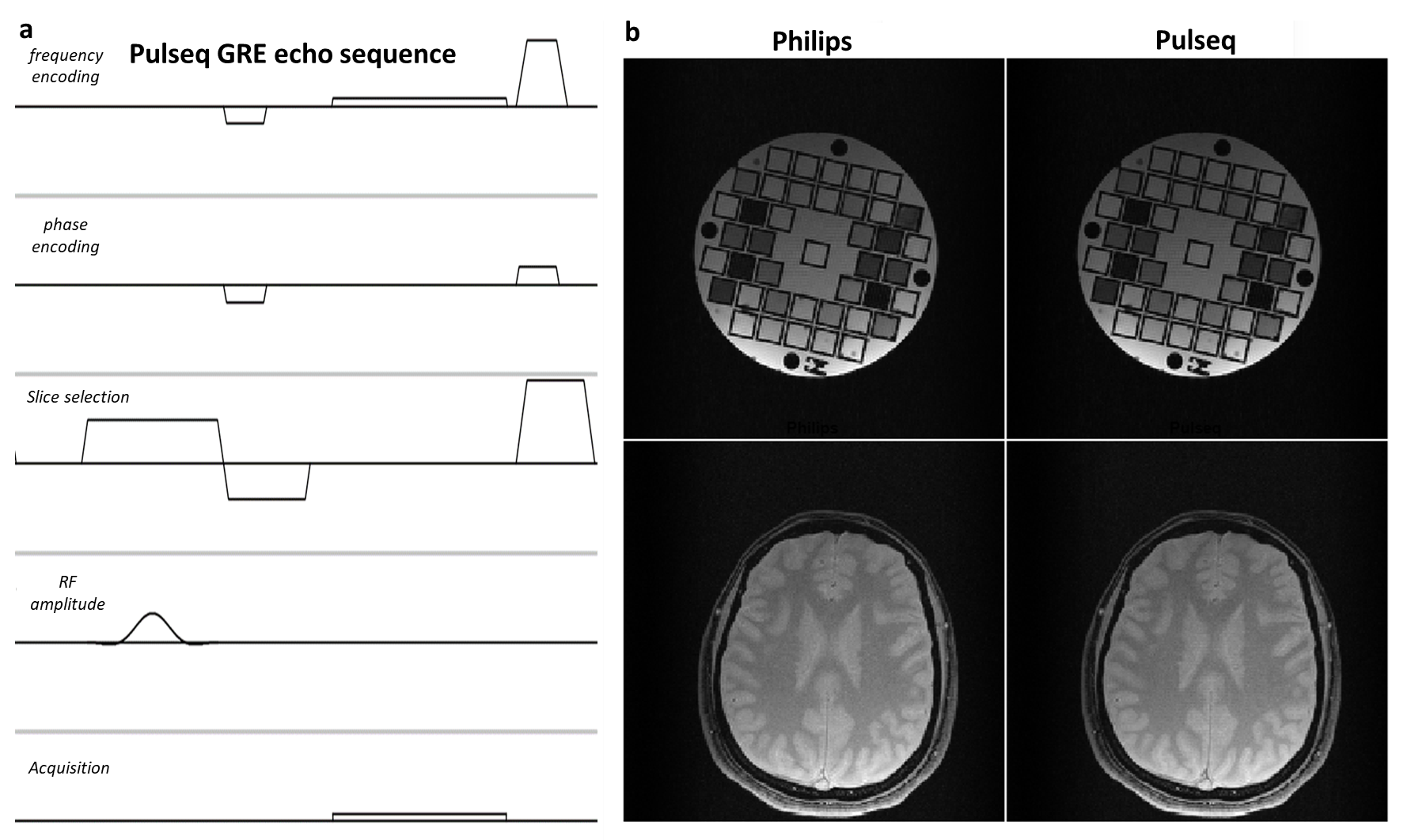
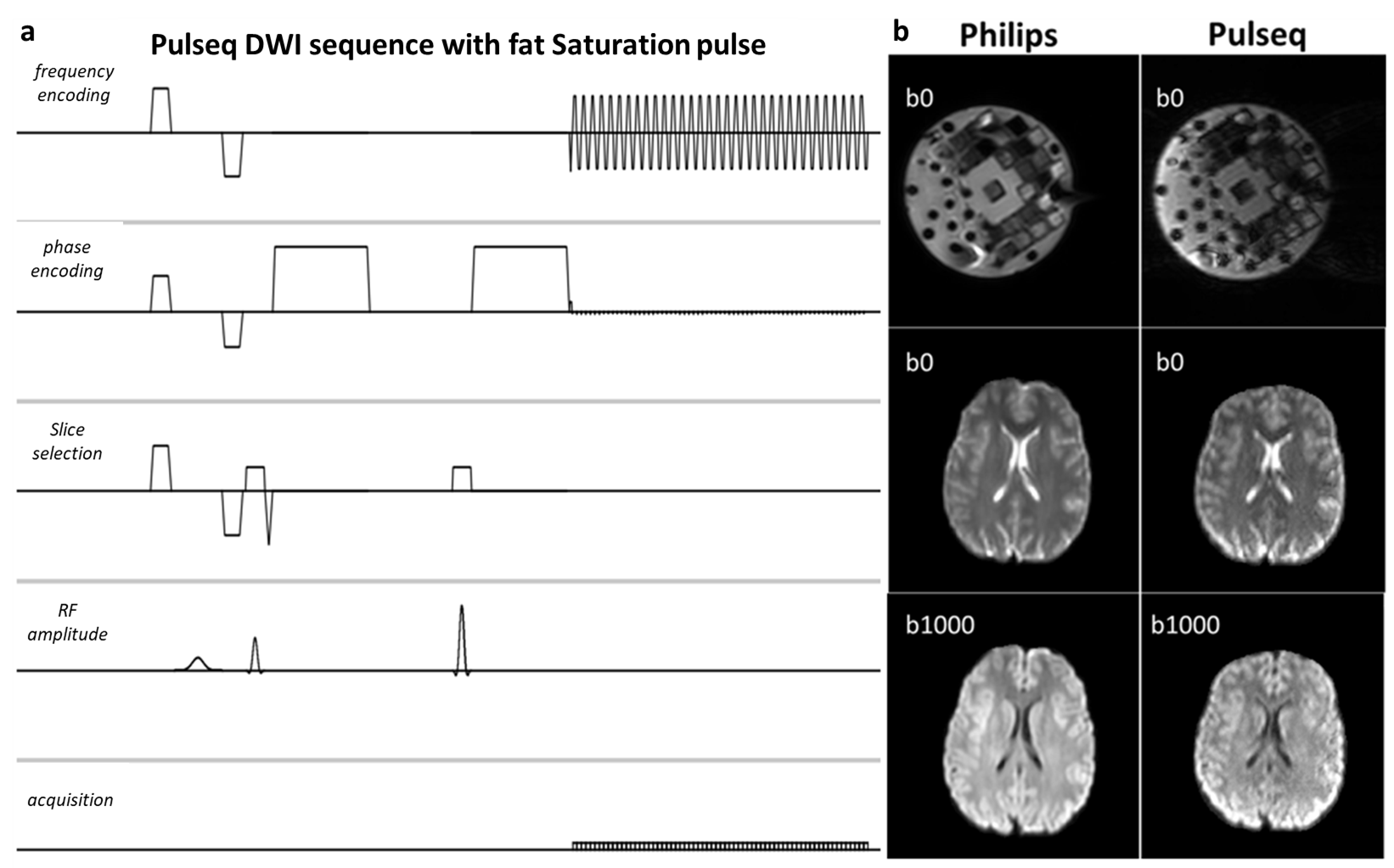
Figure 4a plots a TR of the gradient-recalled echo sequence and Figure 4b shows phantom and in vivo images collected with this sequence and a matched Philips pulse sequence, which show good agreement and no unnecessary dead time. Figure 5a plots a TR of the DW-EPI pulse sequence and Figure 5b shows phantom and in vivo images collected with this sequence and a matched Philips sequence with two b-values, which again show good agreement despite of different reconstruction algorithms. The difference in distortion between the two images could be due to the opposite phase encoding (PE) direction in their respective acquisitions.
Discussion & Conclusion
The p2p Pulseq Philips interpreter was developed, which enables arbitrary pulse sequence execution on Philips MRI scanners and completes the set of interpreters needed to implement harmonized pulse sequences across the three major vendor platforms. Unique features of the p2p interpreter include its ability to intelligently combine adjacent blocks in time to eliminate undesired dead times around RF pulses and ADC windows, and to perform standard vendor safety and hardware checks, prior to executing a sequence. The interpreter was validated to enable the generation of arbitrary gradient waveforms and GRE and DW-EPI imaging which yielded images of equivalent quality to native vendor sequences.Acknowledgements
This work was supported by NIH R01 EB032378.References
[1] Layton KJ, Kroboth S, Jia F, et al. Pulseq: A rapid and hardware-independent pulse sequence prototyping framework. Magn Reson Med 2017;77:1544–52.
[2] Ravi et al., (2019). PyPulseq: A Python Package for MRI Pulse Sequence Design. Journal of Open Source Software, 4(42), 1725,
[3] Nielsen JF, Noll DC. TOPPE: A framework for rapid prototyping of MR pulse sequences. Magn Reson Med 2018;79:3128–34
[4] Roos et.al,. Open-source Pulseq sequences on Philips MRI scanners. arXiv preprint arXiv:2310.06962.
Figures