3241
Spiral cardiac cine imaging with water/fat separation1Department of Radiology, Mayo Clinic, Rochester, MN, United States, 2Department of Radiology, University of Wisconsin-Madison, Madison, WI, United States
Synopsis
Keywords: Data Acquisition, Heart, spiral MRI, cardiac CINE, water/fat separation
Motivation: Water/fat separation can be helpful to better distinguish adipose tissue, blood and myocardium in a cardiac cine series. However, inclusion of a multi-echo acquisition in the conventional bSSFP sequence can introduce artifacts and reduce temporal efficiency.
Goal(s): To develop a fast and robust water/fat separation method for time-resolved cardiac cine imaging.
Approach: A spoiled gradient echo sequence with spiral acquisition is proposed to perform the cine acquisition with retrospectively cardiac gating.
Results: The image from the proposed method has shorter scan time, lower artifact level and lower RF deposition compared to a multi-echo bSSFP sequence.
Impact: We demonstrate the feasibility of spiral cardiac cine imaging with water/fat separation, enabling faster scanning while preserving adequate contrast among adipose tissue, blood and myocardium. This sequence also has low RF deposition with much lower SAR level for the patient.
Introduction
Cardiac cine MRI is considered the clinical reference standard for examining the structural and functional parameters such as ventricular volume and strain1. Cardiac cine imaging is usually performed with a balanced steady state free precession (bSSFP) sequence due to its high SNR, excellent soft tissue contrasts and robustness for characterizing cardiac motion. A disadvantage of bSSFP imaging is its high-magnitude fat signal leading to difficulties to distinguish it from the blood and the pericardial fluid. Conversely, epicardial fat depots have been linked to various cardiovascular disease and their selective depiction might provide additional information2,3. Therefore, a water/fat separation strategy will be helpful for image reading. Water/fat separation methods with multiple TEs, such as Dixon method4 and IDEAL5, are commonly used and are compatible with a bSSFP sequence. However, the echo shifting prolongs TR reducing temporal efficiency and likely invoking susceptibility artifacts. Therefore, there is a need for alternative sequences that maintain temporal efficiency while facilitating separate depiction of water and fat components in cardiac cine imaging.MRI scanning with spiral trajectories is particularly interesting as it achieves high SNR and temporal efficiency with a long acquisition window6. Spiral MRI often includes water/fat separation to avoid blurring from chemical shift of the fat protons7. Here we propose spiral MRI in combination with a fast spoiled gradient echo(SPGR) sequence in order to achieve water/fat separation for the cardiac cine scanning to offer high temporal efficiency and improved image quality.
Methods
Volunteer scans were performed on a 1.5T magnets (Ambition X, Philips) after informed consent with an IRB approved protocol.Spiral cine imaging: Short axis cardiac cine imaging was performed using a breath-hold and retrospectively gating spiral SPGR sequence with TE1/TE2/TR=1.2ms/3.5ms/23.8ms, flip angle=300, acquisition window=18ms, spatial resolution=1.7×1.7×8.0mm3, and a total of 10 spiral arms. In Fig.1a., an example of the sequence acquiring two spiral arms (views per k-space segment (vps) = 2) within a cardiac cycle is shown. The temporal resolution for the acquired data is 2×TR×vps. The reconstruction firstly grid data to the designated cardiac phase with respect to each TE(Fig.1b). Each neighboring TE data can be combined to reconstruct water/fat images using simultaneous deblurring and water/fat separation7,8. Water/fat separation using each neighboring pair of TE data allows to achieve higher reconstruction temporal resolution closer to TR×vps. The final reconstruction refined both water and fat compoents by an exponential sharpening filter in k-space to compensate the T2* decay along the acquisition. The T2* value used for the filter was 25ms.
Conventional water/fat separation: Scans using Cartesian bSSFP sequences for fat/water separation were also performed with identical geometric prescription and SENSE factor 2 using a two TE method and a three TE method, with TE1/TE2/TR = 1.6ms/3.9ms/5.2ms and TE1/TE2/TE3/TR = 1.7ms/2.3ms/2.9ms/4.2ms respectively. The vps setting for these Cartesian scans is 6. The two TE data are reconstructed using a Dixon method and the three TE data using the IDEAL algorithm5.
Results
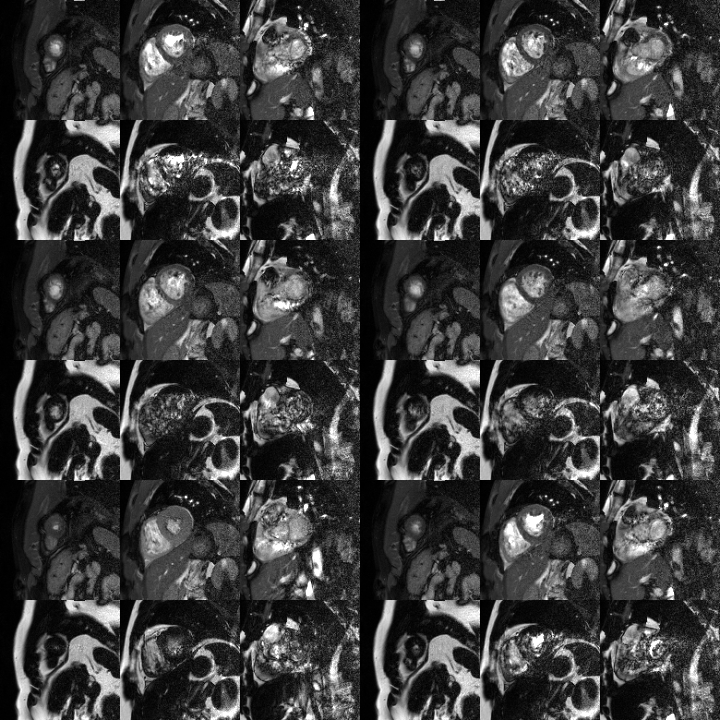
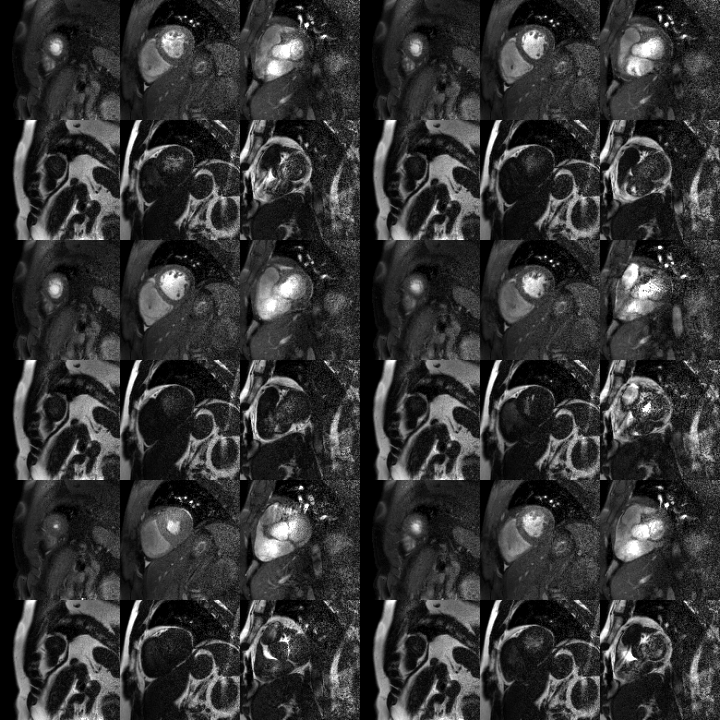
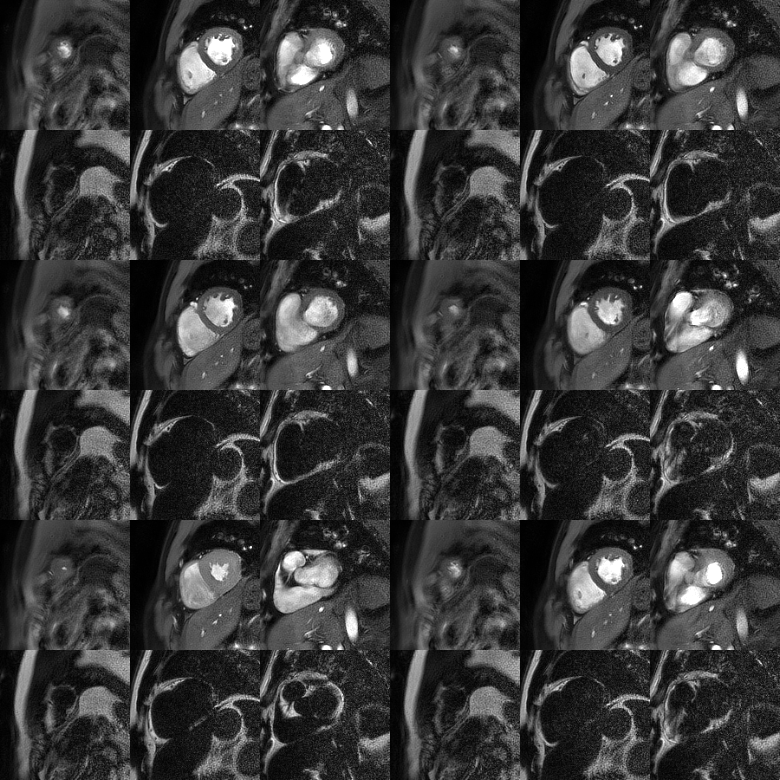
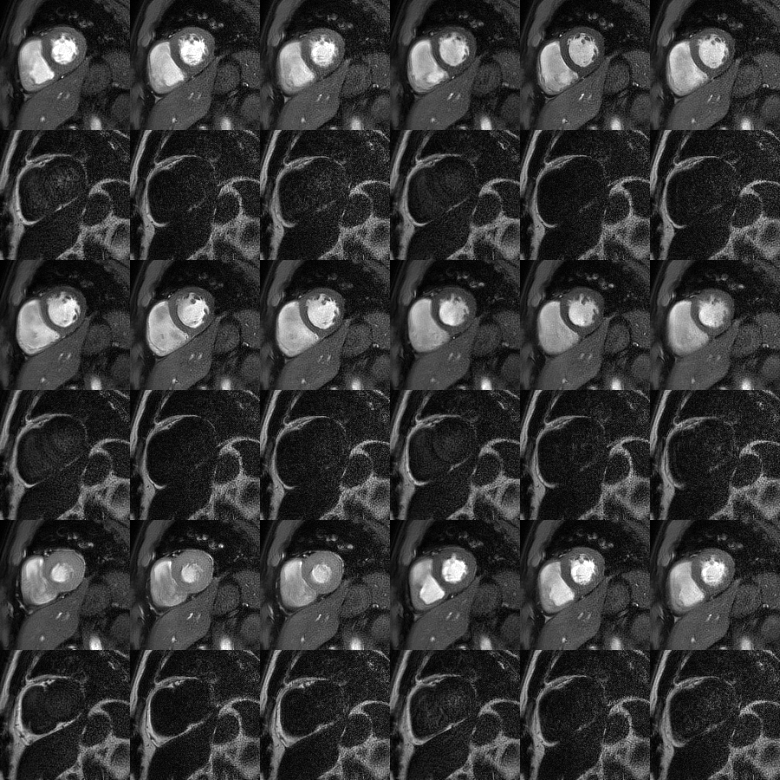
Reconstructions from the scans of the proposed sequence and the Cartesian bSSFP sequences are shown in Figs.2-4. Severe flow artifacts are found in the two TE bSSFP sequence especially during systole. Such artifact becomes less severe yet noticeable in the three TE bSSFP sequence, but are mostly mitigated in the spiral scan. Meanwhile the perceivable SNR of the spiral scan is also higher than the bSSFP scans with SENSE. One issue noticed in the spiral scan is the inconsistent transient signals over the cardiac cycle. As for the scan time, the Cartesian scans take around 20 heartbeats for scanning a slice while the spiral scan only takes 6 heartbeats with vps=2. Fig.5. demonstrates the spiral scans using different vps settings. A larger vps, e.g. vps =3, could introduce temporal smoothing by lowering temporal resolution but it can be used to reduce the scan time. On the other hand, image quality using vps=1 and vps=2 is comparable among the volunteer scans in the present study.Discussion
Results suggest our proposed spiral sequence could offer high quality water/fat separated cardiac cine series with a shortened scan time compared to conventional methods to achieve water/fat separation. The proposed sequence relies on the flow related enhancement for the contrast between the myocardium and the blood which can cause signal variation. Such signal variation can be noticed in some time frames, but it is not seen at end diastole and end systole. One additional advantage of the proposed method is its low RF power deposition. The excitation B1 rms value of the bSSFP for the presented study was around 2.6µT, while the spiral sequence reached around 1.4µT.Acknowledgements
This works is supported in part by Philips.References
1. Schulz-Menger J, et al. Standardized image interpretation and post-processing in cardiovascular magnetic resonance - 2020 update : Society for Cardiovascular Magnetic Resonance (SCMR): Board of Trustees Task Force on Standardized Post-Processing. J Cardiovasc Magn Reson. Mar 12 2020;22(1):19. doi:10.1186/s12968-020-00610-6
2. Kellman P, et al. Multiecho dixon fat and water separation method for detecting fibrofatty infiltration in the myocardium. Magn Reson Med. Jan 2009;61(1):215-21. doi:10.1002/mrm.21657
3. McGavock JM, Victor RG, Unger RH, Szczepaniak LS, American College of P, the American Physiological S. Adiposity of the heart, revisited. Ann Intern Med. Apr 4 2006;144(7):517-24. doi:10.7326/0003-4819-144-7-200604040-00011
4. Dixon WT. Simple proton spectroscopic imaging. Radiology. Oct 1984;153(1):189-94. doi:10.1148/radiology.153.1.6089263
5. Reeder SB, Markl M, Yu H, Hellinger JC, Herfkens RJ, Pelc NJ. Cardiac CINE imaging with IDEAL water-fat separation and steady-state free precession. J Magn Reson Imaging. Jul 2005;22(1):44-52. doi:10.1002/jmri.20327
6. Wang D, Krishnamoorthy G, Ooi MB, Pipe JG. Spiral inflow MRA with sliding-slice localized quadratic encoding. Magn Reson Med. Nov 2023;90(5):1818-1829. doi:10.1002/mrm.29770
7. Wang D, Zwart NR, Pipe JG. Joint water-fat separation and deblurring for spiral imaging. Magn Reson Med. Jun 2018;79(6):3218-3228. doi:10.1002/mrm.26950
8. Chao TC, Wang D, Krishnamoorthy G, Pipe JG. A field map updating algorithm to improve fat-water spiral imaging. Magn Reson Med. Sep 2023;90(3):1219-1227. doi:10.1002/mrm.29697
Figures