3207
Fe(II), Co(II) and Ni(II) complexed DOTA-tetraglycinates as pH and temperature biosensors1Radiology and Biomedical Imaging, Yale University, New Haven, CT, United States, 2Biomedical Engineering, Yale University, New Haven, CT, United States, 3Yale Cancer Center, Yale University, New Haven, CT, United States
Synopsis
Keywords: Contrast Agents, Contrast Agent, pH sensor, temperature sensor, transition metal complex, MRSI, early cancer detection
Motivation: Gadolinium based contrast agents (GBCAs) are reported to be toxic and associated with nephrogenic systemic fibrosis (NSF). Alternative options should be developed to minimize toxicity.
Goal(s): Develop alternative biocompatible transition metal-based MRI agents for advanced imaging.
Approach: Using paramagnetic high spin Fe(II), Co(II), and Ni(II) ions coordinated with well-established cyclic ligands for enhanced MRS imaging to detect cancer tumors at an early stage.
Results: Fe(II)DOTA-4AmC2-, Co(II)DOTA-4AmC2-, and Ni(II)DOTA-4AmC2- were synthesized and characterized. Their in vitro pH and temperature sensing capabilities were assessed using BIRDS at 11.7T.
Impact: These biocompatible pH sensors can be employed for in vivo pH mapping for early cancer diagnosis and can also be adapted for clinical applications.
Purpose:
Develop biocompatible transition metal-based molecular pH sensors for early detection of solid cancer tumors suitable for clinical translation.Introduction:
Monitoring temperature and pH is crucial for tracking disease progression. Our bodies actively work to regulate these parameters to uphold normal physiological conditions.1,2 Fluctuations in local temperature or pH can disrupt blood flow and nutrient supply, potentially resulting in shifts in physiological equilibrium and fostering cancer progression.3 Recently, a novel technique known as Biosensor Imaging of Redundant Deviation in Shifts (BIRDS) was developed to enable high-resolution measurement of temperature and pH in living tissues. BIRDS uses magnetic resonance spectroscopy imaging (MRSI) to measure the hyperfine chemical shifts of non-exchangeable protons from paramagnetic complexes.3,4,5 The current studies using BIRDS rely on exogenous agents composed of paramagnetic Ln3+ ions (e.g., Tm3+, Eu3+, Yb3+) complexed with derivatives of cyclen-based ligands like 1,4,7,10-tetraazacyclododecane-1,4,7,10-tetraacetic acid (DOTA), e.g., DOTA-tetraglycenate (DOTA-4AmC4-), DOTA-tetraaminophosphonate (DOTA-4AmP8-), DOTA- tetraphosphonate (DOTP8-), and methylated DOTA (DOTMA4-).3,4,5 Biocompatible MR agents based on divalent 3d transition metal ions have gained interest in MRI/MRSI due to their ability to shift proton resonance at physiological temperature and pH.6,7 High-spin Fe(II), Co(II), and Ni(II) ions complexed with macrocyclic ligands have been reported to exhibit relatively sharp, dispersed and hyperfine shifted proton resonances.6,7 Here we report, for the first time, BIRDS agents incorporating paramagnetic centers consisting of Fe(II), Co(II), or Ni(II) transition metal ions, complexed with the DOTA-4AmC4- ligand for pH and temperature sensing.Methods:
The DOTA-4AmC4- ligand (0.2 mM, 1 equivalent) was dissolved in ethanol in an Erlenmeyer flask and purged with nitrogen gas. A transition metal salt [Fe(CF3SO3)2], Co(NO₃)₂6H₂O or NiSO₄·7H₂O] of 0.21 mM (1.1 equivalent) was dissolved in ethanol under nitrogen gas in a separate Erlenmeyer flask. Next, both solutions were mixed and stirred under inert atmosphere for 24h. After completion of synthesis, the complex was precipitated with excess diethyl ether and washed three times to remove free metal ions. The samples were further purified and analyzed on HPCL using C18 column. To determine the temperature and pH sensitivities of complexes, proton spectra were acquired at 500MHz at various temperatures (25 to 42 °C ) and pH values (6.5 –8.0). Low-temperature diffraction data of single crystals of complexes were collected on a Rigaku MicroMax-007HF diffractometer coupled to a Saturn 994+CCD detector with CuKα (λ = 1.54178 Å) for the molecular structures.Results and Discussion:
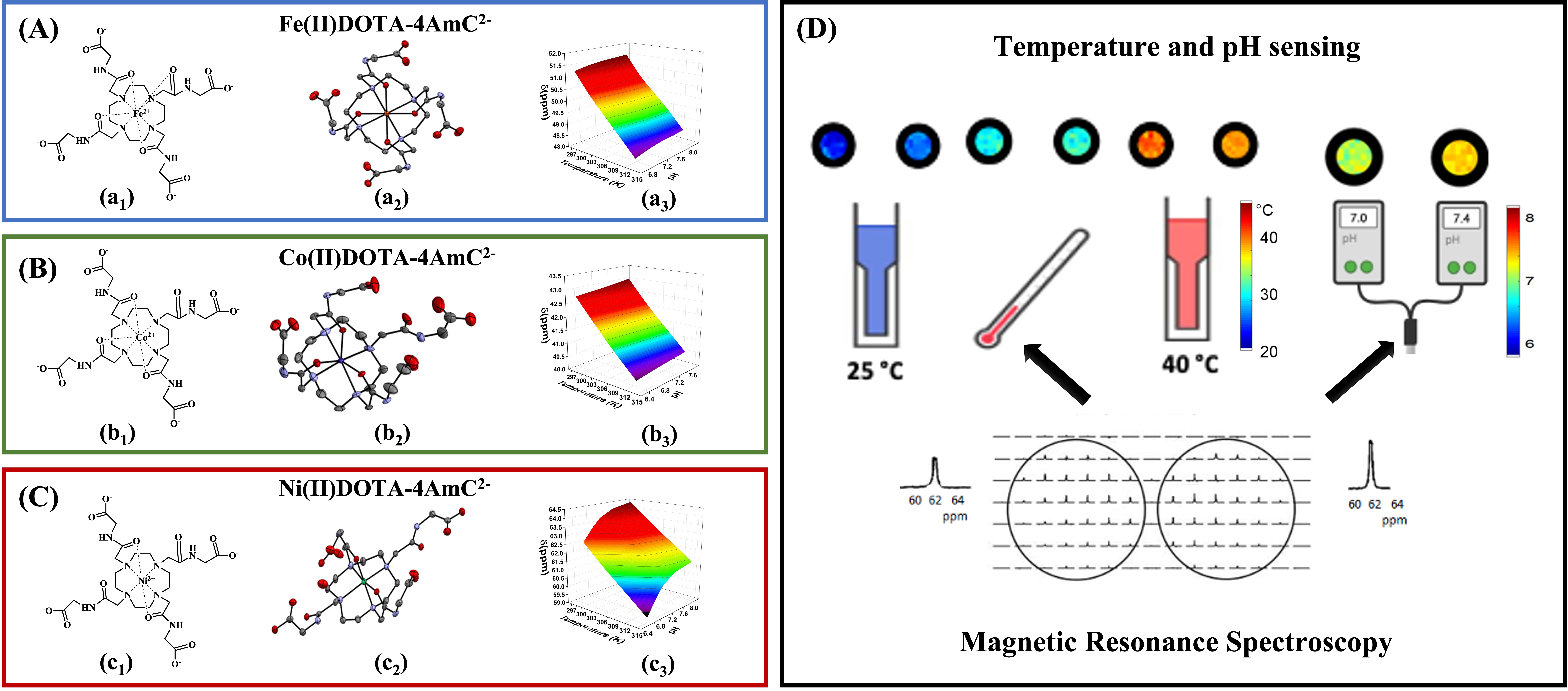
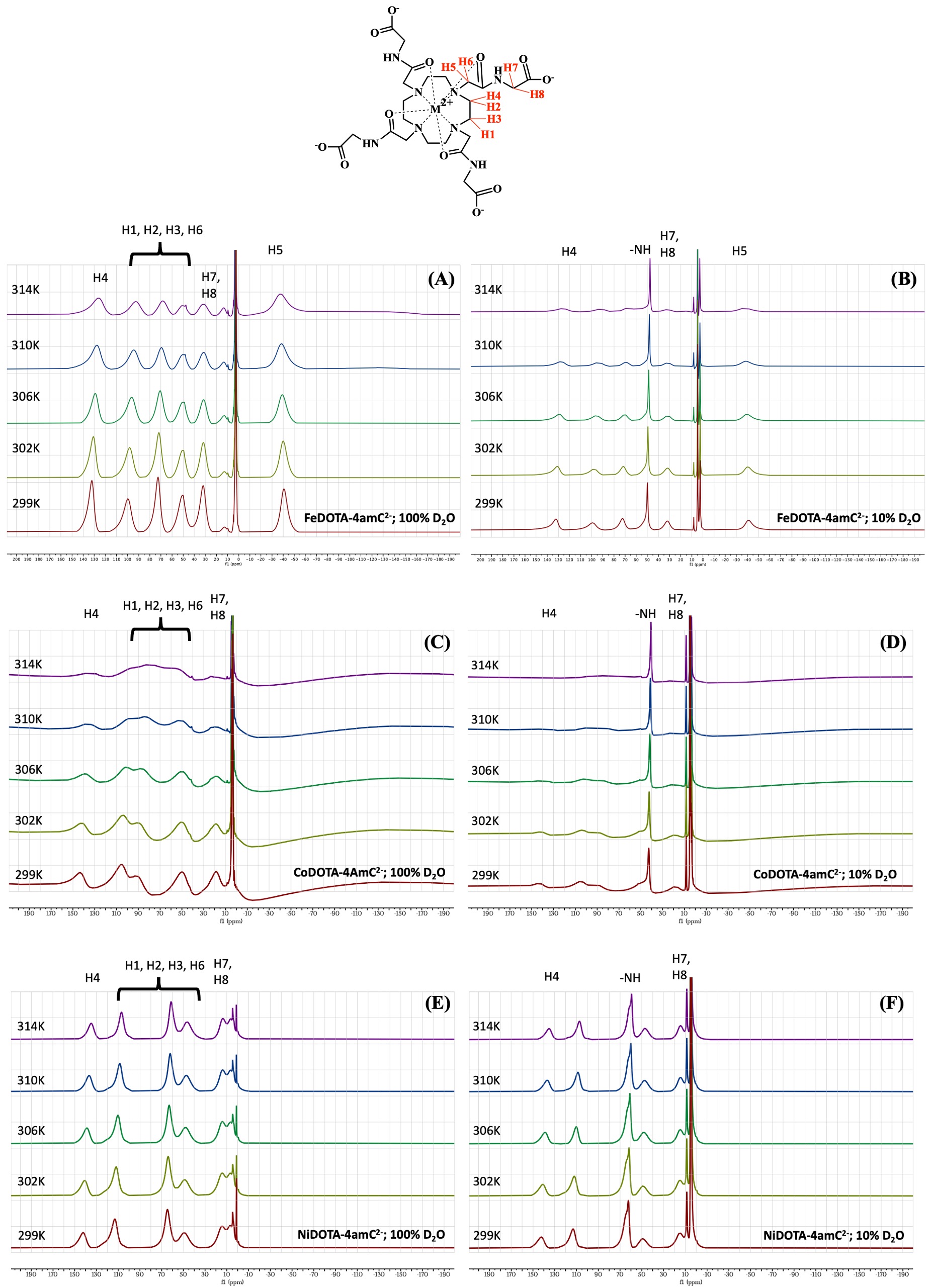
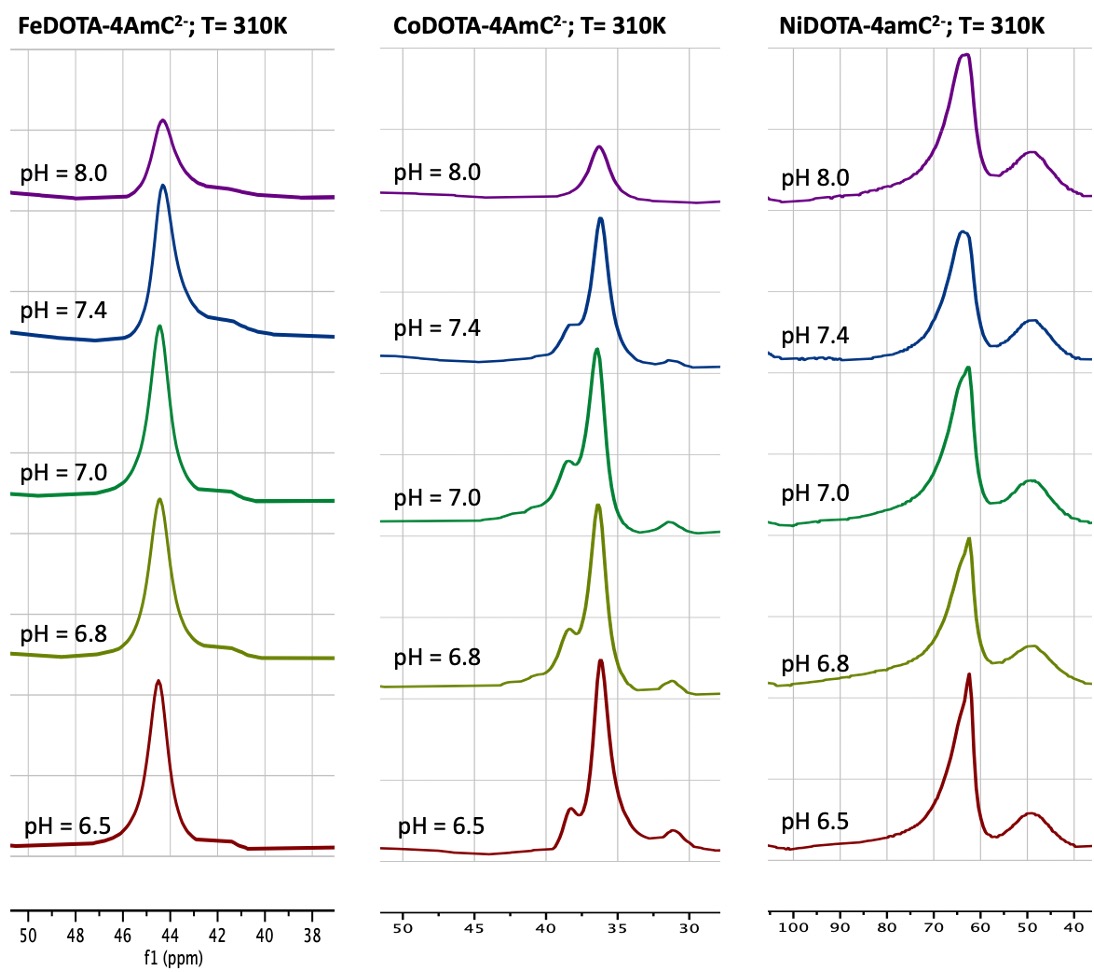
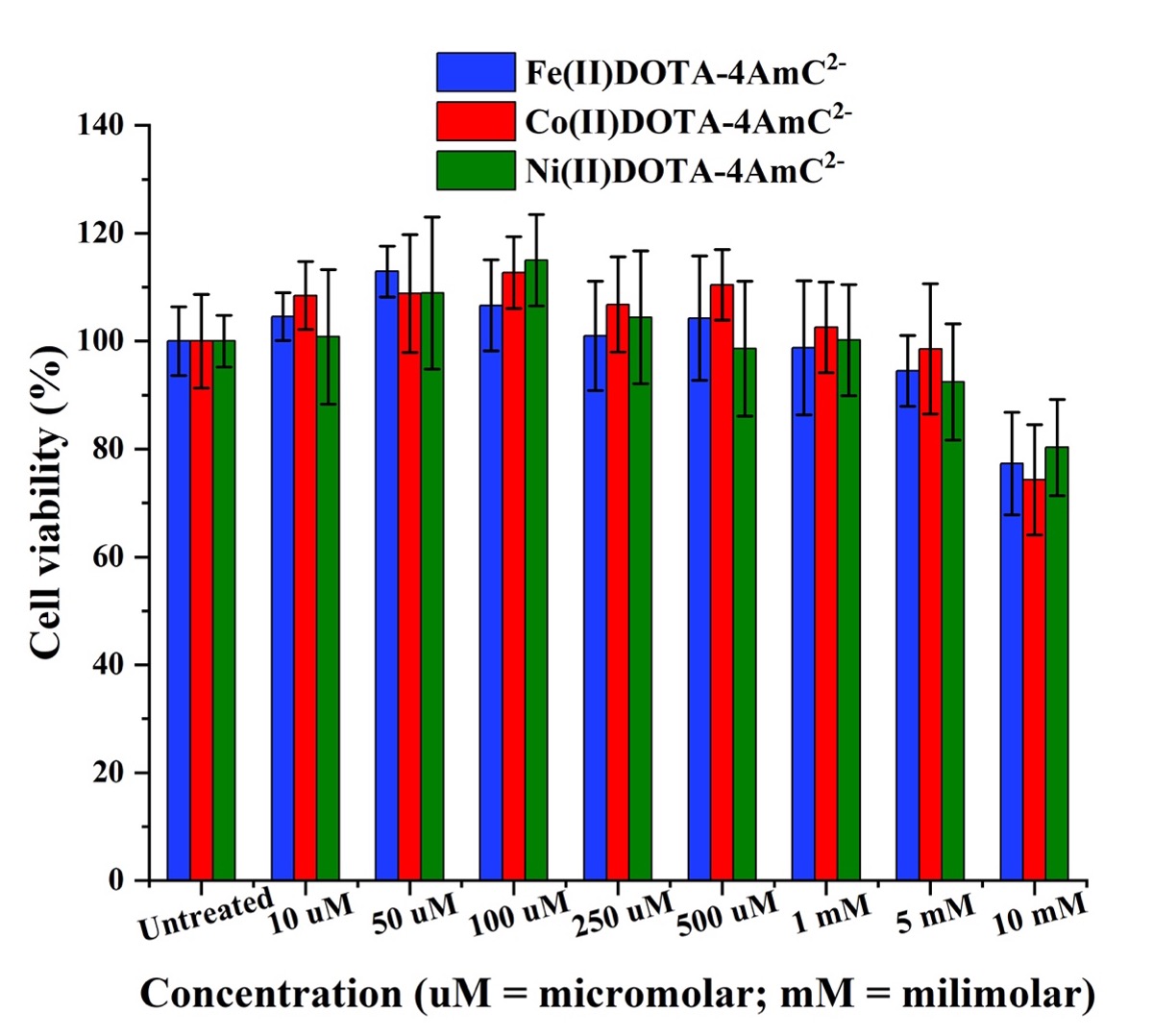
Paramagnetic complexes of divalent transition metal ions (TM2+ = Fe2+, Co2+, Ni2+) were synthesized in combination with DOTA-4AmC4-. These complexes possess a distinctive amide proton (-NH) group, enabling pH and temperature sensing. Fig. 1 shows the chemical and molecular structures of Tn(II)DOTA-4AmC2-. The crystal structures of Fe(II)DOTA-4AmC2- (Fig. 1a1 & a2), Co(II)DOTA-4AmC2- (Fig. 1b1 & b2), and Ni(II)DOTA-4AmC2- (Fig. 1c1 & c2) demonstrate 8-, 7-, and 6-coordinate bonds, respectively. Crystallographic data revealed that oxygen and nitrogen donor atoms of DOTA-4AmC4- coordinated with TM2+ with various geometries: from octahedral [Fe(II)DOTA-4AmC2-] to trigonal prismatic with capped [Co(II)DOTA-4AmC2-] and distorted [Ni(II)DOTA-4AmC2-] orientations. The non-exchangeable -CHy protons of TM(II)DOTA-4AmC2- exhibited temperature/pH sensitivities with BIRDS, however the -NH protons show 3-7 fold higher BIRDS intensity. Among these three complexes, Ni(II)DOTA-4AmC2- displays the highest pH and temperature sensitivity (1.42 ppm/pH and 0.22 ppm/°C), followed by CoDOTA-4AmC2- (0.21 ppm/pH and 0.13 ppm/°C) and FeDOTA-4AmC2- (0.16 ppm/pH and 0.17 ppm/°C) (Fig. 1D). Additionally, the TM(II)DOTA-4AmC2- complexes demonstrated good cell viability at levels as high as 10 mM. (Supporting Data).Conclusion:
The findings suggest that the coordination bonds of the central transition metal atom dictate the rigidity and flexibility of the agent's molecular structure, allowing for temperature and pH sensitivities in BIRDS through the amide proton signal. Among the compounds studied, Ni(II)DOTA-4AmC2- exhibited the highest pH sensitivity, showcasing the most flexible molecular structure, characterized by six coordination bonds to the central Ni2+ ion and two free pendent arms. The biocompatible nature of these transition metal sensors paves the way for their potential for translation to clinical application in the future.Acknowledgements
This work was supported by NIH grants (R01 EB-023366, R01 CA-280871).References
(1) Meier, K.; Lee, K. Neurogenic Fever: Review of Pathophysiology, Evaluation, and Management. J Intensive Care Med 2017, 32 (2), 124-129.
(2) Hashim, A. I.; Zhang, X.; Wojtkowiak, J. W.; Martinez, G. V.; Gillies, R. J. Imaging pH and metastasis. NMR in Biomedicine 2011, 24 (6), 582-591.
(3) Walsh, J. J.; Parent, M.; Akif, A.; Adam, L. C.; Maritim, S.; Mishra, S. K.; Khan, M. H.; Coman, D.; Hyder, F. Imaging Hallmarks of the Tumor Microenvironment in Glioblastoma Progression. Front Oncol 2021, 11, 692650.
(4) Coman, D.; Trubel, H. K.; Rycyna, R. E.; Hyder, F. Brain temperature and pH measured by (1)H chemical shift imaging of a thulium agent. NMR Biomed 2009, 22 (2), 229-239.
(5) Huang, Y.; Coman, D.; Ali, M. M.; Hyder, F. Lanthanide ion (III) complexes of 1,4,7,10-tetraazacyclododecane-1,4,7,10-tetraaminophosphonate for dual biosensing of pH with chemical exchange saturation transfer (CEST) and biosensor imaging of redundant deviation in shifts (BIRDS). Contrast Media Mol Imaging 2015, 10 (1), 51-58.
(6) Perez-Lourido, P.; Madarasi, E.; Antal, F.; Esteban-Gomez, D.; Wang, G.; Angelovski, G.; Platas-Iglesias, C.; Tircso, G.; Valencia, L. Stable and inert macrocyclic cobalt(II) and nickel(II) complexes with paraCEST response. Dalton Trans 2022, (51), 1580–1593.
(7) Burns, P. J.; Cox, J. M.; Morrow, J. R. Imidazole-Appended Macrocyclic Complexes of Fe(II), Co(II), and Ni(II) as ParaCEST Agents. Inorg Chem 2017, 56 (8), 4546-4555.(28) Morrow, J. R.; Raymond, J. J.; Chowdhury, M. S. I.; Sahoo, P. R. Redox-Responsive MRI Probes Based on First-Row Transition-Metal Complexes. Inorg Chem 2022, 61 (37), 14487-14499.
(8) Morrow, J. R.; Raymond, J. J.; Chowdhury, M. S. I.; Sahoo, P. R. Redox-Responsive MRI Probes Based on First-Row Transition-Metal Complexes. Inorg Chem 2022, 61 (37), 14487-14499.
Figures