3201
Routine Hyperpolarized 129Xe Measurements Utilizing a Benchtop NMR Spectrometer: Maintaining High Polarization, Automation and Measurements1Physikalisch-Technische Bundesanstalt (PTB), Braunschweig and Berlin, Germany
Synopsis
Keywords: Hyperpolarized MR (Gas), Hyperpolarized MR (Gas), hyper-CEST, New Devices
Motivation: Routine measurements of hyperpolarized media utilizing low-cost benchtop-NMR spectrometers should allow for sensitive bio-chemical analysis. So far, just an elaborate handling of hyperpolarized 129Xe was demonstrated.
Goal(s): To deliver highly polarized 129Xe to the sample at the time of demand within the NMR spectrometer.
Approach: We present the combination of a continuous-flow 129Xe polarizer with a commercial benchtop-NMR spectrometer. The gas flow into the NMR sample is time-controlled by the spectrometer pulse program and xenon gas densities are user adjustable.
Results: In routine experimentation polarization transfer-losses were minimized, thus allowing for e.g., characterization and concentration determination of future contrast agents.
Impact: Our work demonstrates day-to-day measurements utilizing well-established flow-through 129Xe polarizers in combination with low-cost benchtop NMR spectrometers yielding high sensitivity. Thus, utilizing the high affinity of xenon to proteins or cage molecules allows for various biological studies alike concentration determination.
Introduction
Owing to the large signal enhancement independent of the field strength, it is obvious to combine hyperpolarized nuclei with low-cost benchtop NMR systems as shown for DNP and PHIP [1]. Concerning hyperpolarized 129Xe (hypXe), so far only the principal application for benchtop NMR was demonstrated based on an elaborate handling [2]. Here, the efficient operation of a continuous flow 129Xe polarizer (lab style precursor of [3]) together with a commercial benchtop spectrometer is presented, allowing for routine applications at the time of demand e.g., for characterization and concentration determination of molecular cage systems as future contrast agents [4].Methods
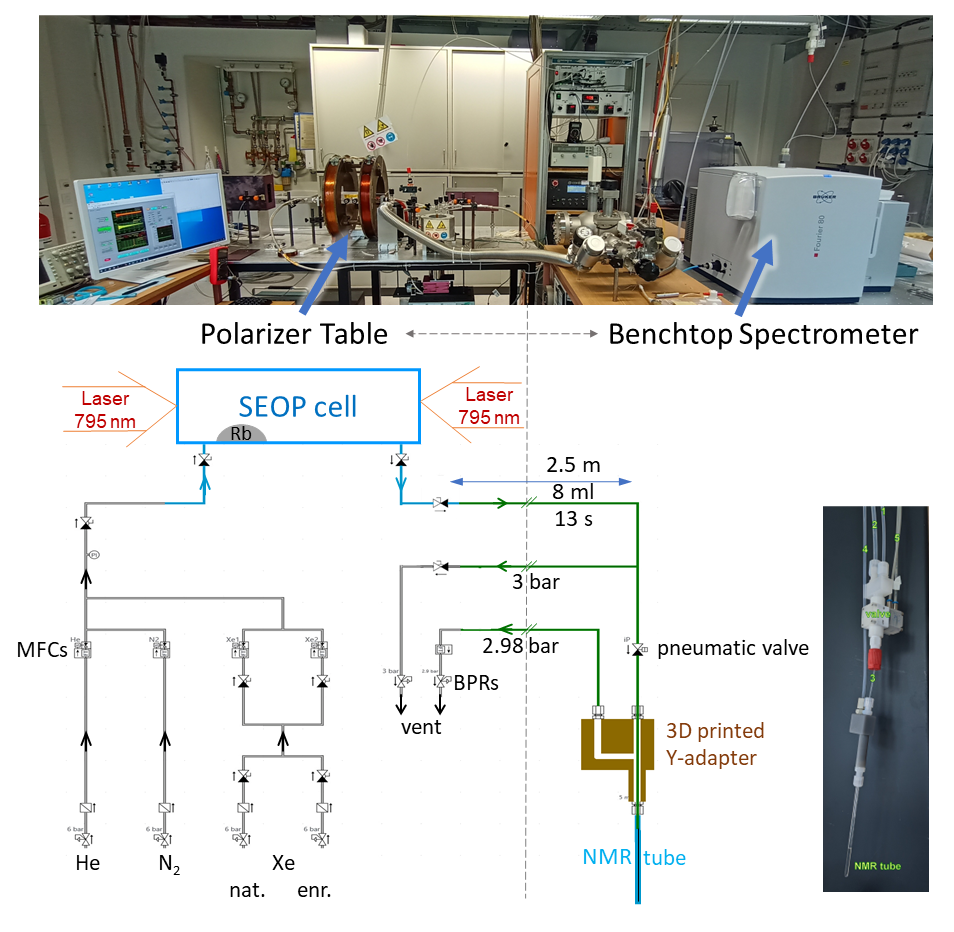
A continuous gas stream (Xe-N2-He mixture with adjustable partial pressures) is blend by three mass-flow controllers (MFCs) and first lead through the $$$70\,$$$ml optical pumping cell at a total volume flow rate of typically $$$35\,$$$ml/min. From the cell’s outlet the gas stream is fed via an $$$\approx2.5\,$$$m long, $$$2\,$$$mm ID PFA tube close to the benchtop spectrometer (lasting $$$\approx13\,$$$s). There, a pneumatically driven, NMR-console controlled PFA membrane valve allows the gas flow either only to by-pass or to partially pass through the $$$5\,$$$mm NMR sample tube via another $$$\approx0.5\,$$$m long, $$$1\,$$$mm ID PFA tube and finally through a $$$\approx5\,$$$cm long, $$$200\,$$$mm ID capillary. A 3D-printed fork-shaped adapter with PVDF connectors allows a gas-tight assembly of the feeding tube, the NMR tube as well as the exhaust tube such that the NMR tube can be hold via the standard tool inside the spectrometer.After testing various arrangements, finally, two digital back-pressure regulators (BPRs) were implemented allowing for two separate vents. The first one in the by-pass is keeping the pressure within the polarizer at $$$3\,$$$bar, whereas the second regulator sitting behind the sample outlet tube is set to some $$$20\,$$$mbar below the $$$3\,$$$bar (Fig.$$$\,$$$1). With a regulation time in the sub-second regime the pressure conditions settle quickly after switching the membrane valve to open such that the flow rate of gas being fed through the sample is governed by the pressure difference held by the BPRs.
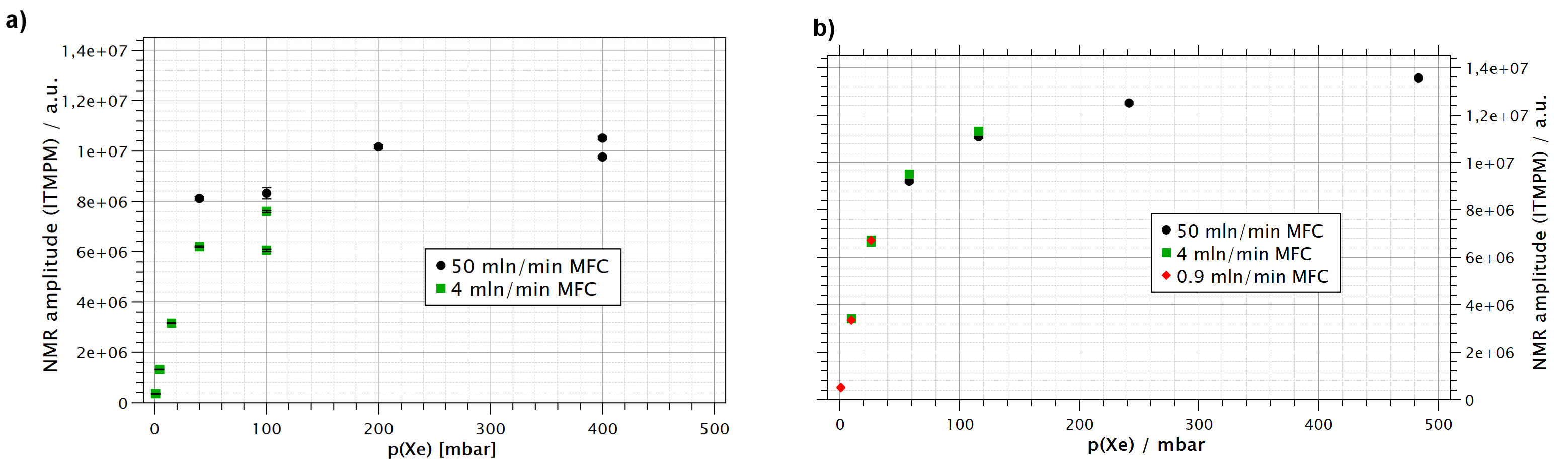
For the concentration measurements [4], a wide variation of xenon concentration in the sample must be set requiring a variation of the xenon partial pressure in a range of >1:500. As standard MFCs have only dynamic ranges of 1:50 two MFCs with different maximum flow rates were used for xenon. To assure a perfect overlap we had to re-calibrate all MFCs by the method of pressure increase when feeding into a container of known volume.
For absolute 129Xe polarization determination within the benchtop spectrometer flame sealed NMR tubes containing precisely known xenon (nat. abundant or enr. 129Xe $$$@\,\approx86$$$%) and oxygen pressures were produced as thermal polarized reference standard.
Results
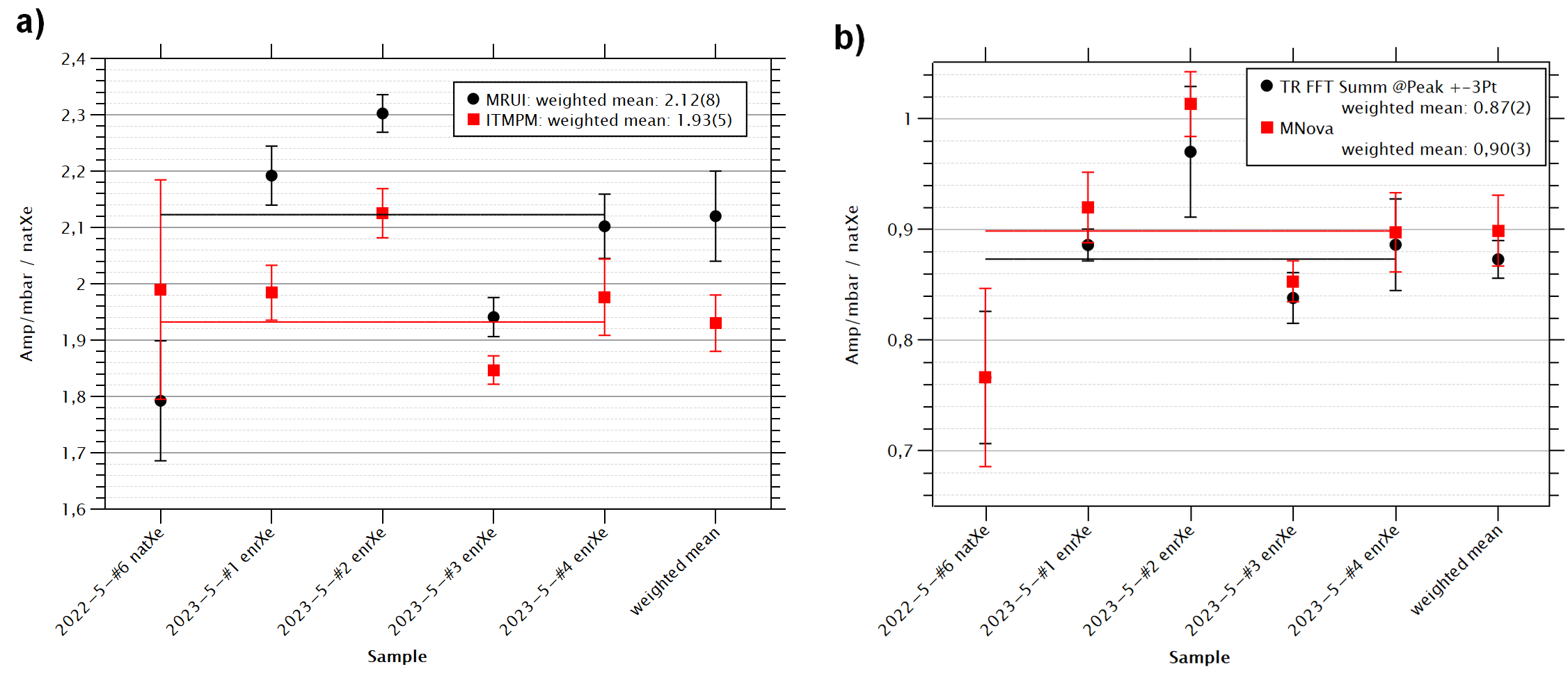
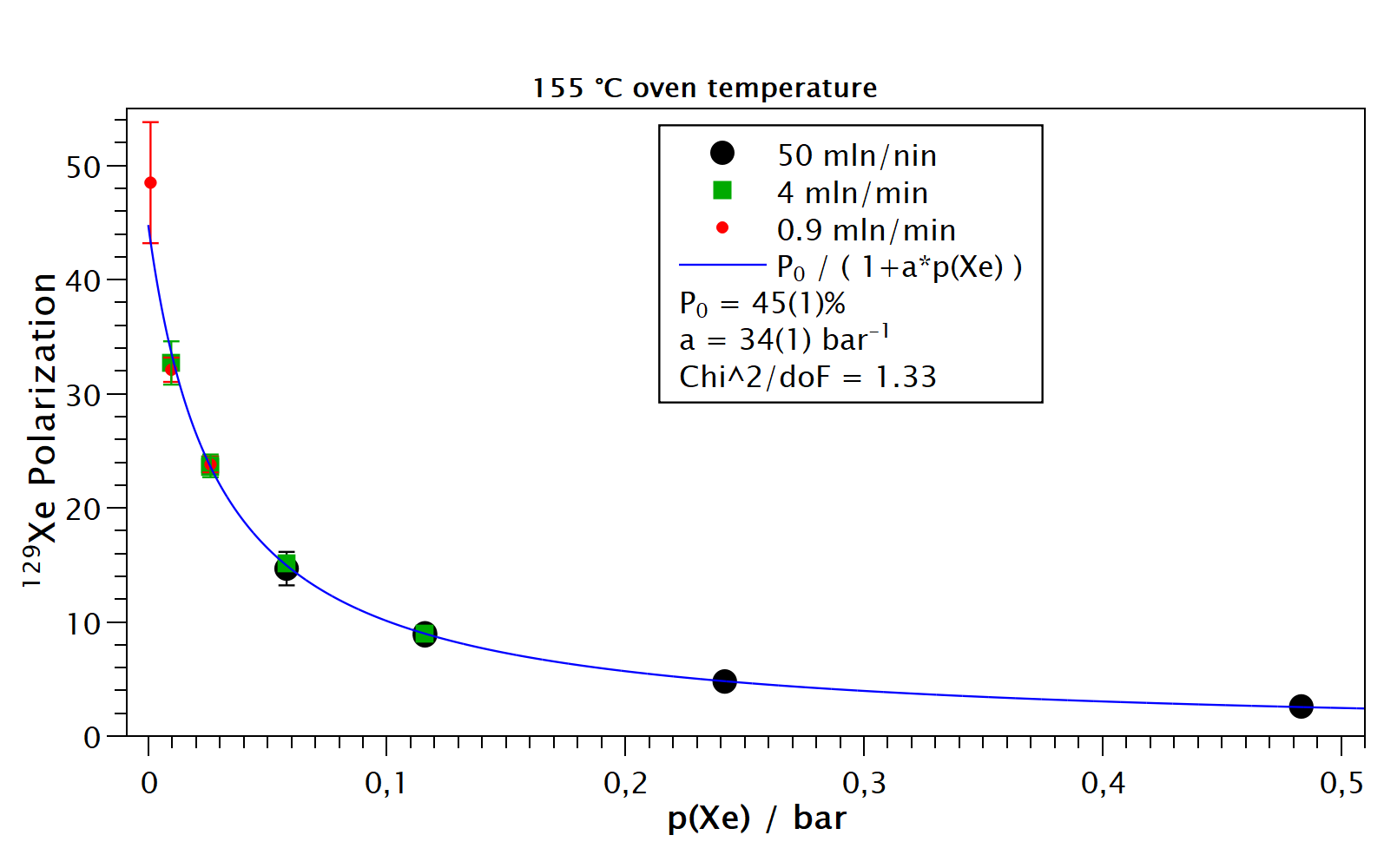
Five to ten Measurements for each of the five reference samples were analyzed by various methods (SVD based [5,6] and spectral-range integration) were tested for their consistency leading to a common scaling factor for absolute 129Xe polarization determination (Fig.$$$\,$$$2).For the absolute 129Xe polarization measurements the gas was fed in an empty NMR tube, directly measuring the hypXe gas signal. By varying the xenon partial pressure from $$$500\,$$$mbar down to $$$1\,$$$mbar with the usage of the two MFCs for the xenon gas flow we have seen that the two Xe-MFCs were not yielding consistent results in their overlap region (Fig.$$$\,$$$3a). After calibrating each of the four MFCs and implementing a 2nd order correction function in our polarizer control software very consistent signal intensities were achieved whichever MFC was used (Fig.$$$\,$$$3b) also important for the future application of the concentration determination [4]. Using these pressure dependent signal intensities and the calibration factor determined from the thermally polarized samples the attained signals could be converted to absolute 129Xe polarization values (Fig.$$$\,$$$4).
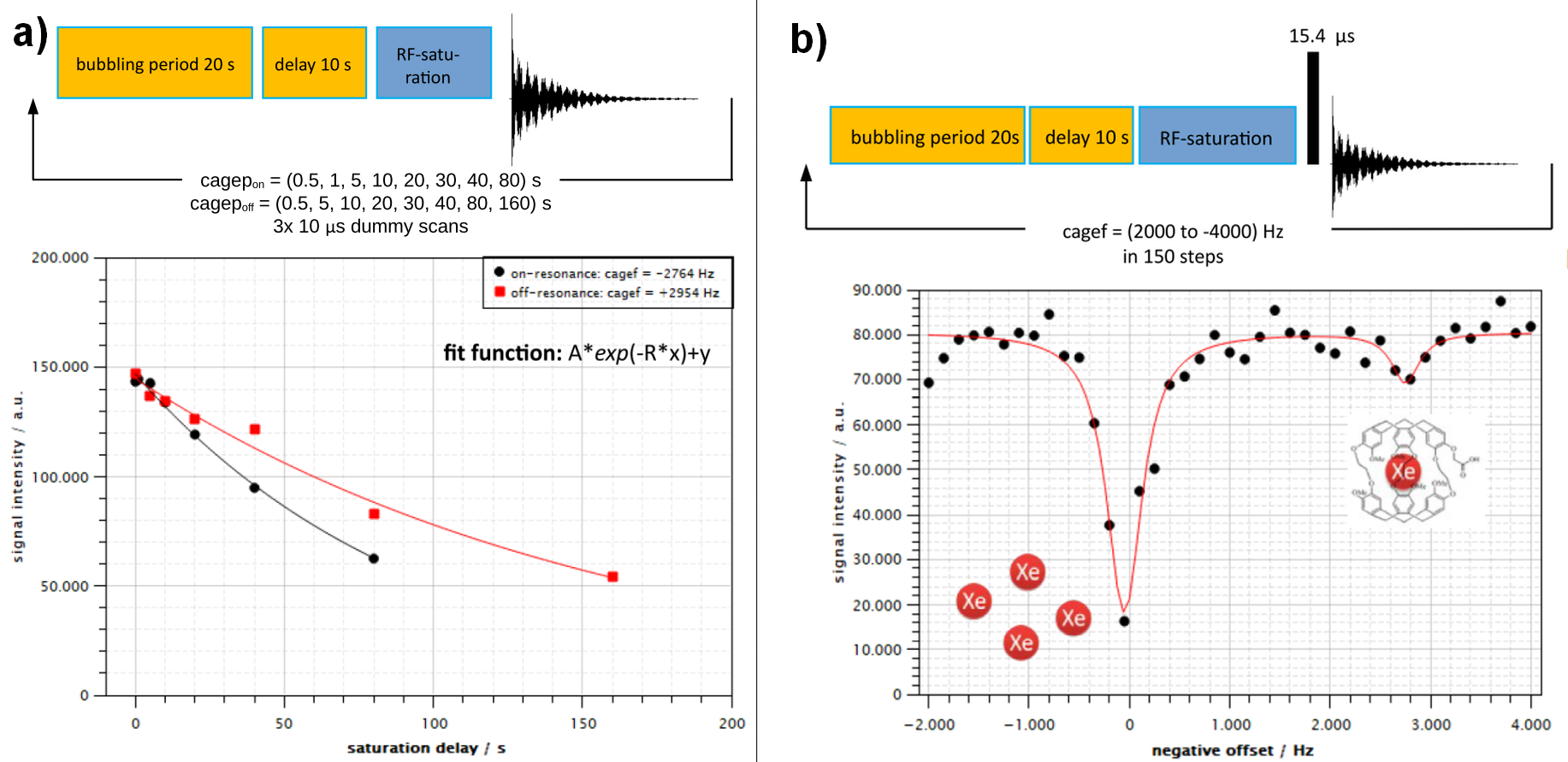
In preliminary measurements we started to investigate the sensitivity limits applying the benchtop spectrometer for concentration determinations (Fig.$$$\,$$$5).
Discussion & Conclusion
The large pressure dependence of the 129Xe polarization ($$$a\approx34\,$$$bar-1) as compared to $$$a\approx8\,$$$bar-1 when performing similar measurements applying our mobile polarizer [7] reflects the advantage of the narrow line-width ($$$\approx0.4\,$$$nm) mobile-polarizer laser as compared to the $$$\approx2\,$$$nm linewidth of the lab-polarizer laser. The $$$\approx50$$$% absolute 129Xe polarization determined at the very lean, $$$1\,$$$mbar xenon partial pressure within the benchtop spectrometer implies that the transfer losses from the polarizer to the NMR sample could not be larger than 50%. With the more narrow line-width lasers also at higher xenon partial pressures polarizations in the 10% range should be attainable demonstrating the high-quality performance of the setup, furthering future routine applications of hypXe benchtop NMR with the potential of a much more compact realization.Acknowledgements
This research was funded by the "Bundesministerium für Bildung und Forschung" (Federal Ministry of Education and Research: VIP+, No. 03VP08891)References
[1] Castaing-Cordier et al., An. Rep. NMR Spect. Elsevier (2021) 103, 191
[2] K. Chighine et al., Mag. Reson. (2021) 2, 409
[3] S.E. Korchak et al., Appl. Magn. Reson. (2013) 44, 65
[4] L. Mitschang et al., Anal. Chem. (2022) 94, 2561
[5] D. Stefan et al., Meas. Sci. Technol. (2009) 20, 104035
[6] Y.-Y. Lin et al., J. Magn. Reson. (1997) 128, 30
[7] S.E. Korchak et al., Phys.Chem.Chem.Phys. (2018) 20, 1800 (supplement)
[8] M. Kunth et al., J. Chem. Phys. (2014) 141, 194202
Figures