3199
129Xe HyperCEST Imaging of a Novel R3-Noria-methanesulfonate Supramolecular Cage using a 3.0 T Clinical MRI1Chemistry, Lakehead University, Thunder Bay, ON, Canada, 2Thunder Bay Regional Health Research Institute, Thunder Bay, ON, Canada, 3Chemistry and Materials Science Program, Lakehead University, Thunder Bay, ON, Canada, 4Applied Life Science Program, Lakehead University, Thunder Bay, ON, Canada, 5Physics Program, Lakehead University, Thunder Bay, ON, Canada, 6California Polytechnic State University, San Luis Obispo, CA, United States, 7University of Rhode Island, Kingston, RI, United States, 8Northern Ontario School of Medicine, Thunder Bay, ON, Canada
Synopsis
Keywords: Hyperpolarized MR (Gas), Hyperpolarized MR (Gas), xenon-129, HyperCEST, chemical exchange, Noria, R3-Noria-methanesulfonate
Motivation: In the setting of molecular MRI, designing a contrast agent that can be applied in clinical studies and which offers high sensitivity poses a significant challenge.
Goal(s): We aimed to demonstrate a novel water-soluble R3-Noria-MeSO3H macrocycle as a viable supramolecular cage agent for 129Xe molecular imaging.
Approach: Hyperpolarized 129Xe chemical exchange saturation transfer MR imaging and spectroscopy were conducted in vitro using a 3.0T clinical MRI scanner.
Results: We demonstrated that R3-Noria-MeSO3H produces a superior HyperCEST effect and investigated its dependence on concentrations in various aqueous solutions.
Impact: The introduction of the novel R3-Noria-MeSO3H macrocycle for HP 129Xe HyperCEST imaging marks a critical milestone, establishing a new frontier in 129Xe molecular imaging with heightened sensitivity and potential for advancing clinical applications in diagnostic precision and therapeutic monitoring.
INTRODUCTION
Molecular magnetic resonance imaging (MRI) is a promising modality due to its ability to accurately monitor molecular changes and interactions. Conventional MRI faces challenges due to its lack of sensitivity in molecular imaging settings. This issue could be overcome using hyperpolarization, which enhances a signal up to five orders in magnitude. Hyperpolarized (HP) xenon-129 (129Xe) MRI is highly effective for functional lung and brain imaging1-4 and is emerging as a potential molecular imaging technique through HP chemical exchange saturation transfer (HyperCEST)5. HyperCEST relies on the reversible binding of 129Xe to a specific supramolecular cage, creating a unique chemical shift of the enclosed xenon. When a radiofrequency (RF) pulse matches the resonance frequency of the 129Xe within the cage, the nuclei undergo depolarization. Chemical exchange prompts depolarized atoms to enter the nearby dissolved pool, causing a decrease in signal. Despite the existence of various cages6-10, their complex synthesis and challenges in functionalization significantly limit their utilization for clinical applications. This research introduces the novel water-soluble resorcinarene trimer methanesulfonate (R3-Noria-MeSO3H) macrocycle and investigates the HyperCEST effect dependency on R3-Noria-MeSO3H concentrations in different solvents.METHODS
The study was conducted using a clinical Philips Achieva 3.0T MRI scanner equipped with a custom-built dual-tuned 129Xe/1H quadrature coil. Naturally abundant 129Xe (~26%) was polarized up to 56% using a XeBox-10E polarizer (Xemed LCC). R3-Noria-MeSO3H was synthesized according to previous procedures11. Samples of R3-Noria-MeSO3H (0 mM, 1 μM, 5 μM, 0.01 mM, 0.05 mM, 0.1 mM, 1 mM, 2.5 mM and 5 mM) in deionized water (DI H2O), phosphate buffer saline (PBS), and saline were prepared. HP 129Xe gas continually flowed through a glass-fritted cell containing 3 mL of R3-Noria-MeSO3H solution. A depolarization pulse train of 16x30ms 3-lobe-sinc pulses (3LS) of 12000 FA was used. Conducted HyperCEST MRS and depletion spectra12, followed by HP 129Xe MRI and HyperCEST imaging. The imaging pulse sequence was initiated within 2s after termination of one minute of continuous 129Xe flow. A GRE technique was used (FOV= 125x125x20 mm3; voxel size = 3.57x3.57x20 mm3; TR/TE = 7.1 ms/2.15 ms; FA = 200; BW = 150 Hz/pixel). In conducting HyperCEST imaging, a pair of HP 129Xe images was acquired. HyperCEST images were acquired utilizing depolarization pulses applied at -100 ppm for off-resonance and at +87 ppm for on-resonance images. Pixel-wise recalculations were performed to generate SNR maps. Images were further thresholded and recalculated pixel-by-pixel into the HyperCEST depletion maps.RESULTS AND DISCUSSION
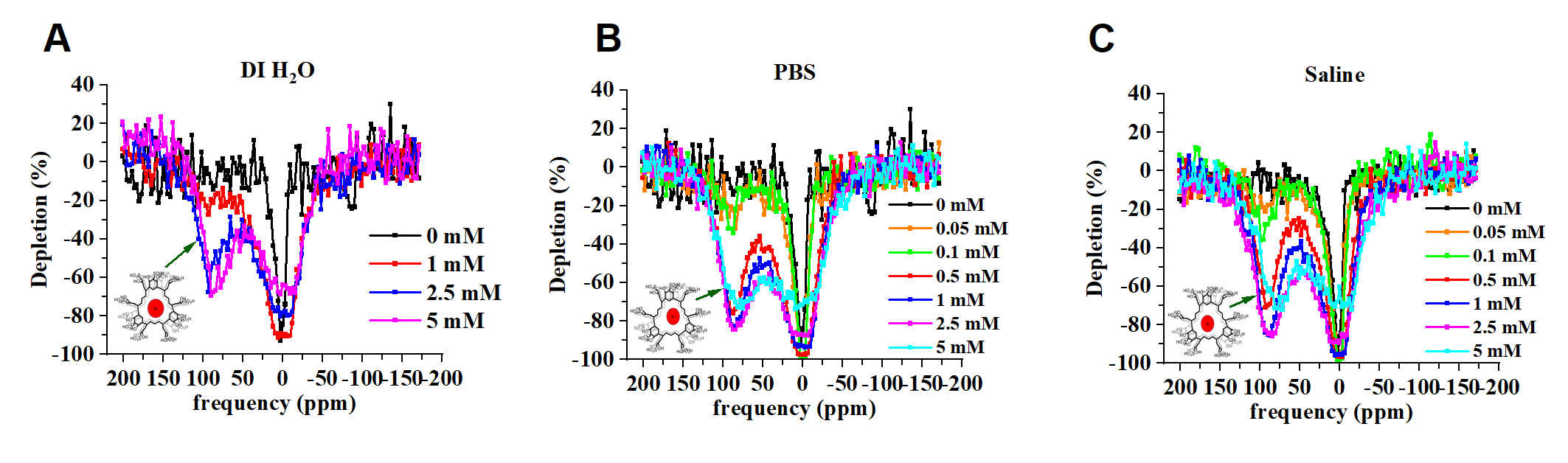
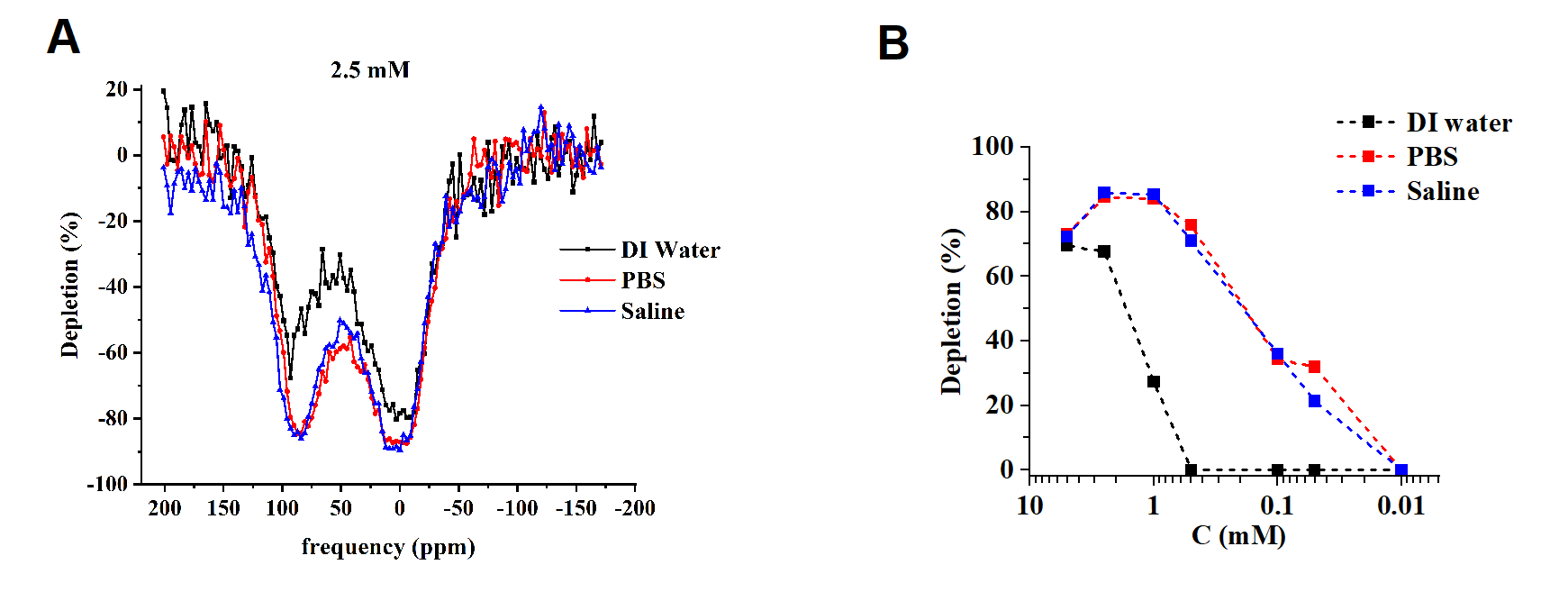
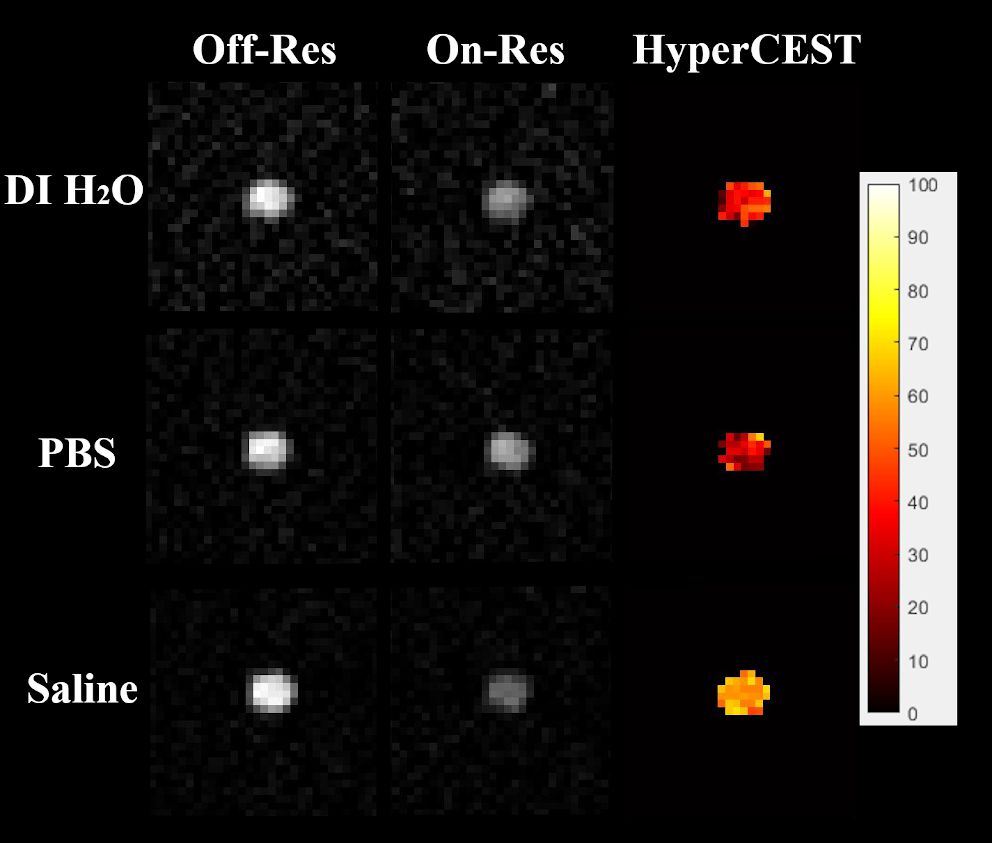
A HyperCEST effect was detected for R3-Noria-MeSO3H in all solutions (Fig. 1, 2A). In DI H2O, R3-Noria-MeSO3H demonstrated a HyperCEST effect at concentrations starting from 1 mM. The asymmetrical depletion peak likely arises due to the presence of various-sized supramolecular aggregates in the solution. A maximum depletion of 70% in DI H2O was observed at around +90 ppm in 5 mM (Fig. 1A). The HyperCEST effect for PBS and saline was detected from 0.05 mM at around +87 ppm. The peak position slightly moved upfield with an increase in concentration. The dependence of HyperCEST on R3-Noria-MeSO3H concentration is shown in Fig. 2B. It increased almost linearly initially, plateaued, and started decreasing at the highest concentration. This dynamic was observed for both PBS and saline, displaying a similar trend in DI H2O with lower depletion. The decrease in the HyperCEST effect for 5 mM in PBS and saline can be plausibly explained by the alternation in a chemical exchange between HP 129Xe dissolved in the pool and the R3-Noria-MeSO3H cages. Due to different exchange rates, the applied depolarization pulses became less effective resulting in partial depolarization of HP 129Xe nuclei. Alternatively, HP 129Xe resonances became too broad for an effective depolarization via the applied 3LS pulse with 3 ppm BW. HP 129Xe HyperCEST imaging was performed for 0 mM, 1 mM (Fig. 3), and 5 mM samples. The strongest HyperCEST effect in 1 mM was observed at 61.1±9.7 % in the saline solution. Furthermore, the mean depletion was equal to 77.0 ± 25.0%, 77.5 ± 25.1% in 5 mM PBS and saline respectively. It was also noted that an increase in the R3-Noria-MeSO3H concentration led to a decrease in the T2* relaxation time, which prevented HyperCEST imaging for 5 mM in DI H2O.CONCLUSION
For the first time, we demonstrated a novel R3-Noria-MeSO3H macrocycle for HP 129Xe HyperCEST molecular imaging. The HyperCEST detectability limit in vitro using a clinical 3.0T MRI was found to be 50 μM, indicating its potential for further clinical translation. Future research should delve into the HP 129Xe relaxation mechanisms in R3-Noria-MeSO3H, assess its aggregation, and explore its functionalization.Acknowledgements
This research was supported by a Natural Science Engineering Research Council Discovery grant (RGPIN-2017-05359), an Ontario Research Fund grant (ORF RE 09 029), and a MITACS Accelerate Grant (IT31144).References
1. Albert, M. S., et al. "Biological magnetic resonance imaging using laser-polarized 129Xe." Nature 370.6486 (1994): 199-201.
2. Matheson, Alexander M., et al. "Persistent 129Xe MRI pulmonary and CT vascular abnormalities in symptomatic individuals with post-acute COVID-19 syndrome." Radiology 305.2 (2022): 466-476.
3. Shepelytskyi, Yurii, et al. "The effects of an initial depolarization pulse on dissolved phase hyperpolarized 129Xe brain MRI." Magnetic Resonance in Medicine 86.6 (2021): 3147-3155.
4. Grynko, Vira, et al. "Hyperpolarized 129Xe multi‐slice imaging of the human brain using a 3D gradient echo pulse sequence." Magnetic Resonance in Medicine 86.6 (2021): 3175-3181.
5. Schröder, L. "Xenon Biosensor HyperCEST MRI." Hyperpolarized and Inert Gas MRI. Academic Press, 2017. 263-277
6. Schröder, Leif, et al. "Molecular imaging using a targeted magnetic resonance hyperpolarized biosensor." Science 314.5798 (2006): 446-449.
7. Hane, Francis T., et al. "In vivo detection of cucurbit[6]uril, a hyperpolarized xenon contrast agent for a xenon magnetic resonance imaging biosensor." Scientific Reports 7.1 (2017): 41027.
8. Hane, Francis T., et al. "Cyclodextrin-Based Pseudorotaxanes: Easily Conjugatable Scaffolds for Synthesizing Hyperpolarized Xenon-129 Magnetic Resonance Imaging Agents." ACS omega 3.1 (2018): 677-681.
9. Fernando, PU Ashvin I., et al. "Decacationic pillar [5] arene: A new scaffold for the development of 129Xe MRI imaging agents." ACS omega 5.43 (2020): 27783-27788.
10. Du, Kang, et al. "Paramagnetic organocobalt capsule revealing xenon host–guest chemistry." Inorganic chemistry 59.19 (2020): 13831-13844.
11. Hasselbrink, Carson Lawrence, et al. "Development and Application of a Supramolecular Brønsted Acid Catalyst Based on the Noria Macrocycle." The Journal of Organic Chemistry 87.23 (2022): 16074-16078.
12. P. U. A. Fernando, Y. Shepelytskyi, P. Cesana, A. Wade, V. Grynko, A. Mendieta, L. Seveney, J. Brown, F. Hane, M. Albert, B. DeBoef, ACS Omega 2020, 5, 27783–27788.
Figures