3195
Quantify sodium transmembrane transport in cells via relaxation exchange spectroscopy1Department of Chemistry, Zhejiang University, Hangzhou, China, 2Institute of Translational Medicine, Shanghai Jiao Tong University, Shanghai, China, 3School of Chemistry and Chemical Engineering, Shanghai Jiao Tong University, Shanghai, China, 4Department of Physical Medicine and Rehabilitation,Sir Run Run Shaw Hospital, Zhejiang University, Hangzhou, China, 5Key Laboratory of Biomedical Engineering of Education Ministry, College of Biomedical Engineering and Instrument Science, Zhejiang University, Hangzhou, China, 6Interdisciplinary Institute of Neuroscience and Technology, School of Medicine, Zhejiang University, Hangzhou, China
Synopsis
Keywords: Spectroscopy, Non-Proton, odium, transmembrane transport
Motivation: Transmembrane transport of sodium ions is directly related to the cell functions and metabolisms and could be an indicator of various diseases such as neurodevelopmental disorders, neuropathic pain, etc. There is a lack of non-invasive and clinically-adaptable techniques for quantifying the rate of transmembrane transport of sodium ions.
Goal(s): Determine the rate of sodium transmembrane transport using noninvasive nuclear magnetic resonance methods.
Approach: 23Na relaxation exchange spectroscopy (REXSY) was applied to the cellular systems for quantitative analysis.
Results: The 23Na REXSY method successfully determined the sub-second transmembrane exchange rate of sodium ions in yeast and HeLa cells.
Impact: Measuring transmembrane rate of sodium via NMR can assist the pathological studies of diseases related to malfunctions of sodium ion channels and/or sodium metabolism. 23Na REXSY could be coupled to MR imaging to offer novel parameters for clinical diagnosis.
Introduction
Sodium plays a crucial role in maintaining electrolyte balance, transmitting nerve impulses, facilitating muscle cell contraction, and influencing cellular metabolism1. The imbalance of sodium in the cellular matrix of body could result in a range of health conditions2–4. 23Na NMR and MRI techniques have been developed to diagnose the pathological status of target tissues by measuring the total sodium concentration5. However, the dynamics of sodium in cellular systems have not been fully understood, especially the transmembrane transport of sodium ions which is crucially related to the functions of muscle and nerve cells. Because 23Na is a special quadrupolar nuclear spin (I=3/2), its NMR signal in a complex system (e.g., the relaxation induced by the quadrupolar interaction) is difficult to interpret.In this study, we established the theory for explaining multiexponential relaxation phenomena in the cellular environment. The decomposition of 23Na relaxation led to the differentiation of intra and extracellular sodium ions6. Then we applied 23Na REXSY to determine the exchange rate between intra and extracellular sodium ions. This method was applied to yeast and HeLa cells, and their sodium ion transmembrane rates have been determined for the first time.
Methods
Theory:In the cellular environment, the decaying signal of 23Na I($$$\tau$$$) under a spin echo pulse sequence (with an echo time $$$\tau$$$) can be written as the following formula6:
$$ {I(\tau) = I^{0}[f_F^{in}exp(-R_2^F\tau)+f_S^{in}exp(-R_2^S\tau)+f^{ex}exp(-R_2^{ex}\tau)}]$$
where $$$f_F^{in}$$$ and $$$f_S^{in}$$$ correspond to the molar fractions of fast and slow relaxation component for intracellular sodium, while $$$f^{ex}$$$ corresponds to the fraction of extracellular sodium. $$$R_2^F$$$, $$$R_2^S$$$ are the relaxation rate constants of fast and slow component for intracellular sodium, and $$$R_2^{ex}$$$ is the extracellular part in solution.
To analyze transmembrane sodium exchange, Bloch-McConnell equations were used. The relaxation components can be represented by the vector signal $$$M(t)$$$ and the exchange and relaxation processes were stimultaneously considered7:
$$\frac{\text{d}}{\text{d}t}M(t) = -(R+K)M(t)$$
$$M(t) = exp[-(R+K)t]\cdot M(0)$$
where $$$R$$$ is the relaxation rate constants matrix and $$$K$$$ is the exchange rate constants matrix. $$$M(0)$$$ and $$$M(t)$$$ represent the initial signal and the signal after a period of relaxation, respectively.
NMR Experiment: 23Na NMR experiments were all performed on a 14.1 T magnet with Bruker AVANCE Ⅲ HD system. The exchange experiments were based on the REXSY sequence8 mentioned above with variable exchange time ranging from 2 ms to 45 ms. The spoiler gradient is 11.262 Hz/T and the duration is 5 ms.
Data Processing: Peak areas were obtained in TOPSPIN (Version 3.6, Bruker), and data processing were completed in MATLAB (MathWorks, USA).
Results and Discussion
The tri-exponential relaxation phenomena were observed in cellular environment (Figure 1a). The two fast relaxation components are attributed to the sodium inside cells (Figure 1b). In a concentrated intracellular plasma, the 23Na relaxation is bi-exponential due to the presence of quadrupolar interaction. The slow relaxation component is attributed to the sodium ions outside cells. The attribution of relaxation components to different cellular compartments has been cross-validated by the diffusion measurement (Figure 1c).Two-dimensional 23Na REXSY experiments (Figure 2a) employed to measure the exchange rate ($$$k$$$) between the two pools of sodium in both yeast and Hela cells (Figure 2b). The $$$k$$$ value of yeast is 2.8s-1, and that of HeLa cells is 9.0s-1. The sodium exchange rates change with respect to external stimuli such as temperature and ion concentrations (Figure 2c). These systematic changes of sodium exchange rate could be related to the modulated activity of sodium pumps on the cell membrane.
Conclusion
We studied sodium ion exchange in cellular systems through 23Na REXSY. This non-invasive method can determine the exchange rate of intra- and extracellular sodium ions in the sub-second time scale.Acknowledgements
We acknowledge support by the National Natural Science Foundation of China grant no. 21922410 and no. 22275159.
References
1. Burnier M. Sodium in Health and Disease. (Burnier M, ed.). CRC Press; 2007.
2. Meisler MH, Hill SF, Yu W. Sodium channelopathies in neurodevelopmental disorders. Nat Rev Neurosci. 2021;22(3):152-166.
3. Fouda MA, Ghovanloo M, Ruben PC. Late sodium current: incomplete inactivation triggers seizures, myotonias, arrhythmias, and pain syndromes. J Physiol. 2022;600(12):2835-2851.
4. Devor M. Sodium Channels and Mechanisms of Neuropathic Pain. J Pain. 2006;7(1):S3-S12.
5. Madelin G, Lee J, Regatte RR, Jerschow A. Sodium MRI: Methods and applications. Prog Nucl Magn Reson Spectrosc. 2014;79:14-47.
6. Yin Y, Song Y, Jia Y, Xia J, Bai R, Kong X. Sodium Dynamics in the Cellular Environment. J Am Chem Soc. 2023;145(19):10522-10532.
7. Bloch F. Nuclear Induction. Phys Rev. 1946;70(7-8):460-474.
8. Bai R, Benjamini D, Cheng J, Basser PJ. Fast, accurate 2D-MR relaxation exchange spectroscopy (REXSY): Beyond compressed sensing. J Chem Phys. 2016;145(15):1-14.
Figures
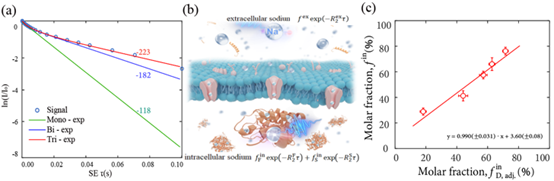
Figure 1. (a) The tri-exponential decay of 23Na signal in living cells. The tri-exponential decay shows the best fitting according to AIC criterion6. (b) The schematics illustrating the multiple relaxation components inside and outside cell. (c) The cross validation of intracellular sodium fraction by diffusion measurement.
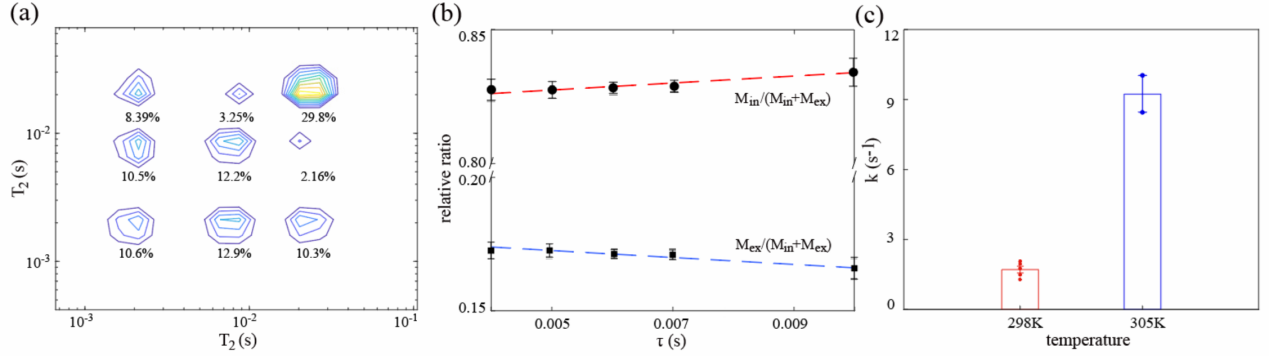
Figure 2. (a) 2D T2-T2 REXSY spectrum of yeast cells in vivo. (b) The fitting of sodium exchange rate at variable exchange time τ. (c) The results of k under 298K and 305K in yeast cells.