3166
Decoding the neural representation of value in schizophrenia with negative symptoms1Cellular and Molecular Medicine, University of Ottawa, Ottawa, ON, Canada, 2The Royal’s institute of mental health research, Ottawa, ON, Canada, 3Department of Psychiatry, Columbia University, New York, NY, United States
Synopsis
Keywords: Task/Intervention Based fMRI, fMRI, Schizophrenia, machine learning, MVPA, decision maiking, MRI, decoding, tasked-based fmri
Motivation: The neural mechanisms underlying motivation and pleasure deficits in schizophrenia have not yet been elucidated.
Goal(s): We aimed to develop a method to disentangle different aspects of value-based decision making to understand these deficits in schizophrenia.
Approach: We developed a novel fMRI task and combined it with machine learning approaches to effectively measure multiple components of value-based decision making.
Results: Our preliminary results revealed that patterns of brain activity in the value regions of the brain (ventromedial PFC and ventral striatum) are predictive of healthy individuals’ decisions; however, such patterns do not provide value representation to support decision making in schizophrenia.
Impact: Neural patterns in the value regions of the brain were shown to not represent value to support decision making in schizophrenia. These findings will provide targets for treatment developments for motivation and pleasure deficits in schizophrenia and other psychiatric conditions.
Introduction
Deficits in pleasure and motivation, a prevalent and debilitating aspect of many neuropsychiatric conditions, remain poorly understood at a mechanistic, neural level.1 Treatments for these deficits are inefficient at best, so understanding the neural mechanisms underlying these deficits is a necessary first step towards the discovery of urgently needed therapies.2 Among the most common and disabling of this type of deficits are those comprising a portion of the ‘negative symptoms’ of schizophrenia (SCZ).The existing theories of negative symptoms, including deficits in motivation and pleasure, cast these deficits as arising from abnormalities in the neural representation of value3 or cost/benefit computations in the presence of spared pleasure responses.4 Prior work has not clarified these mechanisms likely due to limitations of existing paradigms which could be improved by disentangling multiple aspects of value-based decision making and using multivariate pattern analyses (MVPA), a commonly used means of quantifying value representation. In this fMRI study we used a novel decision-making task (the Movie Shopping Task) in which brain activity is monitored while participants experience pleasurable stimuli (movie trailers) and make value-based decisions (willingness to pay/work to win the movies advertised).Methods
Participants: We recruited 34 participants, 14 people with schizophrenia (female=4, aged 37±10) with at least moderate levels of negative symptoms and 20 healthy participants (female=4, aged 30±9).Data collection: Session 1: A clinical assessment of negative symptoms of schizophrenia was performed for each participant. Session 1 and 2 (scans): Participants underwent MRI scanning using the Siemens Biograph mMR 3T PET/MRI located at The Royal Ottawa Mental Health Centre. For each participant, we acquired 10 fMRI scans using a gradient-echo EPI sequence (50 slices; TR = 1600 ms; TE = 26 ms; Voxel size = 2.5 x 2.5 x 2.75 mm3; multiband acceleration factor = 2; slices oriented 30° from the AC-PC axis) each lasting ~12mins and consist of 9 trials of fMRI task, structural T1 and T2-weighted sequences and spin-echo susceptibility images.
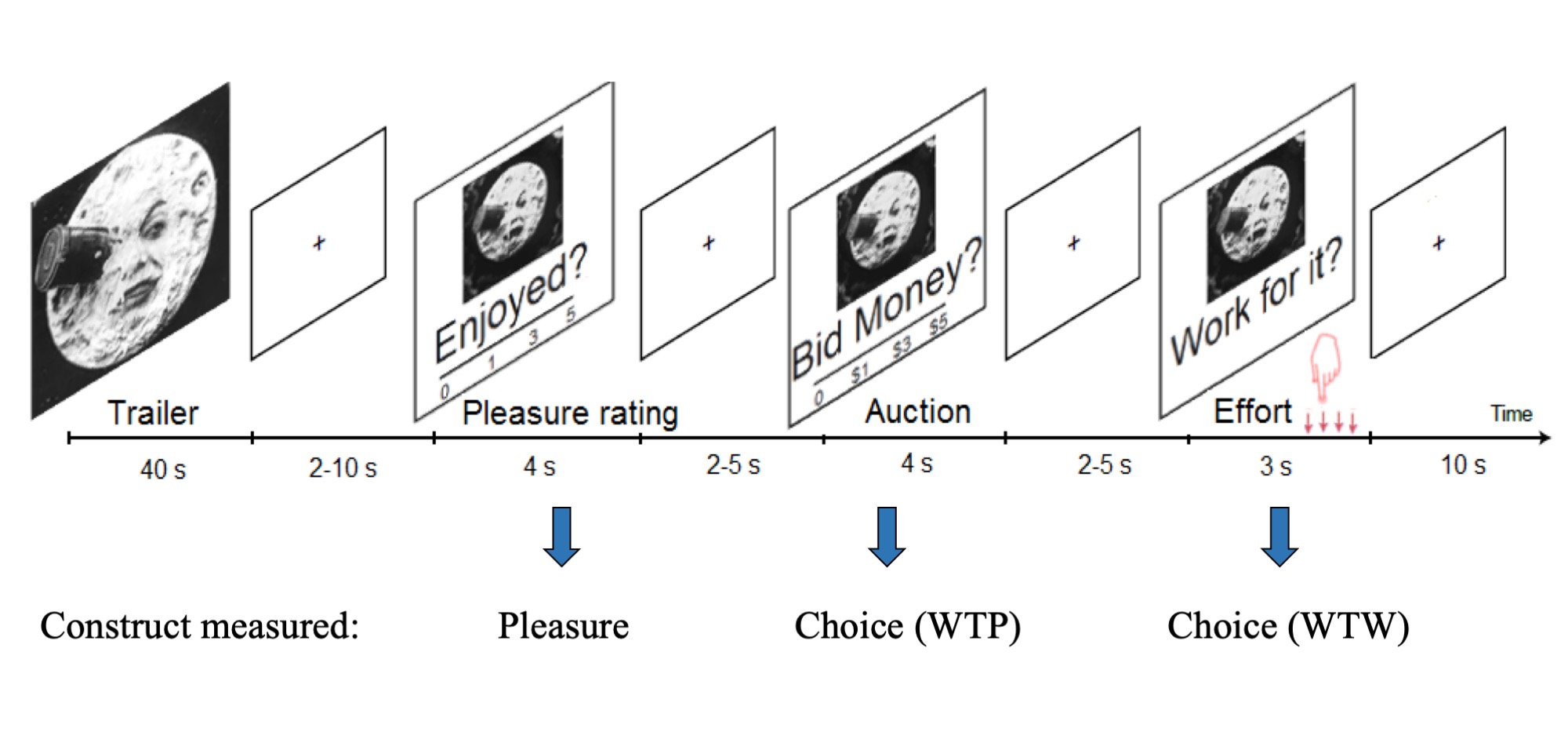
fMRI task: Participants performed the Movie Shopping Task (Fig 1). On each trial participants watch a movie trailer and receive a $5 endowment to bid on the movie advertised. High bids increase the odds of winning a copy of the movie (willingness-to-pay (WTP), following the Becker-Degroot-Marschak5 (BDM) procedure). Participants then have another chance to win the movie by making repeated key presses (willingness-to-work (WTW)). There are 90 trials divided into two 70-minute scan sessions. Following each session, two trials are randomly selected for prize payout (1 for auction, 1 for effort).
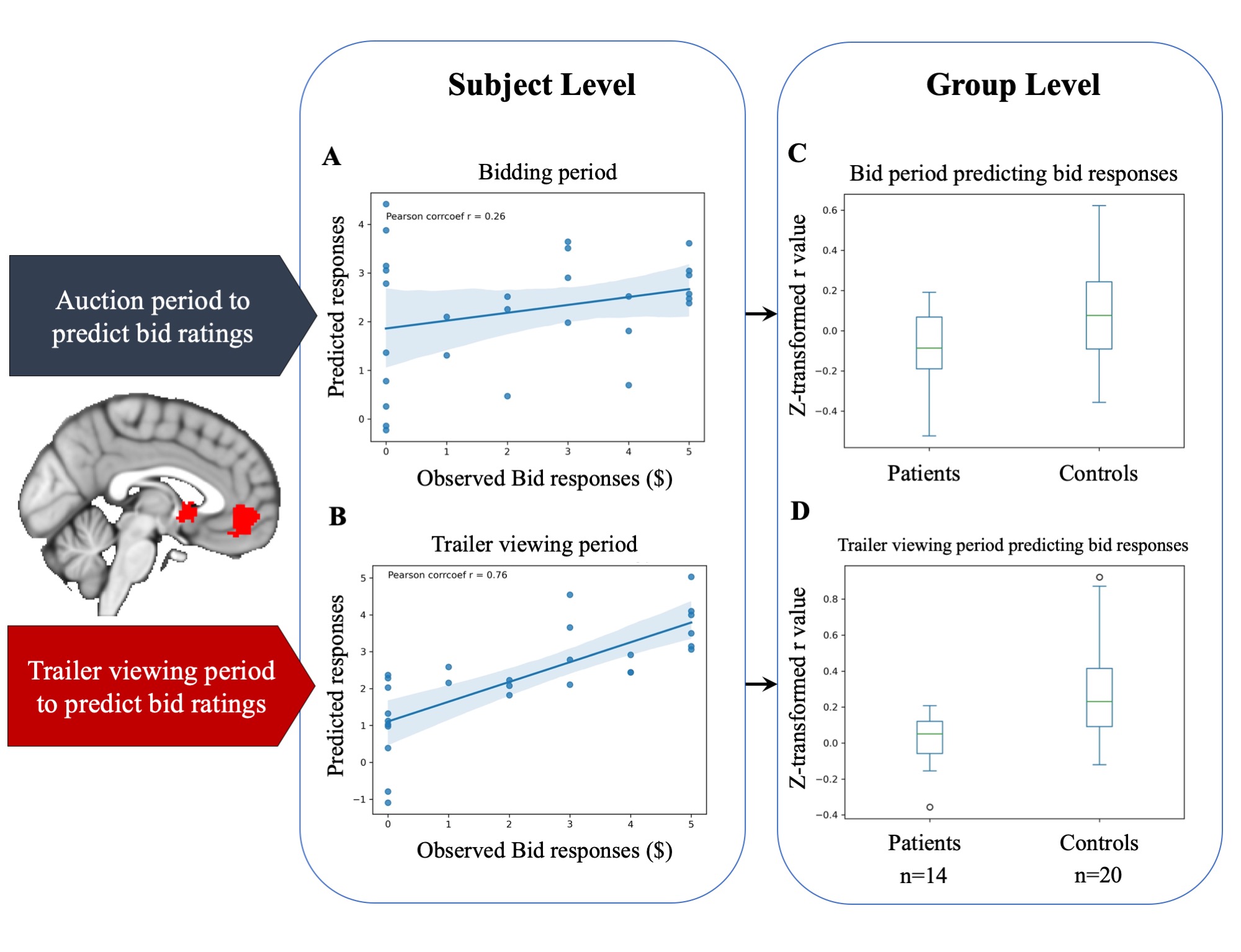
fMRI data analysis: Standard fMRI preprocessing was performed using Fmriprep:20.0.2 6. For each participant a support vector regression7 was performed using Nilearn and Scikit-learn8 relating brain activity to participant responses using a cross validation approach (K=5 folds). For this, the brain activity patterns during the trailer viewing and during the auction period were decoded to predict participant WTP. This primary analysis was performed within a value-encoding regions of ventromedial prefrontal cortex (vmPFC) and Ventral Striatum (VSt)9. Prediction accuracy was determined as the Fisher's Z-transformed correlation coefficient between the predicted bid responses from the model and the observed bid responses.
Results
Using MVPA, patterns of brain activity were identified in two groups (healthy controls and schizophrenia patients) and related to WTP (Fig 2). Preliminary results showed patterns of brain activity in the ventromedial prefrontal cortex during movie trailer viewing (t19=4.40, p=0.0002***, 1-sample t-tests) significantly predicted financial decisions in the control group. Compared to controls, patterns of brain activity were significantly less predictive of WTP in the schizophrenia group (during trailer viewing, t32=3.23, p=0.002*** and auction period, t32=2.28, p=0.02**, 2-sample t-tests)Discussion
This deficit in schizophrenia suggests that value regions in the prefrontal cortex and striatum are not representing value to support decision making, consistent with a leading theory of negative symptoms in schizophrenia.Conclusion
We developed a novel paradigm to isolate the specific components of value-based decision-making that are central to motivation and pleasure deficits, therefore providing targets for therapeutic interventions for negative symptoms. Furthermore, the development of this novel method will open the door to future applications investigating and contrasting the mechanism of pleasure and motivation deficits across neuropsychiatric disorders such as depression, addiction, PTSD, and dementias.Acknowledgements
No acknowledgement found.References
1. J V, KL S, MJ G, et al. Negative symptoms and functioning during the first year after a recent onset of schizophrenia and 8 years later. Schizophr Res 2015; 161: 407–413.
2. Cassidy CM, Norman R, Manchanda R, et al. Testing Definitions of Symptom Remission in First-Episode Psychosis for Prediction of Functional Outcome at 2 Years. Schizophr Bull 2010; 36: 1001.
3. JM G, JA W, KJ P, et al. Reward processing in schizophrenia: a deficit in the representation of value. Schizophr Bull 2008; 34: 835–847.
4. Culbreth AJ, Moran EK, Barch DM. Effort-Based Decision-Making in Schizophrenia. Curr Opin Behav Sci 2018; 22: 1.
5. Becker GM, Degroot MH, Marschak J. Measuring utility by a single-response sequential method. Behavioral Science 1964; 9: 226–232.
6. Esteban O, Blair R, Markiewicz CJ, et al. poldracklab/fmriprep: 1.0.0-rc5. Epub ahead of print 25 September 2017. DOI: 10.5281/ZENODO.996169.
7. Burke CJ, Baddeley M, Tobler PN, et al. Partial Adaptation of Obtained and Observed Value Signals Preserves Information about Gains and Losses. Journal of Neuroscience 2016; 36: 10016–10025.
8. Abraham A, Pedregosa F, Eickenberg M, et al. Machine learning for neuroimaging with scikit-learn. Front Neuroinform 2014; 8: 14.
9. O B, JT M, JW K. The valuation system: a coordinate-based meta-analysis of BOLD fMRI experiments examining neural correlates of subjective value. Neuroimage 2013; 76: 412–427.
Figures