3165
Evaluation of Looping Star, a novel silent fMRI technique for auditory task fMRI1Department of Otolaryngology-Head and Neck Surgery, Shanghai Ninth People’s Hospital, Shanghai Jiao Tong University School of Medicine, Shanghai, China, 2Ear Institute, Shanghai Jiao Tong University School of Medicine, Shanghai, China, 3Shanghai Key Laboratory of Translational Medicine on Ear and Nose Diseases, Shanghai, China, 4MR Research, GE Healthcare, Beijing, China, 5Department of Radiology, Shanghai Ninth People’s Hospital, Shanghai Jiao Tong University School of Medicine, Shanghai, China
Synopsis
Keywords: Task/Intervention Based fMRI, Neuroscience, Looping Star, silent fMRI, auditory task fMRI, auditory processing
Motivation: The scan noise of Gradient-recalled echo echo-planar imaging (GRE-EPI) is a major confounding factor for auditory task fMRI.
Goal(s): This study evaluated a novel silent fMRI technique, "Looping Star," comparing it to the conventional GRE-EPI method.
Approach: A passive listening task consisting of a continuous stream of multilingual babble was applied for seven participants who underwent Looping Star and GRE-EPI scans respectively using similar scan parameters.
Results: Looping Star showed higher sensitivity in detecting activations in primary auditory areas and additional regions not identified by GRE-EPI.
Impact: The results indicate Looping Star's potential for more accurate and comprehensive auditory task fMRI studies due to reduced acoustic interference.
Introduction
Conventional fMRI uses gradient-recalled echo echo-planar imaging (GRE-EPI), which often creates acoustic noise up to 120dBA1, presenting challenges in auditory task fMRI by potentially confounding results. Attempts to reduce these effects haven't been fully successful, and GRE-EPI is prone to various artifacts affecting the spatial accuracy of neural activity localization2. "Looping Star," a new silent fMRI technique, shows promise with lower noise and geometric distortion3, 4. This study evaluates Looping Star's efficacy in auditory fMRI against standard methods.Methods
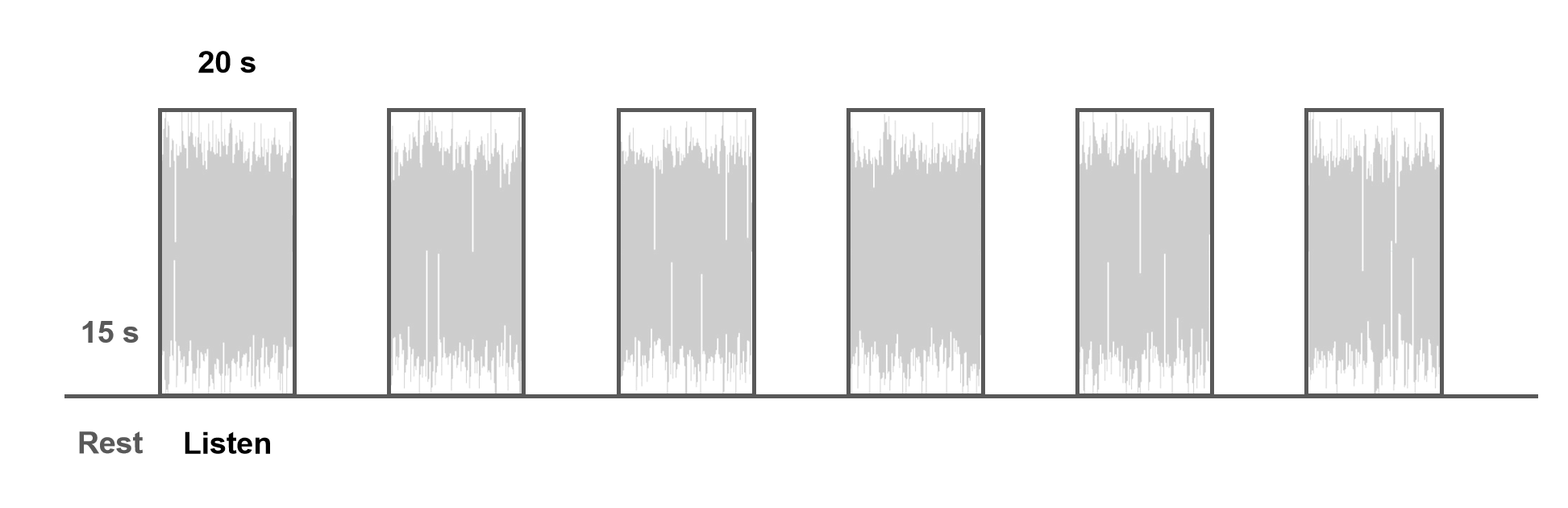
The study protocol was approved (SH9H-2021-T449-1) by the Ethics Committee of Shanghai Jiao Tong University School of Medicine Affiliated Ninth People’s Hospital (Shanghai, China), and written informed consent was obtained from all participants. Seven healthy participants (three females; mean age=33.29 years ± 7.74 years; all right-handed) were recruited.The experiment utilized a block-design passive listening task (Figure 1). Participants experienced six task blocks, each lasting 20 seconds, interspersed with seven rest blocks of 15 seconds each. During task blocks, subjects were exposed to a continuous stream of multilingual babble sourced from standard corpora commonly utilized in audiological assessments. This paradigm was consistently employed for both Looping Star and GRE-EPI image acquisitions. The order of Looping Star and GRE-EPI scans was counterbalanced among participants.
Imaging data were acquired on a 3.0-T scanner (Premier, GE Healthcare, WI) using 48-channel receive-only head coil. The parameters for the two-echo Looping Star and conventional GRE-EPI sequences were closely matched. For Looping Star: TE = 0 ms, 26.88 ms, TR = 2611 s, number of volumes = 90, matrix size = 64x64x64, resolution = 3mm, FOV = 19.2 cm, 24 spokes per echo, 2 echoes, flip angle=3°. For GRE-EPI: TE = 30 ms, TR = 2611 ms, 90 volumes, matrix size = 64x64, slice thickness = 3mm, 48 slices, slice gap = 0 mm, FOV = 19.2 cm, flip angle=90°. Additionally, a 3D T1-weighted Bravo image was acquired (TE =2.2 ms, TR =5.8 ms, TI = 450 ms, flip angle=12°, matrix size = 256x256, resolution = 1mm, 160 slices).
The preprocessing of Looping Star and GRE-EPI data followed a similar, yet slightly different pipeline. For GRE-EPI: the initial five volumes were discarded to address signal instability, followed by head motion correction using FSL's MCFLIRT, slice timing correction with AFNI's 3dTshift, a two-step registration process with ANTs, and finally, smoothing using an 8 mm full width at half maximum (FWHM) kernel. In contrast, Looping Star preprocessing involved both Echo 1 and Echo 2, with Echo 2 showing the BOLD effect and being utilized for further activation analysis. Unlike the GRE-EPI protocol, Looping Star did not require slice timing correction. In the registration phase, average images from Echo 1 were aligned to individual T1-weighted images and subsequently to standard space. These transformations were then applied to Echo 2. All other preprocessing steps were consistent with those used for GRE-EPI.
Individual auditory responses and group-level statistics were computed with SPM12. Multiple comparison was performed for each sequence (voxel p < 0.001, cluster p<0.05, cluster-level family-wise error corrected).
Results
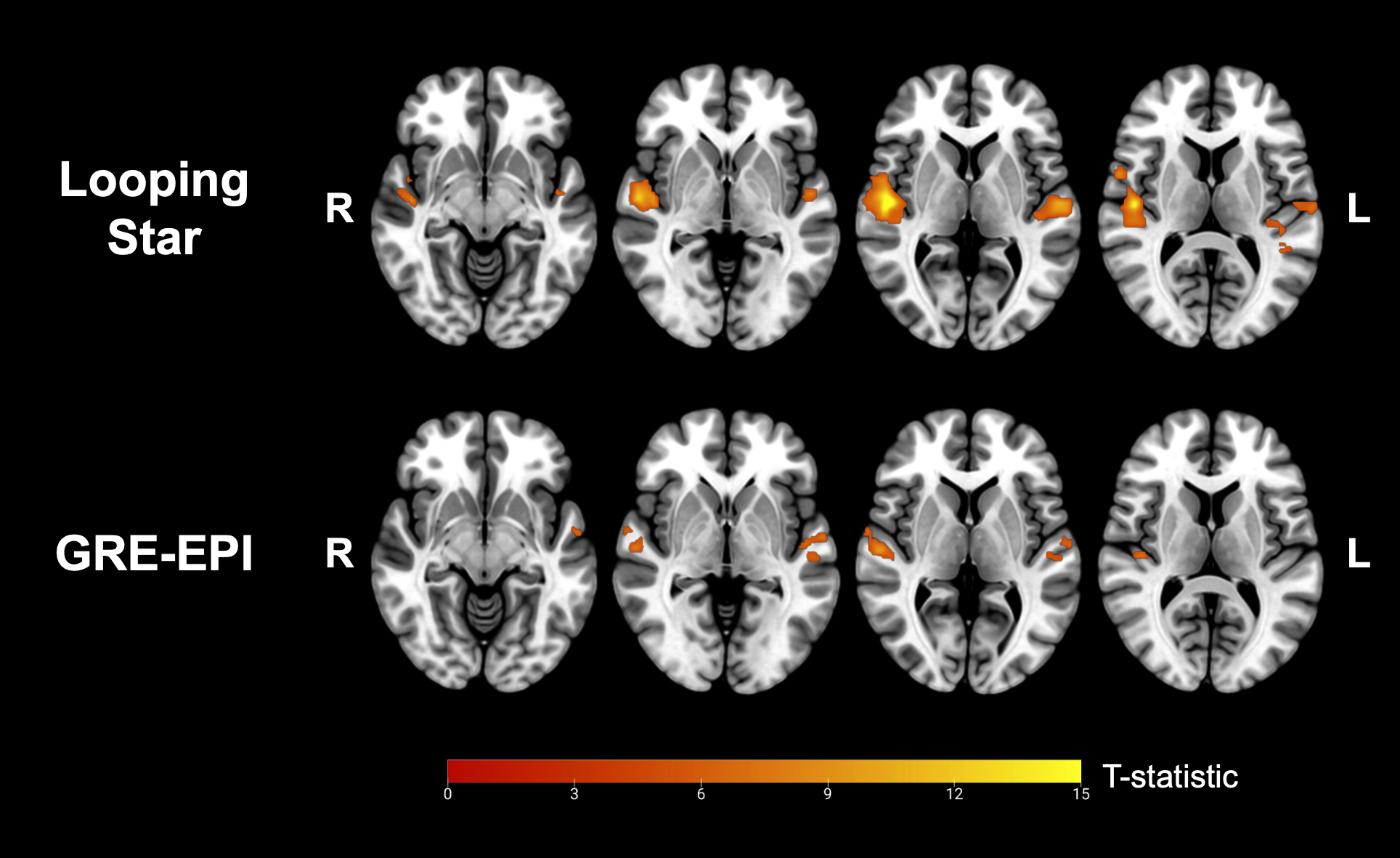
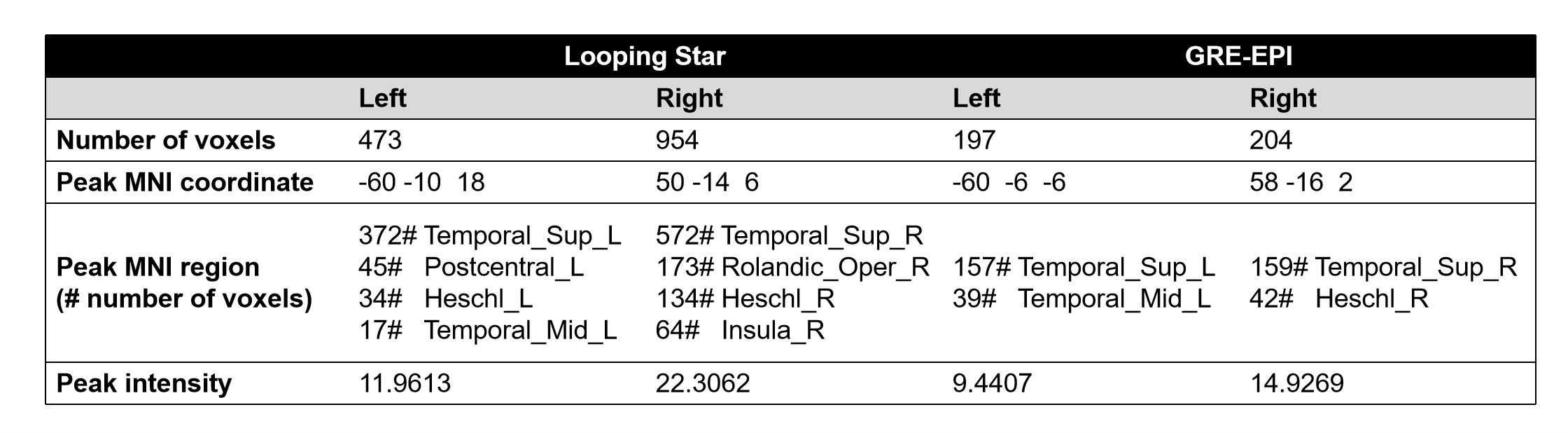
Looping Star showed broader activation and stronger signal detection compared to GRE-EPI, with a notable voxel count increase in both hemispheres (Table 1, Figure 2). Looping Star demonstrates enhanced reliability over GRE-EPI in detecting activations within Heschl's gyrus (HG) and the superior temporal gyrus (STG) on both sides, which serve as the primary and associative auditory centers essential for auditory processing. Thus, Looping Star demonstrates superior sensitivity in neural activity detection over GRE-EPI, possibly due to its enhanced reduction of acoustic noise interference, yielding clearer activation patterns.In addition, Looping Star uncovers activations in brain regions not detected by GRE-EPI, specifically in the left posterior central gyrus, right Rolandic operculum, and right insula (Table 1). Although the posterior central gyrus is primarily associated with somatosensory processing, its activation may reflect its integration with auditory functions5. The Rolandic operculum and the insula have been implicated in a variety of functions including language processing, emotional responses to sounds, and complex auditory processing that goes beyond simple sound perception6,7. The silent acquisition characteristic of Looping Star may thus provide a more comprehensive view of the auditory processing network.
Conclusions
This preliminary study suggests that Looping Star improves the detection of auditory-related brain regions during listening task fMRI, owing to its reduction of acoustic interference. This technique holds promise for offering more detailed and extensive insights into auditory processing.Acknowledgements
This work is supported by Science and Technology Commission of Shanghai Municipality Major Basic Research (2018SHZDZX05), Science and Technology Commission of Shanghai Municipality Shanghai Key Laboratory of Translational Medicine on Ear and Nose diseases (14DZ2260300), Shanghai Municipal Health Commission Shanghai Key Clinical Specialty Construction - Otolaryngology-Head and Neck Surgery (shslczdzk00802), Shanghai Shen Kang Hospital Development Center Emerging Frontier Project (SHDC12020105), Shanghai Jiao Tong University School of Medicine Translational Medicine Collaborative Innovation Project (TM202011), and Shanghai Jiao Tong University School of Medicine High-level Local University Construction Project.References
- Moelker A, Pattynama P. Acoustic noise concerns in functional magnetic resonance imaging. Hum Brain Mapp. 2003;20:123‐141.
- Ojemann, J.G., Akbudak, E., Snyder, A.Z., McKinstry, R.C., Raichle, M.E. and Conturo, T.E., 1997. Anatomic localization and quantitative analysis of gradient refocused echo-planar fMRI susceptibility artifacts. Neuroimage, 6(3), pp.156-167.
- Solana AB., Menini A., Wiesinger, F. 2017. Silent, Multi‐Echo T2* Looping Star fMRI. In Proceedings of the 25th Annual Meeting of ISMRM. Honolulu, HI. Abstract 585.
- Damestani, N.L., Zelaya, F.O., and Lythgoe, D.J. 2018. Looping Star: a novel silent approach to imaging brain function in health and disease. In Proceedings of British Chapter for ISMRM.
- Kropf E, Syan SK, Minuzzi L, Frey BN. From anatomy to function: the role of the somatosensory cortex in emotional regulation. Braz J Psychiatry. 2019;41(3):261-269.
- Mălîia MD, Donos C, Barborica A, et al. Functional mapping and effective connectivity of the human operculum. Cortex. 2018;109:303-321.
- Koelsch S, Fritz T, V Cramon DY, Müller K, Friederici AD. Investigating emotion with music: an fMRI study. Hum Brain Mapp. 2006;27(3):239-250.
Figures