3163
Functional Magnetic Resonance Imaging Unveils Acupuncture's Impact on Postpartum Depression1The Fourth Clinical Medical College of Guangzhou University of Chinese Medicine, Shenzhen, China, 2Shenzhen Traditional Chinese Medicine Hospital, Shenzhen, China, 3MR Research Collaboration, Siemens Healthineers, Guangzhou, China
Synopsis
Keywords: Task/Intervention Based fMRI, Brain, fractional amplitude of low-frequency fluctuation, postpartum depression, acupuncture, left supramarginal gyrus
Motivation: Acupuncture has received increasing attention for the treatment of postpartum depression (PPD), but the biological mechanisms are unclear.
Goal(s): Our study focused on the mechanisms of acupuncture-induced changes in brain function in PPD and whether this correlates with improvements in clinical symptoms.
Approach: The PPD group underwent depression scale assessment and fMRI at baseline, after 8 weeks of acupuncture, comparing pre- and post-acupuncture data to the HPD cohort.
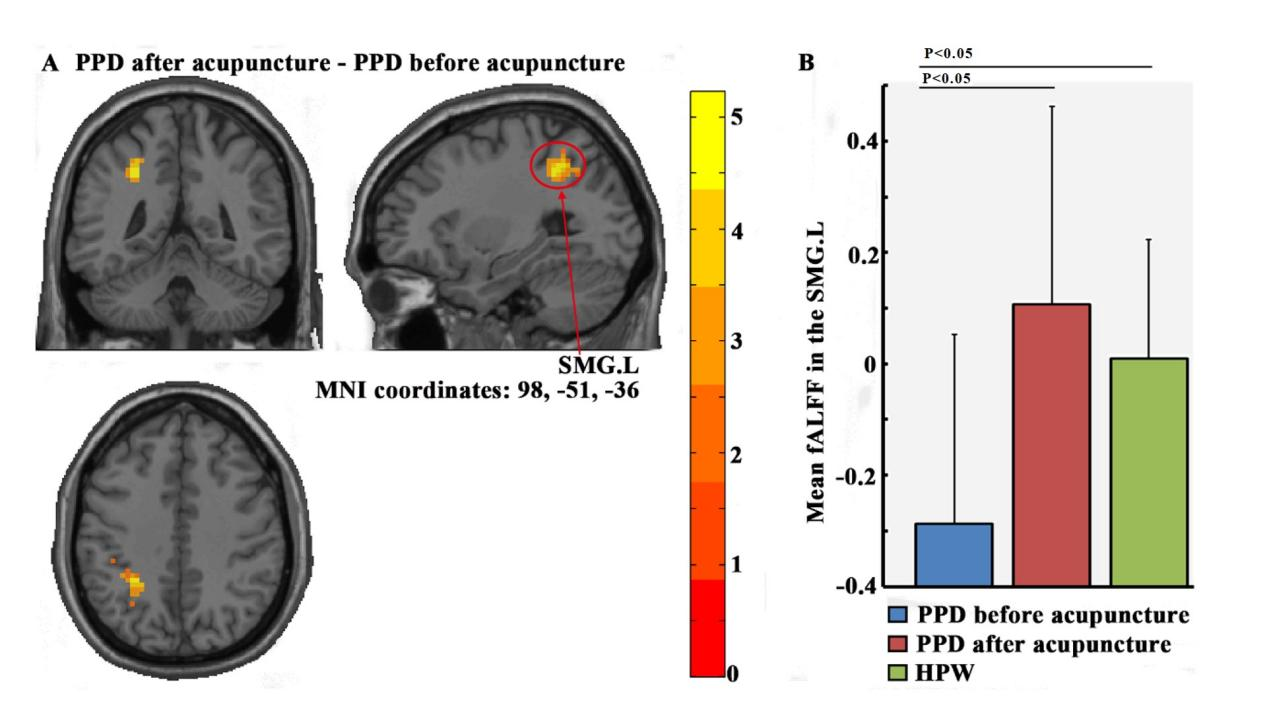
Results: The results showed a significant decrease in HAMD scores and a significant increase in fALFF values of SMG.L in the PPD group after needling, but no correlation was found between the two.
Impact: This article offers preliminary evidence for acupuncture's potential in treating postpartum depression and explores brain activity changes using neuroimaging. It has the potential to inspire further research on depression treatment and neural mechanisms, providing new insights for clinical practice.
Introduction
Due to insufficient understanding of the causes and the particularity of the affected population, current clinical treatments for postpartum depression (PPD) are insufficiently effective with drugs and psychotherapy[1–3]. As an effective and safe alternative therapy, acupuncture is widely used in clinical practice[4]. Studies have shown that cupuncture not only has a beneficial effect on PPD, but can also reduce the Hamilton Depression Rating Scale (HAMD) score[5]. However, the biological mechanism behind it is still unclear. Functional magnetic resonance imaging (fMRI) is widely used in clinical research for its non-invasive display of brain neural activity. Researches have shown that the fractional amplitude of low-frequency fluctuation (fALFF) is a reliable and sensitive algorithm, which can measure characteristics of spontaneous neural activities in brain with less physiological noise effects[6]. The purpose of this study was to investigate the changes of neuronal activity in patients with PPD before and after acupuncture treatment through fractional amplitude of fALFF, and analyze the correlation with HAMD.Methods
The study subjects were divided into two groups. 22 patients who had completed eight weeks of acupuncture were entered into the PPD group and 24 healthy postpartum women (HPW) were entered into the control group. Acupuncture treatment for patients with PPD was performed within a week after screening by experienced acupuncturists. The acupuncture procedure lasted for 8 weeks and was performed three times a week[7,8]. The 17-item Hamilton depression rating scale (17-HAMD) and the Edinburgh Postnatal Depression Scale (EPDS) were assessed for each subject at baseline, and the 17-HAMD score was administered at the end of the eight weeks of acupuncture. fMRI scans were performed at baseline and at the end of acupuncture treatment to extract fALFF data (Figure 1). Functional imaging data were obtained using a 3T system (MAGNETOM Prisma, Siemens healthineers, Erlangen, Germany). An echo-planar imaging sequence was performed to collect functional data. Parameters is shown in Table 1. fALFF in DPABI (DPABI v6.0, http://lab.rfmri.org/), was calculated by applying fast Fourier transformation to voxel time courses, specifically focusing on the 0.01–0.08 Hz frequency range. It quantified the ratio of power in this low-frequency range to the entire frequency spectrum. Regions showing fALFF changes were considered as points of interest for this study, and regional fALFF means were calculated. Paired t-test was used to compare the scale scores and region of interest fALFF changes before and after treatment. Correlations between these two changes were analyzed using Pearson's correlation analyses.Result
Details on study characteristics are reported in Table 1. We found that before acupuncture treatment, the fALFF values of the left supramarginal gyrus (SMG.L) in the PPD group were significantly lower than those in the HPW group. From the perspective of clinical symptoms, after acupuncture treatment, the HAMD score in the PPD group were significantly decreased (P<0.05) (Figure 2). From a biological perspective, the mean value of fALFF in the SMG.L was significantly increased (P<0.05), reaching a level similar to that of the HPW group and slightly higher than that of the HPW group (Figure 3). The results of the correlation study suggested that there is no significant correlation between the changes in fALFF in the SMG.L and the changes in HAMD scores in the PPD group before and after treatment.Discussion
Our study initially discovered that before acupuncture treatment, PPD patients exhibited diminished neural activity in the left marginal superior gyrus, suggesting differences in this region between the PPD and non-PPD groups. Importantly, this finding serves as a foundational observation, indicating an association between PPD and altered neural activity in this specific brain region. We acknowledge the need for further research to replicate and confirm these initial results in larger, multicenter studies. In a promising development, our study also demonstrates a significant increase in the excitability of the left supramarginal gyrus and a noteworthy decrease in HAMD scores following acupuncture treatment, underlining the positive impact of acupuncture on alleviating depressive symptoms in PPD patients.Furthermore,our study did not find a direct correlation between changes in left supramarginal gyrus neural activity and HAMD scores. This could be due to the complexity of depressive syndromes and the coexistence of various clinical symptoms[2,9]. Future research should consider sub-scale assessments based on different PPD symptom profiles to explore more nuanced relationships between neural activity and specific clinical syndromes, enhancing our understanding of acupuncture's effects on PPD[10,11].
Conclusion
Our findings demonstrated that the left supramarginal gyrus may be a target brain area for PPD functional changes and acupuncture treatment.Acknowledgements
We are grateful for the support from our patients and healthy volunteers.References
[1] Stewart D E, Vigod S. Postpartum depression[J]. New England Journal of Medicine, 2016, 375(22): 2177–2186. DOI:10.1056/NEJMcp1607649.
[2] US Preventive Services Task Force, Curry S J, Krist A H, et al. Interventions to prevent perinatal depression: us preventive services task force recommendation statement[J]. JAMA, 2019, 321(6): 580. DOI:10.1001/jama.2019.0007.
[3] Stewart D E, Vigod S N. Postpartum depression: pathophysiology, treatment, and emerging therapeutics[J]. Annual Review of Medicine, 2019, 70(1): 183–196. DOI:10.1146/annurev-med-041217-011106.
[4] Tong P, Dong L-P, Yang Y, et al. Traditional chinese acupuncture and postpartum depression: a systematic review and meta-analysis[J]. Journal of the Chinese Medical Association, 2019, 82(9): 719–726. DOI:10.1097/JCMA.0000000000000140.
[5] Li W, Yin P, Lao L, et al. Effectiveness of acupuncture used for the management of postpartum depression: a systematic review and meta-analysis[J]. BioMed Research International, 2019, 2019: 1–8. DOI:10.1155/2019/6597503.
[6] Zou Q-H, Zhu C-Z, Yang Y, et al. An improved approach to detection of amplitude of low-frequency fluctuation (alff) for resting-state fmri: fractional alff[J]. Journal of Neuroscience Methods, 2008, 172(1): 137–141. DOI:10.1016/j.jneumeth.2008.04.012.
[7] Manber R, Schnyer R N, Allen J J B, et al. Acupuncture: a promising treatment for depression during pregnancy[J]. Journal of Affective Disorders, 2004, 83(1): 89–95. DOI:10.1016/j.jad.2004.05.009.
[8] Hu X, Fan Q, Ma L, et al. Reliability of evidence to guide decision-making in the use of acupuncture for postpartum depression[J]. Frontiers in Public Health, 2022, 10: 942595. DOI:10.3389/fpubh.2022.942595.
[9] Nutt D. The hamilton depression scale- accelerator or break on antidepressant drug discovery?[J]. Journal of Neurology, Neurosurgery & Psychiatry, 2014, 85(2): 119–120. DOI:10.1136/jnnp-2013-306984.
[10] Carrozzino D, Patierno C, Fava G A, et al. The hamilton rating scales for depression: a critical review of clinimetric properties of different versions[J]. Psychotherapy and Psychosomatics, 2020, 89(3): 133–150. DOI:10.1159/000506879.
Figures
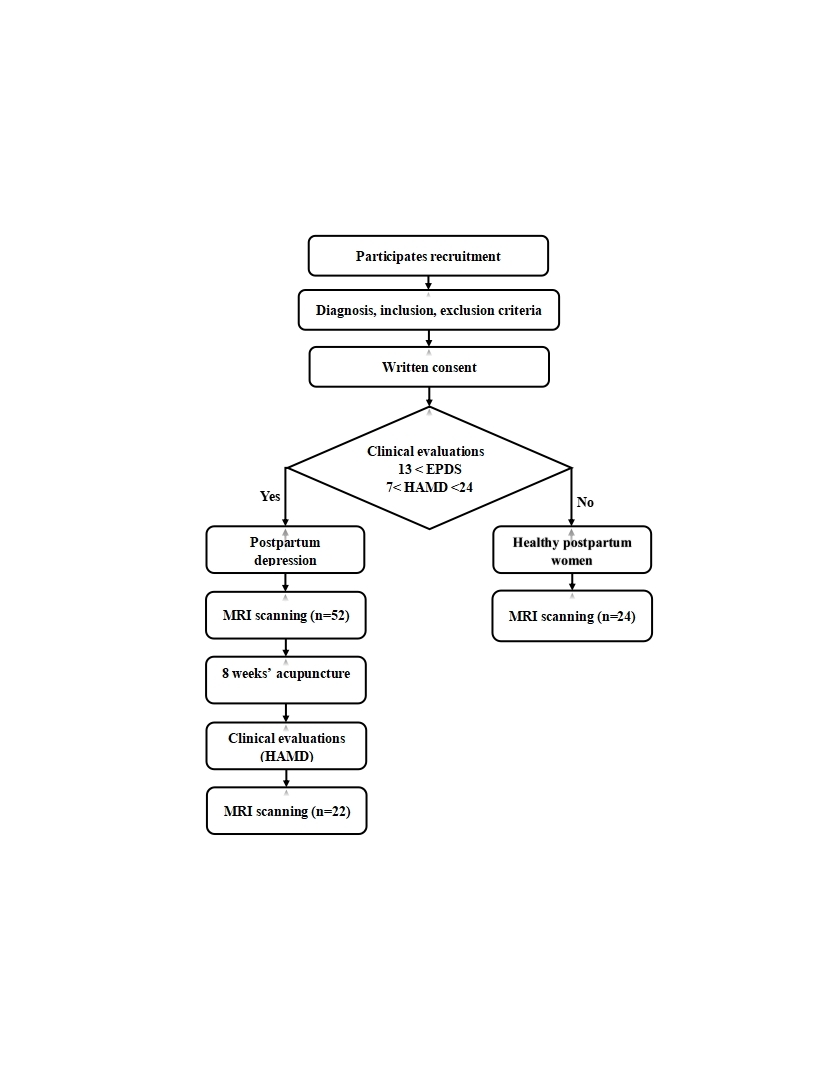
The flow chart of study design. Abbreviations: EPDS, Edinburgh postnatal depression scale; and HAMD, Hamilton depression scale.
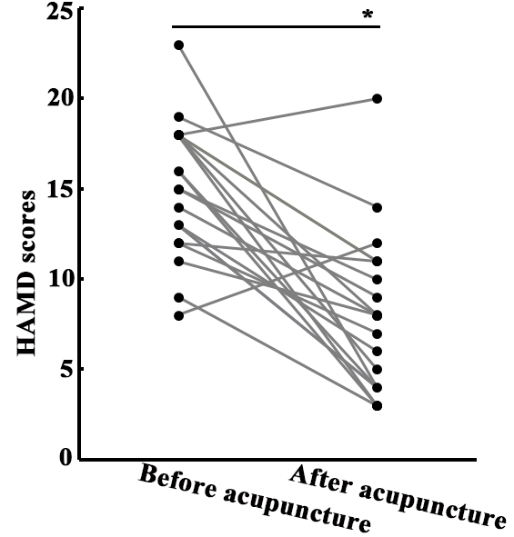
Positive effects of acupuncture on clinical measurements in the PPD. The Hamilton depression scale (HAMD) scores were significantly decreased in the PPD after acupuncture treatment. The results were obtained using paired t-test between PPD before and after acupuncture. P < 0.05 was considered as significant.
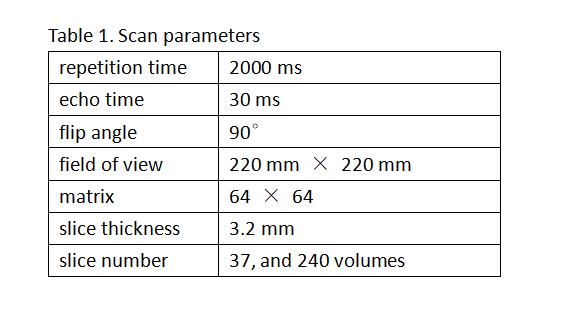
Scan parameters
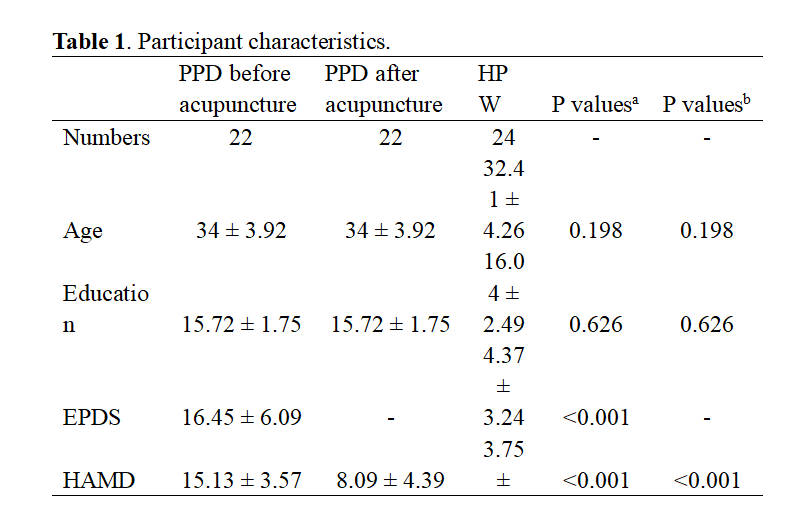
Participant characteristics.Notes: a p values between PPD before acupuncture and HPW; b p values between PPD after acupuncture and HPW; values were displayed by mean ± standard. Abbreviations: HPW, healthy postpartum women; PPD, postpartum depression; EPDS, Edinburgh Postnatal Depression Scale; and HAMD, Hamilton depression scale.