3159
A functional magnetic resonance imaging (fMRI) study of adolescents solving complex mathematical operations1High School of Economics, Moscow, Russian Federation, 2Clinical and Research Institute of Emergency Pediatric Surgery and Trauma, Moscow, Russian Federation, 3York University, Toronto, ON, Canada
Synopsis
Keywords: Task/Intervention Based fMRI, Data Analysis, Neuroimaging AFNI
Motivation: Mathematical processes are widely studied using neuroimaging techniques.
Goal(s): However limited knowledge exists on neurofunctional correlates of distinct mathematical operations, in adolescent samples, as the majority of studies are with adults or children.
Approach: We examine for the first time, using fMRI, brain activity associated with complex addition, subtraction, multiplication, and division in adolescents.
Results: Our study demonstrates the engagement of fronto-parietal, cingulo-operclum networks, and the cerebellum in mathematical operations. Further, we shed light on brain regions not frequently discussed in models of mathematical cognition, including the left temporal gyrus and bilateral supplementary motor area (SMA), specific to complex subtraction and division.
Impact: Results of the study add new knowledge on a modeling mathematical processes in adolescents. Coordinates in stereotaxic space can serve as a benchmark for future research with neurodevelopmental disorders as well as for individuals exhibiting exceptional mathematical proficiency.
Introduction
Four basic mathematical operations: addition, subtraction, multiplication, and division are fundamental to our day-to-day calculations. Although many studies examine brain correlates of math cognition few consider all four mathematical operations together and none to our knowledge has examined all four operations with adolescents. We examine for the first time using functional magnetic resonance imaging (fMRI) brain activity associated with difficult addition, subtraction, multiplication, and division in adolescents.Methods
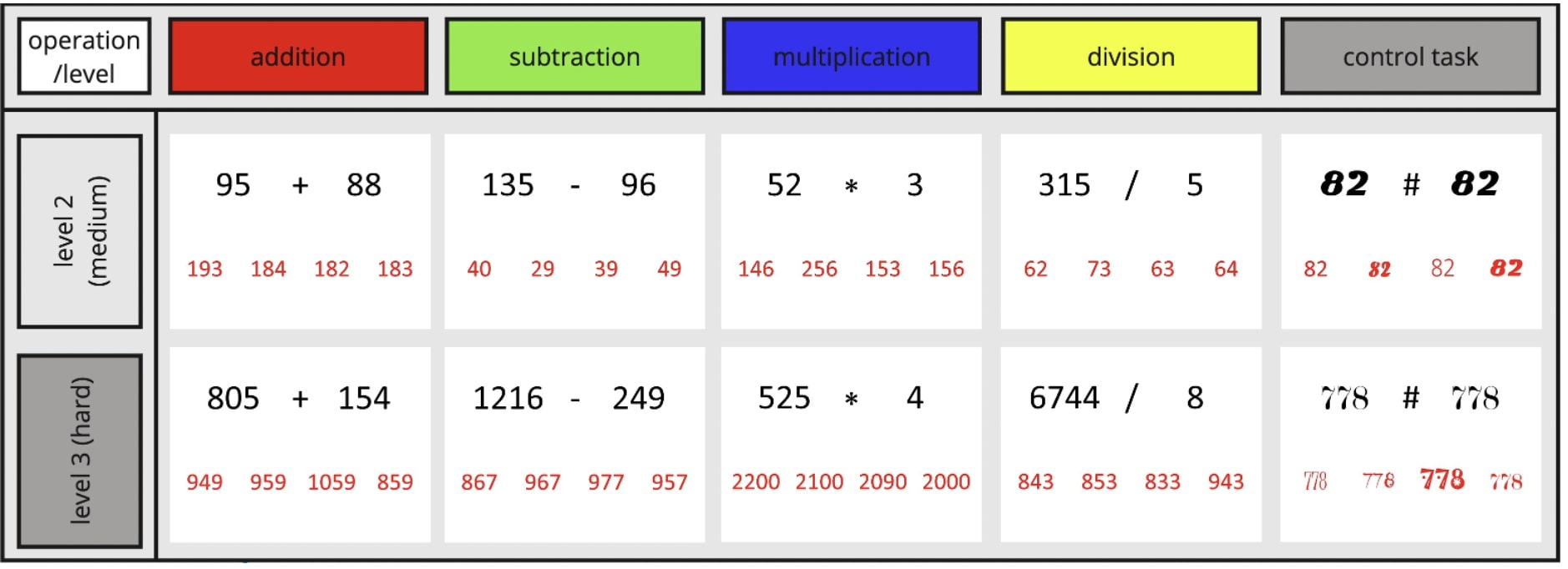
Structural (TR = 8.4 ms, matrix = 240 × 222, voxel size = 1.0 × 1.0 × 1.0 mm; FOV = 240 × 240 × 170 mm; TE = 3.9 ms; FA = 8°) and functional (TR = 2500 ms; TE = 35 ms; FOV = 230 × 230 × 150 mm, 260 measurements per run; voxel size = 3.0 × 3.0 × 3.0 mm) brain data of 20 adolescents (9 female, 14-16 years) were acquired using a magnetic resonance Philips Achieva dStream 3.0T scanner. Participants performed 2-digit and 3-digit versions of the Parametric Math Task, which includes all four mathematical operations. Adolescents were asked to perform math problems that appear on a computer screen together with four potential answers: a correct option and three alternative incorrect options. Each condition appears in a 32 second block, during which participants are asked to give as many correct answers as possible (Figure 1). To demonstrate stimuli and record motor responses we used Presentation software (Neurobehavioural Systems Inc.) and responses were recorded using two MRI compatible button boxes with two keys each for left and right hands. AFNI software (version AFNI for Mac OS versions 23.2-04; [2]) was used to preprocess and analyze the fMRI data. In the initial phase, a high-resolution T1-weighted anatomical scan underwent nonlinear warp estimation using the 3dQwarp AFNI function [3]. Functional data were corrected for differences in slice-time acquisition, head motion, linear trends, and low-frequency noise. Functional images were registered to each participant's T1-weighted anatomical warped image, subsequently normalized to the Montreal Neurological Institute (MNI) coordinate system, and then subjected to spatial smoothing using a 8-mm Full Width at Half Maximum (FWHM) Gaussian smoothing kernel. Individual participants whole-brain responses were modeled using a general linear model (GLM) with each experimental condition used as a regressor. Our data analyses focused only on the contrasts of parameter estimates: math task > control task. Individual parametric maps were then combined into mixed effects group GLM employing the 3dMEMA function in AFNI [4]. Statistical maps were corrected for multiple comparisons using q-value 0.01 false discovery rate (FDR).Results
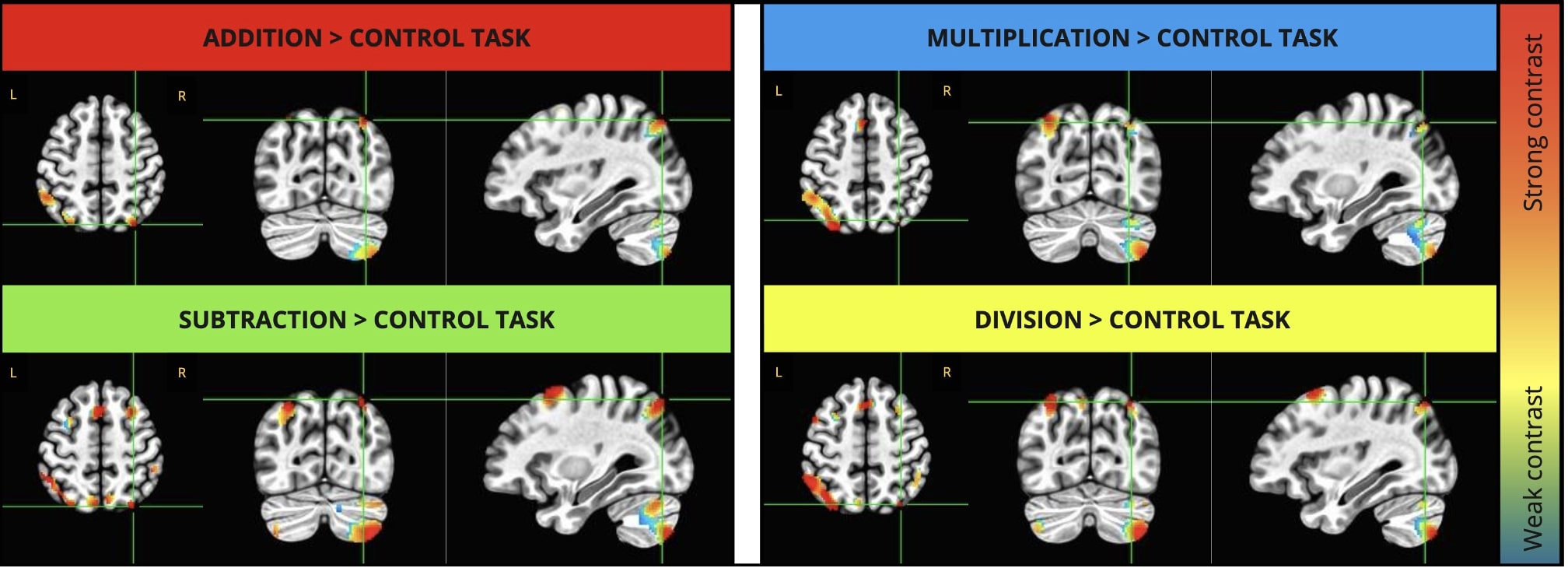
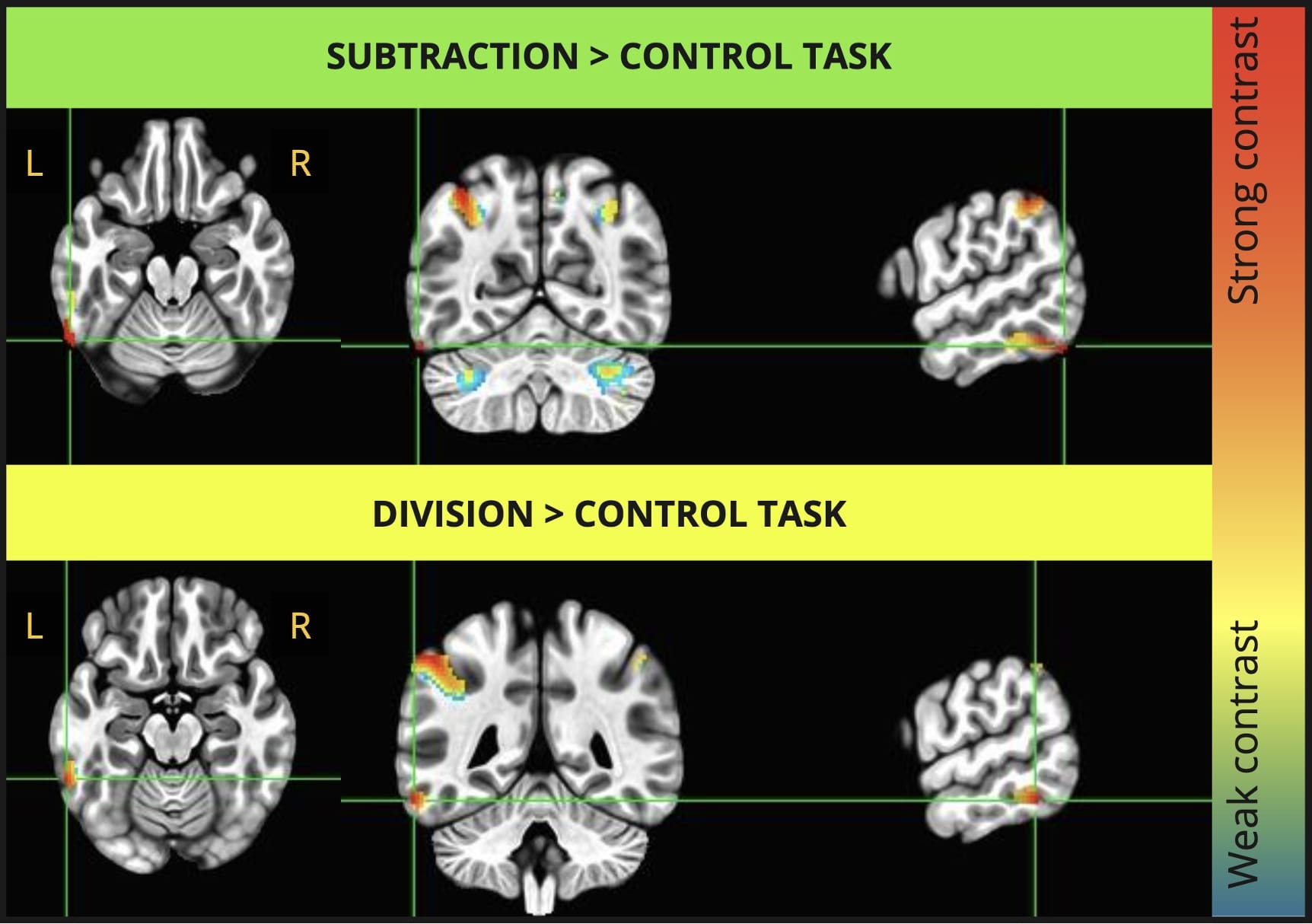
Behavioral scores were comparable among operations. Adolescents activate a widespread set of regions in both hemispheres when solving all four mathematical operations (e.g., addition, subtraction, multiplication, division), that include areas in the fronto-parietal network (e.g., bilateral inferior and superior parietal lobules, bilateral middle and superior frontal gyri). Notably, all math tasks elicited activity in the cerebellum and angular gyrus exhibited activation specifically on the right hemisphere (Figure 2). Subtraction elicited activity in the left cerebellum as well. Areas specific to subtraction and division included the left inferior temporal gyrus and bilateral SMA (Figure 3). We highlight that activation of the left insular cortex was exclusive to multiplication and division operations.Discussion
Many areas underlie mathematical performance in adolescents. We highlight three main findings, (a) generally mathematical operations activate similar brain areas, consistent with previous meta-analyses [5, 6], (b) the involvement of the insular cortex, which is a characteristic feature in complex multiplication and division tasks, may be linked to increased effort exerted by the participants also associated with risky decision-making or emotional experiences [7], such as high motivation or stress, during these genuinely complex tasks [1, 8], (c) subtraction and division may employ similar strategies, as evidenced by the observed activity in the SMA during the resolution of these tasks. The SMA is frequently associated with the planning of sequences of movements, visual perception of motion, execution of speech, and may manifest when participants employ a verbal rehearsal strategy in cognitive tasks [9]. Additionally, the discernible activity during complex subtraction and division observed in the left inferior temporal gyrus, which is recognized for its role in housing the representations of arithmetic facts within long-term memory [10]. Overall, results converge in revealing that multiple brain areas are needed in mathematical cognition, albeit the extent of brain area involvement is in part modulated by operation, indicating that the solution of tasks involving different mathematical operations necessitates the application of both similar and distinct strategies. The results of the study add to existing knowledge on neuromapping of math cognition in adolescent samples.Acknowledgements
This work was supported by Brain Program of the IDEAS Research Center.References
[1] Arsalidou, M., Pawliw-Levac, M., Sadeghi, M., & Pascual-Leone, J. (2018). Brain areas associated with numbers and calculations in children: Meta-analyses of fMRI studies. Developmental cognitive neuroscience, 30, 239-250.
[2] Cox, R. W. (1996). AFNI: software for analysis and visualization of functional magnetic resonance neuroimages. Computers and Biomedical research, 29(3), 162-173.
[3] Cox, R. W., & Glen, D. R. (2013). Nonlinear warping in AFNI. In Poster presented at the 19th Annual Meeting of the Organization for Human Brain Mapping.
[4] Chen, G., Saad, Z. S., Nath, A. R., Beauchamp, M. S., & Cox, R. W. (2012). FMRI group analysis combining effect estimates and their variances. Neuroimage, 60(1), 747-765.
[5] Arsalidou, M., & Taylor, M. J. (2011). Is 2+ 2= 4? Meta-analyses of brain areas needed for numbers and calculations. Neuroimage, 54(3), 2382-2393.
[6] Pollack, C., & Ashby, N. C. (2018). Where arithmetic and phonology meet: the meta-analytic convergence of arithmetic and phonological processing in the brain. Developmental cognitive neuroscience, 30, 251-264.
[7] Uddin, L. Q., Nomi, J. S., Hébert-Seropian, B., Ghaziri, J., & Boucher, O. (2017). Structure and function of the human insula. Journal of clinical neurophysiology: official publication of the American Electroencephalographic Society, 34(4), 300.
[8] Hawes, Z., Sokolowski, H. M., Ononye, C. B., & Ansari, D. (2019). Neural underpinnings of numerical and spatial cognition: An fMRI meta-analysis of brain regions associated with symbolic number, arithmetic, and mental rotation. Neuroscience & Biobehavioral Reviews, 103, 316-336.
[9] Emch, M., Von Bastian, C. C., & Koch, K. (2019). Neural correlates of verbal working memory: An fMRI meta-analysis. Frontiers in human neuroscience, 13, 180.
[10] Suárez‐Pellicioni, M., & Booth, J. R. (2022). Temporal cortex activation explains children’s improvement in math attitudes. Child Development, 93(4), 1012-1029.
Figures