3154
Unbiased validation of connectivity-based cohesive brain parcellation1Imaging Institute, Cleveland Clinic, Cleveland, OH, United States
Synopsis
Keywords: Functional Connectivity, fMRI (resting state), Parcellation, Cohesion, DCBC
Motivation: Cohesive parcellation provides optimal connectivity-based parcels for downstream brain modeling, but at the cost of high parcel count, making comparisons to traditional parcellations difficult.
Goal(s): We aim to fairly compare parcellations across a wide array of parcel sizes and counts.
Approach: rsfMRI of 18 healthy subjects were parcellated based on cohesion and evaluated with the distance-controlled boundary coefficient (DCBC), an unbiased metric that incorporates spatial features of parcels in addition to connectivity.
Results: Cohesive parcellation compared favorably to traditional parcellations based on DCBC of rsfMRI.
Impact: Using an unbiased metric (DCBC), we show that the utility of connectivity-based cohesive parcellation is not simply due to high parcel count.
Introduction
Parcellation is a fundamental step in the modeling of the brain function. We have previously introduced cohesive parcellation, a functional connectivity-based approach that was shown to be optimal for downstream, exemplar-based network analysis1. However, this cohesion-sensitive method produces many more parcels than other widely used parcellations. Most connectivity-based performance metrics of parcellations are sensitive to the size and number of parcels, complicating direct comparison. Recently, the distance-controlled boundary coefficient (DCBC) was introduced, an unbiased, parcel resolution invariant measure incorporating both connectivity and distance2. We evaluate cohesive parcellation using DCBC and compare the results to other parcellations.Methods
18 healthy subjects (age 20-36, 8 female) were scanned on a 7T Siemens Magnetom (Erlangen, Germany) using a 32 channel Nova head coil (Massachusetts, USA) after giving informed consent in this IRB-approved study. Whole-brain, task-free fMRI (rsfMRI) were acquired (SMS multi-band=3, 81 1.5mm slices, 128 volumes, TE/TR=21/2800 ms, 70° flip, FOV=192 mm2, resolution=1.2x1.2x1.5 mm3). High resolution T1w images were acquired for anatomical context as well as duel-echo B0 field maps. Each subject's rsfMRI data were corrected for B0 distortions, slice timing, motion3, and physiologically-based nuisances4, then linearly registered to their corresponding anatomical data. Anatomical data were non-linearly registered the MNI template, and the combined registrations were used to warp the rsfMRI data to MNI space. Cortical and subcortical grey matter segmentation were applied to the normalized rsfMRI data. Subject-specific cohesive parcellation was performed using a previously introduced method based on Pearson correlations of the grey matter rsfMRI data1. A cohesion threshold of 0.5 was used. Cohesion, homogeneity, and adjusted Silhouette coefficient were calculated at the voxelwise level, grouped by parcel, and a parcel size-weighted average determined. For DCBC, a distance-based graph was assembled from the grey matter voxels based on spatial adjacency. This graph was corrected for gyral and sulcal folds using FreeSurfer derived white and pial surface reconstructions. For each subject, DCBC was calculated for each parcel using voxel-to-voxel correlations and geodesic distances, with a final parcel size-weighted average extracted as above2.Results
Cohesive parcellation generated 441-3579 parcels across subjects. Cohesive parcellation and associated parcel-based Silhouette and DCBC distributions are shown for a representative subject (figure 1, 2530 parcels). The parcel size-weighted averages of Silhouette and DCBC for this subject was 0.329 and 0.0973, respectively (dashed red lines). The Silhouette coefficient shows a strong dependence on parcel size, while the DCBC is largely independent, except in the smallest parcels. The corresponding distributions for all validity measures are shown for all subjects (figure 2). Over all subjects, the parcel size-weighted averages were 0.520±0.0038, 0.484±0.0038, 0.292±0.033, 0.0845±0.012 for cohesion, homogeneity, silhouette, and DCBC, respectively. For cohesion, homogeneity, and silhouette, these results are consistent with previous findings1, which showed superior performance to a variety of anatomical and connectivity-based parcellations. The DCBC for cohesive parcellation compares favorably to previously published DCBC of rsfMRI across a number of traditional parcellations, including the Yeo5 (0.0213), Power6 (0.0261), and Gordon7 (0.0236) parcellations2.Discussion
Cohesive parcellation of rsfMRI has been shown to compare favorably to other connectivity-based parcellations across a number of traditional measures of cluster validity at both the individual subject1 and group8 levels while providing optimal parcel exemplars for downstream brain modelling. However, unlike other approaches, there is no predefined parcel count--instead, a minimum quality is selected, which dictates the number of parcels required to achieve this threshold. This often results in smaller parcels with significantly higher counts for which standard metrics (homogeneity, silhouette, etc.) are biased towards. While we have shown that cohesive parcellation produces similar or better results to other data-driven parcellations with matched parcel counts1, this study applied DCBC as a complementary evaluation unbiased to parcel size or count. DCBC metrics show that cohesive parcellation of rsfMRI data produced superior results than those published using traditional parcellations2.Conclusion
Because cohesive parcellation is focused on generating optimal exemplars, it will typically produce much higher parcel counts, complicating evaluation with traditional parcellation metrics. The recently introduced DCBC metric is invariant to parcel count, which showed that cohesive parcellation performs better than prior data-driven functional parcellations. Cohesive parcellation was designed to optimize parcels that generate functional exemplars derived from simple averages of underlying voxel members, as is most common in connectivity-based modeling. Incorporating spatial context into network analysis may improve these brain models9,10. Cohesive parcellation utilizes a flexible hierarchical platform for optimization. Future work will look to incorporate spatial context into this framework in a DCBC-like manner in order to further optimize parcels for downstream brain modeling.Acknowledgements
No acknowledgement found.References
1. Nemani A and Lowe MJ. Cohesive parcellation of the human brain using resting-state fMRI. J Neuroscience Methods 2022;377:109629.
2. Zhi D, et al. Evaluating brain parcellations using the distance-controlled boundary coefficient. Hum Brain Mapp 2022;43:3706-20.
3. Beall EB and Lowe MJ. SimPACE: generating simulated motion corrupted BOLD data with synthetic-navigated acquisition for the development and evaluation of SLOMOCO: a new, highly effective slicewise motion correction. Neuroimage 2014;101:21-34.
4. Beall EB and Lowe MJ. Isolating physiologic noise sources with independently determined spatial measures. Neuroimage 2007;37(4):1286-300.
5. Yeo BTT, et al. The organization of the human cerebral cortex estimated by intrinsic functional connectivity. J Neurophys 2011;106:1125-65. 6. Power J, et al. Functional network organization of the human brain. Neuron 2011;72(4):665-78. 7. Gordon EM, et al. Generation and evaluation of a cortical area parcellation from resting-state correlations. Cerebral Cortex 2016;26(1):288-303.
6. Power J, et al. Functional network organization of the human brain. Neuron 2011;72(4):665-78.
7. Gordon EM, et al. Generation and evaluation of a cortical area parcellation from resting-state correlations. Cerebral Cortex 2016;26(1):288-303.
8. Nemani A and Lowe MJ. Group cohesive parcellation results in superior
functional-based parcellation with greater parcel-level parsimony than current approaches. Proc 30th ISMRM 2021;#3140.
9. Zalesky A, et al. On the use of correlation as a measure of network connectivity. NeuroImage 2012;60:2096-2106.
10. Welton
T, et al. Reproducibility of graph-theoretic brain network metrics: a
systematic review. Brain Connect 2015;5:193-202.
Figures
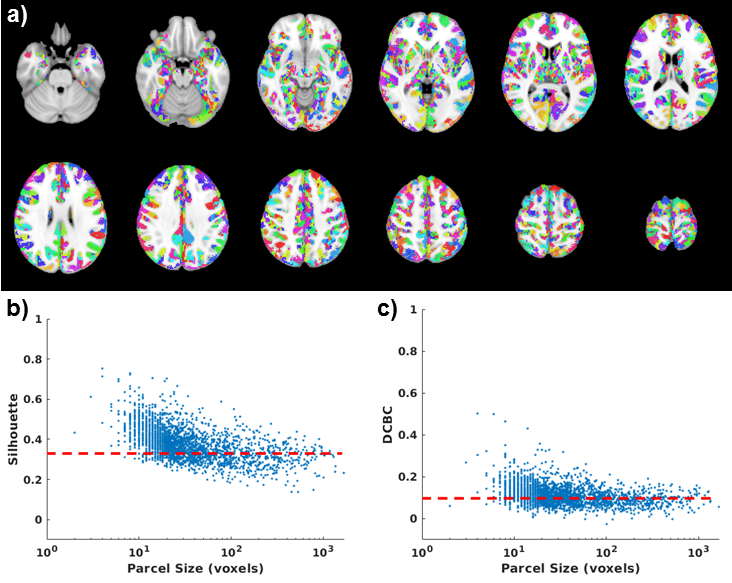
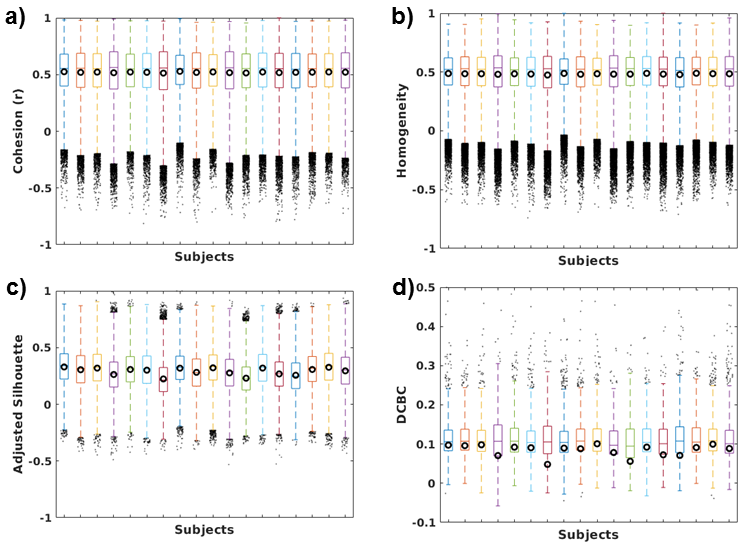
Figure 2: Evaluation of cohesive parcellation across all 18 subjects. Black circles represent parcel size-weighted average. a) Cohesion (0.520 +/- 0.0038). b) Homogeneity (0.484 +/- 0.0038). c) Silhouette coefficient (0.292 +/- 0.033). d) DCBC (0.0845 +/- 0.012).