3148
Altered static and dynamic functional network connectivity in individuals with subthreshold depression: a resting-state fMRI study1Radiology, Guizhou Provincial People's Hospital,, Guiyang, China, 2Guizhou Provincial People's Hospital, Guiyang, China, 3Beijing Hospital of Traditional Chinese Medicine, Capital Medical University, Beijing, China
Synopsis
Keywords: Functional Connectivity, Psychiatric Disorders, subthreshold depression
Motivation: identifying the neural pathology mechanisms has the potential value to elucidate risk factors and prognostic markers for subthreshold depression(StD)
Goal(s): FNC is a useful imaging tool in detecting the neuro-mechanism of the brain
Approach: This study involved in the static functional network connectivity (sFNC) and dynamic functional network connectivity (dFNC) to investigate the FNCdifferences between the StD and HCs groups
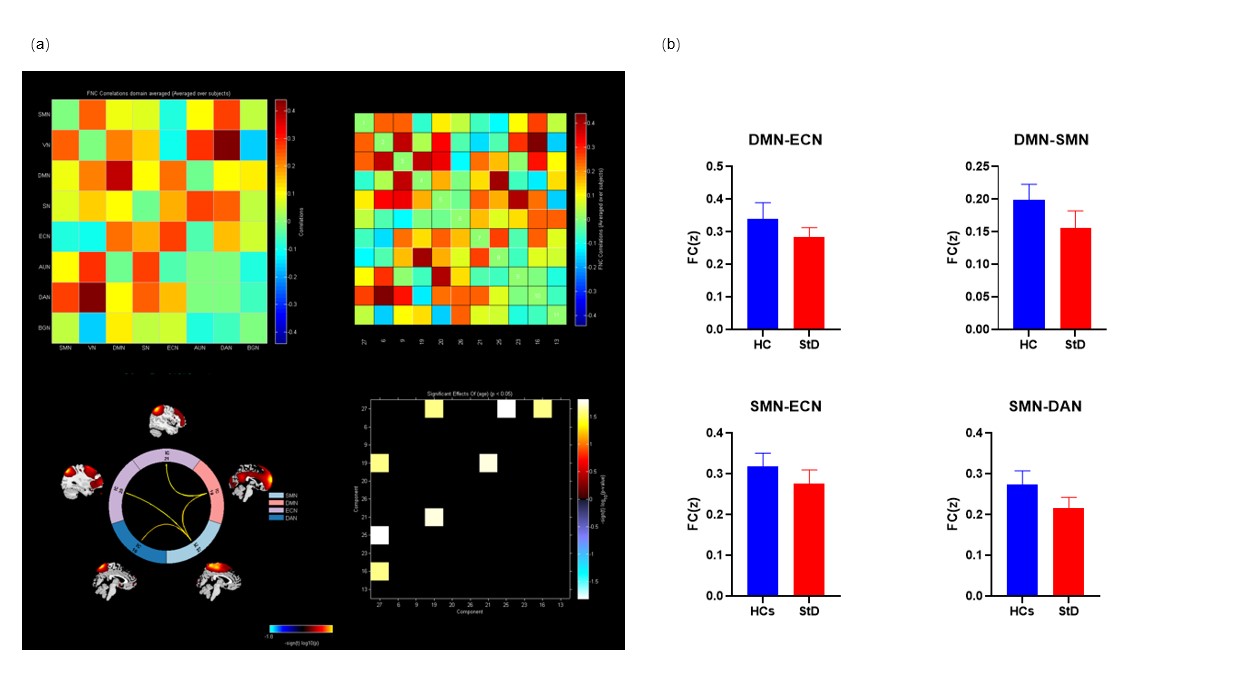
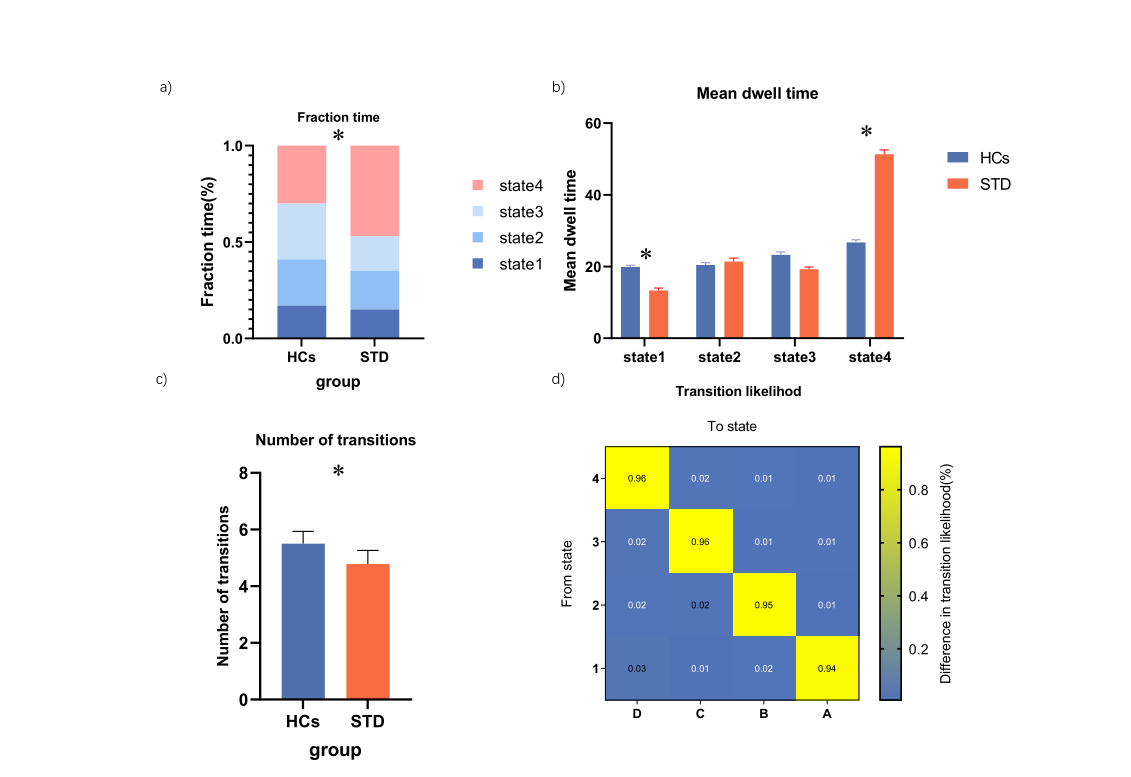
Results: StD demonstrated altered FNC in executive control network (ECN), default mode network (DMN), sensorimotor network (SMN) and dorsal attentional network (DAN), in addition, Std had increased mean dwell time and fraction time in a weak connected state concerning the dFNC analysis.
Impact: The sFNC and dFNC findings could enrich our understanding of the large-scale resting-state FNC abnormalities in StD individuals, which could provide insights for a better understanding of the behind neural mechanisms
Introduction
Subthreshold depression (also referred to as subsyndromal depression, subclinical depression, or mild depression) is an umbrella term that encompasses several depressive conditions, but does not fulfill the criteria for MDD, which is more prevalent than MDD [1]. Though the number of symptoms is lower in individuals with subthreshold depression (StD), it can significantly affect people’s quality of life and health care system, and represent as an important risk factor for later MDD and suicidality [2]. Dynamic functional network connectivity (dFNC) is an extension of static functional network connectivity (sFNC) that takes into account fluctuating states of connectivity across the time domain [3-5]. This dynamic method uses a sliding window and clustering technique to evaluate FNC, which can identify multiple functional connectivity states during the entire scan period, and characterize the brain behavior based on temporal properties [6]. This study aims to investigate the changes of sFNC and dFNC strengths as well as temporal properties in individuals with subthreshold depression (StD).Methods
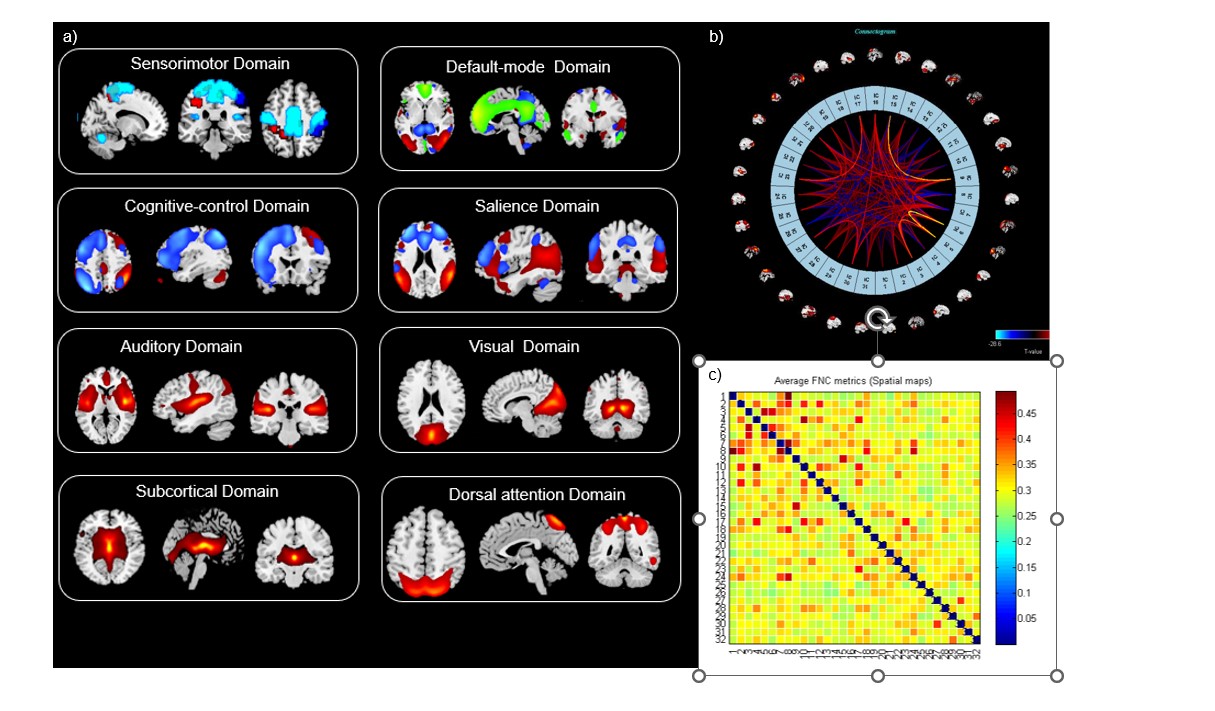
Forty-two individuals with subthreshold depression and 38 healthy controls were included in this study. All participants were scanned by using a 3.0 T MR scanner (Discovery MR 750W, GE Healthcare, Milwaukee, WI) with a 32-channel phased-array coil. Data preprocessing was carried out using GRETNA software (http://www.nitrc.org/projects/gretna) based on MATLAB (Version R2013b) [7-8]. We applied group independent component analysis (GICA) on the preprocessed data with the GIFT toolbox (http://mialab.mrn.org/software/gift) [9-10]. Sliding window and k-means clustering analysis were used to obtain dFNC patterns and temporal properties for each subject. We compared sFNC and dFNC differences between the StD and HCs groups. Relationships between changes of FNC strength, temporal properties, and neurophysiological scores were evaluated by Spearman's correlation analysis.Results
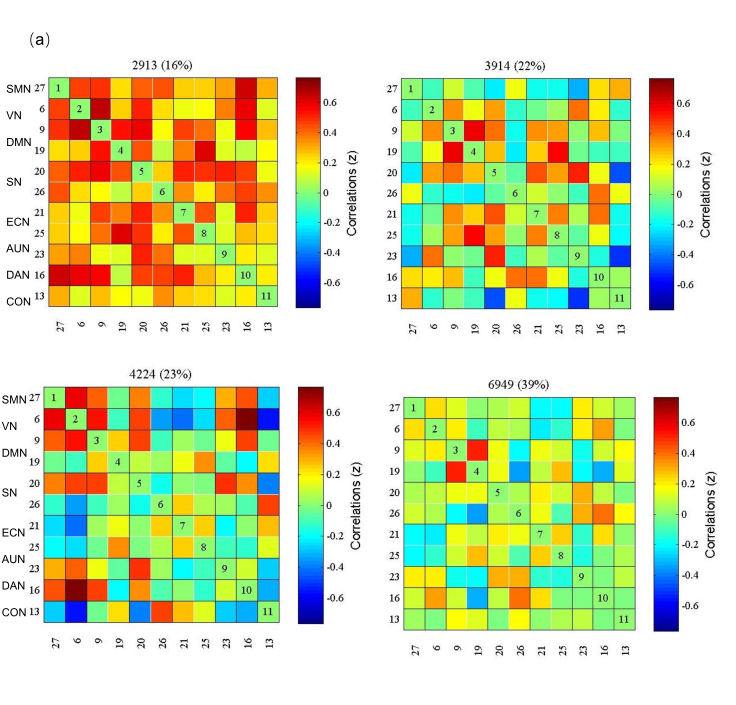
Regarding the analysis of sFNC, StD individuals showed altered FNC among four functional domains, mainly involving in executive control network (ECN), default mode network (DMN), sensorimotor network (SMN) and dorsal attentional network (DAN). For the dFNC analysis, 4 recurring FNC patterns were identified. When compared to HCs, StD had increased mean dwell time and fraction time in a weak connected state (state 4), which is associated with self-focused thinking status. In addition, StD demonstrated decreased dFNC strength between DMN-DAN in state 2. The sFNC strength (DMN-ECN) and temporal properties were correlated with HAMD-17 scores in StD individuals.Discussion
Our study provides new evidence on aberrant time-varying brain activity and large-scale network interaction disruptions in StD individuals, which may provide novel insight to better understand the underlying neuropathological mechanisms.Acknowledgements
We would like to thank all the patients and healthy controls who joined the present studyReferences
1. Allen EA, Damaraju E, Plis SM, Erhardt EB, Eichele T, Calhoun
VD (2014) Tracking whole-brain connectivity dynamics in the resting state.
Cereb Cortex 24:663-676
2. Cui J, Wang Y, Liu R, Chen X, Zhang Z, Feng Y, Zhou J, Zhou Y,
Wang G (2021) Effects of escitalopram therapy on resting-state functional
connectivity of subsystems of the default mode network in unmedicated patients
with major depressive disorder. Transl Psychiatry 11:634
3. Cuijpers P, Pineda BS, Ng MY, Weisz JR, Muñoz RF, Gentili
C, Quero S, Karyotaki E (2021) A meta-analytic review: Psychological treatment
of subthreshold depression in children and adolescents. J Am Acad Child Adolesc
Psychiatry 60:1072-1084
4. Espinoza FA, Anderson NE, Vergara VM, Harenski CL, Decety J,
Rachakonda S, Damaraju E, Koenigs M, Kosson DS, Harenski K, Calhoun VD, Kiehl
KA (2019) Resting-state fmri dynamic functional network connectivity and
associations with psychopathy traits. Neuroimage Clin 24:101970
5. Espinoza FA, Liu J, Ciarochi J, Turner JA, Vergara VM, Caprihan
A, Misiura M, Johnson HJ, Long JD, Bockholt JH, Paulsen JS, Calhoun VD (2019)
Dynamic functional network connectivity in huntington's disease and its
associations with motor and cognitive measures. Hum Brain Mapp 40:1955-1968
6. Fu Z, Caprihan A, Chen J, Du Y, Adair JC, Sui J, Rosenberg GA,
Calhoun VD (2019) Altered static and dynamic functional network connectivity in
alzheimer's disease and subcortical ischemic vascular disease: Shared and
specific brain connectivity abnormalities. Hum Brain Mapp 40:3203-3221
7. Ho TC, Connolly CG, Henje Blom E, LeWinn KZ, Strigo IA,
Paulus MP, Frank G, Max JE, Wu J, Chan M, Tapert SF, Simmons AN, Yang TT (2015)
Emotion-dependent functional connectivity of the default mode network in
adolescent depression. Biol Psychiatry 78:635-646
8. Huang J, Cheng R, Liu X, Chen L, Luo T (2022) Abnormal static
and dynamic functional connectivity of networks related to cognition in
patients with subcortical ischemic vascular disease. Neuroradiology
64:1201-1211
9. Huang L, Huang G, Ding Q, Liang P, Hu C, Zhang H, Zhan L, Wang
Q, Cao Y, Zhang J, Shen W, Jia X, Xing W (2021) Amplitude of low-frequency
fluctuation (alff) alterations in adults with subthreshold depression after
physical exercise: A resting-state fmri study. J Affect Disord 295:1057-1065
10. Hwang JW, Egorova N, Yang XQ, Zhang WY, Chen J, Yang XY, Hu
LJ, Sun S, Tu Y, Kong J (2015) Subthreshold depression is associated with
impaired resting-state functional connectivity of the cognitive control
network. Transl Psychiatry 5:e683
Figures