3103
Predicting online plan adaptation strategy using radiomics in MR-guided radiotherapy of localized prostate cancer1Hong Kong Sanatorium and Hospital, Hong Kong, Hong Kong, 2The Chinese University of Hong Kong, Hong Kong, Hong Kong
Synopsis
Keywords: Radiomics, Radiomics, MRgRT, online adaptation
Motivation: MRI-guided radiotherapy (MRgRT) offers the advantage of superior soft-tissue image contrasts, particularly beneficial for daily online treatment plan adaptation in prostate cancer (PC). However, the decision between “adapt-to-position” (ATP) or “adapt-to-shape” (ATS) is subjective and complicated.
Goal(s): This study aims to use radiomics to predict the ATP or ATS adaptation for localized PC.
Approach: Daily MRI images from 210 fractions were included. 1023 radiomics features were extracted and used to build a logistic regression model for predicting ATP or ATS adaptations.
Results: The MRI radiomics model built was relatively good in objectively predicting ATP and ATS adaptations for MRgRT in localized PC.
Impact: Our study showed that MRI radiomics have promising predictive capabilities for determining online adaptation strategies for MRgRT in localized PC. This could enhance workflow efficiency and personalize care by providing quantitative and objective criteria for adaptation strategy determination in MRgRT.
Introduction
MRI-guided radiotherapy (MRgRT) allows for daily online treatment plan adaptation based on up-to-date anatomical information from daily MRI acquired on an MRI integrated linear accelerator (MR-LINAC) by taking the advantages of superior soft-tissue MR image contrasts of prostate gland and organs-at-risk (OARs) [1]. The online plan adaptation strategies on a 1.5T MR-LINAC are normally divided into “adapt-to-position” (ATP) and “adapt-to-shape” (ATS). ATP is usually adopted when no substantial anatomical change or deformation is observed on daily MR images compared to the reference planning MRI. Rigid registration is applied to correct the inter-fractional position shift in ATP, without the need of re-contouring of targets and OARs. In contrast, ATS is used when substantial inter-fractional anatomical change or deformation is found to severely deteriorate the reference plan quality which cannot be sufficiently compensated by rigid registration. Thus, re-contouring of targets and OARs is conducted and deformable registration is used in ATS. ATP generally has a less complex workflow and higher efficiency than ATS, although ATS could theoretically lead to more precise dose delivery. The decision of adopting ATP or ATS, however, is subjective for attending oncologists, physicists and radiotherapists, complicated and dependent heavily on individual patient and many other factors [2].We hypothesize that MRI radiomics based on the daily images acquired on an MR-LINAC could reveal inter-fractional anatomical changes and thus aid quantitative and objective online plan adaptation decision. Hence, this study aims to use radiomics to predict the ATP or ATS adaptations in MRgRT for localized prostate cancer (PC) patients.
Materials and Methods
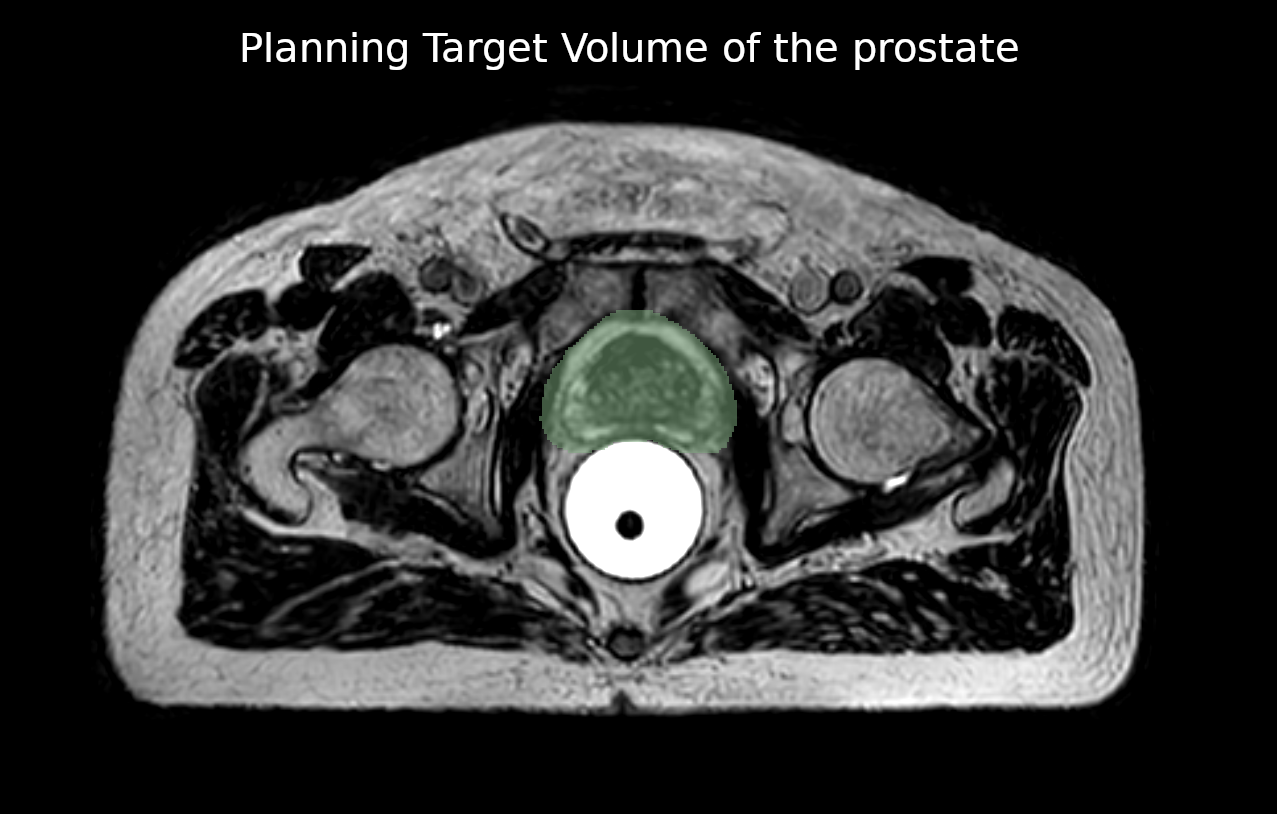
42 histologically-confirmed localized PC patients who underwent five-fractionated MRgRT were retrospectively included. Hence, a total of 210 fractions were analyzed. An experienced radiation oncologist segmented the prostate gland in the planning MRI as the reference clinical target volume (CTV), which was isotropically expanded by 5 mm to generate the planning target volume (PTV), as shown in Figure 1. 1023 radiomics features were extracted from the planning MRI and the daily online MRI in the reference and propagated (to daily MRI) PTV and then normalized. The reliable change index (RCI) [3] of the radiomics features between fractions was calculated. Records of ATP or ATS adaptation for each fraction were extracted from clinical logs. Mann Whitney U test (with a 0.05 threshold) was used to filter the radiomics features by their RCI values. After the filtering, the dataset was then divided into a training set and a testing set with a ratio of 8:2. Random forest was used to select the top 15 radiomics features, which were later used to build a model using logistic regression for predicting the ATP or ATS adaptations used in that fraction. The data was trained using 5-fold stratified cross-validation. The area under the curve (AUC), sensitivity, and specificity of the models, both using the training set and the testing set, were calculated.Results
There were 157 ATP (75%) and 53 ATS (25%) adaptations. The AUC of the training set was 0.874±0.024, while the AUC of the testing set was 0.822. The sensitivity, specificity, and accuracy of the training set were 0.919±0.020, 0.839±0.015, and 0.894±0.016, while in the testing set, they were 0.905, 0.692, and 0.824, respectively. Some top selected features are log.sigma.3.0.mm.3D_gldm_DependenceEntropy, wavelet.HLH_ngtdm_Contrast, wavelet.HLH_glcm_ldmn, and original_firstorder_Skewness. Significant inter-fractional changes in these features captured relatively larger inter-fractional variations in spatial complexity, gray-level characteristics, and skewness patterns, which may reflect the degree of inter-fractional changes in the reference PTV. Hence, ATS adaptation would be more appropriate for the fraction.There are some limitations in this study, including the relatively small sample size and the retrospective analysis of the data from all fractions, which may limit the generalizability of the findings. Future study is warranted.
Conclusion
Our study demonstrated that MRI radiomics exhibited a relatively good predictive capability in predicting online adaptation strategies for MRgRT in localized PC, which could potentially aid in quantitative and objective adaptation strategy determination to optimize workflow efficiency and personalized care in MRgRT.Acknowledgements
We gratefully acknowledge the invaluable participation of the patients in this study, whose involvement has greatly contributed to this study.References
[1]Lagendijk JJ, Raaymakers BW, Van den Berg CA, Moerland MA, Philippens ME, van Vulpen M. MR guidance in radiotherapy. Phys Med Biol. 2014 Nov 7;59(21):R349-69. doi: 10.1088/0031-9155/59/21/R349. Epub 2014 Oct 16. PMID: 25322150.
[2]van Herk M, McWilliam A, Dubec M, Faivre-Finn C, Choudhury A. Magnetic Resonance Imaging-Guided Radiation Therapy: A Short Strengths, Weaknesses, Opportunities, and Threats Analysis. Int J Radiat Oncol Biol Phys. 2018 Aug 1;101(5):1057-1060. doi: 10.1016/j.ijrobp.2017.11.009. PMID: 30012525.
[3]Xue C, Chu WCW, Yuan J, Poon DMC, Yang B, Zhou Y, Yu SK, Cheung KY. Determining the reliable feature change in longitudinal radiomics studies: A methodological approach using the reliable change index. Med Phys. 2023 Feb;50(2):958-969. doi: 10.1002/mp.16046. Epub 2022 Oct 27. PMID: 36251320.
Figures