3101
Radiomics-optimized MRI: Evaluation of keyhole technique to prostate cancer DWI1Department of Urology, University of Turku, Turku, Finland, 2Department of Diagnostic Radiology, University of Turku, Turku, Finland, 3Radiology Enterprise Service Group, Mass General Brigham, Boston, MA, United States, 4Siemens Healthineers, Helsinki, Finland, 5Department of Medical Physics, Turku University Central Hospital, Turku, Finland
Synopsis
Keywords: Radiomics, Prostate, Repeatability, Optimization
Motivation: Radiomic feature extraction techniques may be combined with reduced k-space data acquisition, if their repeatability and clinical performance would stay in the same levels as with full data acquisition.
Goal(s): We evaluate radiomics for their potential to be used in keyhole imaging acquiring k-space only partially.
Approach: We utilized 78 patients with prostate cancer who underwent short-term test-retest prostate MRI examination. We calculated ADC parameter map with different portions of k-space, simulating keyhole acquisitions. We extracted radiomics, evaluating intra-class correlation coefficient ICC(3,1) changes and area under ROC curve (AUC).
Results: Repeatability and classification performance stayed in acceptable limits for some of the radiomics.
Impact: The technique is relative easy to implement, and thus may benefit clinical MR examinations in the near future.
Introduction
Radiomic feature extraction has shown great promise in retrieving information from MRI images which may otherwise be omitted by human eye. In addition, keyhole imaging techniques and other data reduction techniques such as compressed sensing can be used to achieve faster MRI image acquisition. Radiomic feature extraction techniques depend on information located in different spatial frequencies, e g mean intensity inside Region Of Interest (ROI) use lower spatial frequency than texture features. Obtaining k-space data only in central part corresponds to omitting higher spatial frequency information, can be leveraged by using radiomic features which are robust to excluding higher frequencies in the data acquistion, to optimize radiomic feature extraction together with k-space filling. In this study, we evaluated keyhole approach by means of simulations, to see which radiomic features can be used together with partially obtained k-space.Methods
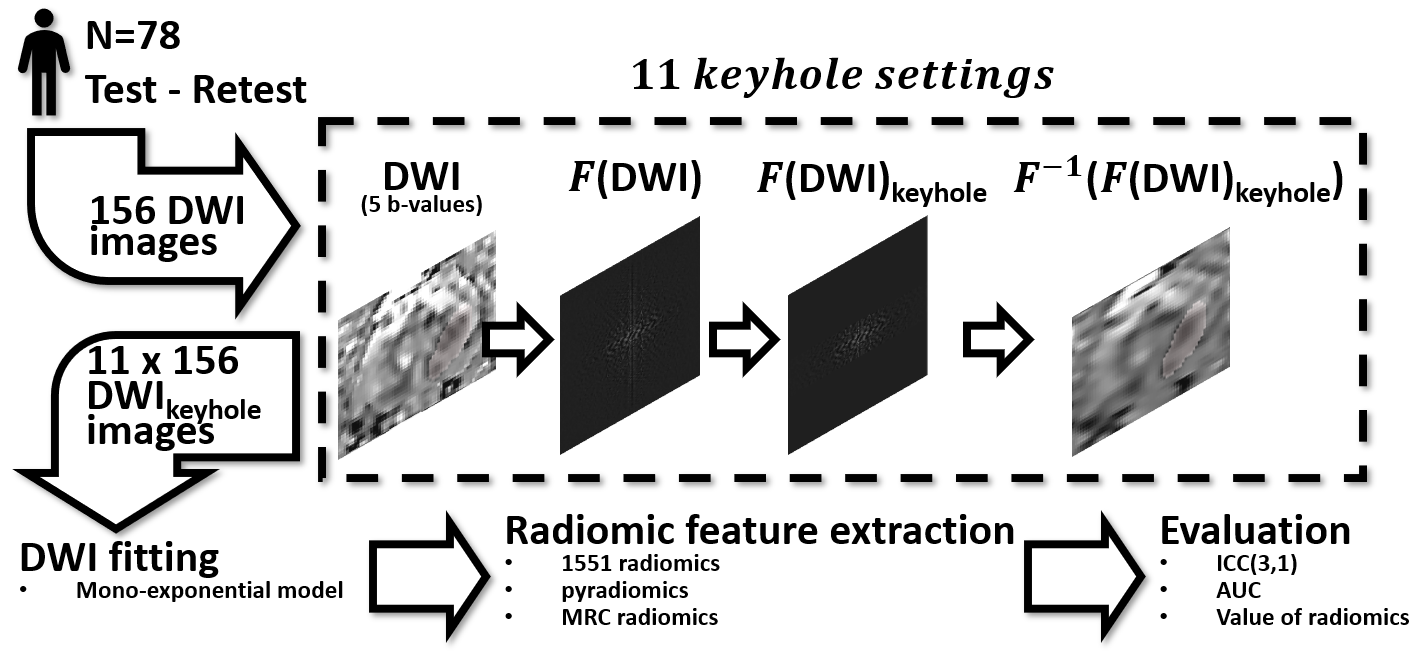
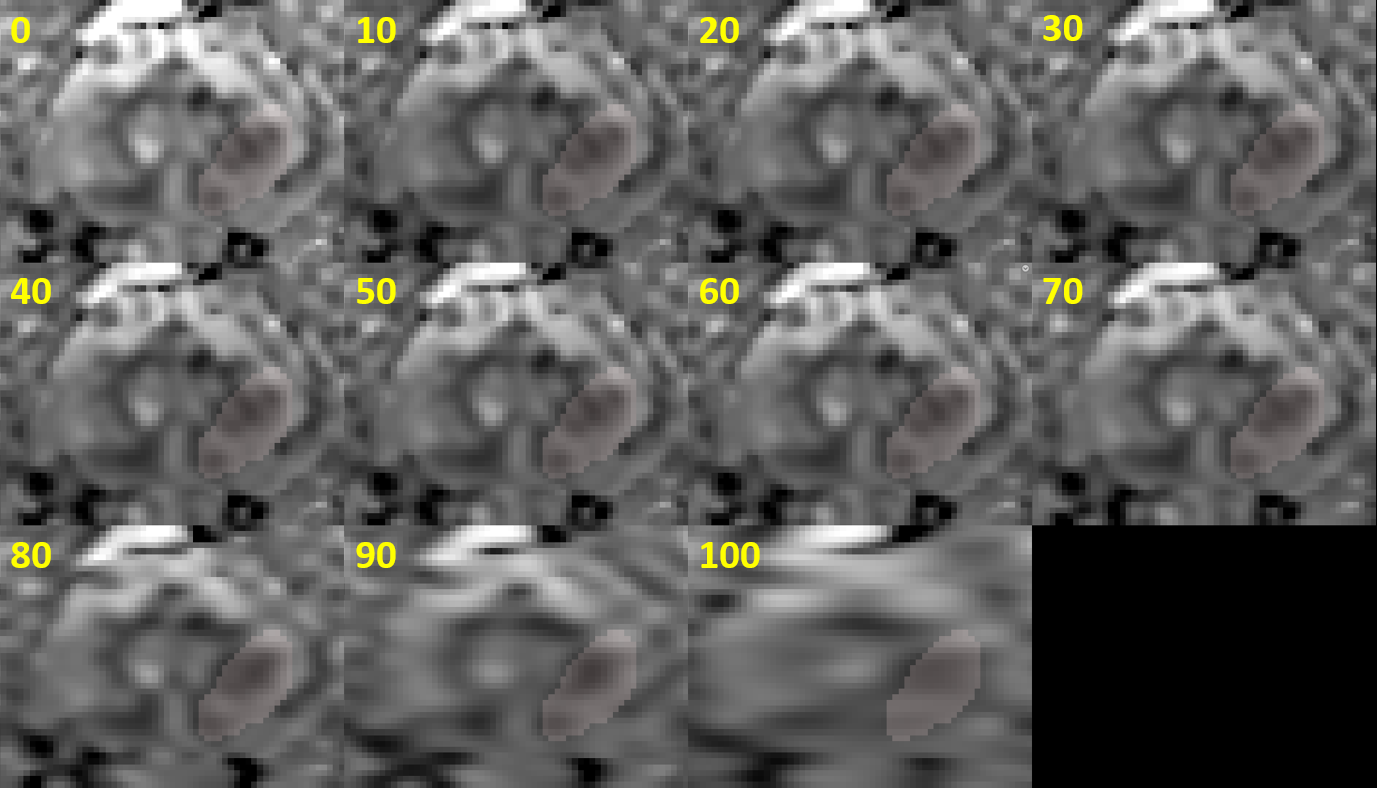
We evaluated DWI dartaset of 78 repeated prostate MRI performed on the same day. The DWI images were acquired using a 3T MR scanner, SE-EPI sequence, monopolar diffusion gradient scheme, TR/TE 3141 ms/51 ms, FOV 250x250 mm2 , acquisition matrix 100x99, reconstruction matrix 224x224, slice thickness 5 mm, 12 b-values of (number of signal averages) 0(2), 100(2), 300(2), 500(2), 700(2), 900(2), 1100(2), 1300(2), 1500(2), 1700(3), 1900(4), 2000(4) s/mm2; diffusion time of 20.3, and acquisition time of 8 min and 29 sec. Prostate cancer lesions were delineated using whole mount prostatectomy sections as the "gold standard".We converted the DWI data to fourier space, and reduced the data in initial 256 size matrix gradually in steps of 10 from the top and bottom until 100 lines were removed from both of them. At each iteration, we fitted mono-exponential model to the DWI data with 5 b-values up to 500 s/mm2 with in-house fitting using 1000 iterations and 5 multiple initializations using GPU with pytorch. We extracted total of 1551 radiomic features using open source pyradiomics and MRCTurku radiomics packages. See Figure 1 for illustration of the study setup, and Figure 2 of an example ADC parameter map.
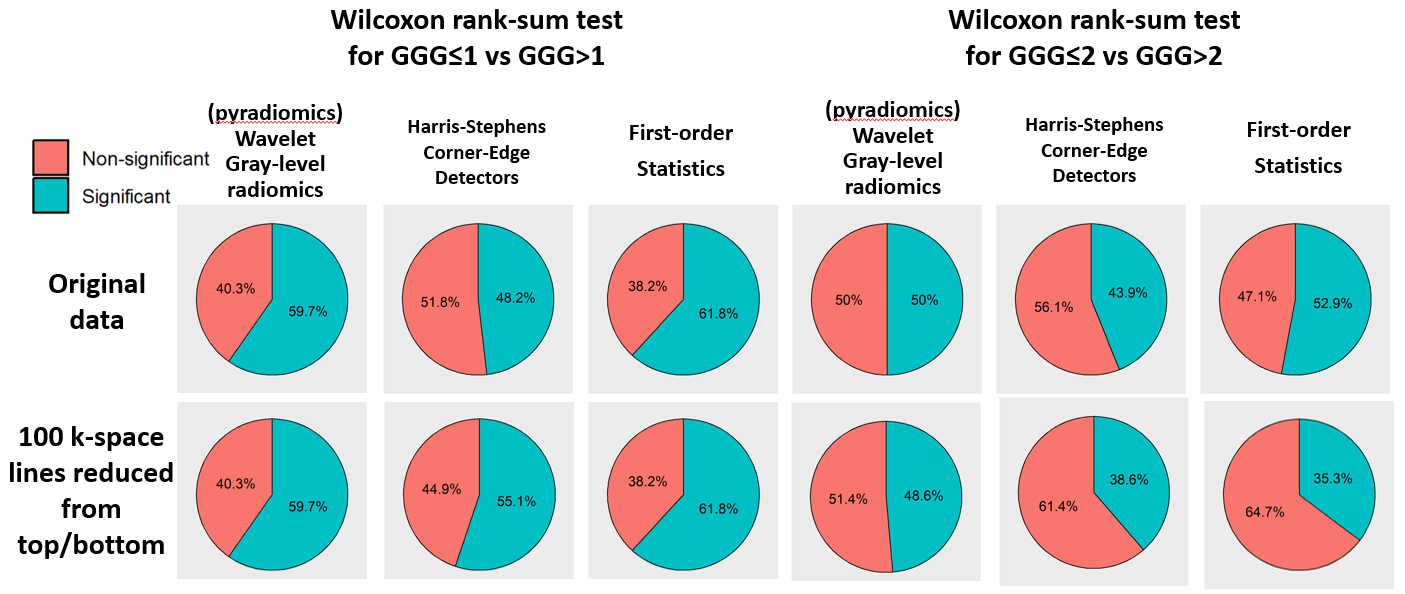
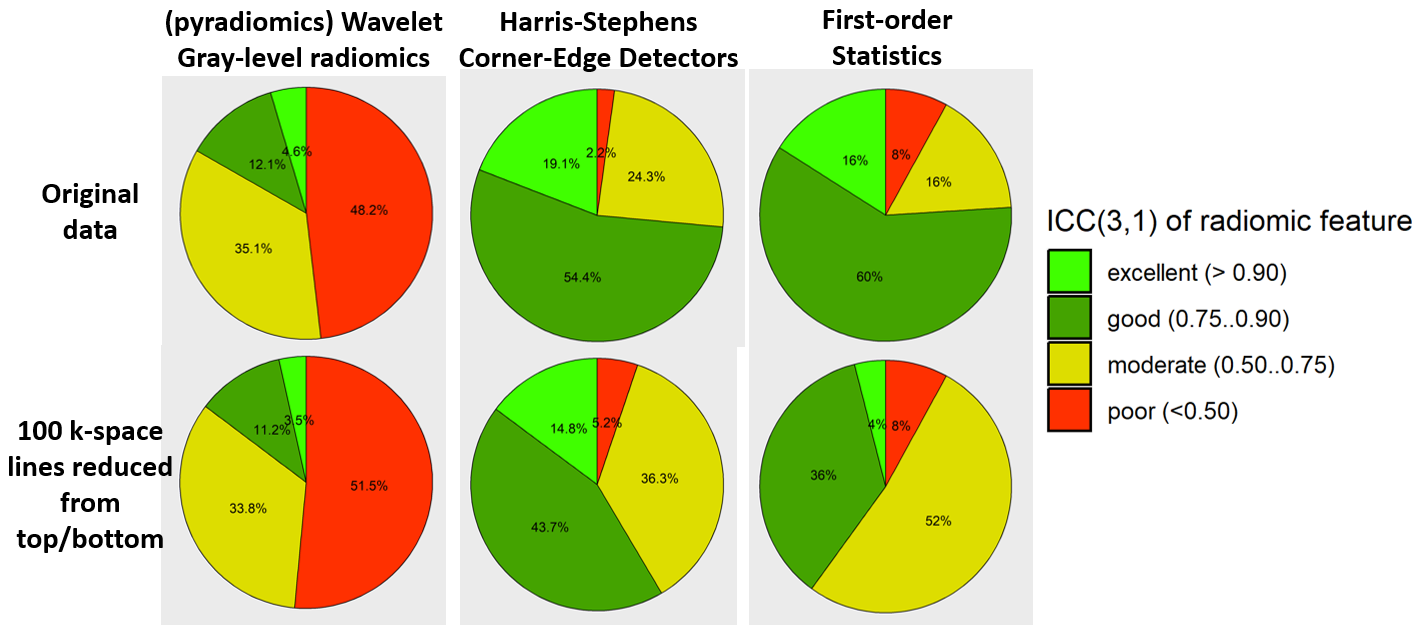
We calculated intra-class correlation coefficient ICC(3,1) for repeatability measurements, and area under receiver operating characteristic curve (AUC) for classification performance evaluations, to see how reduced k-space information would affect the extracted radiomics. We evaluated effect of the simulated k-space reduction to the radiomic feature values, to reliability as measured with ICC(3,1), and to AUC of prostate cancer classification between Gleason Grade Groups (GGG) ≤1 vs >1, and GGG ≤2 vs >2.
Results
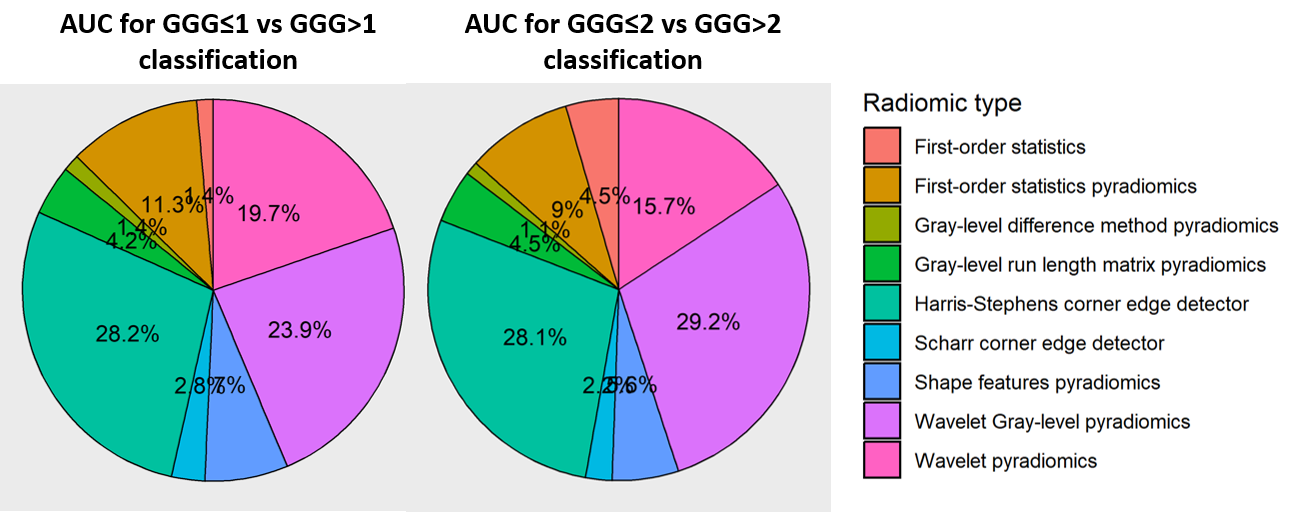
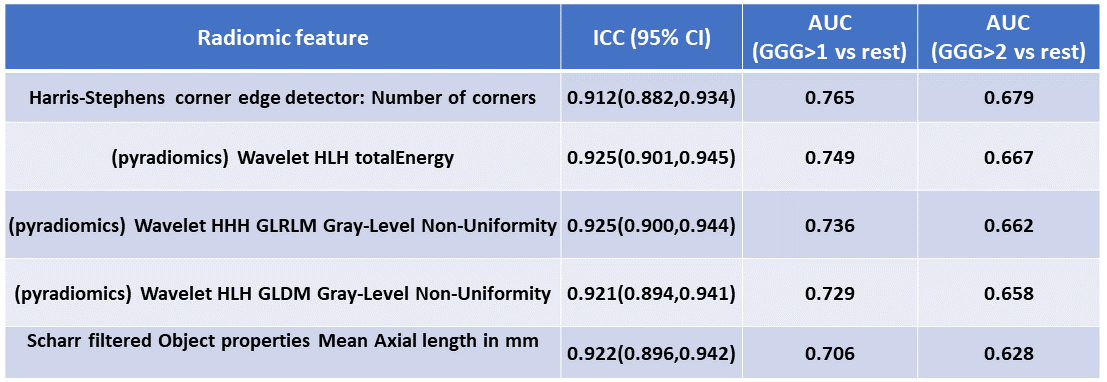
As expected, robustness of specific radiomics allowed reduction of acquired k-space to some extent. There was negligible change in ICC(3,1) and AUC when up to 100 k-space lines were zeroed in best performing radiomics, see Figure 3 for effect in AUC , and Figure 4 for effect in ICC(3,1). In comparison of corner edge detector radiomics and wavelet-based radiomics with conventional first-order statistical descriptors, the overall performance loss with data reduction was similar or better (see Figures 3 and 4). Overall 71 radiomics from total evaluated 1551, were demonstrating good performance after data reduction, with ICC(3,1) being above 0.9 and AUC>0.7 for GGG ≤1 vs >1 classification (see Figure 5). None of the radiomics performed well in terms of classification performance between for GGG ≤2 and >2 when more than 50 lines were removed in the simulations. However, 89 radiomics were having ICC>0.9 and AUC>0.7 when simulating 50 lines of data reduction. The best radiomics with 100 lines data reduction were corner edge detectors and wavelet-based radiomics, see Figure 6.Conclusion
Radiomic techniques of corner edge detectors and wavelets provided superior or non-inferior performance to conventional use of first order statistics in prostate cancer characterization. Radiomics-optimized k-space filing may allow faster reliable MRI image acquisition, and future studies will involve implementation of the radiomics-optimized MRI into body and brain.Acknowledgements
HM was supported by Academy of Finland (#26080983)References
Van Vaals, J.J., Brummer, M.E., Thomas Dixon, W., Tuithof, H.H., Engels, H., Nelson, R.C., Gerety, B.M., Chezmar, J.L. and Den Boer, J.A., 1993. “Keyhole” method for accelerating imaging of contrast agent uptake. Journal of Magnetic Resonance Imaging, 3(4), pp.671-675.
Van Griethuysen, J.J., Fedorov, A., Parmar, C., Hosny, A., Aucoin, N., Narayan, V., Beets-Tan, R.G., Fillion-Robin, J.C., Pieper, S. and Aerts, H.J., 2017. Computational radiomics system to decode the radiographic phenotype. Cancer research, 77(21), pp.e104-e107.
Merisaari, H., Taimen, P., Shiradkar, R., Ettala, O., Pesola, M., Saunavaara, J., Boström, P.J., Madabhushi, A., Aronen, H.J. and Jambor, I., 2020. Repeatability of radiomics and machine learning for DWI: Short‐term repeatability study of 112 patients with prostate cancer. Magnetic resonance in medicine, 83(6), pp.2293-2309.
Koo, T.K. and Li, M.Y., 2016. A guideline of selecting and reporting intraclass correlation coefficients for reliability research. Journal of chiropractic medicine, 15(2), pp.155-163.
Figures