3095
Intratumor and peritumor MRI radiomics features of rectal cancer can predict overall survival after neoadjuvant therapy1Department of Radiology, Hubei Cancer Hospital, Tongji Medical College, Huazhong University of Science and Technology, Wuhan, China, 2Department of Radiology, Wuhan Zhongnan hospital of Wuhan University, Wuhan, China
Synopsis
Keywords: Radiomics, Radiomics, rectal cancer;neoadjuvant therapy;overall survival
Motivation: Use MR radiomics features as a potential factor for predicting overall survival (OS) after neoadjuvant therap in rectal cancer.
Goal(s): To explore the ability of the intratumoral and peritumoral radiomics features to predict the OS.
Approach: A nomogram that combines clinical features, intratumor and peritumor radiomics features from T2WI using Machine Learning to predict OS was developed, validated using the Kaplan-Meier survival curve.
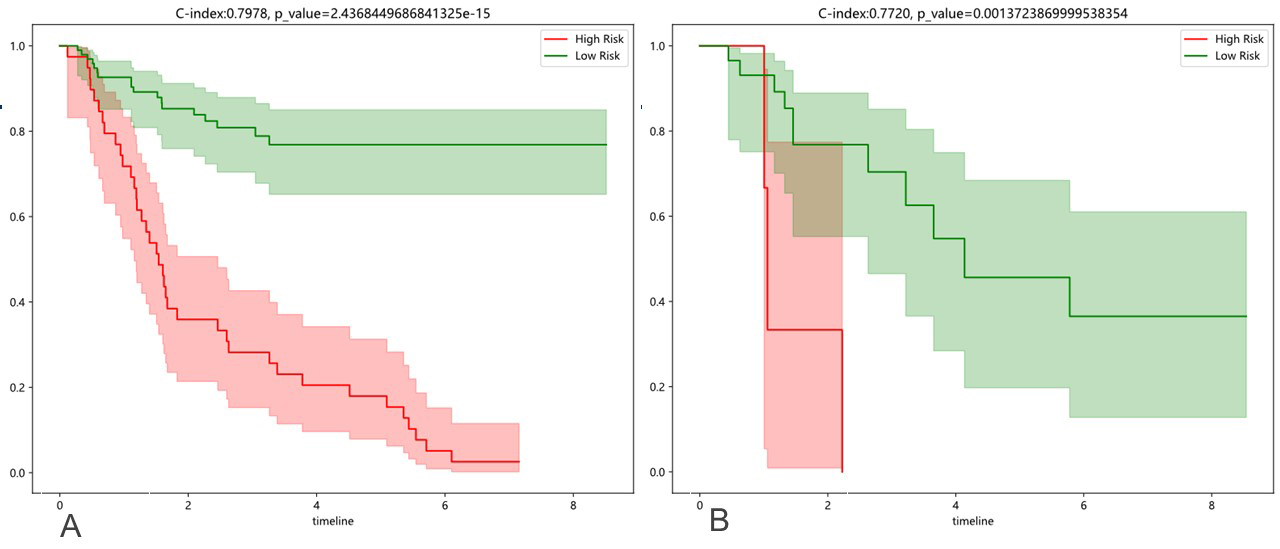
Results: There was a significant statistical difference in the label scores between the high-risk and low-risk groups divided by median survival time as the cutoff value. The C-index of the training and test cohort was 0.798, 0.772 respectively.
Impact: The radiomics model of peritumor radiomics features as the intratumor model can predict the OS in rectal cancer with neoadjuvant therapy. Combined with clinical features and the radiomics model of intratumor radiomics features, high accuracy can be obtained.
neoadjuvant therapy, overall survival, rectal cancer, radiomics
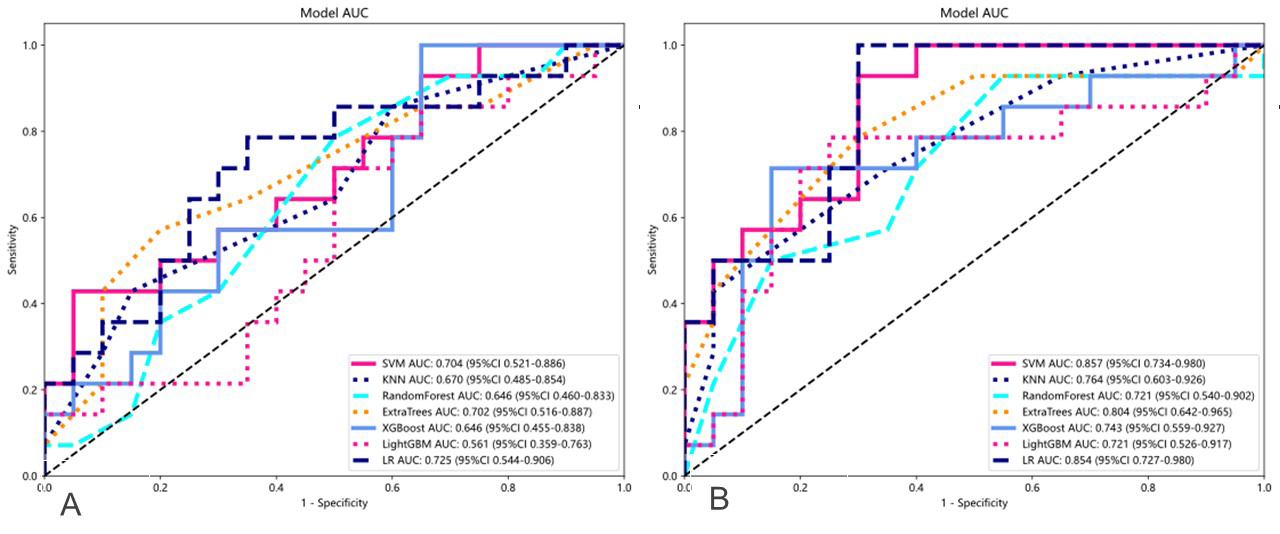
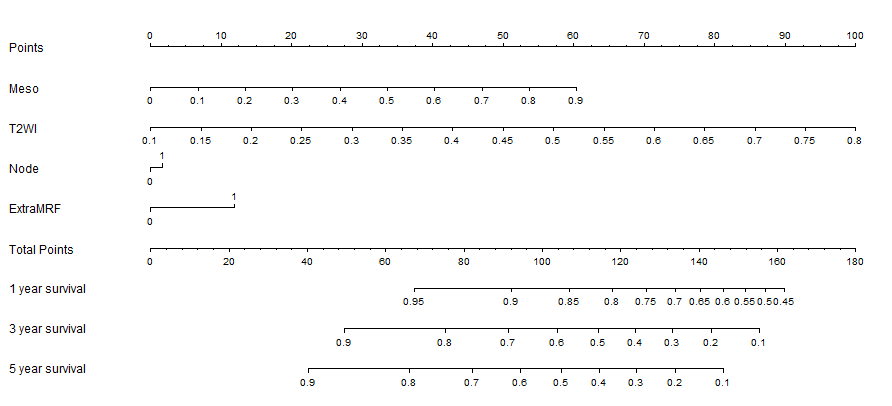
Introduction:Radiomics is a field of medical study that aims to extract a large number of quantitative features from medical images and can help predict clinical or prognostic features, such as treatment response [1], pathologic complete response [2], disease-free survival [3], distant metastasis and OS [4, 5]. However, most radiomics studies focused on the intratumor features, ignoring the peritumoral features. In this study, we hypothesized that the peritumoral features, along with intratumor features, could serve as auxiliary factors to predict OS. Objective: To explore the predictive value of clinical features and extracted intratumor and peritumor radiomics features for overall survival rate (OS) in rectal cancer (RC) after neoadjuvant therapy. Methods: A total of 171 RC patients who underwent radical resection after neoadjuvant therapy from January 2017 to May 2022 were retrospectively collected. Intratumor (ROI-tumor) and peritumor (ROI-Meso) radiomics features from MRI-T2WI were extracted, and the features with good stability (ICC ≥ 0.75) were retained through intra-analysis. Least absolute shrinkage and selection operator(LASSO) was used to select intratumor and peritumor radiomics features related to OS. Different modeling methods were also applied, and the optimal model was selected. Meanwhile, the radiomic scores (Radscores) were obtained by logistic regression analysis. A nomogram that combines clinical features, intratumor and peritumor radiomics features to predict 1- and 3-year OS was developed and then validated using the Kaplan-Meier survival curve. Results: Among the 20 clinical imaging features, only the Node (irregular tumor nodules) and ExtraMRF (metastatic lymph nodes outside the perirectal mesentery) had significant differences (all P <0.05). Twenty-six ROI-tumor features and 20 ROI-Meso features related to OS were extracted. Support Vector Machine (SVM) showed the best efficacy in the intratumor model, with an Area Under Curve (AUC) of 0.948, accuracy of 0.876, sensitivity of 0.821, specificity of 0.913 in the training cohort, and 0.857, 0.794, 0.929, and 0.700 in the test cohort, respectively (Figure 1A). Among the peritumor models, the Logistic Regression (LR) model had the optimal efficacy, with an AUC of 0.866, an accuracy of 0.810, a sensitivity of 0.696, a specificity of 0.889 in the training cohort, and 0.725, 0.706, 0.786, and 0.650 in the corresponding test cohort, respectively (Figure 1B). The comparison of models showed that the intratumor model (T2WI) was superior to the peritumor model (Meso). In the COX regression model, the score of each RC patient was calculated based on the labels composed of four variables: Radscore (ROI-T2WI), Radscore (ROI-Meso), Node, and ExtraMRF (Table 1). A nomogram that combines these feature to predict 1- and 3-year OS was showed as figure 2. There was a significant statistical difference in the label scores obtained between the high-risk and low-risk groups divided by median survival time (969 days vs. 2.655 years) as the cutoff value (Figure 3).The C-index of the training and test cohort obtained was 0.798 and 0.772, respectively (P<0.005). Discussion: This study established a nomogram incorporating Node, ExtraMRF, intratumor, and peritumor MRI radiomics features into risk factors. The nomogram was found to have a strong predictive ability for risk stratification and could be personalized to calculate corresponding scores to obtain the corresponding probability of 1-, 3-yearOS in rectal cancer. This also proves that the peritumor MRI radiomics features can assist in predicting survival. The intratumor and peritumor MRI radiomics features are independent predictive biomarkers that allow for non-invasive risk stratification in RC patients, contributing to early treatment efficacy and survival prediction. For RC, only two studies have verified that the peritumor features can predict the treatment response and tumor recurrence, and one study[6] reported on the prediction of lymph node metastasis in RC showed that the peritumor features extracted from the mesorectal fat could predict the pathological complete response (pCR)(AUC=0.89) and local and distant recurrence (AUC=0.79) in patients with locally advanced rectal cancer(LARC). Similarly, Chen et al.[7] suggested that this method could also predict treatment response (AUC=0.838) in LARC patients.Although we have also extracted the imaging characteristics of the perirectal mesentery, future research should include functional MRI, pathology, and molecular imaging to establish a more comprehensive and stable prediction model. Conclusion:A comprehensive nomogram based on multi-parameter MRI-based features can predict 1, 3-year OS after neoadjuvant therapy for RC. Combined with clinical features, the radiomics model of intratumor and peritumor radiomics features can predict the OS in RC with neoadjuvant therapy.Acknowledgements
This work was supported by the Cancer Research Program of National Cancer Center [grant number NCC201917B05], and the Special Research Fund Project of Biomedical Center of Hubei Cancer Hospital [grant number 2022SWZX06]
Thanks to the Onekey platform.
References
1. Horvat N, Veeraraghavan H, Khan M, et al. MR Imaging of Rectal Cancer: Radiomics Analysis to Assess Treatment Response after Neoadjuvant Therapy. Radiology. 2018;287 (3):833-43. doi: 10.1148/radiol.2018172300. PubMed Central PMCID: PMCPMC5978457.
2. Shin J SN, Baek SE, Son NH, et al. MRI Radiomics Model Predicts Pathologic Complete Response of Rectal Cancer Following Chemoradiotherapy. Radiology. 2022;303 (2):351-8. doi: 10.1148/radiol.211986.
3. Tibermacine H, Rouanet P, Sbarra M, et al. Radiomics modelling in rectal cancer to predict disease-free survival: evaluation of different approaches. British Journal of Surgery. 2021;108 (10):1243-50. doi: 10.1093/bjs/znab191.
4. Liu X, Zhang D, Liu Z, et al. Deep learning radiomics-based prediction of distant metastasis in patients with locally advanced rectal cancer after neoadjuvant chemoradiotherapy: A multicentre study. EBioMedicine. 2021; 69:103442.
5. Li M, Zhu YZ, Zhang YC, et al. Radiomics of rectal cancer for predicting distant metastasis and overall survival. World J Gastroenterol. 2020;26(33):5008-21. doi: 10.3748/wjg.v26.i33.5008. PubMed Central PMCID: PMCPMC7476170.
6.Jayaprakasam VS, Paroder V, Gibbs P, et al. MRI radiomics features of mesorectal fat can predict response to neoadjuvant chemoradiation therapy and tumor recurrence in patients with locally advanced rectal cancer. European Radiology. 2022;32 (2):971-80. doi: https://doi.org/10.1007/ s00330-021-08144-w. PubMed Central PMCID: PMCPMC9018044.
7. Chen BiYun, Xie Hui, Li Yuan,, et al. MRI-Based Radiomics Features to Predict Treatment Response to Neoadjuvant Chemotherapy in Locally Advanced Rectal Cancer: A Single Center, Prospective Study. Frontiers in oncology. 2022;12:801743.
Figures