3072
Optimal, AUC-Derived Coil Combination Coefficients for Hyperpolarized 13C Imaging1Imaging Physics, The University of Texas MD Anderson Cancer Center, Houton, TX, United States, 2The University of Texas MD Anderson Cancer Center UTHealth Graduate School of Biomedical Sciences, Houston, TX, United States, 3Physics, University of Houston, Houston, TX, United States, 4Electrical Engineering, University of Houston, Houton, TX, United States, 5Head and Neck Surgery, The University of Texas MD Anderson Cancer Center, Houton, TX, United States
Synopsis
Keywords: Hyperpolarized MR (Non-Gas), Hyperpolarized MR (Non-Gas), Coil combination, 13C, Pyruvate, optimal combination coefficients
Motivation: B1-maps that are used for optimal combination in array coils are generally unavailable for hyperpolarized (HP) MRI. Alternative methods for determining optimal combination coefficients are needed.
Goal(s): To show that optimal combination coefficients can be derived from area-under-the-curve (AUC) and noise measurements to maximize SNR in HP MR imaging and spectroscopy.
Approach: We derive combination coefficients from AUC and noise covariance measurements, simulate noisy HP 13C-pyruvate and 13C-lactate signals, and analyze the SNR of combined signals using this method compared to sum-of-squares (SoS) combination.
Results: Simulated 13C HP signals that were combined using this approach demonstrated higher SNR compared to the SoS method.
Impact: The optimal combination coefficients for HP 13C in MR imaging and spectroscopy can be derived from AUC and noise covariance measurements. This straightforward method can enhance SNR for HP 13C MRI.
Introduction
In magnetic resonance (MR) imaging and spectroscopy, phased arrays support efficient data acquisition1, high flexibility for large or multiple region-of-interest (ROI), and improved signal-noise-ratio (SNR) in clinical imaging and tumor studies2-5. Receive arrays are also useful in monitoring tumor metabolism using hyperpolarized (HP) 13C-pyruvate by providing dynamic information about HP 13C-pyruvate and its product HP 13C-lactate6-9. However, the coil combination coefficients that can achieve optimal SNR [as previously derived by Roemer3 and Wright4] in HP 13C MR spectra and imaging are unavailable in HP 13C MR spectra and imaging because of the irreversible and time limited nature of HP signals, which lead to difficulties in measuring the B1 sensitivity profile of array coils. Therefore, many efforts have been made to improve SNR in HP 13C MR spectra and imaging9-11. In this work, we show that optimal combination coefficients in HP 13C MR spectra and imaging can be derived from area-under-the-curve (AUC) of HP 13C-pyruvate and 13C-lactate signals and noise covariance measurements acquired from individual coils.Methods
Theory: In MR spectroscopy, the optimal weighting coefficient $$$w$$$ for the coil array4 is:$$[w]=λ_n[R]^{-1}[B_t^*]\tag1$$
Where $$$λ_n=([B_t]^T[R]^{-1}[B_t^*])^{-1/2}$$$ normalizes data to ensure uniform noise, $$$[B_t]$$$ denotes the effective transverse magnetic field and $$$[R]$$$ represents the noise correlation matrix. Here, we propose a method that can achieve optimal combination coefficients using AUC of HP 13C-pyruvate and 13C-lactate signals acquired from each individual coil:
$$[w]=([AUC]^{T}[\sigma^{2}]^{-1}[AUC^{*}])^{-1/2}\cdot[\sigma^{2}]^{-1}[AUC^{*}]\tag2$$
Here, $$$[\sigma^{2}]$$$ represents the noise covariance matrix observed in a signal-free region. The AUC of HP signals at a point in space depends on coil sensitivity and a local, time-varying and tissue-dependent function:
$$AUC_i=\int S_i(r,t)dt=\int f(r,t)B_{t,i}(r)dt=F(r)\cdot B_{t,i}(r)=F\cdot[B_t]\tag3$$
$$$S_i(r,t)$$$ is the HP signal observed by the ith coil at a given point in space. F reflects the integral of HP signal evolution over time at that point in space. The vector of AUCs at that point in space is the product of F, which is observed in common by all coils, and the relative sensitivity of array elements at that point in space. The noise covariance matrix can be measured from a signal-free region of data.
The optimal combination coefficients $$$[w]$$$ for uniform noise then has the form:
$$[w]=([F\cdot[B_t]]^{T}[\sigma^{2}]^{-1}[F\cdot[B_t^{*}]])^{-1/2}\cdot[\sigma^{2}]^{-1}[F\cdot[B_t^{*}]]\tag4$$
Recognizing that $$$[\sigma^{2}]\propto[R]$$$, with simplification, $$$[w]$$$ reduces to a form that is identical to eqn(1).
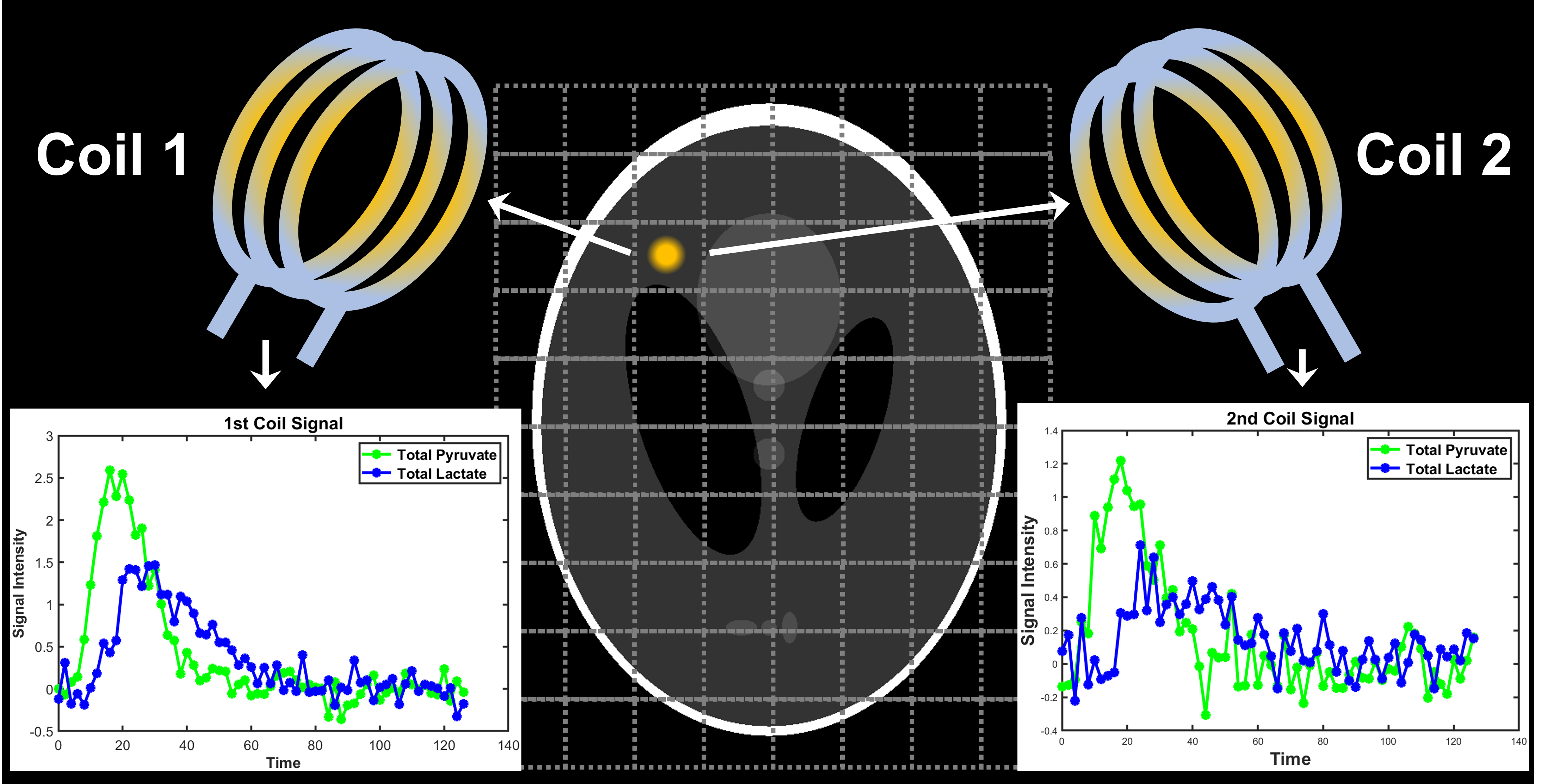
Simulation: Simulation was performed using MATLAB R2023a (The MathWorks Inc., Natick, MA). HP signal evolution of [1-13C]-pyruvate and [1-13C]-lactate were simulated using a pharmacokinetic model with 2 physical compartments and 2 chemical pools7. This simulated HP 13C-pyruvate and lactate evolution represented the signals from the single voxel in MR imaging or spectroscopy (shown in Fig. 1). Individual signals were subsequently captured by two coils with different coil sensitivities (magnitude and phase).
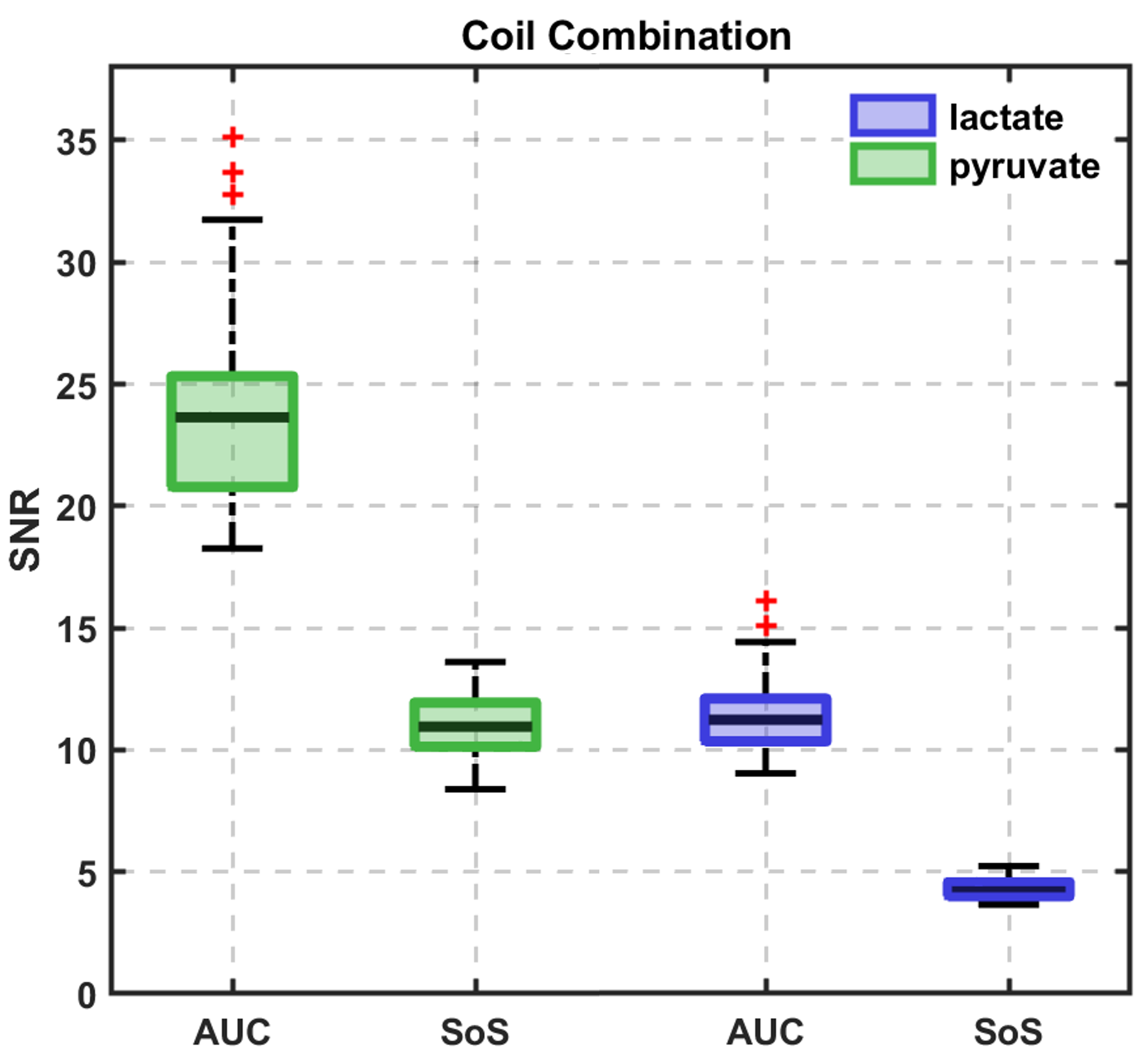
Coil Combination analysis: The simulated HP 13C-pyruvate and lactate signals from two coils were merged using AUC combination coefficients. The SNR of signals after combination were then used to evaluate the performance of AUC combination method. Data was also combined using the sum-of-squares (SoS) method. The distributions of SNR from different combination methods were acquired by repeating each combination 50 times.
Results
The simulated HP 13C-pyruvate signals from two coils were merged using the optimal combination coefficients from the AUC combination method, showing HP 13C-pyruvate SNR at 24.1±3.9, and HP 13C-lactate SNR at 11.6±1.5. These results present an enhancement over the SoS method, where SNR was 11.0±1.3 for HP 13C-pyruvate and 4.3±0.4 for HP 13C-lactate (Fig. 2).Discussion
For combination of signals that are observed through an array of receive coils, the SoS combination method is straightforward but provides suboptimal SNR and eliminates phase information. On the contrary, this proposed AUC combination method provides a way to combine HP signals from different coils using optimal combination coefficients. Simulated HP 13C measurements demonstrate improvements in SNR over SoS combination method. These results suggest that AUC combination method is a feasible approach to coil combination when HP 13C MR imaging and spectroscopy are performed.Conclusion
In this study, we show that optimal coil combination coefficients for HP 13C MR imaging and spectroscopy can be derived from AUC and noise covariance measurements. In simulations, the proposed method demonstrates improved SNR compared to the SoS method.Acknowledgements
This research was supported in part by funding from the National Cancer Institute of the National Institutes of Health (R01CA211150, R01CA280980). The content is solely the responsibility of the authors and does not necessarily represent the official views of the sponsors.References
1. Larkman DJ, Nunes RG. Parallel magnetic resonance imaging. Phys Med Biol. 2007;52(7):R15-55.
2. Rodgers CT, Robson MD. Coil combination for receive array spectroscopy: Are data-driven methods superior to methods using computed field maps? Magn Reson Med. 2016;75(2):473-87.
3. Roemer PB, Edelstein WA, Hayes CE, Souza SP, Mueller OM. The NMR phased array. Magnetic resonance in medicine. 1990;16(2):192-225.
4. Wright SM, Wald LL. Theory and application of array coils in MR spectroscopy. NMR in Biomedicine. 1997;10(8):394-410.
5. Vareth M, Lupo JM, Larson PEZ, Nelson SJ. A comparison of coil combination strategies in 3D multi-channel MRSI reconstruction for patients with brain tumors. NMR in Biomedicine. 2018;31(11):e3929.
6. Ardenkjaer-Larsen JH, Fridlund B, Gram A, Hansson G, Hansson L, Lerche MH, Servin R, Thaning M, Golman K. Increase in signal-to-noise ratio of > 10,000 times in liquid-state NMR. Proc Natl Acad Sci U S A. 2003;100(18):10158-63.
7. Bankson JA, Walker CM, Ramirez MS, Stefan W, Fuentes D, Merritt ME, Lee J, Sandulache VC, Chen Y, Phan L, Chou P-C, Rao A, Yeung S-CJ, Lee M-H, Schellingerhout D, Conrad CA, Malloy C, Sherry AD, Lai SY, Hazle JD. Kinetic Modeling and Constrained Reconstruction of Hyperpolarized [1-13C]-Pyruvate Offers Improved Metabolic Imaging of Tumors. Cancer Research. 2015;75(22):4708-17.
8. Larson PEZ, Chen H-Y, Gordon JW, Korn N, Maidens J, Arcak M, Tang S, Criekinge M, Carvajal L, Mammoli D, Bok R, Aggarwal R, Ferrone M, Slater JB, Nelson SJ, Kurhanewicz J, Vigneron DB. Investigation of analysis methods for hyperpolarized 13C-pyruvate metabolic MRI in prostate cancer patients. NMR in Biomedicine. 2018;31(11):e3997.
9. Zhu Z, Zhu X, Ohliger MA, Tang S, Cao P, Carvajal L, Autry AW, Li Y, Kurhanewicz J, Chang S, Aggarwal R, Munster P, Xu D, Larson PEZ, Vigneron DB, Gordon JW. Coil combination methods for multi-channel hyperpolarized 13C imaging data from human studies. Journal of Magnetic Resonance. 2019;301:73-9.
10. Hansen RB, Sánchez-Heredia JD, Bøgh N, Hansen ESS, Laustsen C, Hanson LG, Ardenkjær-Larsen JH. Coil profile estimation strategies for parallel imaging with hyperpolarized 13C MRI. Magnetic Resonance in Medicine. 2019;82(6):2104-17.
11. Dominguez-Viqueira W, Geraghty BJ, Lau JYC, Robb FJ, Chen AP, Cunningham CH. Intensity correction for multichannel hyperpolarized 13C imaging of the heart. Magnetic Resonance in Medicine. 2016;75(2):859-65.
Figures