3066
Portable polarizer for clinical-scale metabolic MRI of hyperpolarized pyruvate1Max Planck Institute for Multidisciplinary Sciences, Goettingen, Germany, 2Center for Biostructural Imaging of Neurodegeneration, Goettingen, Germany
Synopsis
Keywords: Hyperpolarized MR (Non-Gas), Cancer, clinical application
Motivation: The limited availability and accessibility of cost-effective quantities of 13C-hyperpolarized metabolites, such as pyruvate, acts as a significant barrier to the advancement and practical clinical implementation of metabolic-driven molecular imaging, especially in early-stage cancer detection.
Goal(s): Objective is to develop a portable device capable of delivering sufficient, clinically relevant doses of hyperpolarized pyruvate to support medical applications.
Approach: We employ the Parahydrogen-Induced Polarization with Side Arm Hydrogenation approach, which offers a faster (~1min) and more cost-efficient alternative to the prevailing state-of-the-art technology, dissolution Dynamic Nuclear Polarization.
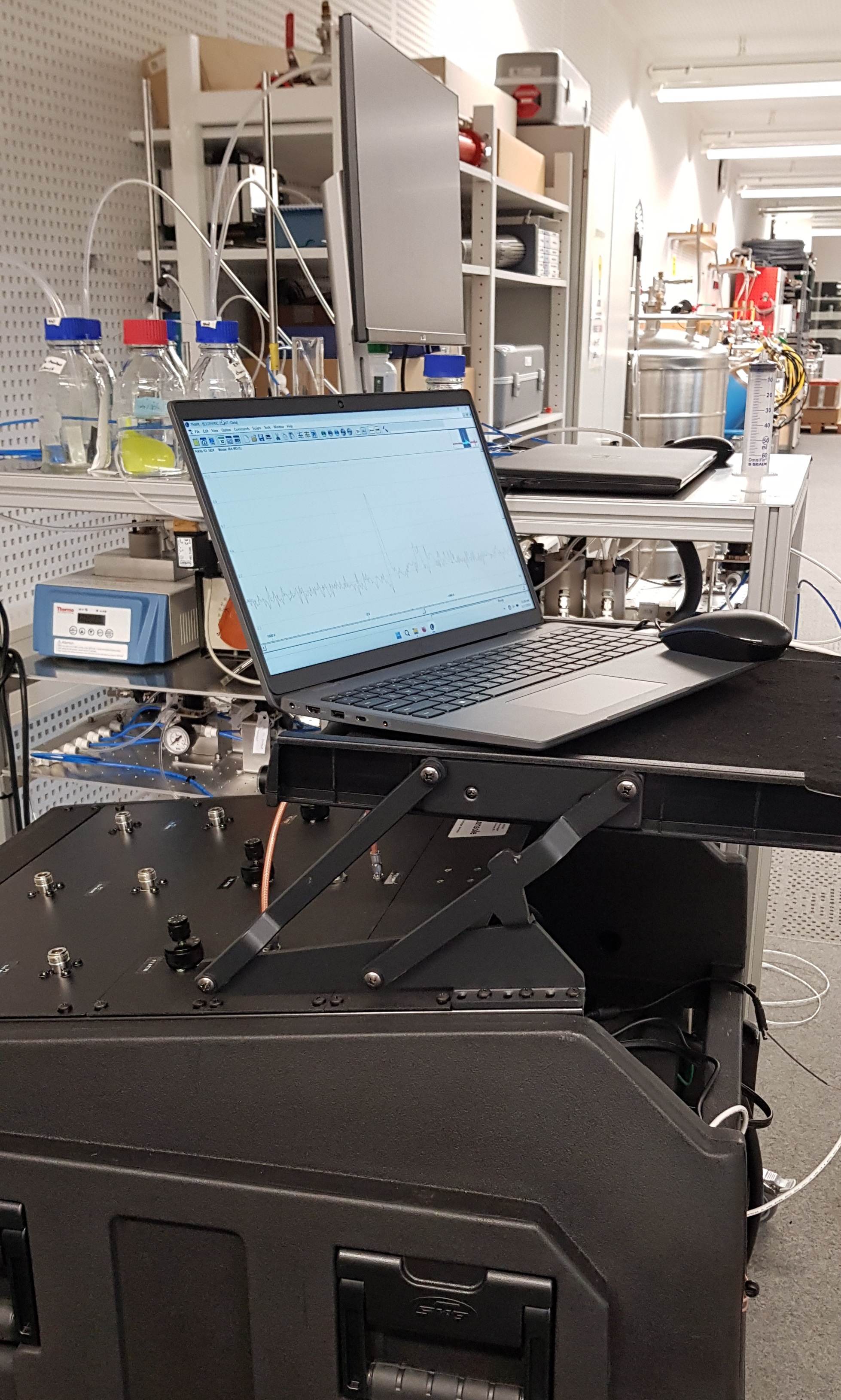
Results: Our polarizer routinely produces a 40ml dose of hyperpolarized 13C-pyruvate-d3, containing a concentration exceeding 100mM.
Impact: Enhancing accessibility to clinically relevant hyperpolarized pyruvate will empower more MR research groups to leverage its potential. This development also paves the way for easier translation to clinical settings, ultimately benefiting cancer patients by supporting early detection and diagnosis capabilities.
INTRODUCTION
Changes in metabolic processes often serve as indicators of pathological alterations within an organism, offering valuable diagnostic insights. Metabolites, when harnessed as biomarkers, could play a pivotal role in magnetic resonance imaging (MRI). However, increasing sensitivity is imperative, particularly when detecting trace concentrations, especially of 13C nuclei. Hyperpolarization stands out as a potent method to overcome the inherent limitations of nuclear magnetic resonance (NMR) sensitivity, effectively amplifying signals by several thousand-fold. This advancement enables the real-time detection of metabolic reactions in MRI, facilitating the tracking of dynamic metabolic changes, such as those in potential tumors, in vivo1,2. For human applications, substantial quantities of injectable doses, often on the order of tens of milliliters, are essential. Dissolution Dynamic Nuclear Polarization (d-DNP) has emerged as the gold standard for enhancing the sensitivity of numerous metabolites, with pyruvate being a prominent example. However, its integration into clinical practice has been hindered by the considerable expenses, labor-intensive processes, and substantial infrastructure investments required. These impediments not only hinder the translation of these advancements into clinical settings but also hamper progress in the field of research. An alternative approach involves the hyperpolarization of metabolites using parahydrogen which effectively addresses cost-related challenges, the demand for a fast production of hyperpolarized contrast agents and provide substantial polarization3. In this study, we present the achievement of pyruvate hyperpolarization in a 40-ml dose of injection buffer, marking a significant advancement in the field.METHODS
An automated polarizer was designed to yield signal-enhanced pyruvate in a clean aqueous solution. To achieve this, we successfully generated 13C hyperpolarized 1-13C-pyruvate-d3 through the application of the MINERVA (Maximizing Insensitive Nuclei Enhancement Reached Via para-hydrogen Amplification) protocol3. The process commences with the hydrogenation of vinyl pyruvate on a rhodium catalyst within an acetone medium, employing para-enriched hydrogen, which results in the production of 1H-polarized ethyl pyruvate. In the subsequent step, the nuclear polarization is transferred to the carbon nucleus through the utilization of an MINERVA pulse sequence within the confines of the polarizer magnet3,4. Subsequently, an alkaline solution is introduced to dissociate free pyruvate from the ethyl group. Concurrently, the organic solvent is removed through evaporation, leaving only an aqueous medium. The alkaline environment is neutralized through the incorporation of an acidic buffer. This series of steps is a side arm hydrogenation approach (PHIP-SAH)5. Finally, the catalyst is eliminated by filtering the solution through a sterile filter.RESULTS
The polarizer yields hypeprolarized 1-13C-pyruvate-d3 and provides a high concentration that was assessed using an external commercial spectrometer and compared to a standard reference sample. The ultimate concentration of pyruvate can be varied based on the initial content of vinyl pyruvate. Through the processes of bond cleavage and catalyst filtration, the result is a pure aqueous and biocompatible solution.DISCUSSION
The combined utilization of parahydrogen-induced signal enhancement and metabolic imaging has been demonstrated as an effective means to characterize tumor metabolism4. The application of 13C hyperpolarized metabolites in human studies spans a broad range, encompassing both general metabolic assessments6 and the investigation of specific diseases using various metabolites as biosensors2,7. The potential repertoire of biomarkers that can be hyperpolarized using parahydrogen is extensive. As a result, the MINERVA approach can be extended to encompass other metabolites, thereby facilitating research into a diverse array of disease models, including those currently explored through d-DNP.CONCLUSION
In this work, we introduce a pioneering polarizer capable of generating ample quantities of highly polarized pyruvate within a clear buffer solution. The dosage parameters align closely with those established by d-DNP, meeting the prerequisites for clinical human applications2,7. However, our polarizer operates with significantly enhanced speed and markedly reduced device and infrastructure costs, by an order of magnitude. Its compact footprint allows for convenient placement adjacent to existing MRI machines. Moreover, the polarization process has been automated, rendering it readily applicable in medical settings. The primary cost component for a single experiment resides in the dose of the specialized precursor molecule. We have successfully demonstrated the synthesis of small quantities3, with ongoing efforts to scale up precursor production. This development opens up new prospects for conducting in vivo clinical studies and medical imaging on human subjects in a multitude of healthcare facilities beyond the current scope.Acknowledgements
We gratefully acknowledge the financial support provided by the Else Kröner-Fresenius-Foundation Translational Research (EKSF ForTra gGmbH) for this projectReferences
1. Hesketh, R. L.; Brindle, K. M. Magnetic resonance imaging of cancer metabolism with hyperpolarized 13C-labeled cell metabolites. Curr. Opin. Chem. Biol. 2018;45:187.
2. Kurhanewicz, J., et al. Hyperpolarized 13C MRI: path to clinical translation in oncology. Neoplasia 2019;21:1.
3. Ding, Y., et al. Rapidly Signal‐enhanced Metabolites for Atomic Scale Monitoring of Living Cells with Magnetic Resonance. Chemistry‐Methods 2022;e202200023.
4. Hune, T., et al. Metabolic Tumor Imaging with Rapidly Signal‐Enhanced 1‐13C‐Pyruvate‐d3. Chemphyschem 2022:e202200615.
5. Reineri, F., et al. ParaHydrogen Induced Polarization of 13C carboxylate resonance in acetate and pyruvate. Nature Communications 2015;6:5858.
6. Grist, J. T., et al. Quantifying normal human brain metabolism using hyperpolarized [1–13C]pyruvate and magnetic resonance imaging. Neuroimage 2019;189:171.
7. Vaeggemose, M., et al. Comprehensive literature review of hyperpolarized Carbon-13 MRI: the road to clinical application. Metabolites 2021;11:219.
Figures