3061
Molecular Profiling Distinguishes HCC Metabotypes Identified on Hyperpolarized 1-13C Pyruvate Magnetic Resonance Spectroscopy1Department of Bioengineering, University of Pennsylvania, Philadelphia, PA, United States, 2Department of Radiology, University of Pennsylvania, Philadelphia, PA, United States, 3Bioengineering, University of Pennsylvania, Philadelphia, PA, United States, 4Department of Chemical Engineering, University of Pennsylvania, Philadelphia, PA, United States, 5Department of Radiology. Department of Cancer Biology, University of Pennsylvania, Philadelphia, PA, United States
Synopsis
Keywords: Hyperpolarized MR (Non-Gas), Hyperpolarized MR (Non-Gas), Hepatocellular Carcinoma, Kinetic Modeling
Motivation: While hyperpolarized 1-13C Pyruvate Magnetic Resonance Spectroscopy holds great promise for in vivo profiling of cellular metabolism, the molecular alterations underlying the observed metabolic phenotypes (metabotypes) remain understudied.
Goal(s): We sought to characterize the molecular features contributing to the metabotypes identified on Hyperpolarized 1-13C Pyruvate MRS in hepatocellular carcinoma (HCC).
Approach: We integrated transcriptomic and proteomic profiling together with hyperpolarized 1-13C Pyruvate MRS of HCC patient-derived xenografts (PDX) that recapitulate the diversity of gene and protein expression observed in patients.
Results: Our data suggest that hyperpolarized 1-13C Pyruvate MRS distinguishes HCC metabotypes based on MCT4 expression.
Impact: By applying clinically relevant PDX models of HCC harboring naturally occurring variability in expression of metabolic enzymes and transporters, our data provide critical insights into the interpretation of hyperpolarized 1-13C Pyruvate MRS during clinical translation.
Introduction
Hyperpolarized-13C-Magnetic Resonance Spectroscopy (HP-13C-MRS) is a unique molecular imaging modality that enables sensitive, real-time, non-invasive measurements of metabolic flux. Several preclinical and clinical studies have demonstrated the utility of this technology for probing metabolism using HP [ 1-13C] Pyruvate, as pyruvate lies at the intersection of multiple metabolic pathways1. While this technology holds great promise for characterizing cellular metabolism based on the fate of HP [1-13C] pyruvate, the molecular alterations underlying the observed metabolic phenotypes (metabotypes) remain understudied. Herein, we integrate transcriptomic and proteomic profiling together with HP [1-13C] Pyruvate MRS to characterize factors contributing to the observed metabotypes in clinically relevant patient-derived xenografts (PDX) of hepatocellular carcinoma (HCC).Methods
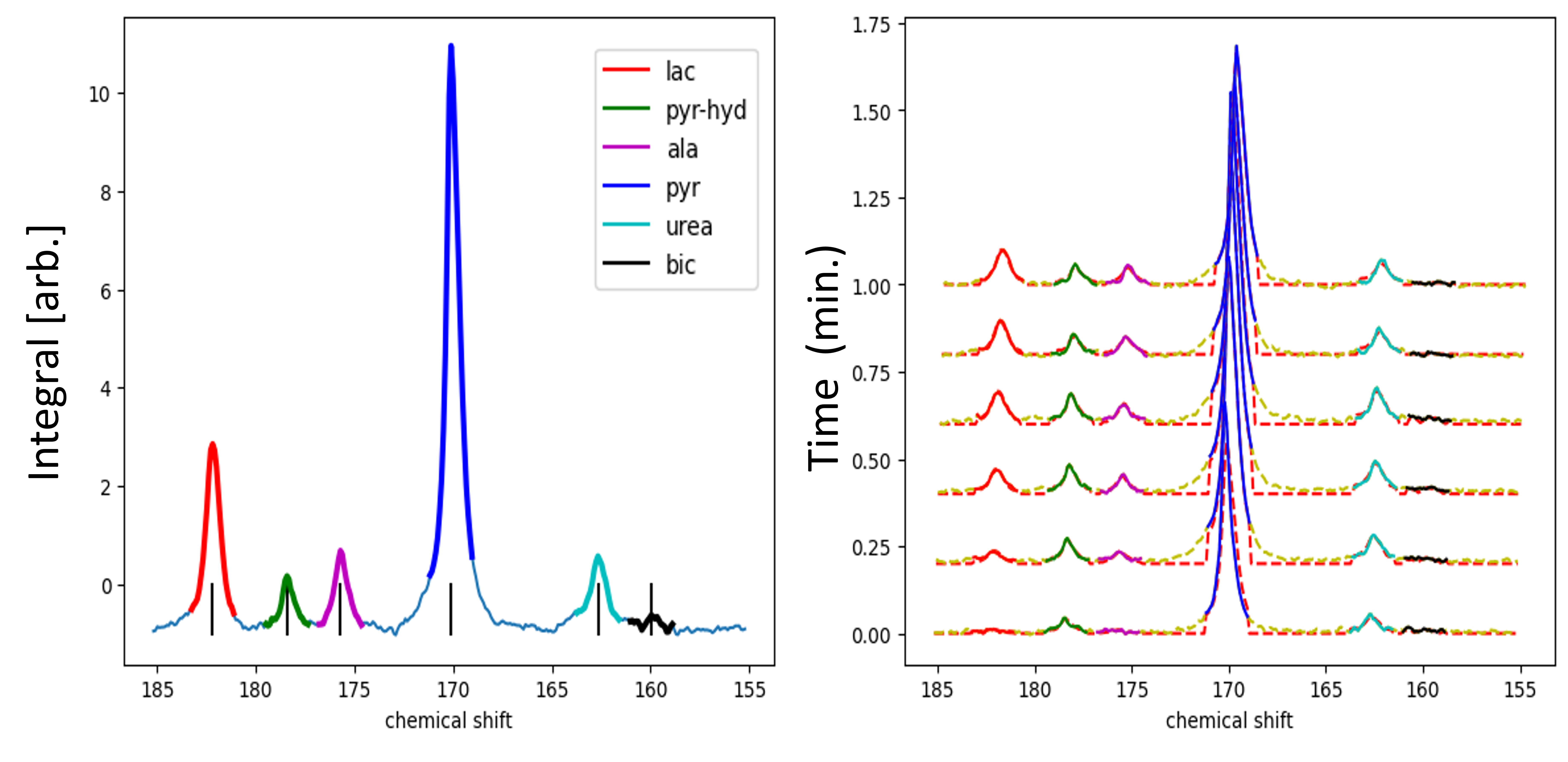
Tumor tissue from HCC PDXs was implanted into the flanks of nude mice. 1-13C Pyruvic Acid and 13C Urea were co-polarized in a HyperSense DNP polarizer (Oxford Instruments) and dissolution was performed with a Trizma buffer to yield a final concentration, pH, and osmolality of 80mM/64mM Pyruvate/Urea, 7.4, and 300 mOsm, respectively. Mice received a bolus injection of the hyperpolarized substrates via the tail vein (6.7mL/kg) and 13C-MRS was performed in either a 4.7T or 7T MR scanner with a custom-built, two-turn solenoid] 13C coil encompassing the tumor. Spectra were acquired every 2s for 3 minutes using a spatially non-selective spectroscopy sequence with a 20o flip angle and the peaks for each metabolite were integrated over the entire period for which any spectral features were discernable. RNA sequencing and proteomics were performed to quantify the expression levels of relevant genes and proteins. The total HP [1-13C] Pyruvate-to-[1-13C] Lactate and HP [1-13C] Pyruvate-to-[1-13C] Alanine conversion rates were calculated as described in Rao et al2. Correlations between the conversion rates and RNA/protein expression were assessed using the Pearson test.Results
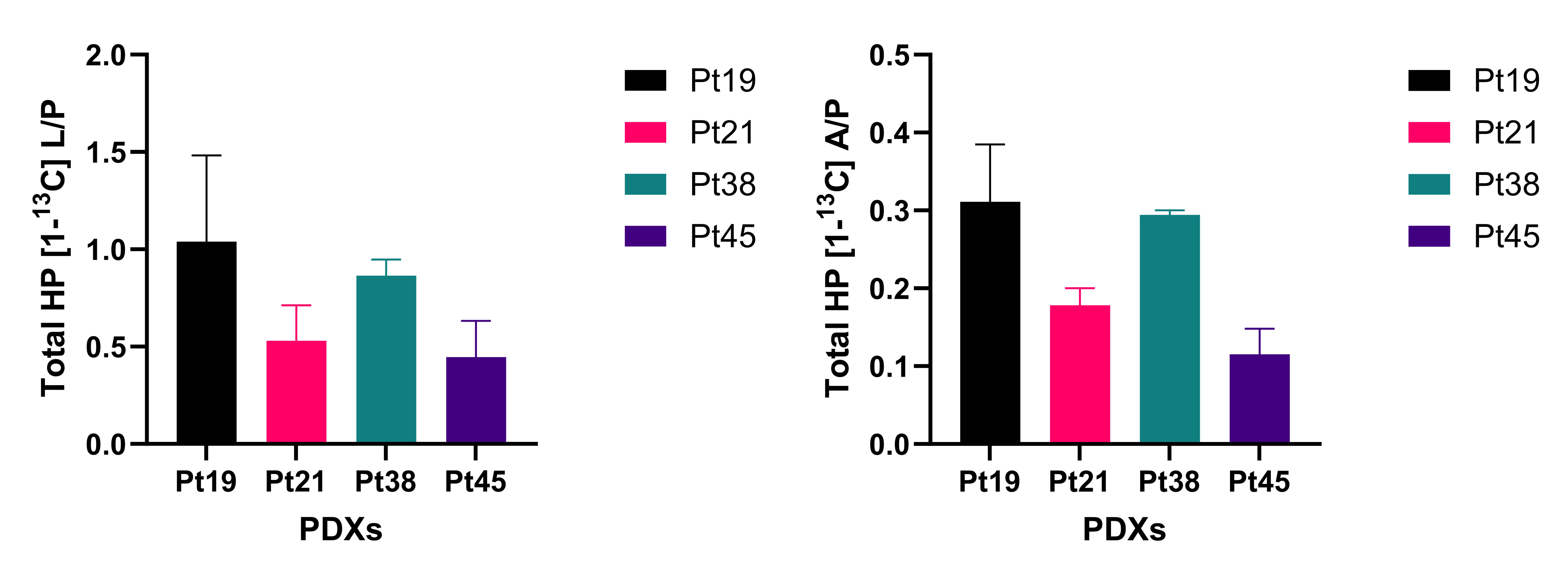
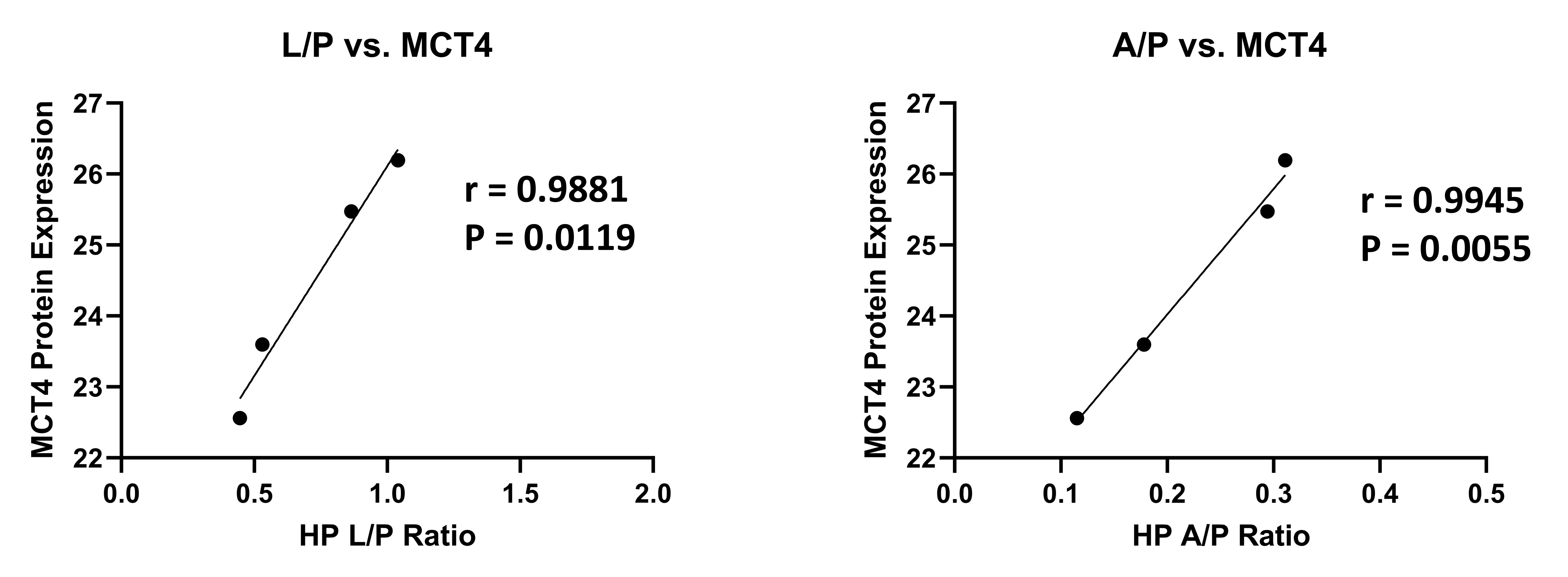
HP [1-13C] Pyruvate MRS in 4 HCC PDX lines [Pt19 (n=3), Pt21 (n=2), Pt38 (n=2), Pt45 (n=2)] revealed a strongly positive and statistically significant correlation between the total HP [1-13C] Lactate-to-Pyruvate ratios (L/P) and Monocarboxylate transporter 4 (MCT4) protein expression (r = 0.9881, P = 0.0119; Fig. 3). Additionally, we observed a similar trend with respect to alanine metabolism: The HP [1-13C] Alanine-to-Pyruvate ratios (A/P) strongly correlated with MCT4 protein expression levels (r = 0.9945, P = 0.0055; Fig. 3).Furthermore, we observed that the L/P and A/P ratios correlated negatively but not significantly with Monocarboxylate Transporter 1 (MCT1) mRNA expression and poorly with MCT1 protein expression. Similarly, the L/P ratio correlated poorly with Lactate Dehydrogenase A (LDHA) mRNA and protein expression. The A/P ratio showed a non-significant negative correlation with Glutamine Pyruvate Transaminase (GPT1 and GPT2) mRNA and protein expression levels.
Discussion
Contradictory reports of the molecular source of the signal observed on HP [1-13C] pyruvate imaging have been published in recent years. While some studies attribute elevated HP [1-13C] Pyruvate-to-Lactate conversion rates in aggressive tumors to increased LDHA activity and glycolytic flux, others have demonstrated that the conversion rate is critically rate-limited by MCT1, independent of LDHA activity2. However, most of these studies were performed on cell lines in vitro and utilized genetically engineered tumor models which may not recapitulate patient biology.Herein, we sought to characterize the molecular factors contributing to the metabotypes observed on hyperpolarized 1-13C Pyruvate MRS in HCC PDX models that recapitulate the natural diversity of gene and protein expression observed in patients. Our data demonstrated that the HP [1-13C] Pyruvate-to-Lactate and the HP [1-13C] Pyruvate-to-Alanine conversion rates correlated strongly with protein expression levels of Monocarboxylate Transporter 4 (MCT4), the transporter that predominantly mediates lactate transmembrane efflux3. Contrary to prior studies, we observed no correlation between L/P and MCT1, the transporter that primarily mediates pyruvate transmembrane influx, and LDHA, the enzyme that catalyzes the conversion of pyruvate to lactate; however, we are unable to rule out a mechanistic dependence on these factors due to a limited number of samples and replicates. Future work will include more data points and additional PDX lines as well as mechanistic studies and kinetic modeling.
Conclusion
Our data indicates that in vivo HP 1-13C Pyruvate MRS distinguishes HCC metabotypes based on MCT4 protein expression levels, potentially providing a noninvasive functional assessment of this transporter as a clinical biomarker in HCC patients. By applying clinically relevant PDX models of HCC harboring naturally occurring variability in expression of metabolic enzymes and transporters, our data provides critical insights into the interpretation of hyperpolarized 1-13C Pyruvate MRS that are essential for clinical translation.Acknowledgements
The authors acknowledge Dr. Steven Pickup for his assistance with MRI experiments.References
1. Wang ZJ, Ohliger MA, Larson PEZ, Gordon JW, Bok RA, Slater J, Villanueva-Meyer JE, Hess CP, Kurhanewicz J, Vigneron DB. Hyperpolarized 13C MRI: State of the Art and Future Directions. Radiology. 2019 May;291(2):273-284. doi: 10.1148/radiol.2019182391. Epub 2019 Mar 5. PMID: 30835184; PMCID: PMC6490043.
2. Rao Y, Gammon S, Zacharias NM, Liu T, Salzillo T, Xi Y, Wang J, Bhattacharya P, Piwnica-Worms D. Hyperpolarized [1-13C]pyruvate-to-[1-13C]lactate conversion is rate-limited by monocarboxylate transporter-1 in the plasma membrane. Proc Natl Acad Sci U S A. 2020 Sep 8;117(36):22378-22389. doi: 10.1073/pnas.2003537117. Epub 2020 Aug 24. PMID: 32839325; PMCID: PMC7486767.
3. Kroemer G, Pouyssegur J. Tumor cell metabolism: cancer's Achilles' heel. Cancer Cell. 2008 Jun;13(6):472-82. doi: 10.1016/j.ccr.2008.05.005. PMID: 18538731.
Figures