3039
Optimizing spoiling characteristics for gas-phase hyperpolarized 129Xe transmit RF calibration1Medical Physics, Duke University, Durham, NC, United States, 2Radiology, Duke University, Durham, NC, United States, 3Radiology, University of Virginia, Charlottesville, VA, United States
Synopsis
Keywords: Hyperpolarized MR (Gas), Hyperpolarized MR (Gas)
Motivation: Manufacturer-supplied transmitter calibrations are unsuitable for 129Xe MRI due to the transient nature of its magnetization, but existing 129Xe calibration protocols exhibit incomplete spoiling that adversely affects accuracy in flip angle measurements.
Goal(s): We sought to develop a new spoiling-gradient configuration for 129Xe MRI transmit calibration that corrects the incomplete spoiling and improves accuracy.
Approach: Spoiling configurations were simulated, tested, and optimized in a water phantom. The optimal configuration was tested in subjects who underwent 129Xe MRI with both calibration schemes.
Results: A configuration that increases spoiling-gradient moment with each FID corrected the incomplete spoiling and improved the accuracy of flip angle measurements.
Impact: Implementing a 129Xe MRI transmit calibration that increases spoiling-gradient moment with each FID acquisition improves accuracy in flip angle calculations, thereby ensuring consistently optimal image quality for all subjects and advancing the clinical utility of 129Xe MRI.
Introduction
During an MRI examination, individual subject characteristics may significantly affect the transmit gain (transmit reference voltage) necessary to achieve the desired flip angle. Given the contribution of flip angle to SNR, accurate transmit calibration prior to each exam is essential for ensuring optimal image quality. However, the hyperpolarized nature of 129Xe gas results in irreversible losses of magnetization with each RF excitation. Therefore, manufacturer-supplied adjustment routines, which are optimized for proton MRI, are not well suited for 129Xe MRI. The 129Xe MRI Clinical Trials Consortium (XCTC) has made recommendations for suitable adjustment procedures1. In particular, the recommended transmitter adjustment procedure collects 20 gas-phase FIDs (each including excitation and acquisition, followed by a constant spoiling moment of at least 15 mT/m-ms on each axis), which are subsequently fit to a mono-exponential decay to estimate the flip angle. Using the XCTC-recommended transmitter calibration (with a spoiling moment of 24 mT/m-ms on each axis), we have observed that, while in some subjects the transmitter calibration data is well fit by a mono-exponential decay, in others, the signal decay is clearly not mono-exponential (Figure 1). We hypothesize that non-mono-exponential behavior is due to incomplete spoiling of residual transverse magnetization between FID acquisitions. The purpose of this work was to investigate the spoiling behavior of the XCTC-recommended transmitter calibration with the goal of improving the consistency and accuracy of transmitter calibration results.Methods
The evolution of transverse magnetization during the 20-FID transmitter calibration acquisition was simulated using the Bloch equations to evaluate the effects of different spoiling-gradient configurations. To account for incomplete spoiling of residual transverse magnetization, emphasis was placed on testing configurations that increased the spoiling-gradient moment with each FID acquisition. A scheme predicted to perform well in simulation was first tested experimentally on a water phantom, since its much longer T2 makes achieving adequate spoiling more challenging than in 129Xe gas. Finally, this spoiling scheme was tested in human subjects (n=3) undergoing hyperpolarized 129Xe MRI, who also had prior examinations using the XCTC-recommended transmitter calibration. For each subject, the results of the calibration with the new spoiling scheme were compared to the results of their prior calibration with XCTC recommendations. Improvements in accuracy were quantified using the flip angle uncertainty, calculated based on confidence intervals on the angular component of the decay fit function.Results
Using the standard configuration, with constant spoiler-gradient moments, both simulated (Figure 2, left) and experimental (Figure 3, left) water phantom calibration data showed very poor agreement with the mono-exponential fit function. A spoiling-gradient configuration that yielded good calibration accuracy in both the water phantom simulation and experiments was given by: $$grad_n=grad_1*(1+x)^{FID_n-1},$$ where gradn refers to the nth spoiling gradient magnitude, FIDn refers to the nth FID acquisition, and x is a parameter set by the user, which quantifies the percent increase in magnitude (and hence moment) of each subsequent spoiling gradient. Setting x to 0.01 (1%) for the modified spoiling scheme yielded good agreement with the mono-exponential fit in both simulated (Figure 2, right) and experimental (Figure 3, right) water phantom calibrations, while requiring an acceptable maximum gradient moment. These results suggested that, if the problem in subject calibration data was incomplete spoiling, as hypothesized, the new spoiling-gradient configuration should correct it.When the modified spoiling scheme was tested on returning subjects, all calibration fits improved, reducing the average uncertainty in the estimated flip angle by 74.4% (Figure 4). Furthermore, in this cohort, we observed notable differences in the true reference voltages computed using each calibration spoiling scheme, with an average magnitude change of 8.7% (Figure 4). Thus, the calibration results were markedly different between spoiling schemes, and markedly improved with the modified scheme.
Discussion
During pre-scan RF calibration for 129Xe MRI, constant spoiler-gradient moments often yield poor agreement of calibration data to mono-exponential fits, due to incomplete spoiling of residual transverse magnetization between FID acquisitions. Through simulation and experimentation in a water phantom, we found a configuration which increases spoiler-gradient moment with each FID acquisition, correcting for incomplete spoiling. When this configuration was applied to returning subjects, who previously underwent RF calibration using the standard configuration, we observed notable differences in the computed reference voltages between configurations and saw large reductions in flip angle uncertainty. These results indicate that the standard configuration generates incomplete spoiling, as hypothesized, while the modified spoiling scheme offers a means of correcting for this problem and improving accuracy in RF calibration for 129Xe MRI.Acknowledgements
R01HL105643, R01HL153872, Polarean ImagingReferences
- Niedbalski PJ, Hall CS, Castro M, Eddy RL, Rayment JH, Svenningsen S, Parraga G, Zanette B, Santyr GE, Thomen RP, Stewart NJ, Collier GJ, Chan HF, Wild JM, Fain SB, Miller GW, Mata JF, Mugler JP 3rd, Driehuys B, Willmering MM, Cleveland ZI, Woods JC. Protocols for multi-site trials using hyperpolarized 129 Xe MRI for imaging of ventilation, alveolar-airspace size, and gas exchange: A position paper from the 129 Xe MRI clinical trials consortium. Magn Reson Med. 2021 Dec;86(6):2966-2986.
Figures
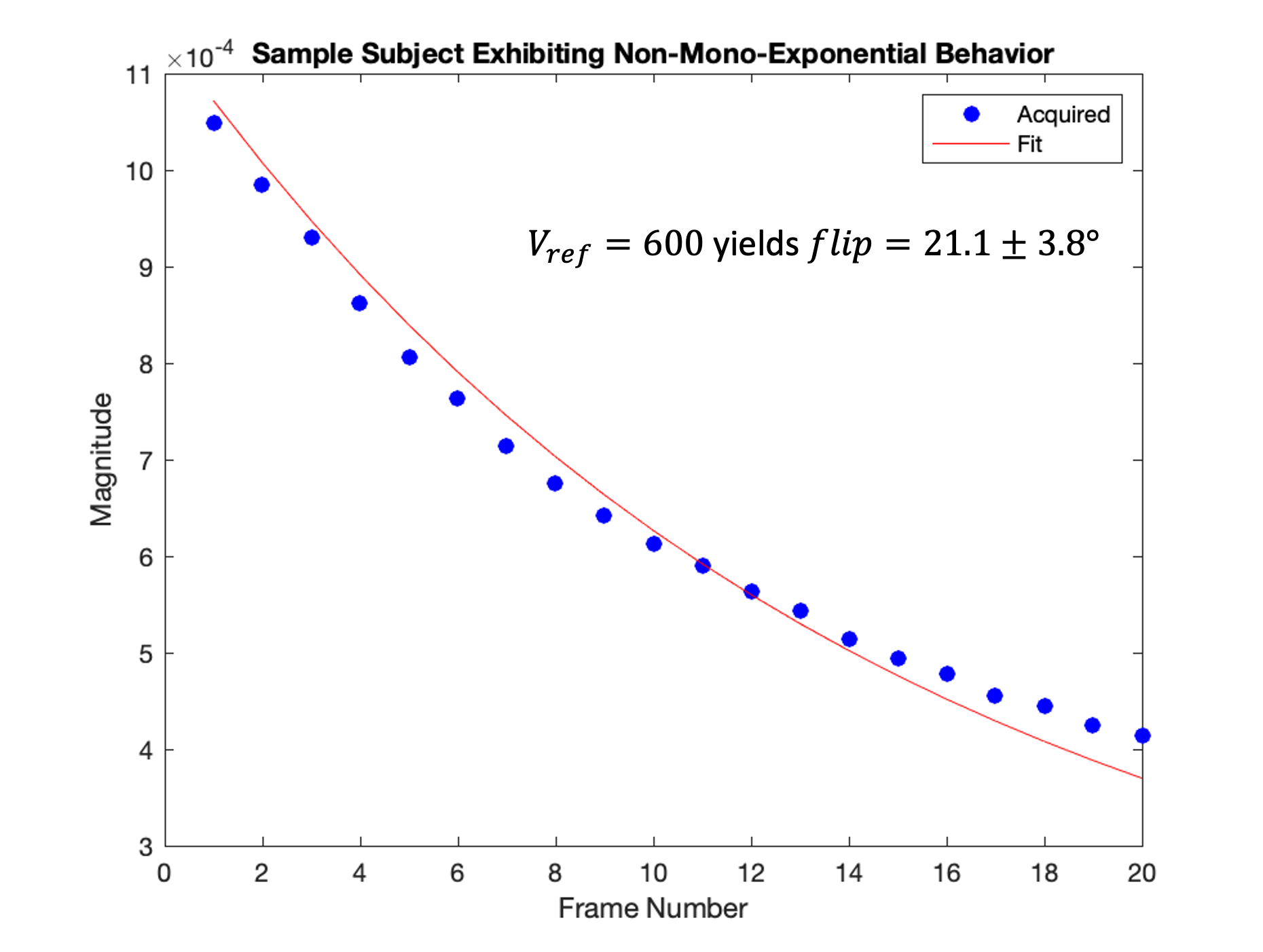
Figure 1. Example of subject calibration data which does not appear to exhibit mono-exponential behavior. The red fit line shows the expected mono-exponential decay, and clear deviations are observed between frames 4 and 10 and between frames 18 and 20. These deviations result in a flip angle uncertainty of ±3.76˚.
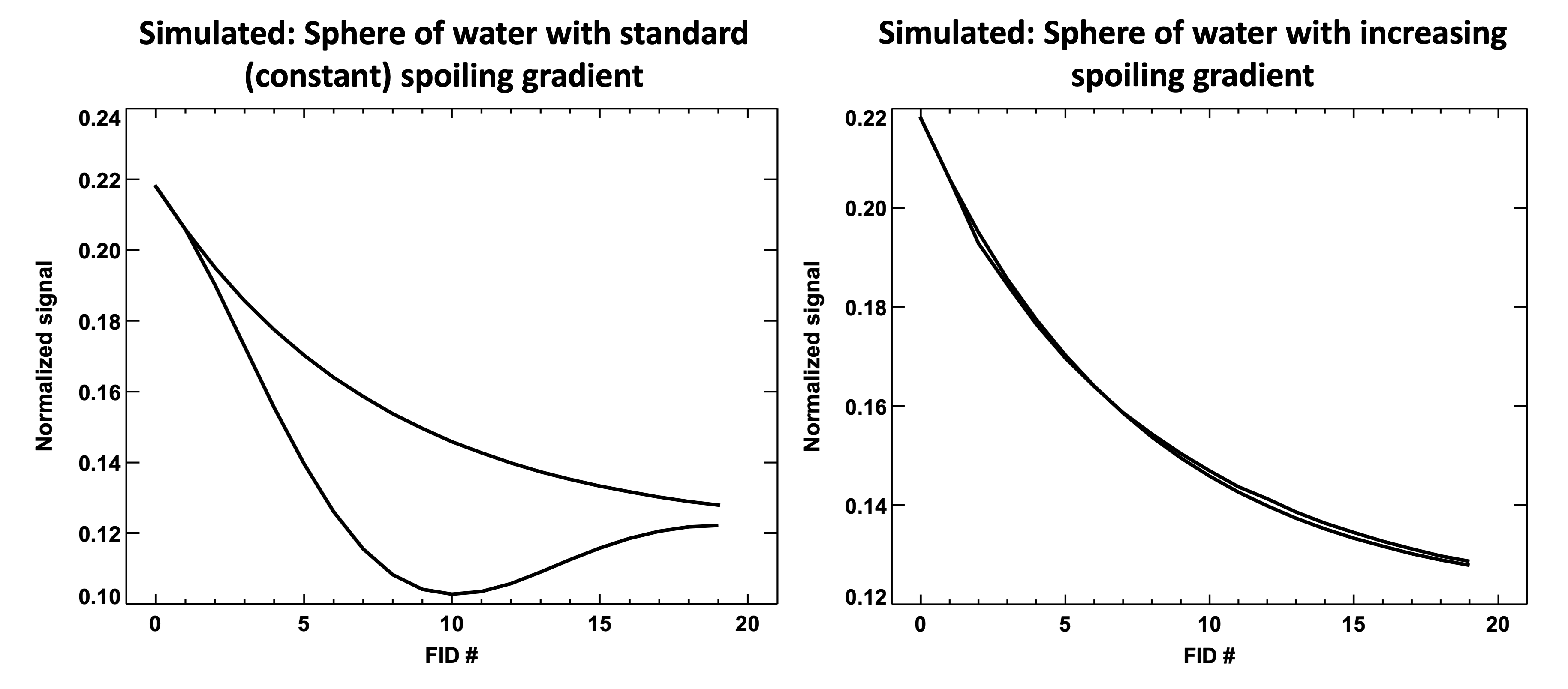
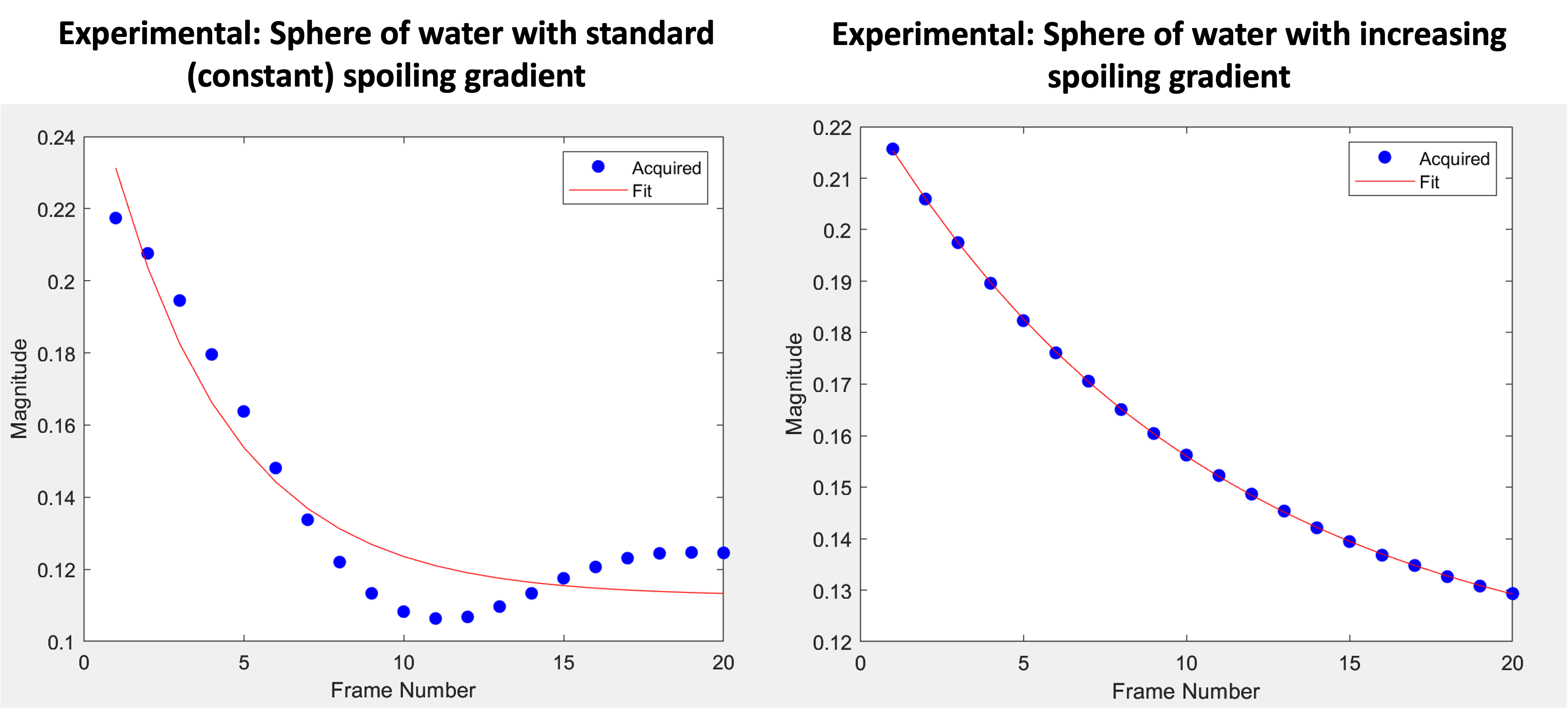
Figure 3. Results of spoiling-gradient experimentation in a water phantom. On the left, constant spoiling-gradient moments yield behavior that clearly deviates from expected mono-exponential decay. On the right, the modified configuration, found to improve accuracy in simulations, was implemented, and the behavior of the experimental calibration data aligns well with expected mono-exponential decay. This substantiates the results of the simulation, confirming that the modified configuration corrects the incomplete spoiling observed in the standard configuration.
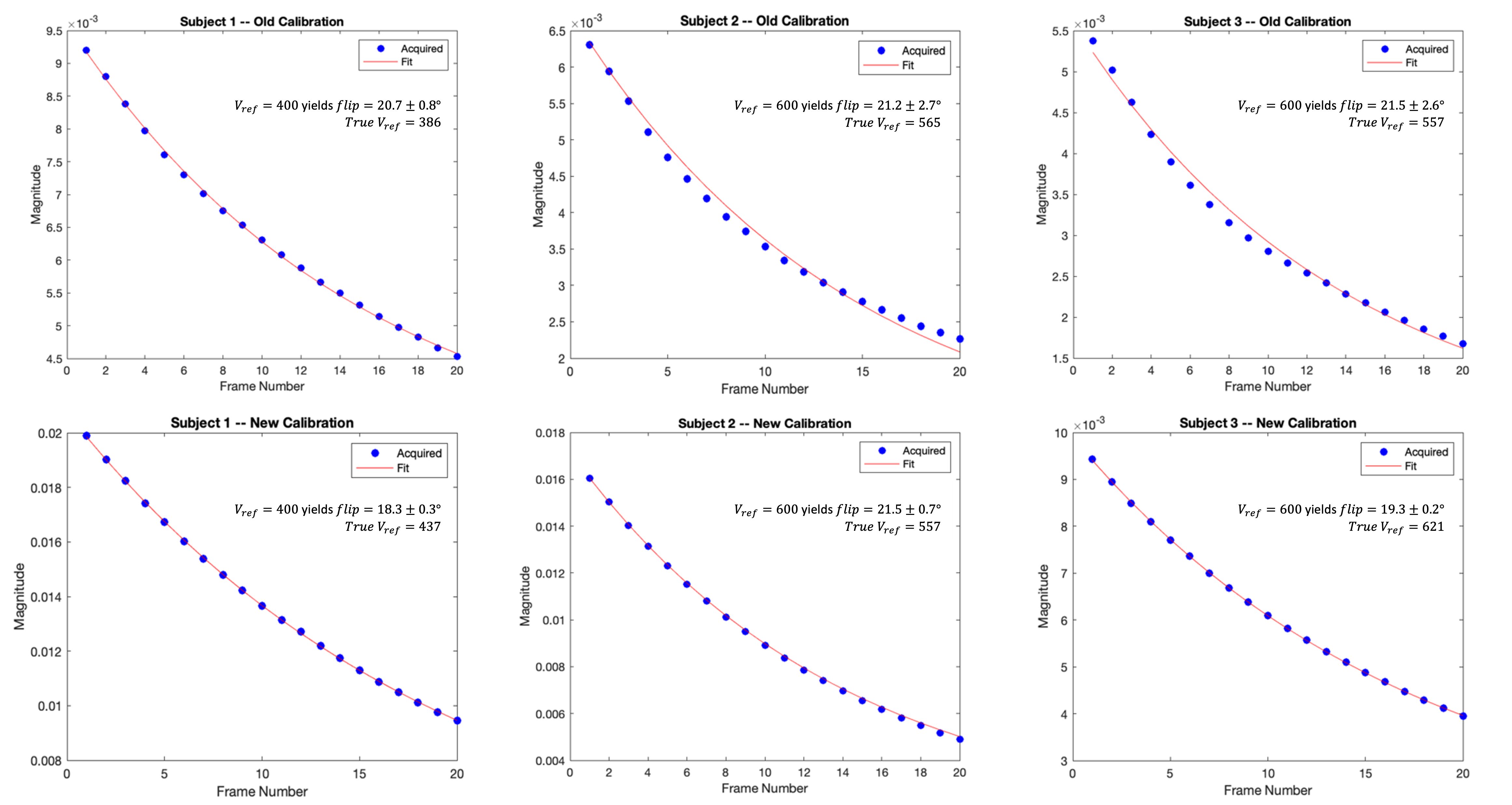
Figure 4. Calibration data for subjects who underwent 129Xe MRI using both the standard spoiling-gradient configuration and the modified spoiling-gradient configuration. Results from the standard calibration are shown in the first row, and results from the modified calibration are shown in the second row. For all three subjects, the predicted reference voltage changed between configurations, and uncertainty in the flip angle was dramatically reduced. Improvement is also seen, qualitatively, in the agreement with the mono-exponential fit.