2990
Serine de novo synthesis in glioma patients studied through 13C isotopomer analysis1Neurosurgery, Houston Methodist Research Institute, Houston, TX, United States, 2Houston Methodist Research Institute, Houston, TX, United States, 3UT Southwestern Medical Center, Dallas, TX, United States
Synopsis
Keywords: Radiomics, Metabolism, 13C NMR, 13C isotopomer analysis
Motivation: The TCGA database reveals that gliomas exhibit the presence of phosphoglycerate dehydrogenase (PHGDH), a crucial enzyme in the generation of serine through de novo biosynthesis.
Goal(s): Our objective was to measure the serine biosynthesis flux in glioma patients.
Approach: We used 13C-glucose intravenous infusion during the surgical resection and 13C isotopomer analysis to track serine biosynthesis in patients.
Results: We detected 19.2% ± 6.5% of serine biosynthetic flux relative to lactate production and the generation of glycine to produce one-carbon units in both low-grade gliomas and GBMs.
Impact: These results indicate that targeting serine de novo synthesis may be of therapeutic value. We are currently working on developing PHGDH knockdown cell line from a GBM patient to test the effects of serine synthesis on cellular viability.
Introduction
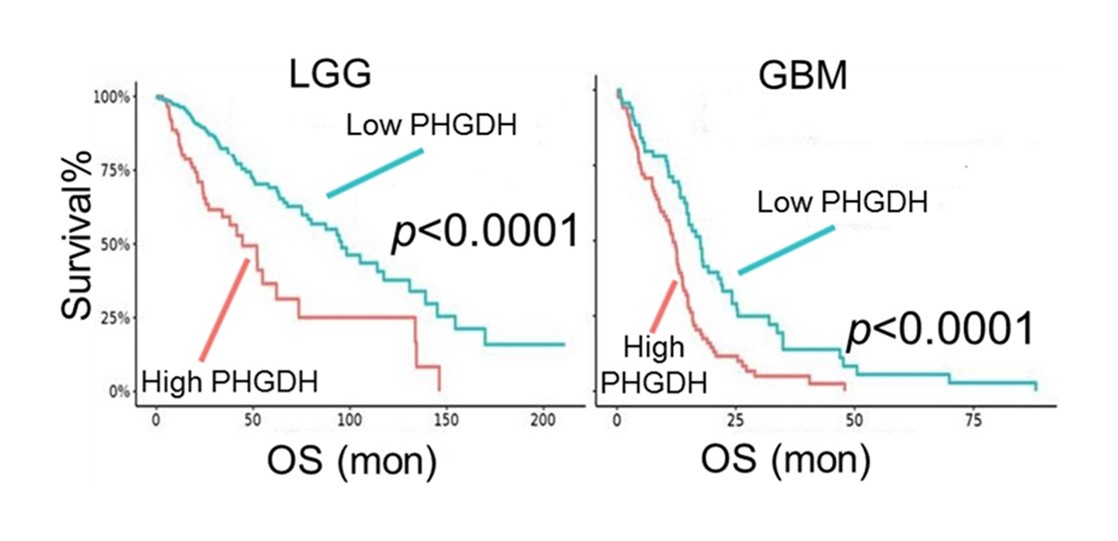
Serine is a non-essential amino acid that acts as a precursor for de novo synthesis of many important amino acids (cysteine, methionine, and glycine), thymidine, purines, glutathione, porphyrins, head groups of phospholipids and sphingosine. Conversion of serine to glycine via serine hydroxymethyltransferase (SHMT) generates one-carbon units which are directly utilized in the biosynthesis of thymidine and purines1,2. Also, one carbon unit that is generated via SHMT is used in the synthesis of methionine and S-adenosylmethionine (SAM). SAM is known as a key player in DNA and histone methylation reactions which influences epigenetic control in gene expression2. Irrespective of higher levels of serine in the blood, cancer cells exhibited decreased proliferation in the absence of serine biosynthesis1,2. This indicates that serine de novo synthesis by cancer cells is a requirement for cell proliferation. Human gliomas express phosphoglycerate dehydrogenase (PHGDH), critical enzyme required for the synthesis of serine from glycolytic intermediate, 3-PG3. Higher levels of PHGDH are shown to be associated with shorter survival in glioma patients (Figure 1). Nonetheless, the status of the serine synthesis pathway in brain tumors remains uncertain. In this study, we have introduced a novel 13C isotopomer approach to assess the extent of relative serine biosynthesis flux with respect to glycolysis (lactate production) in glioma patients who have undergone surgical resection to excise their tumor mass.Methods
Five brain tumor patients (GBM=3; Low grade glioma=1; Giant Cell Astrocytoma=1) were included in this study who were enrolled through the IRB protocol approved by UT Southwestern Medical Center, Dallas, TX. Subjects were infused with [U-13C]glucose at 8.0 g for 10 minutes as a bolus followed by 8.0 g/h for 2 hours during the surgical removal of the tumor. Resected tumor tissues were immediately snap-frozen and stored at -80°C for further ex vivo NMR analysis. Methods for sampling tumor tissue for NMR spectroscopy have been described previously4-6. 1H-decoupled 13C spectra of tumor extracts were acquired at 150 MHz (for 13C) on an Agilent NMR spectrometer equipped with 3-mm broadband room temperature probe. C2 serine (57.10 ppm) multiplet peak areas were used to determine the population of [U-13C]serine isotopomer that was generated from the glycolytic intermediate, 3-PG (Figure 2). Since lactate is also the three carbon molecule as serine, the same 13C isotopomer analysis can be extended to determine the production of [U-13C]lactate using C2 lactate (69.21 ppm) 13C NMR signal. Relative serine synthesis flux was determined from the ratio of [U-13C]serine and [U-13C]lactate isotopomer population (%).Results and Discussion
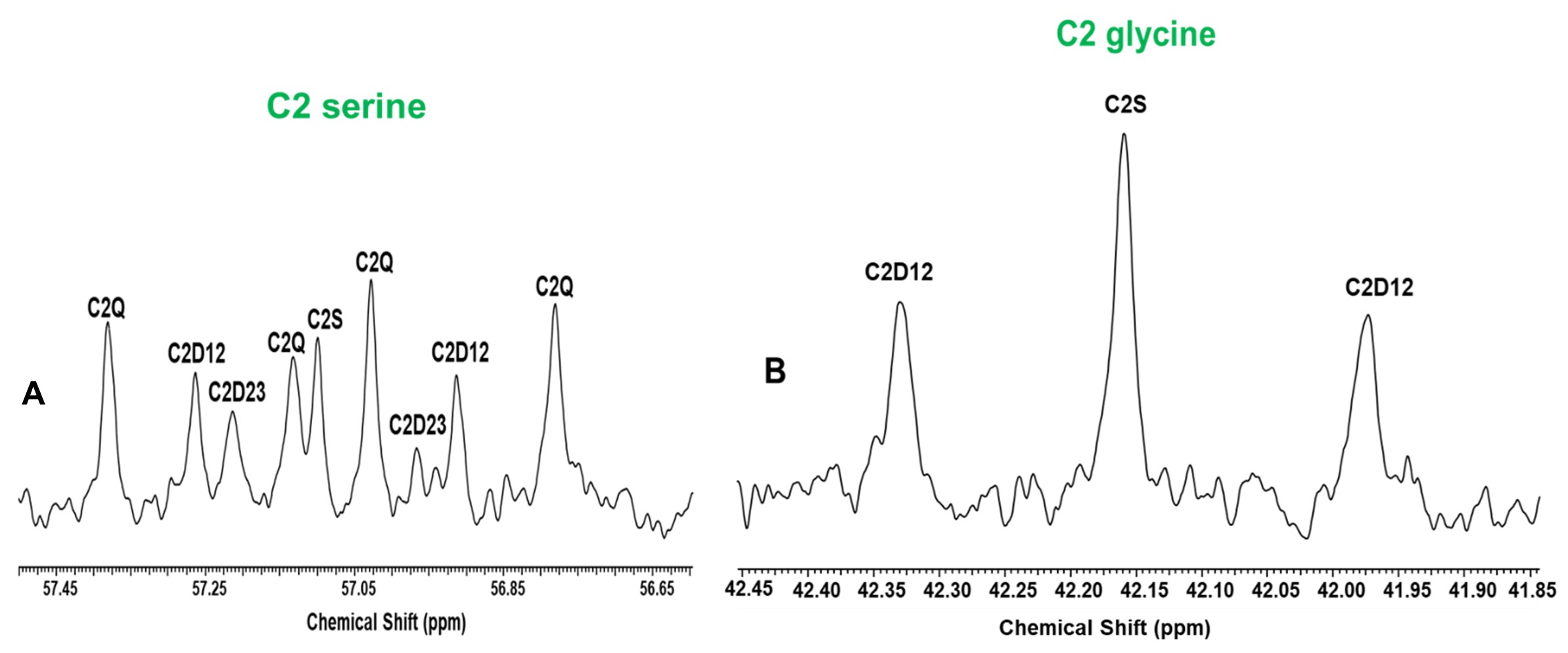
Figure 3 shows the details of 13C carbons flow during the infusion of [U-13C]glucose. [U-13C]3-phosphoglycerate (3-PG) is generated from [U-13C]glucose during glycolysis which leads to the synthesis of [U-13C]serine through the combined activities of the following three enzymes, PHGDH, PSAT and PSPH. [U-13C]serine further leads to the production of [1,2-13C]glycine via the enzyme SHMT and was detected in the 13C NMR spectrum of the tumor samples . A 13C-13C-13C spin coupled quartet (C2Q) observed in the 13C NMR signal of C2 serine (Figure 4A) is due to [U-13C]serine and is the marker of serine biosynthetic flux in the tumor . 13C-13C spin coupled doublet (C2D12) in C2 serine signal represents [1,2-13C]serine isotopomers that are generated due to the conversion of [1,2-13C]glycine via reversible activity of SHMT (Figure 4B). A small doublet C2D23 is due to [2,3-13C]serine which may be generated through multiple pathways involved in glycine cleavage/degradation system. C2S is due to natural abundance signal of 13C.
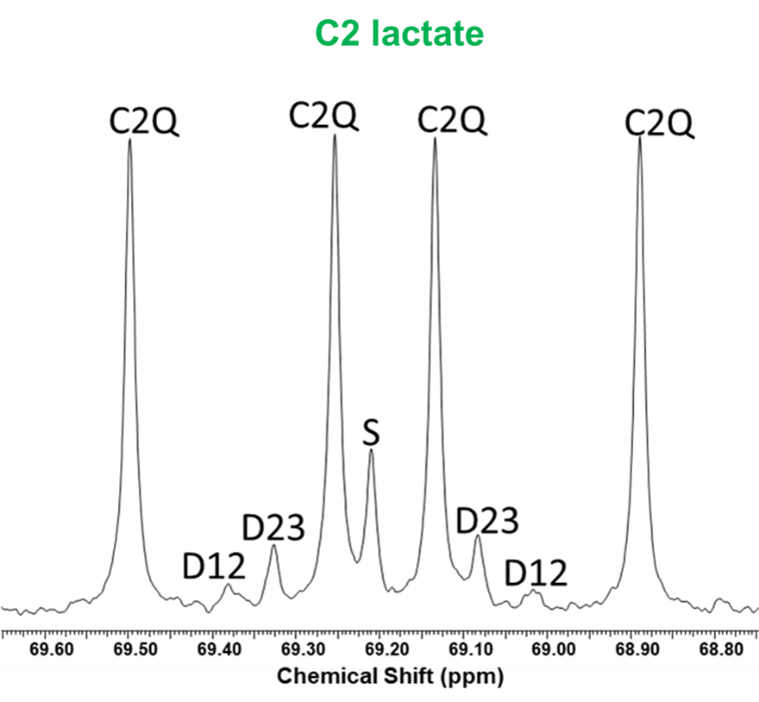
[U-13C]glucose further leads to the generation of [U-13C]pyruvate, and subsequently, lactate dehydrogenase (LDH) produces [U-13C]lactate from [U-13C]pyruvate (Figure 3). A 13C-13C-13C spin coupled quartet (C2Q) observed in the 13C NMR signal of C2 lactate (Figure 5) is due to [U-13C]lactate and is the marker of the Warburg effect, which we used to determine the relative serine biosynthesis flux with respect to lactate synthesis. From the five glioma patients’ data, relative serine synthesis flux was found to be at 19.2% ± 6.5%. We did not detect any 13C-labeled serine or glycine in the plasma. This indicated that effects of [U-13C]glucose metabolism in the peripheral tissues leading to the generation of 13C labeled serine or glycine were negligible.
Conclusion
We have demonstrated a facile method to directly quantify levels of de novo serine biosynthesis relative to Warburg glycolysis (13C-lactate). This method allows a rigorous assessment of what impact targeting PHGDH, using genetic and pharmacological approaches, will have on GBM tumor growth7.Acknowledgements
This study was supported by NIH (R01 CA272763 to KP), the Donna and Kenneth R. Peak Foundation, the Kenneth R. Peak Brain and Pituitary Tumor Treatment Center at Houston Methodist Hospital, The Houston Methodist Foundation, The Taub Foundation, The Pauline Sterne Wolff Foundation, The Veralan Foundation, The Marilee A. and Gary M. Schwarz Foundation, The John S. Dunn Foundation and The McKone Family Foundation. We thank all the patients who volunteered to participate in this study.References
1. K.R. Mattaini, M.R. Sullivan, M.G. Vander Heiden, The importance of serine metabolism in cancer, J. Cell Biol. 214 (2016) 249-257.
2. J.W. Locasale, Serine, glycine, and the one-carbon cycle: cancer metabolism in full circle, Nat. Rev. Cancer. 13 (2013) 572-583.
3. J. Liu, S. Guo, Q. Li, L. Yang, Z. Xia, L. Zhang, Z. Huang, N. Zhang, Phosphoglycerate dehydrogenase induces glioma cells proliferation and invasion by stabilizing forkhead box M1, J. Neurooncol. 111 (2013) 245-255.
4. E.A. Maher, I. Marin-Valencia, R.M. Bachoo, T. Mashimo, J. Raisanen, K.J. Hatanpaa, A. Jindal, F.M. Jeffrey, C. Choi, C. Madden, D. Mathews, J.M. Pascual, B.E. Mickey, C.R. Malloy, R.J. DeBerardinis, Metabolism of [U-13C]glucose in human brain tumors in vivo, NMR. Biomed. 25 (2012) 1234-1244.
5. T. Mashimo, K. Pichumani, V. Vemireddy, K.J. Hatanpaa, D.K. Singh, S. Sirasanagandla, S. Nannepaga, S.G. Piccirillo, Z. Kovacs, C. Foong, Z. Huang, S. Barnett, B.E. Mickey, R.J. DeBerardinis, B.P. Tu, E.A. Maher, R.M. Bachoo, Acetate is a bioenergetic substrate for human glioblastoma and brain metastases, Cell 159(2014) 1603-1614.
6. K. Pichumani, T. Mashimo, H-M. Baek, J. Ratnakar, B. Mickey, R.J. DeBerardinis, E.A. Maher, R.M. Bachoo, C.R. Malloy, Z. Kovacs, Conditions for 13C NMR detection of 2-Hydroxyglutarate in tissue extracts from isocitrate dehydrogenase-mutated gliomas, Anal. Biochem. 481 (2015) 4-6.
7. E. Mullarky, N.C. Lucki, R.B. Zavareh, J.L. Anglin, A.P. Gomes, B.N. Nicolay, J.C. Wong, S. Christen, H. Takahashi, P.K. Singh, J. Blenis, J.D. Warren, S.M. Fendt, J.M. Asara, G.M. DeNicola, C.A. Lyssiotis, L.L. Lairson, L.C. Cantley, Identification of a small molecule inhibitor of 3-phosphoglycerate dehydrogenase to target serine biosynthesis in cancers, Proc Natl Acad Sci U S A. 113 (2016) 1778-17783.Figures
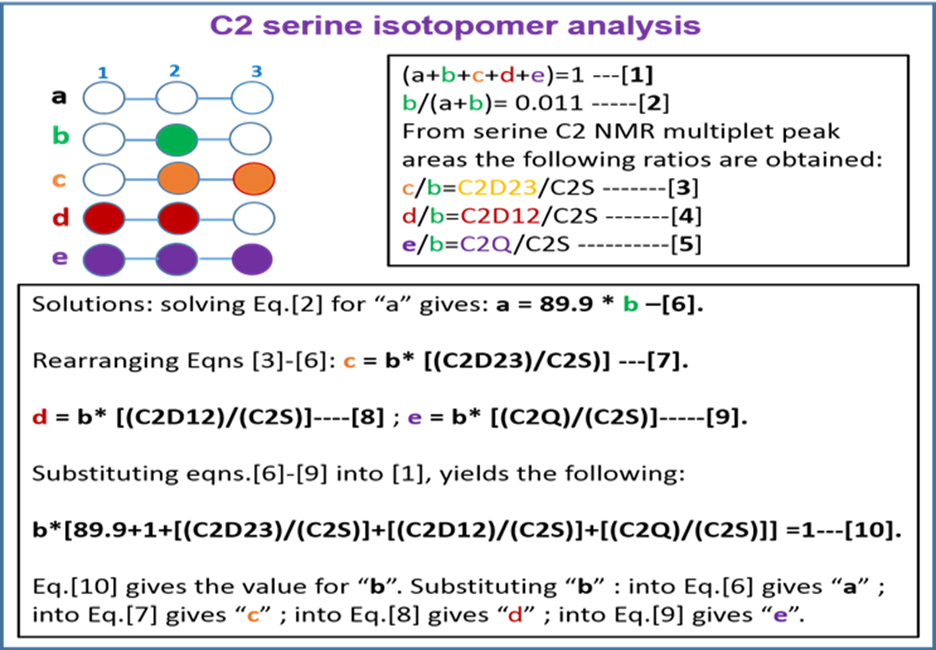
13C-isotopomer analysis of C2 serine. Various 13C isotopomer fractions are represented (a-e). “e” is the uniformly labeled 13C isotopomer fraction that is generated from the [U-13C]glucose and is taken as a readout of serine biosynthetic flux. Bottom panel describes the mathematical analysis of determination of 13C isotopomers and their fractional enrichment using C2 serine 13C NMR multiplet signals.
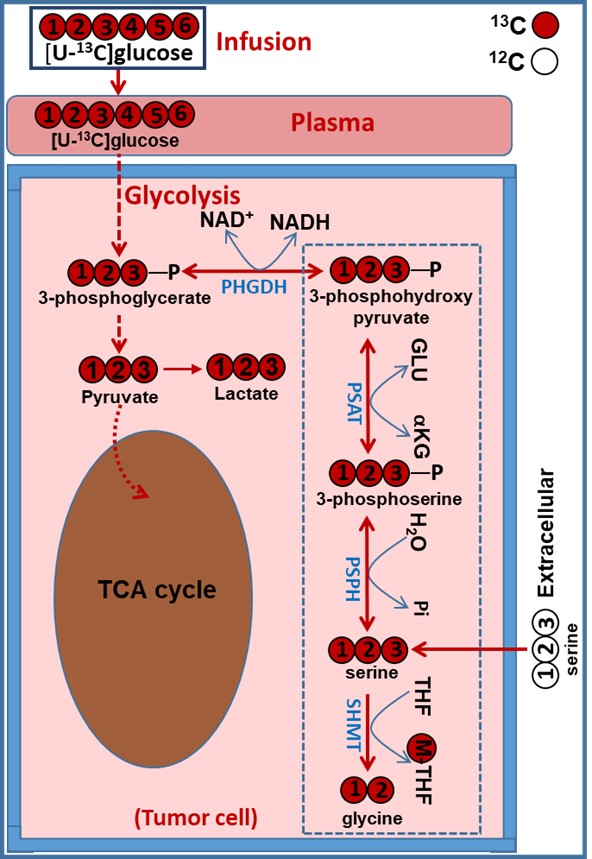
Schema showing the biosynthesis of [U-13C]serine from [U-13C]glucose. [U-13C]serine is further metabolized to produce [U-13C]glycine via the enzyme SHMT. Abbreviations: PHGDH, phosphoglycerate dehydrogenase; PSAT, phosphoserine aminotransferase; PSPH, phosphoserine phosphatase; SHMT, serine hydroxymethyltransferase; [U-13C]glucose, [1,2,3,4,5,6-13C]glucose; [U-13C]serine, [1,2,3-13C]serine; α-KG, α-ketoglutarate; GLU, glutamate; Pi, inorganic phosphate; THF, tetrahydrofolate; M-THF, 5,10-methylenetetrahydrofolate.