2985
1H-MRS VERI: The Proton Magnetic Resonance Spectroscopy Validation Effort Resource Initiative1Faculty of Medicine, Lund University, Lund, Skåne, Sweden, 2Department of Biomedical Engineering, Columbia University School of Engineering and Applied Science, New York, NY, United States, 3International Society for Magnetic Resonance in Medicine Magnetic Resonance Spectroscopy Study Group Code and Data Sharing Committee, Concord, CA, United States, 4Russell H. Morgan Department of Radiology and Radiological Science, Johns Hopkins University, Baltimore, MD, United States, 5Faculty of Computer Science, Technische Universität München, München, Germany, 6Animal Imaging and Technology Core, Center for Biomedical Imaging, École Polytechnique Fédérale de Lausanne, Lausanne, Switzerland, 7Physical Sciences Platform, Sunnybrook Research Institute, Toronto, ON, Canada, 8Department of Radiology and Imaging Sciences, Emory University School of Medicine, Atlanta, GA, United States, 9Department of Radiology, Columbia University Vagelos College of Physicians and Surgeons, New York, NY, United States
Synopsis
Keywords: Data Processing, Spectroscopy, Reproducible Research
Motivation: Many details of in vivo proton magnetic resonance spectroscopy (1H MRS) data analysis still lack evidence-based standards.
Goal(s): The 1H-MRS Validation Effort Resource Initiative (1H-MRS VERI) is a public repository for sharing spectral datasets useful for formulating such standards.
Approach: 1H-MRS VERI data sets include measurements from phantoms (VERIph), spectral simulations of predefined metabolite scaling, including simulated and/or measured in-vivo-like nuisance signals (VERIsim), and 1H-MRS acquisitions from human or other tissues colocalized with supporting measurements from non-1H-MRS experiments (VERIvivo).
Results: 1H-MRS VERI facilitates field-wide efforts toward accurate and precise in vivo 1H-MRS quantification via transparent, replicable investigation of shared empirical standards.
Impact: 1H-MRS research marches on, largely uninformed by commonly accepted evidence-based guidelines for many data analysis details from denoising methods to baseline definitions. 1H-MRS VERI provides a curated collection of data standards to facilitate the shared development of these still-needed guidelines.
Background
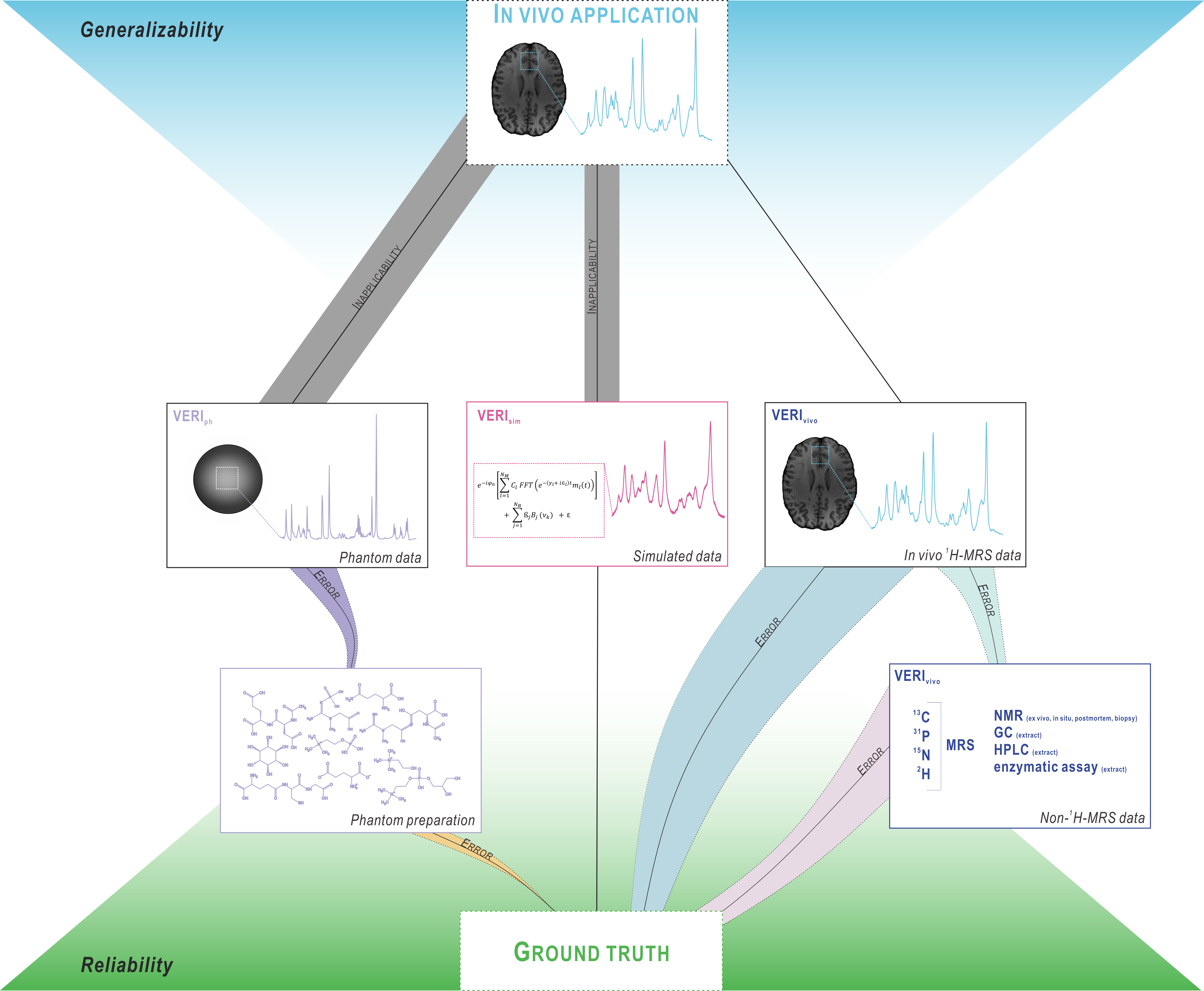
Multiple steps of processing and analysis are required to derive scientifically or clinically useful metabolite concentrations from the raw data of in vivo proton magnetic resonance spectroscopy (1H-MRS) experiments. The errors introduced by these steps, including spectral analysis and concentration referencing, remain incompletely addressed. The question therefore remains: What is the most accurate and precise approach for estimating the metabolite concentrations from a given 1H-MR spectrum? A lack of publicly accessible data standards that feature both a) ground-truth labels and b) experimental realism (Fig. 1) currently complicates efforts to answer this question. The Proton Magnetic Resonance Spectroscopy Validation Effort Resource Initiative (1H-MRS VERI) is a multi-center community endeavor by the International Society for Magnetic Resonance in Medicine (ISMRM) MRS Study Group Code and Data Sharing Committee supporting a living open-access repository for such high-quality spectral data standards.Framework
Every 1H-MRS VERI data set offers at least one 1H-MR spectrum containing one or more metabolites with a concentration defined or estimated using a non-1H-MRS method. VERIph submissions are acquisitions from phantoms of defined composition. VERIsim submissions are simulated spectra also of defined metabolite composition, plus additional nuisance signals like residual water, macromolecules and lipids, lineshape artifacts, and other features expected for in vivo datasets. Finally, VERIvivo submissions are in vivo 1H-MR spectral acquisitions from experiments colocalized with non-1H-MRS concentration estimates of at least one metabolite in the 1H-MR spectrum.Submission to 1H-MRS VERI is open to the 1H-MRS community worldwide. Interested researchers are asked to first review the minimum reporting standards for submission, based on recent expert consensus guidelines1,2, available via the dedicated 1H-MRS VERI Open Science Framework (OSF) project3. To be considered for the database, each 1H-MRS VERI data set must contain at least one simulated, phantom, or in vivo 1H-MR spectrum as per the above, in addition to two metadata components:
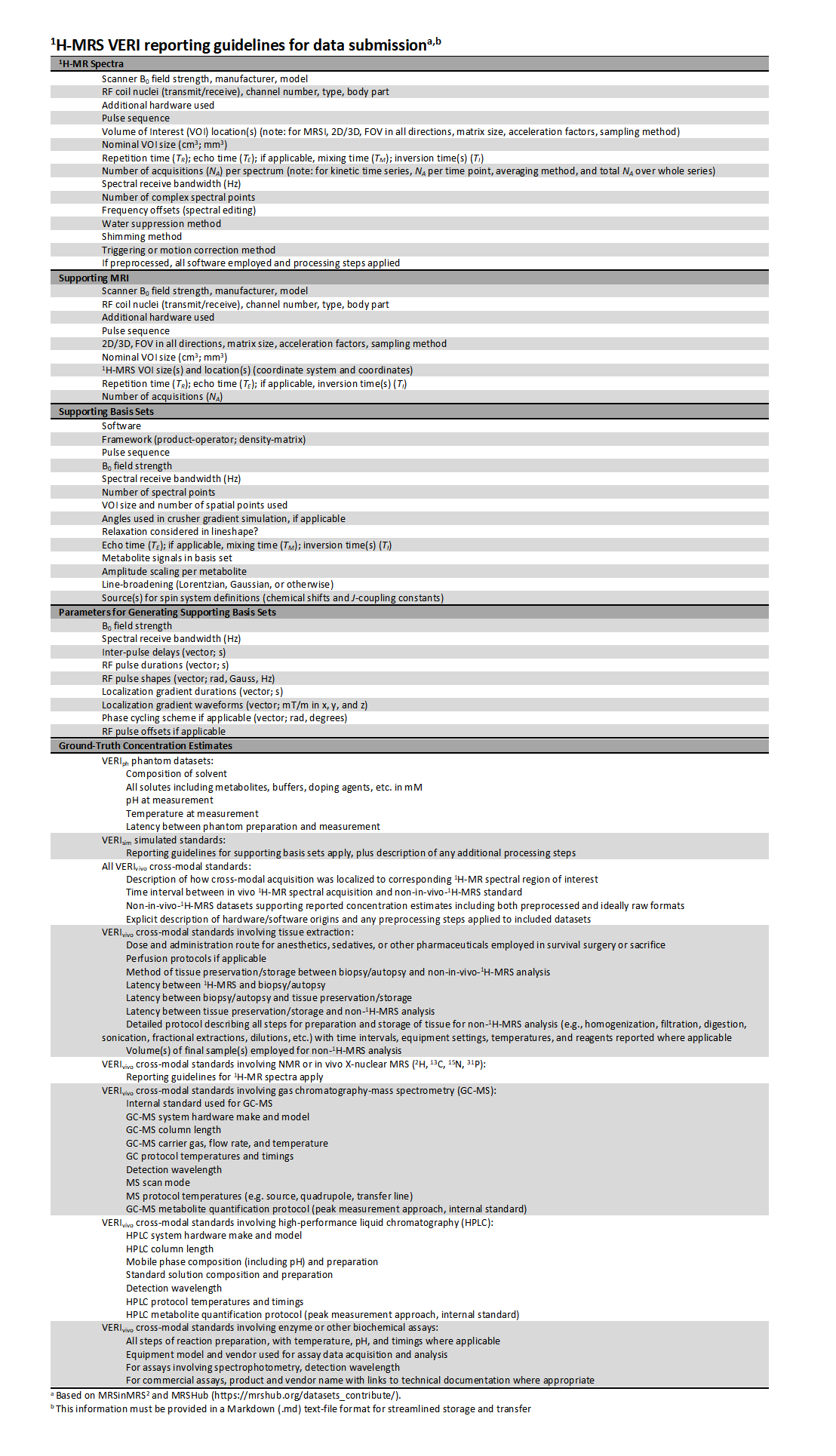
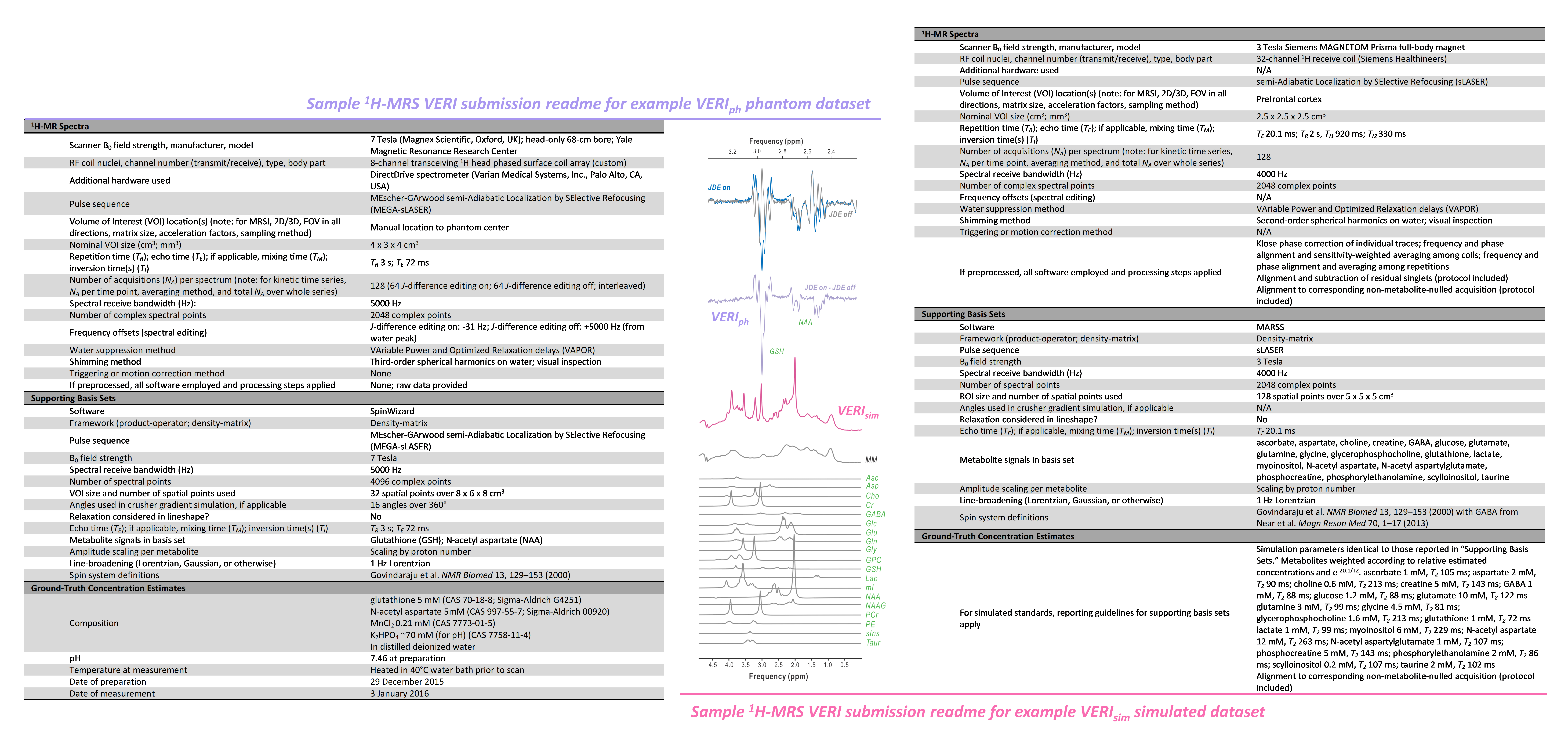
1. A readme file providing key details about the data’s generation and/or acquisition, in addition to associated ground-truth concentration estimates of at least one metabolite in the data (Fig. 3). Notably, these ground-truth estimates must be accessible by the data themselves such that signals from a quantification reference, ideally also of known or at least estimable concentration, should also be available. The three types of accepted 1H-MRS VERI datasets—phantom, simulated, and cross-modal in vivo—are expected to exhibit distinct confounds to their aforementioned a) ground-truth reliability and b) experimental realism and are thus associated with slightly different reporting standards (Fig. 4).
2. A license file dictating the limits of fair data use. A boilerplate 2-clause BSD license can be provided.
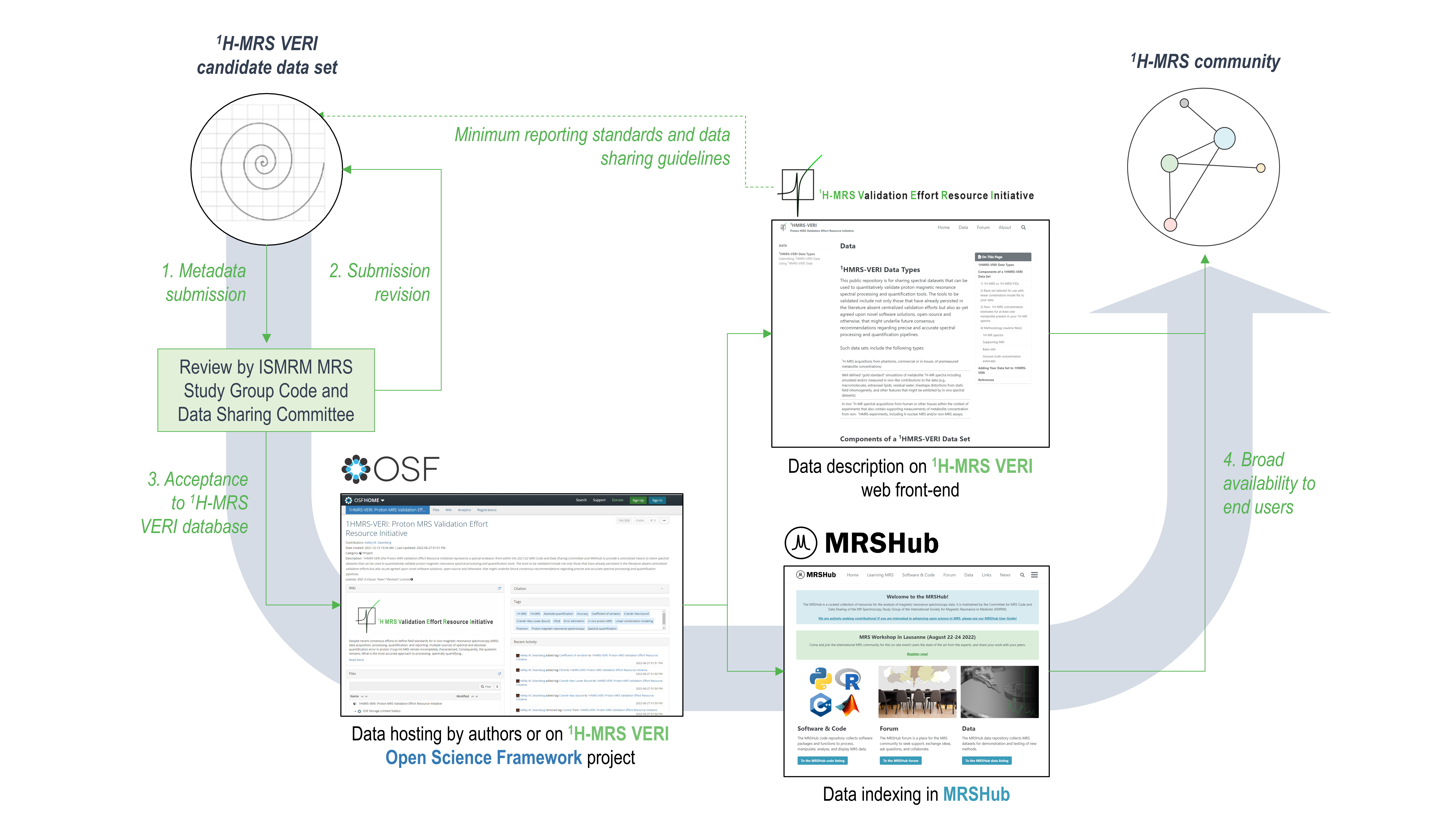
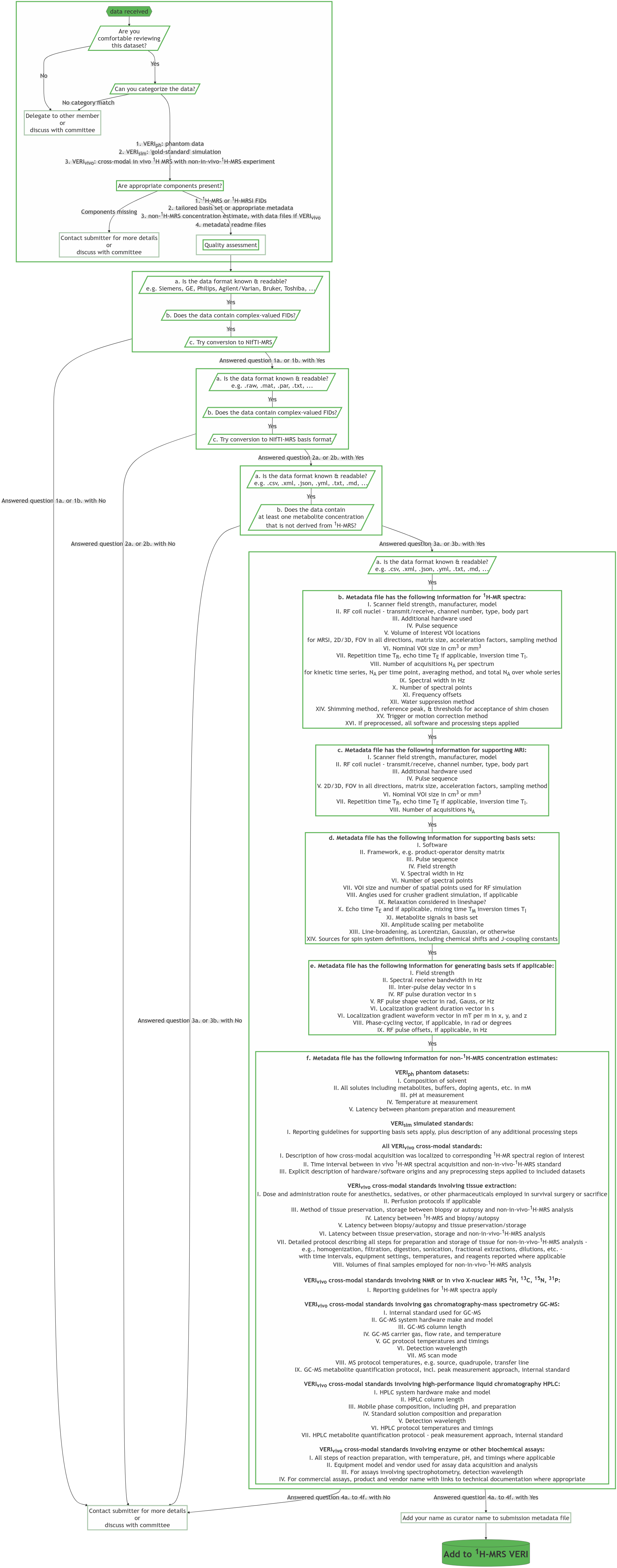
In addition, given the importance of linear combination modeling with basis sets conforming to spectral acquisition sequence details4,5, all submitted data involving measured acquisitions should include the appropriate basis sets. Otherwise, 1H-MRS VERI requests that submission readmes specify the pulse sequence details necessary to correctly generate an external basis set. Completed readme and license files are sent by email to the standing 1H-MRS VERI review board within the Code and Data Sharing Committee as per instructions on the 1H-MRS VERI OSF project. Submission review is then conducted according to posted protocols (Fig. 5).
Accepted 1H-MRS VERI submissions are made publicly available on OSF and further indexed on MRSHub6. Submitters can choose to host the data themselves and provide the link to 1H-MRS VERI in their readme, or under limited circumstances may transfer their data for hosting on the 1H-MRS VERI OSF project directly. 1HMRS-VERI follows the MRSHub policy on data privacy and compliance7.
Summary
1H MRS VERI is a field-wide effort overseen by the ISMRM Magnetic Resonance Spectroscopy Study Group Code and Data Sharing Committee to curate, centralize, and publicize open data standards suitable for quantifying the accuracy and precision of 1H-MRS data analysis pipelines. No single flavor of 1H-MRS standard can perfectly capture the errors of all possible 1H-MRS acquisitions. Some error sources, e.g. from assumed concentration referencing parameters, are likely not addressed by validation against simulated or even many measured datasets. Other sources, like spectral baseline modeling technique, likely demonstrate limited generalizability to varied 1H-MR spectral compositions. The goal of 1H-MRS VERI is not a one-size-fits-all procedure for analyzing all conceivable 1H-MR spectra. Rather, this repository of varied ground-truth datasets provides a foundation for more explicit investigation of diverse possible such procedures that have heretofore lacked the context of quantifiable performance outputs.Acknowledgements
This work was performed in part at the Zuckerman Mind Brain Behavior Institute MRI Platform, a shared resource and Columbia MR Research Center site.References
1. Kreis, R., Boer, V., Choi, I. Y., Cudalbu, C., de Graaf, R. A., Gasparovic, C., Heerschap, A., Krssak, M., Lanz, B., Maudsley, A. A., Meyerspeer, M., Near, J., Oz, G., Posse, S., Slotboom, J., Terpstra, M., Tkáč, I., Wilson, M., Bogner, W. & Experts' Working Group on Reporting Standards for MR Spectroscopy. MRS terminology and concepts for the characterization of in vivo MR spectroscopy methods and MR spectra: Background and experts' consensus recommendations. NMR Biomed e4347, doi:10.1002/nbm.4347 (2020).
2. Lin, A., Andronesi, O., Bogner, W., Choi, I. Y., Coello, E., Cudalbu, C., Juchem, C., Kemp, G. J., Kreis, R., Krššák, M., Lee, P., Maudsley, A. A., Meyerspeer, M., Mlynarik, V., Near, J., Oz, G., Peek, A. L., Puts, N. A., Ratai, E. M., Tkáč, I., Mullins, P. G. & Experts' Working Group on Reporting Standards for MR Spectroscopy. Minimum Reporting Standards for in vivo Magnetic Resonance Spectroscopy (MRSinMRS): Experts' consensus recommendations. NMR Biomed 34, e4484, doi:10.1002/nbm.4484 (2021).
3. International Society for Magnetic Resonance in Medicine Magnetic Resonance Spectroscopy Study Group Code and Data Sharing Committee. 1H-MRS VERI: Proton MRS Validation Effort Resource Initiative. Open Science Framework. Available at osf.io/26btq (2023).
4. Öz, G., Deelchand, D. K., Wijnen, J. P., Mlynárik, V., Xin, L., Mekle, R., Noeske, R., Scheenen, T. W. J., Tkáč, I. & Experts' Working Group on Advanced Single Voxel 1H MRS, H. M. Advanced single voxel (1) H magnetic resonance spectroscopy techniques in humans: Experts' consensus recommendations. NMR Biomed, e4236, doi:10.1002/nbm.4236 (2020).
5. Near, J., Harris, A. D., Juchem, C., Kreis, R., Marjańska, M., Oz, G., Slotboom, J., Wilson, M. & Gasparovic, C. Preprocessing, analysis and quantification in single-voxel magnetic resonance spectroscopy: experts' consensus recommendations. NMR Biomed 34, e4257, doi:10.1002/nbm.4257 (2021).
6. International Society for Magnetic Resonance in Medicine Magnetic Resonance Spectroscopy Study Group Code and Data Sharing Committee. MRSHub. Available at mrshub.netlify.app/ (2023).
7. International Society for Magnetic Resonance in Medicine Magnetic Resonance Spectroscopy Study Group Code and Data Sharing Committee. Data Privacy and Compliance. MRSHub. Available at https://mrshub.netlify.app/datasets_privacy/ (2023).
Figures