2984
Learning-based Separation of Macromolecules and Metabolites in Ultrashort-TE FID MRSI with Auxiliary SE MRSI Data1Beckman Institute for Advanced Science and Technology, University of Illinois at Urbana-Champaign, Urbana, IL, United States, 2Department of Electrical and Computer Engineering, University of Illinois at Urbana-Champaign, Urbana, IL, United States, 3National Center for Supercomputing Applications, University of Illinois at Urbana-Champaign, Urbana, IL, United States, 4Siemens Medical Solutions USA, Inc., Urbana, IL, United States, 5School of Biomedical Engineering, Shanghai Jiao Tong University, Shanghai, China
Synopsis
Keywords: Data Processing, Data Analysis
Motivation: Macromolecules have significant spectral overlap with metabolites, confounding accurate quantification of metabolites in ultrashort-TE MRSI.
Goal(s): To develop a novel method for effective and reliable separation of metabolites and macromolecules from ultrashort-TE FID MRSI data.
Approach: We translated auxiliary macromolecule-free SE metabolite signals to FID signals using a learning-based approach. The translated metabolite reference was incorporated in the spectral model of FID MRSI data through generalized series modelling. Macromolecules signals were modelled with probabilistic subspaces.
Results: The proposed method has been validated using numerical simulation and experimental data from healthy subjects and a tumor patient, producing encouraging results.
Impact: This work provides a novel approach to exploiting the characteristic spectral features in FID and SE MRSI experiments for effective separation of metabolites and macromolecules.
Introduction
Macromolecules (MM) generate broad baseline signals in ultrashort-TE FID MRSI data, overlapping with most metabolites and confounding their biological interpretation1. Reliable separation of MM and metabolites is thus highly desirable, but has been challenging due to low SNR and severe spectral overlap2-5. To address this problem, parametric model fitting methods exploiting prior information of metabolites and MM (resonance structure and relaxation properties) have been proposed6-8, but these methods are usually susceptible to modelling errors and noise perturbations. Deep-learning-based methods have shown promise in separating MM and metabolite signals9-12, yet may suffer from instabilities, especially when the size of training data is limited13,14.Here we propose a novel method to separate metabolites and MM signals in ultrashort-TE FID MRSI data. Auxiliary long-TE SE MRSI data was incorporated to provide MM-free metabolite signals, which was translated from SE to FID data as a reference. The proposed method has been validated in simulation and experimental data, producing encouraging results.
Methods
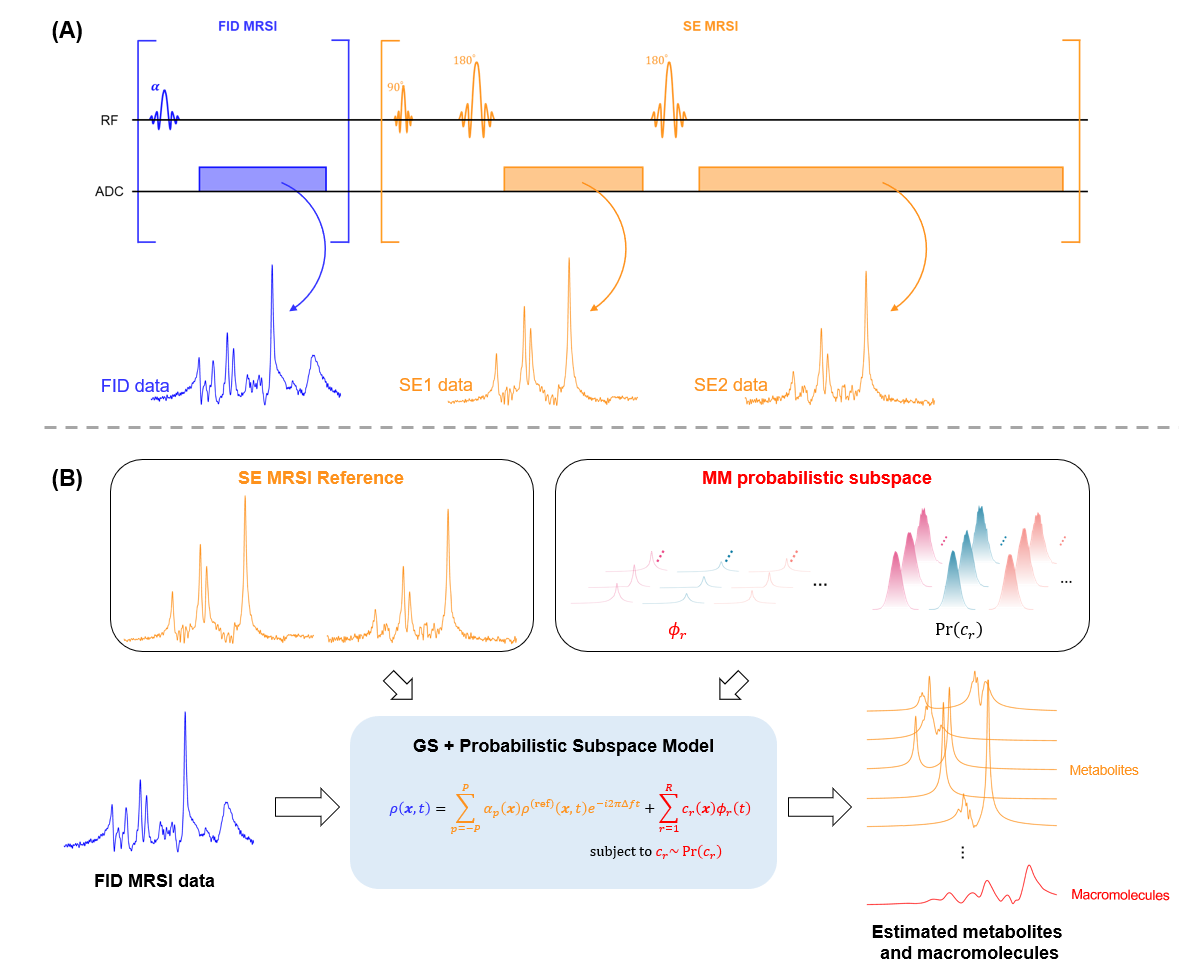
We used a hybrid FID/SE MRSI acquisition scheme15: the FID data was acquired in ultrashort TE and high spatial resolution, while the auxiliary SE data was acquired with two TEs. As illustrated in Figure 1, this data acquisition scheme generates three datasets (FID, SE1, SE2) that can effectively differentiate metabolites and MM based on the fast-decay nature of MM. We represented the FID MRSI data $$$\rho(\boldsymbol{x},t)$$$ using the following model:$$\rho(\boldsymbol{x},t)=\sum_{p=-P}^{P}\alpha_p(\boldsymbol{x})\rho^{(\mathrm{ref})}(\boldsymbol{x},t)e^{-2\pi{\Delta}ft}+\sum_{r=1}^{R}c_r(\boldsymbol{x})\phi_r(t),\\\mathrm{subject~to~}c_{r}\sim\mathrm{Pr}(c_r)$$
where $$$\rho^{(\mathrm{ref})}(\boldsymbol{x},t)$$$ represents the SE-translated reference metabolite signals, $$$\alpha_p(\boldsymbol{x})$$$ the generalized-series (GS) model coefficients, $$$\phi_r(t)$$$ the pre-learned MM basis functions, $$$c_r(\boldsymbol{x})$$$ the corresponding spatial coefficients with probabilistic constraints $$$\mathrm{Pr}(c_r)$$$. The GS model16,17 enables efficient incorporation of metabolite spectral information encoded in the long-TE SE data, while effectively compensating the difference between FID and SE acquisitions. The probabilistic subspace model18-23 significantly reduced the degrees-of-freedom of MM signals with pre-learned bases and probabilistic constraints.
We obtained the metabolite reference signal $$$\rho^{(\mathrm{ref})}(\boldsymbol{x},t)$$$ by translating SE data to FID with physics-based and data-driven priors. More specifically, we adopted the following spectral model for the SE signals of the $$$m$$$th metabolite $$$s_m(t,\mathrm{TE})$$$21:
$$s_m(t,\mathrm{TE})=a_m{\cdot}e^{-\mathrm{TE}/T_{2,m}}{\cdot}\psi_m(t,\mathrm{TE}){\cdot}e^{-t/T_{2,m}}{\cdot}h(t),$$
where $$$a_m$$$ denotes the concentration, $$$\psi_m(t,\mathrm{TE})$$$ the resonance structure, $$$T_{2,m}$$$ the transverse relaxation time, and $$$h(t)$$$ the lineshape function. The model parameters $$$\theta=\{a_m,T_{2,m},h(t)\}$$$ were determined from SE data with prior distribution constraints $$$\mathrm{Pr}(\theta)$$$ learned from SE training data. Afterwards, the FID metabolite reference was synthesized as follows:
$$s_{m}^{\mathrm{(FID)}}(t)=a_m{\cdot}w_m{\cdot}\psi_{m}^{\mathrm{(FID)}}(t){\cdot}e^{-t/T_{2,m}}{\cdot}h(t).$$
Here the resonance structure has been replaced to that of FID data, $$$\psi_{m}^{\mathrm{(FID)}}(t)$$$, and a relaxation term obtained by the Bloch-equation-simulated steady-state FID signals, $$$w_m$$$, has been added. This strategy effectively compensated for the physics-induced differences between FID and SE signals. Residual FID/SE discrepancies were further compensated using the GS model.
The MM signals are represented using a probabilistic subspace model. The spectral basis functions and coefficient distributions were pre-learned from inversion-recovery MM training data, and adapted to the imaging data, as described in the previous work23.
Finally, we reconstructed metabolite and MM signals by estimating the GS coefficients for metabolites and the spatial coefficients for MM:
$$\{\hat{\boldsymbol{\alpha}},\hat{\boldsymbol{\mathrm{C}}}\}=\arg\min_{\{\boldsymbol{\alpha},\boldsymbol{\mathrm{C}}\}}\frac{1}{2}\left\|\boldsymbol{\mathrm{\rho}}-\begin{bmatrix}\boldsymbol{\mathrm{G}}&\boldsymbol{\mathrm{\Phi}}\end{bmatrix}\begin{bmatrix}\boldsymbol{\mathrm{\alpha}}\\\boldsymbol{\mathrm{C}}\end{bmatrix}\right\|_2^2+ \lambda\left\|\boldsymbol{\mathrm{W}}\boldsymbol{\mathrm{C}}\right\|_2^2-\sigma_{\mathrm{noise}}^{2}\log \mathrm{Pr}(\boldsymbol{\mathrm{C}}),$$
where $$$\boldsymbol{\mathrm{\rho}}$$$, $$$\boldsymbol{\mathrm{G}}$$$, $$$\boldsymbol{\mathrm{\Phi}}$$$, $$$\boldsymbol{\alpha}$$$, and $$$\boldsymbol{\mathrm{C}}$$$ represent the matrix forms of FID MRSI data, GS encoding, MM spectral basis, GS coefficients and MM spatial coefficients, respectively. Edge-preserving spatial regularization24 $$$\lambda\left\|\boldsymbol{\mathrm{W}}\boldsymbol{\mathrm{C}}\right\|_2^2$$$ and probabilistic regularization $$$\sigma_{\mathrm{noise}}^{2}\log \mathrm{Pr}(\boldsymbol{\mathrm{C}})$$$ were imposed on the MM spatial coefficients.
Results
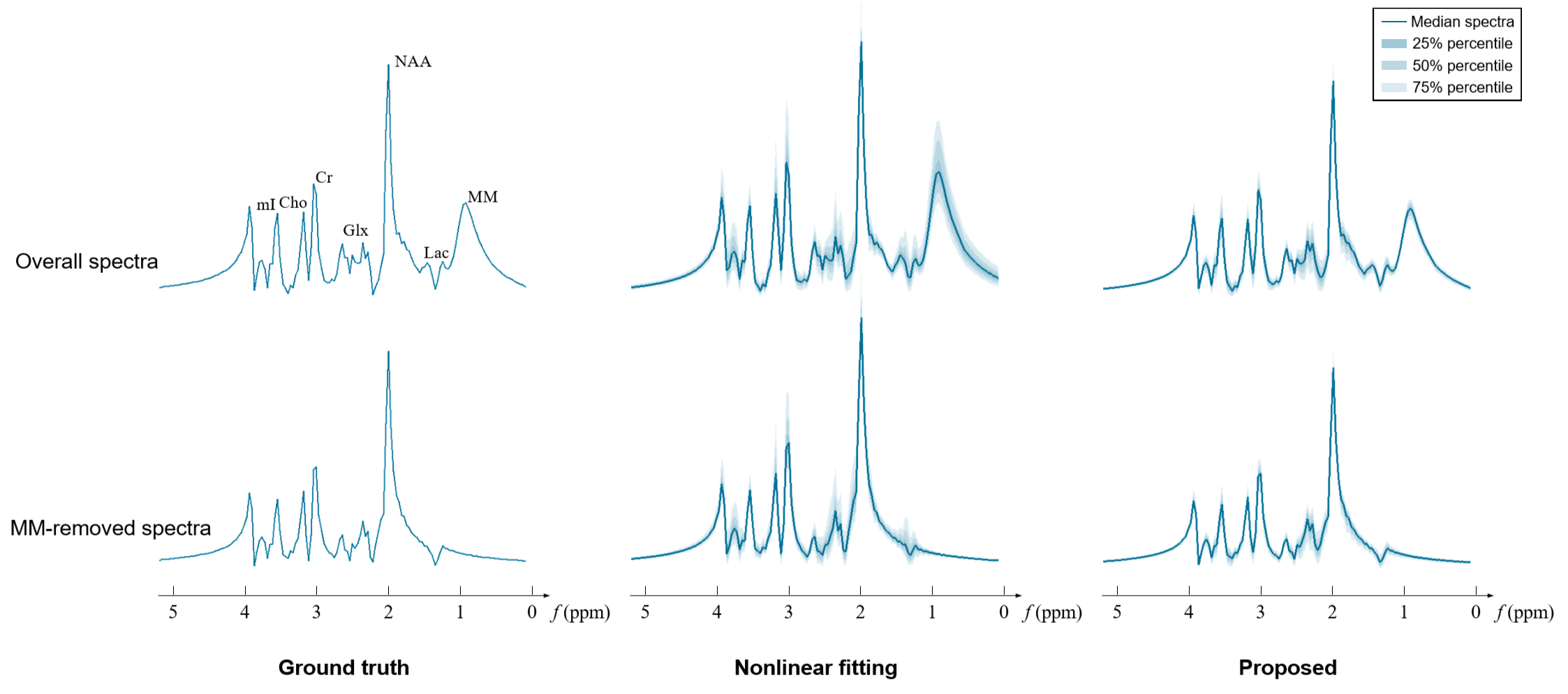
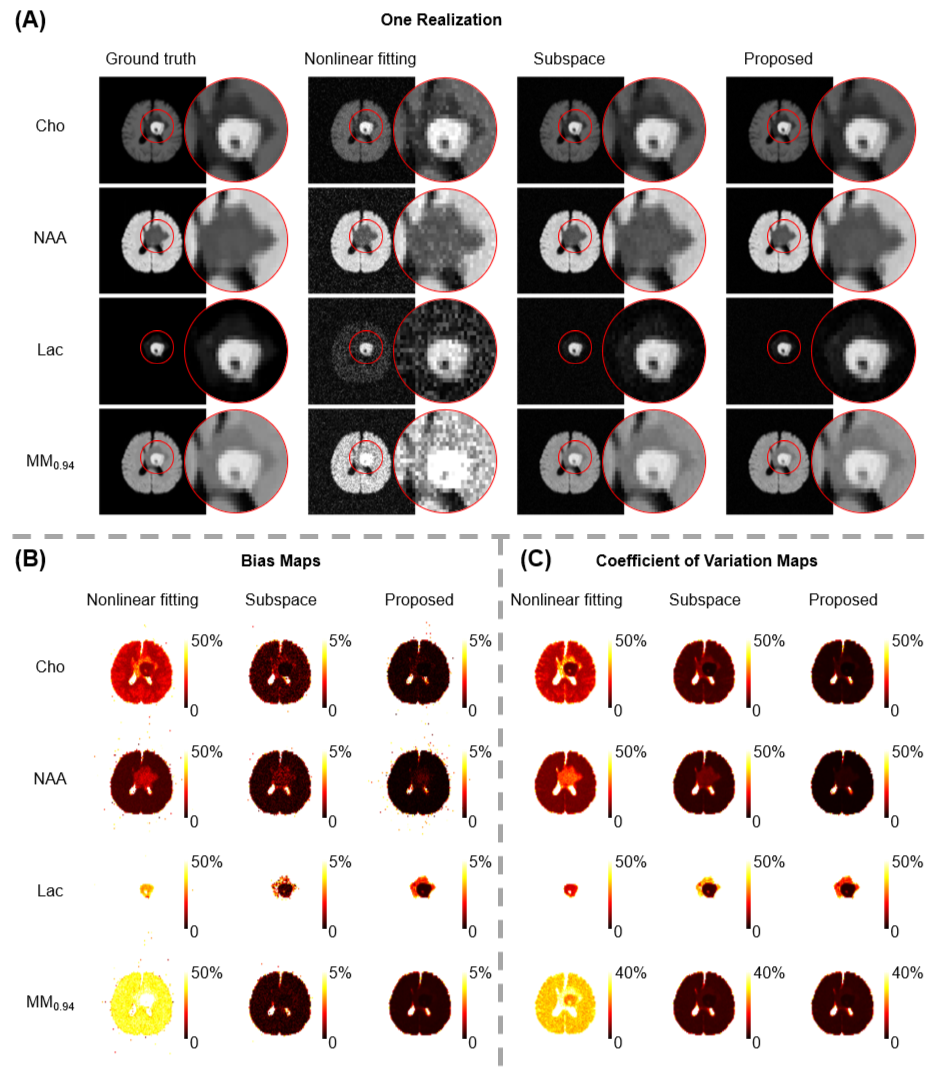
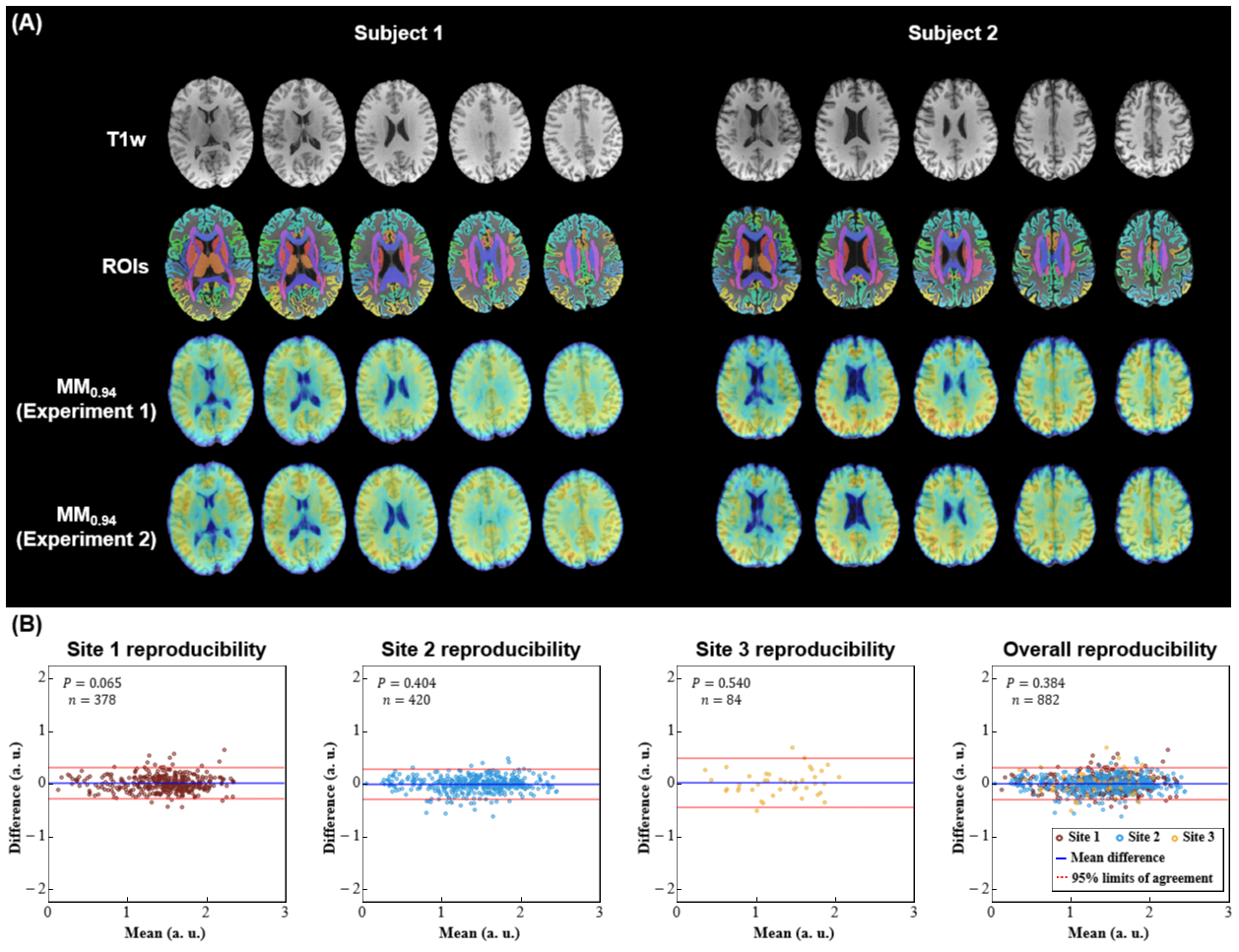
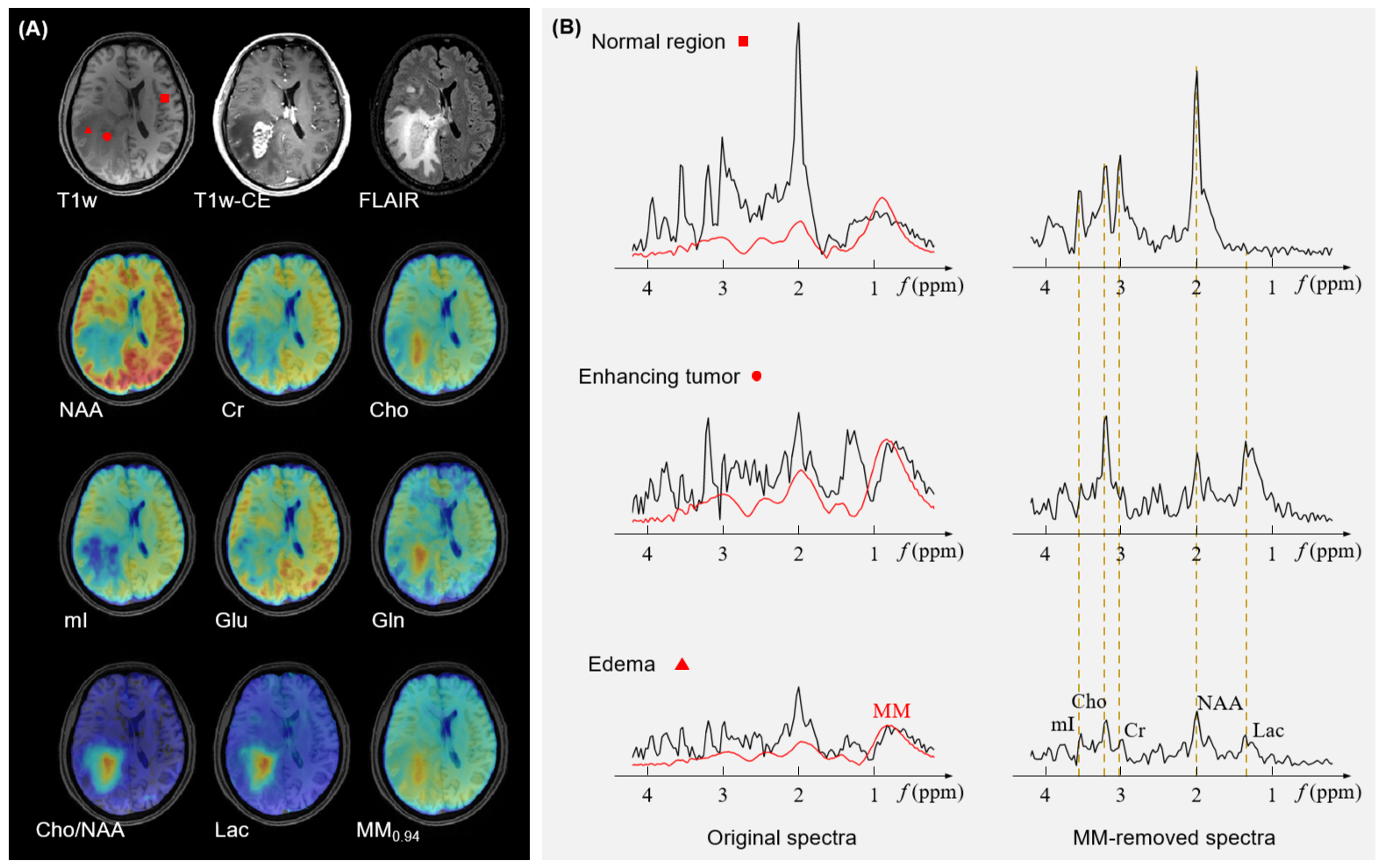
Figures 2 and 3 show the Monte Carlo simulation results. Figure 2 compares the uncertainties in metabolite and MM using the conventional nonlinear fitting algorithm7 and the proposed method. The proposed method led to negligible bias and noticeable reduction in uncertainties compared to nonlinear fitting method. The tumor MRSI simulation results in Figure 3 further confirmed the reduction in bias and variations provided by the proposed method.Experimental data were acquired from 3T scanners (MAGNETOM Prisma, Siemens Healthcare, Erlangen, Germany) at three different sites to evaluate the proposed method. Figure 4 shows the MM reproducibility of the proposed method in 21 healthy subjects. The MM maps obtained from the first and the second experiments match each other well, and Bland-Altman analysis in 42 small subcortical and white matter regions did not reveal significant bias (P>0.05). Figure 5 shows metabolite and MM results obtained from a glioblastoma patient. Noticeably elevated Cho, Gln and Lac were found in the enhancing tumor region, and reduction in most metabolites was found in the edema, with minimal contamination from MM signals.
Conclusion
This work proposes a novel method to separate metabolites and MM in ultrashort-TE FID MRSI with auxiliary SE MRSI data. This method was validated using experimental data acquired from healthy volunteers and a tumor patient, producing encouraging results.Acknowledgements
This work is supported in part by NIH: P41EB022544 and R01EB033582.References
1. Cudalbu C, Mlynárik V, Gruetter R. Contribution of macromolecules to brain 1H MR spectra: Experts' consensus recommendations. NMR in Biomedicine. 2021;34(5): e4393.
2. Cudalbu C, Behar KL, Bhattacharyya PK, et al. Handling macromolecule signals in the quantification of the neurochemical profile. J Alzheimers Dis. 2012;S3: S101–S115.
3. Schaller B, Xin L, Cudalbu C, Gruetter R. Quantification of the neurochemical profile using simulated macromolecule resonances at 3T. NMR in Biomedicine. 2013;26(5): 593–599.
4. Považan M, Hangel G, Strasser B, et al. Mapping of brain macromolecules and their use for spectral processing of 1H-MRSI data with an ultra-short acquisition delay at 7T. NeuroImage. 2015;121: 126–135.
5. Birch R, Peet AC, Dehghani H, Wilson M. Influence of macromolecule baseline on 1H MR spectroscopic imaging reproducibility. Magn Reson Med. 2017;77(1): 34–43.
6. Provencher SW. Estimation of metabolite concentrations from localized in vivo proton NMR spectra. Magn Reson Med. 1993;30: 672–679.
7. Ratiney H, Coenradie Y, Cavassila S, Ormondt D, Graveron-Demilly D. Time-domain quantitation of 1H short echo-time signals: Background accommodation. MAGMA Magn Reson Mater Phys, Biol Med. 2014;16(6): 284–296.
8. Lee HH, Kim H. Parameterization of spectral baseline directly from short echo time full spectra in 1H-MRS. Magn Reson Med. 2017;78(3): 836–847.
9. Lee HH, Kim H. Intact metabolite spectrum mining by deep learning in proton magnetic resonance spectroscopy of the brain. Magn Reson Med. 2019;82(1): 33–48.
10. Lee HH, Kim H. Deep learning‐based target metabolite isolation and big data‐driven measurement uncertainty estimation in proton magnetic resonance spectroscopy of the brain. Magn Reson Med. 2020;84(4): 1689–1706.
11. Li Y, Wang Z, Lam F. Separation of metabolite and macromolecule signals for 1H-MRSI using learned nonlinear models. IEEE ISBI. 2020; 1–4.
12. Li Y, Wang Z, Sun R, Lam F. Separation of metabolites and macromolecules for short-TE 1H-MRSI using learned component-specific representations. IEEE TMI. 2021;40(4): 1157–1167.
13. Antun V, Renna F, Poon C, Adcock B, Hansen AC. On instabilities of deep learning in image reconstruction and the potential costs of AI. Proc Natl Acad Sci. 2020;117(48): 30088–30095.
14. Knoll F, Hammernik K, Kobler E, Pock T, Recht MP, Sodickson DK. Assessment of the generalization of learned image reconstruction and the potential for transfer learning. Magn Reson Med. 2019;81(1): 116–128.
15. Zhao Y, Li Y, Xiong J, Guo R, Li Y, Liang Z-P. Rapid high-resolution mapping of brain metabolites and neurotransmitters using hybrid FID/SE-J-resolved spectroscopic signals. In Proceedings of the Annual Meeting of ISMRM, pp. 0366, 2020.
16. Liang Z-P, Lauterbur PC. A generalized series approach to MR spectroscopic imaging. IEEE Trans Med Imaging. 1991;10(2):132-137.
17. Hess CP, Liang Z-P, Lauterbur PC. Maximum cross-entropy generalized series reconstruction. Int J Imaging Syst Technol. 1999;10(3):258-265.
18. Liang Z-P. Spatiotemporal imaging with partially separable functions. IEEE ISBI. 2007; 988–991.
19. Ma C, Lam F, Johnson CL, Liang Z-P. Removal of nuisance signals from limited and sparse 1H MRSI data using a union-of-subspaces model. Magn Reson Med. 2016;75(2): 488–497.
20. Li Y, Lam F, Clifford B, Liang Z-P. A subspace approach to spectral quantification for MR spectroscopic imaging. IEEE TBME,2017;64(10): 2486–2489.
21. Lam F, Li Y, Guo R, Clifford B, Liang Z-P. Ultrafast magnetic resonance spectroscopic imaging using SPICE with learned subspaces. Magn Reson Med. 2020;83(2), 377–390.
22. Li Y, Zhao Y, Guo R, et al. Machine learning-enabled high-resolution dynamic deuterium MR spectroscopic imaging. IEEE TMI, 2021;40(12), 3879–3890.
23. Zhao Y, Li Y, Jin W, Guo R, Li W, Li Y, Luo J, Liang Z-P. Separation of macromolecules and metabolites in ultrashort-TE MRSI data with learned probabilistic subspaces. In Proceedings of the Annual Meeting of ISMRM, pp. 0474, 2022.
24. Haldar JP, Hernando D, Song SK, Liang Z-P. Anatomically constrained reconstruction from noisy data. Magn Reson Med. 2008;59(4), 810–818.
Figures