2909
Exploration of the Jacobian Determinant in Voxel-wise Lung Ventilation (VOLVE) Analysis to Assess Local Expansion in COPD1Sir Peter Mansfield Imaging Centre, University of Nottingham, Nottingham, United Kingdom, 2NIHR Nottingham Biomedical Research Centre (BRC), Respiratory Medicine, School of Medicine, University of Nottingham, Nottingham, United Kingdom
Synopsis
Keywords: Lung, Quantitative Imaging, Registration
Motivation: To develop 1H MRI methods to study dynamical lung expansion as a marker of lung function.
Goal(s): To collect free breathing 1H MRI over the respiratory cycle and investigate the feasibility of using the Jacobian determinant of the registered images for dynamic functional assessment of local expansion, instead of the signal intensity as is used in FD/PREFUL analyses.
Approach: Voxel-wise lung ventilation (VOLVE) analysis using the timecourse of deformation based Jacobian determinant to assess the ventilation correlation coefficient.
Results: Significant differences in the Jacobian-derived correlation coefficient between healthy and COPD groups indicating differences in local expansion which may provide a lung functional marker.
Impact: The Jacobian determinant obtained from registering free breathing 1H lung MRI images provides a metric of local expansion related to respiratory phase, which is sensitive to lung disease. This motivates future work to combine signal intensity-based and deformation-based functional assessments.
Introduction
Recently several analysis methods have emerged to quantify lung function from free-breathing 1H lung MRI. These methods all rely on non-rigid image registration to align the lung boundary prior to quantitative parameter computation. However, the registration deformation fields have associated Jacobian fields, from which the Jacobian determinant can be computed voxel-wise, which itself can provide a measure of local lung expansion[1]. Recent work suggests the Forsberg registration package[2] yields accurate and repeatable results for quantitative lung imaging[3]. Here, the use of the Jacobian determinant from this registration scheme is explored.The primary aim of this work is to perform VOxel-wise Lung VEntilation (VOLVE) analysis[4] by comparing the Jacobian determinant (deformation-based), rather than the conventional registered parenchyma signal (intensity-based), with the global respiratory phase (navigator). Comparing directly to the expansion from the deformation field assesses the motion-related change, rather than motion-induced changes of the density-related signal intensity. A secondary aim was to assess whether the Jacobian determinant can be used as a measure of respiratory phase, testing the hypothesis that the average Jacobian determinant across the entire lung corresponds to the lung-diaphragm navigator signal.
Methods
Data was analysed from healthy non-smokers (n=12), healthy smokers (>10 pack-years, no abnormal spirometry) (n=4) and people with COPD (n=8). Images were acquired on a 3T Philips Ingenia scanner during free-breathing using a 2D fast field echo (FFE) sequence (TR/TE=1.9/0.57ms, α=18°, 4.37 images/second), with a single coronal slice placed ~1cm posterior to the heart, and 512 images collected in 117s.VOLVE analysis was performed as described in [4], but rather than using the voxel-wise registered MR signal, the voxel-wise Jacobian determinant timecourse was compared with the respiratory phase (determined from a lung navigator) – this is termed VOLVE-Jacobian analysis. Images were registered to a mid-ventilation image using the Forsberg registration package[2], and the Jacobian determinant time courses computed from the deformation fields. These were compared voxel-wise to the lung-diaphragm navigator signal (from a ROI spanning the right hemidiaphragm) using a Pearson correlation coefficient to determine the Jacobian ventilation correlation coefficient, J-CCV. J-CCv measures were compared to VOLVE intensity-based CCv measures.
Additionally, the mean Jacobian determinant over both lungs was computed and the Pearson correlation coefficient (R) with the lung-diaphragm navigator signal computed. Differences between the subject groups were assessed via the Mann-Whitney U-test.
Results
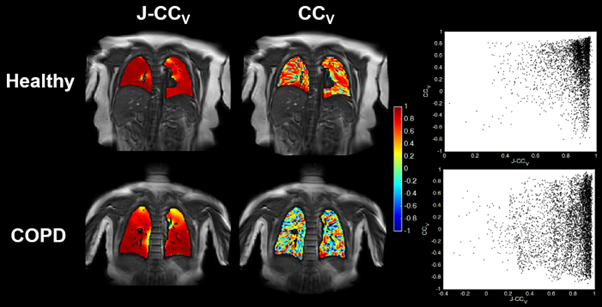
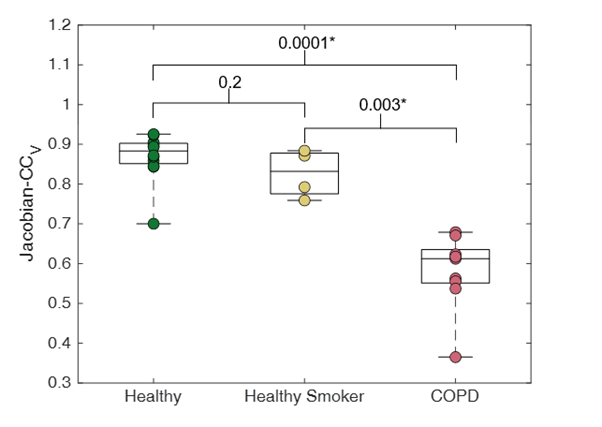
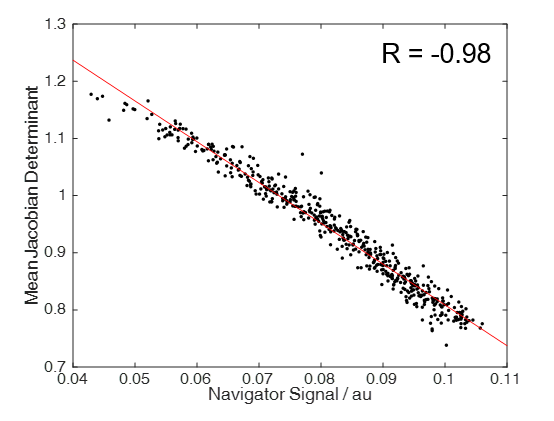
Figure 1 shows example J-CCV maps. Generally, in healthy subjects the maps are homogenous with very strong correlation values throughout the lung. In COPD participants, some areas show reduced correlation. No direct spatial relationship is seen between J-CCV and CCV. The median J-CCV values across the lung parenchyma show significant differences between the healthy groups and the COPD group (Figure 2). Figure 3 shows a strong negative correlation for the plot of mean Jacobian determinant against the lung-diaphragm navigator signal. This was seen for all subjects, across all groups (R median (IQR) = 0.97 (0.03)).Discussion
This work demonstrates the feasibility of using the Jacobian determinant as a functional measure of localised expansion, and as a measure of global respiratory phase.The J-CCV maps (Figure 1) provide an insight into how local expansion relates to respiratory phase. In healthy participants, there is generally a very strong relationship between the voxel-wise expansion and the lung-diaphragm navigator signal. J-CCV is close to 1 except near the major pulmonary vessels, which could be due to errors in registration due to cardiac motion. Conversely, in COPD, some lung regions have considerably reduced J-CCV. A significant difference in J-CCV is seen between groups (Figure 2), indicating sensitivity to lung disease.
The reduced Jacobian-CCV in COPD agrees with our previous findings that the intensity-based CCV is reduced in COPD[4]. The deformation-based Jacobian-CCV gives complimentary information to the intensity-based CCV (Figure 1) and hence this analysis should be carried out in conjunction with signal intensity-based approaches, and structural imaging, to obtain a holistic picture of lung function.
The average Jacobian determinant across the entire lung area corresponded strongly to the lung-diaphragm navigator signal (Figure 3), with all groups showing a similar trend. Nevertheless, there was a tendency for a slightly weaker correlation in COPD, which could be due to the increased reliance on intercostal muscles for breathing effort. Hence the average Jacobian determinant could provide a more accurate measure of respiratory phase, as it is not dependent on the spatial position of a navigator ROI, and so is not biased by breathing style or asymmetric diaphragm excursion.
Conclusion
Using the Jacobian determinant in VOLVE analysis provides a metric of local expansion which is sensitive to lung disease.Acknowledgements
No acknowledgement found.References
1. Chassagnon et al. Use of Elastic Registration in Pulmonary MRI for the Assessment of Pulmonary Fibrosis in Patients with Systemic Sclerosis. Radiology, vol. 291, no. 2, pp. 487-492 (2019)
2. Forsberg D. fordanic/image-registration. https://github.com/fordanic/image-registration. GitHub.
3. Klimeš et al. Evaluation of image registration algorithms for 3D phase-resolved functional lung ventilation magnetic resonance imaging in healthy volunteers and chronic obstructive pulmonary disease patients. NMR in Biomedicine, vol. 36, no. 3, e4860 (2022)
4. Peggs et al. Functional Pulmonary Proton MRI: Voxel-wise Linear-fitting Ventilation (VOLVE) Assessment in Chronic Obstructive Pulmonary Disease (COPD) [abstract]. In: Proceedings of the 32nd Joint Annual Meeting of the ISMRM-ESMRMB & ISMRT; 2023 June 3-8; Toronto, CA. Abstract # 4662.
Figures